IAM usually means “I Am” in text messages. People may type IAM instead of writing the two words separately, especially when chatting quickly. However, IAM can also have other meanings in technology, business, and online discussions.
The correct meaning depends on the conversation. In everyday texting, it is often a shortened way of writing “I am.”
Quick Answer: What Does IAM Mean in Text?
IAM can mean “I Am” in casual text messages. It is used when someone wants to describe themselves, explain how they feel, or tell another person what they are doing.
For example:
- Friend: “Are you ready?”
- You: “IAM ready.”
Here, IAM means “I am.”
However, IAM is not a standard replacement for “I am” in formal English. Writing the two words separately is clearer.
What Does IAM Stand For?
The meaning of IAM changes depending on the situation.
| Meaning | Context |
| I Am | Casual texting or informal writing |
| Identity and Access Management | Technology and cybersecurity |
| In a Message (context-dependent) | Possible personal shorthand |
The most important distinction is that IAM is not always slang. In technology, Identity and Access Management is a well-established professional term.
How Is IAM Used in Text Messages?
When someone uses IAM to mean “I Am,” they are usually talking about themselves.
Here are some common situations.
1. To Describe Yourself
Someone may use IAM before an adjective or description.
Example:
- Alex: “Are you happy with the result?”
- Sam: “IAM happy.”
Meaning: Sam is saying, “I am happy.”
2. To Explain How You Feel
IAM may appear before a word that describes someone’s feelings.
Example:
- Friend: “How are you today?”
- You: “IAM fine.”
Meaning: You are saying that you are fine.
3. To Tell Someone What You Are Doing
A person may use IAM before an activity.
Example:
- Friend: “Where are you?”
- You: “IAM studying.”
Meaning: You are studying.
4. To Make a Personal Statement
Someone may use IAM to introduce a statement about themselves.
Example:
- Alex: “You can do this!”
- Sam: “IAM trying.”
Meaning: Sam is saying that they are making an effort.
What Does IAM Mean on Social Media?
The meaning of IAM depends on the platform and the topic being discussed.
IAM on Instagram
On Instagram, IAM may appear in captions, comments, or direct messages as a shortened form of “I am.”
Example:
“I’m IAM ready for the weekend.”
A more natural version would be “I’m ready for the weekend.” People do not need to combine “I’m” and “IAM” because both express the same idea.
IAM on TikTok
TikTok users may write IAM in captions or comments when making statements about themselves.
Example:
“IAM learning something new every day.”
The intended meaning is “I am learning something new every day.”
IAM on Snapchat
In a Snapchat conversation, someone may type IAM before describing their mood or activity.
Example:
- Friend: “Are you busy?”
- You: “IAM free.”
Meaning: You are saying that you are free.
IAM on WhatsApp
On WhatsApp, IAM may be used in informal conversations as a shortened way of writing “I am.”
Example:
- Friend: “Are you coming?”
- You: “IAM coming.”
Meaning: You are on your way or planning to come.
These examples show possible informal uses. IAM is not a standard texting abbreviation that everyone uses in the same way.
10 Examples of IAM in Text Conversations
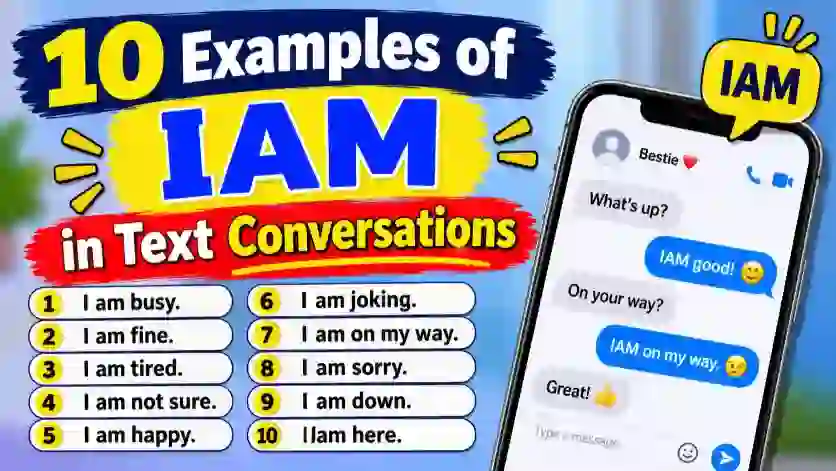
Here are ten simple examples showing how IAM may be understood as “I Am.”
1. Talking About Your Mood
- Alex: “How are you?”
- Sam: “IAM happy today.”
2. Discussing School
- Alex: “Are you studying?”
- Sam: “IAM studying for my test.”
3. Making Plans
- Alex: “Are you coming with us?”
- Sam: “IAM coming.”
4. Talking About Work
- Alex: “Are you busy right now?”
- Sam: “IAM working.”
5. Sharing Excitement
- Alex: “Are you excited about the trip?”
- Sam: “IAM so excited!”
6. Answering a Question
- Alex: “Are you ready?”
- Sam: “IAM ready.”
7. Explaining Your Situation
- Alex: “Why aren’t you answering?”
- Sam: “IAM in class.”
8. Showing Confidence
- Alex: “You can finish this task.”
- Sam: “IAM confident.”
9. Talking About Food
- Alex: “Do you want something to eat?”
- Sam: “IAM hungry.”
10. Describing Your Plans
- Alex: “What are you doing tomorrow?”
- Sam: “IAM visiting my cousins.”
How Should You Reply When Someone Says IAM?
Your reply depends on the complete message, not just the abbreviation.
Here are some natural responses:
| Message | Possible Reply |
| “IAM happy.” | “That’s great!” |
| “IAM tired.” | “Hope you get some rest.” |
| “IAM ready.” | “Let’s go!” |
| “IAM studying.” | “Good luck with your studies!” |
| “IAM hungry.” | “What do you want to eat?” |
| “IAM excited.” | “That’s awesome!” |
| “IAM coming.” | “See you soon!” |
| “IAM confused.” | “What part is confusing?” |
Always consider what the person is trying to communicate before replying.
Is IAM Rude or Offensive?
No. When IAM means “I Am,” it is not rude or offensive.
It is simply a way of expressing something about yourself. However, the complete sentence can affect the tone.
For example:
- “IAM happy!” sounds positive.
- “IAM serious.” sounds direct.
- “IAM not interested.” communicates a clear refusal.
The abbreviation itself does not carry an insulting meaning.
Is IAM Appropriate for School or Work?
IAM is understandable in casual messages, but it is not the best choice for formal writing when you mean “I am.”
For school assignments, professional emails, and official documents, write the complete words.
| Informal Writing | Standard Writing |
| IAM ready. | I am ready. |
| IAM working. | I am working. |
| IAM happy. | I am happy. |
| IAM learning. | I am learning. |
Using standard grammar makes your writing easier to understand.
One important exception is the professional abbreviation IAM for Identity and Access Management. That term is appropriate in technology and cybersecurity discussions.
What Does IAM Mean in Technology?
In technology, IAM commonly stands for Identity and Access Management.
It refers to the systems and processes organizations use to manage digital identities and control access to applications, accounts, and information.
For example, a company may use IAM systems to:
- Manage employee accounts.
- Control access to company applications.
- Protect sensitive information.
- Set permissions for different users.
- Manage login and authentication processes.
This meaning is common in cybersecurity and IT discussions. It is different from the informal phrase “I am.”
IAM vs. Similar Texting Abbreviations
IAM can be confused with other short forms because they contain similar letters.
| Abbreviation | Meaning | Main Use |
| IAM | I Am | Describing yourself |
| IM | I’m | Short form of I am |
| IMO | In My Opinion | Sharing an opinion |
| IMHO | In My Humble Opinion | Giving a personal view |
| IDK | I Don’t Know | Expressing uncertainty |
| IKR | I Know, Right? | Showing agreement |
| TBH | To Be Honest | Expressing honesty |
| NGL | Not Gonna Lie | Introducing an honest thought |
Remember that these expressions have different meanings and should not be used interchangeably.
Common Mistakes When Understanding IAM
People sometimes misunderstand IAM because it has more than one possible use.
Here are some common mistakes to avoid:
1. Assuming IAM Always Means I Am
IAM can mean “I Am” in informal writing, but it also has a professional meaning in technology.
2. Confusing IAM With IM
IM is commonly used as a contraction of “I am” in informal writing. IAM is not the same standard spelling.
3. Using IAM in Formal Writing
Writing “I am” is more appropriate for school assignments, professional emails, and official documents.
4. Ignoring the Conversation
If someone is discussing cybersecurity, IAM probably refers to Identity and Access Management rather than “I am.”
5. Using IAM and I’m Together
Avoid writing expressions such as “I’m IAM ready.” They repeat the same idea and make the sentence incorrect.
When Should You Use IAM?
You may see IAM in informal messages when someone wants to write “I am” quickly.
It may appear in:
- Casual conversations with friends.
- Informal text messages.
- Personal captions.
- Online comments.
- Messages about feelings or activities.
However, use “I am” in formal writing. Also, use IAM as an abbreviation for Identity and Access Management when discussing that technology topic.
Key Takeaways
- IAM can mean “I Am” in informal messages.
- It is used to describe feelings, activities, and personal situations.
- IAM also stands for Identity and Access Management in technology.
- It is not normally rude or offensive.
- “I am” is the clearer choice in standard English.
- Context helps identify the correct meaning.
Frequently Asked Questions
1. What does IAM mean in texting?
IAM can mean “I Am” in informal messages. People may use it before describing their feelings, activities, or personal situations. However, it is not a standard texting abbreviation with one meaning in every context. It can also refer to Identity and Access Management in technology.
2. What does IAM mean from a girl?
If a girl writes IAM in a casual conversation, she may mean “I Am.” For example, “IAM happy” means “I am happy.” The abbreviation itself does not suggest romantic interest or a special hidden message. The complete sentence provides the meaning.
3. What does IAM mean from a guy?
When a guy writes IAM, he may be using it as a shortened form of “I Am.” For example, “IAM busy” means “I am busy.” However, the intended meaning depends on the topic and the rest of the conversation.
4. Is IAM a slang word?
IAM is not a traditional slang word. It may be used informally as a shortened way of writing “I Am,” but it is also a recognized abbreviation for Identity and Access Management in technology. Its meaning depends on the situation.
5. What does IAM mean on Instagram?
On Instagram, IAM may be used in captions, comments, or direct messages to express “I Am.” For example, someone might write “IAM excited” to describe their feelings. However, it is not a fixed Instagram-specific slang term.
6. What does IAM mean on Snapchat?
On Snapchat, IAM may be used as informal shorthand for “I Am.” Someone might write “IAM ready” or “IAM busy” when chatting with friends. The complete message helps explain what the person wants to say.
7. Is IAM rude or offensive?
No. IAM is not generally rude or offensive when it means “I Am.” It is simply an informal way to write a personal statement. The tone depends on the complete sentence rather than the letters themselves.
8. What is the difference between IAM and IM?
IAM contains the letters of “I Am” without a space, while IM is often used informally as a contraction or shorthand for “I’m.” In standard English, “I am” and “I’m” are the clearer forms. IAM is also used professionally for Identity and Access Management.
Conclusion
IAM can mean “I Am” in informal text messages when someone describes their feelings, activities, or personal situation. It can also stand for Identity and Access Management in technology and cybersecurity.
The correct meaning depends on the conversation. If someone uses IAM in a casual message, look at the complete sentence to understand what they are trying to say. For formal writing, use “I am” instead of IAM.
Read more about!
- What Does HYO Mean in Text? Real Meaning, & Social Media Use
- What Does HYK Mean in Text? Real Examples & Social Media Use
- What Does HYYY Mean in Text? Social Media Use

Daniel Brooks is an English vocabulary educator and content editor with experience creating educational resources about English words, idioms, and everyday communication. He reviews language content for clarity, accuracy, and readability to ensure readers receive reliable and easy-to-understand information.