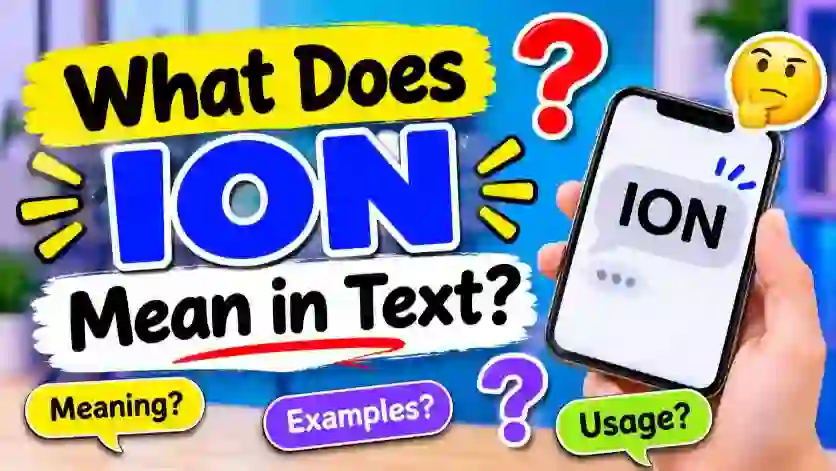
ION usually means “I don’t” in text messages. It is a casual texting abbreviation often used in online conversations, especially when someone wants to deny something, explain their feelings, or disagree with a statement.
For example, someone might text, “ION know what happened.” This means “I don’t know what happened.”
You may see ION in Snapchat messages, TikTok comments, Instagram DMs, WhatsApp chats, and other online conversations. It is informal slang, so its meaning may be unfamiliar to people who do not use texting abbreviations.
ION can also have other meanings in science and everyday language. However, in casual texting, it commonly represents “I don’t.”
Quick Answer: ION means “I don’t” in informal texting. People use it before words such as know, want, or think to make quick messages. For example, “ION want to go” means “I don’t want to go.” It is casual slang, not suitable for formal writing.
What Does ION Mean in Text?
Simple Meaning of ION
ION is a shortened way of writing “I don’t.”
People use it to save time when typing messages or comments.
Examples:
- “ION know.” = I don’t know.
- “ION want that.” = I don’t want that.
- “ION think so.” = I don’t think so.
- “ION understand.” = I don’t understand.
The abbreviation is often used in relaxed conversations with friends.
Is ION Slang or an Acronym?
ION is informal internet and texting slang.
It is not a standard English abbreviation with one official full form. In casual messages, it represents the spoken phrase “I don’t.”
Some people also use ION as a shortened form of “in other news,” but that meaning is less common and depends on context.
Does ION Have More Than One Meaning?
Yes. The meaning depends on where you see it.
| Meaning | Where It Is Used |
| I don’t | Casual texting and social media |
| In other news | Informal online posts and conversations |
| Ion (charged particle) | Science and chemistry |
For most casual texting conversations, “I don’t” is the meaning to consider first.
Quick Meaning Table
| Question | Answer |
| Main texting meaning | I don’t |
| Other possible meaning | In other news |
| Type | Informal slang |
| Tone | Casual, direct, or dismissive |
| Used by | People familiar with online slang |
| Platforms | TikTok, Snapchat, Instagram, WhatsApp |
| Offensive? | No |
| Formal? | No |
| Example | ION know |
Where Is ION Used?
ION on TikTok
TikTok users may write ION in comments, captions, or replies.
Example:
“ION understand this trend.”
Meaning: I don’t understand this trend.
It can also appear in funny or opinion-based comments.
ION on Snapchat
On Snapchat, ION is used in quick messages between friends.
Example:
“ION know what you’re talking about.”
Meaning: I don’t know what you’re talking about.
ION on Instagram
Instagram users may use ION in direct messages and comments.
Example:
“ION like that picture.”
Meaning: I don’t like that picture.
ION on WhatsApp
ION can appear in everyday WhatsApp chats.
Example:
“ION have time today.”
Meaning: I don’t have time today.
ION in SMS Text Messages
Some people use ION in regular text messages when chatting casually.
Example:
“ION think I’ll be able to come.”
Meaning: I don’t think I’ll be able to come.
Platform Usage Table
| Platform | Example | Meaning |
| TikTok | ION get it | I don’t get it |
| Snapchat | ION know | I don’t know |
| ION like it | I don’t like it | |
| ION have time | I don’t have time | |
| SMS | ION think so | I don’t think so |
10 Real Chat Examples of ION in Text
Example 1: Not Knowing Something
A: Do you know where Sarah went?
B: ION know.
A: Okay, I’ll ask someone else.
Meaning: I don’t know.
Example 2: Turning Down an Invitation
A: Want to go shopping today?
B: ION feel like going out.
A: No problem.
Meaning: I don’t feel like going out.
Example 3: Talking About School
A: Did you understand the lesson?
B: ION understand that last part.
A: I’ll explain it.
Meaning: I don’t understand.
Example 4: Discussing a Movie
A: Did you like the movie?
B: ION think it was very good.
A: Really?
Meaning: I don’t think it was very good.
Example 5: Making Weekend Plans
A: Are you free on Saturday?
B: ION know yet.
A: Let me know later.
Meaning: I don’t know yet.
Example 6: Talking About Food
A: Do you want pizza?
B: ION want pizza today.
A: What about burgers?
Meaning: I don’t want pizza today.
Example 7: Gaming Conversation
A: Are you joining our team?
B: ION have enough time tonight.
A: Maybe tomorrow.
Meaning: I don’t have enough time tonight.
Example 8: Social Media Comment
A: This challenge is so easy!
B: ION see how people find it easy.
A: Everyone has different opinions.
Meaning: I don’t see how people find it easy.
Example 9: Friendly Conversation
A: Are you upset with me?
B: ION have a problem with you.
A: Okay, good.
Meaning: I don’t have a problem with you.
Example 10: Sharing News
A: Did you hear about the new update?
B: ION know anything about it.
A: I’ll send you the details.
Meaning: I don’t know anything about it.
How to Reply When Someone Says ION
Your reply depends on the full message.
Funny Replies
- “Okay, fair enough 😂”
- “You don’t know anything? 😂”
- “That’s a strong no!”
- “Well, now you know!”
Casual Replies
- “Alright.”
- “No worries.”
- “That’s fine.”
- “Okay, got it.”
Friendly Replies
- “That’s okay!”
- “No pressure.”
- “Let me explain.”
- “I understand.”
Neutral Replies
- “Can you explain?”
- “What do you mean?”
- “Okay, thanks for telling me.”
- “Understood.”
Best Replies by Situation
| Situation | Suggested Reply |
| They don’t know something | No worries |
| They don’t want to go | That’s fine |
| They don’t understand | Let me explain |
| They disagree | That’s okay |
| Their message is unclear | What do you mean? |
Is ION Rude or Offensive?
Is ION a Bad Word?
No. ION is not a swear word or offensive expression.
It is simply an informal way to write “I don’t.”
Can ION Sound Rude?
Sometimes. The tone depends on the complete message.
For example:
Neutral: “ION know what happened.”
Potentially dismissive: “ION care.”
The second message may sound uncaring, but the tone comes from the phrase “I don’t care,” not from ION itself.
Is ION Appropriate for School?
ION is fine in casual conversations with classmates.
However, avoid using it in essays, assignments, or formal school writing.
Write “I don’t” instead.
Is ION Appropriate at Work?
Usually, ION is too informal for professional communication.
For example:
Informal: “ION think we can finish today.”
Professional: “I don’t think we can finish today.”
The complete phrase is clearer and more professional.
Who Uses ION in Text Messages?
Do Gen Z Users Use ION?
ION is recognizable in informal online conversations, including some Gen Z texting and social media communities.
However, not every Gen Z user uses it.
Do Teenagers Use ION?
Some teenagers use ION when chatting with friends or posting online.
It can make messages shorter and more casual.
Do Adults Use ION?
Some adults may recognize or use ION, especially if they regularly communicate online.
However, many prefer writing “I don’t.”
Is ION Popular on Social Media?
ION appears in casual online language, but its use varies by platform and community.
It should not be treated as a universal abbreviation.
Origin of ION in Texting
Where Did ION Come From?
ION is connected to informal pronunciation and shortened writing.
In some speech styles, “I don’t” can sound like “I’on” or “ion.” People began using this shortened form in casual digital conversations.
Did Social Media Create ION?
Social media helped spread many informal spellings and abbreviations.
However, the exact first use of ION to mean “I don’t” is not clearly documented.
Why Do People Write ION?
People use ION because it is short and fits casual online speech.
It can also make a message sound more conversational.
ION vs. IDK, IDC, IMO, and NGL
| Term | Meaning | Type | Usage | Popularity |
| ION | I don’t | Informal slang | Denial or disagreement | Community-dependent |
| IDK | I don’t know | Initialism | Lack of knowledge | Very common |
| IDC | I don’t care | Initialism | Lack of concern | Common |
| IMO | In my opinion | Initialism | Sharing an opinion | Common |
| NGL | Not gonna lie | Initialism | Honest reaction | Common |
Popularity descriptions are general observations, not measured rankings.
ION vs. IDK
ION means “I don’t,” while IDK means “I don’t know.”
Example:
“ION want to go.”
“IDK where to go.”
The first expresses what someone does not want. The second expresses uncertainty.
ION vs. IDC
IDC means “I don’t care.”
ION can be followed by different words, such as know, want, or think.
ION vs. IMO
IMO means “In my opinion.”
ION means “I don’t.”
They have different purposes in a conversation.
ION vs. NGL
NGL means “Not gonna lie.”
People use it before sharing an honest thought.
ION is used to express a negative statement or denial.
Common Mistakes People Make With ION
Mistake 1: Thinking ION Always Means Instagram
ION is not the usual abbreviation for Instagram. IG is the common shortened name for Instagram.
Mistake 2: Confusing ION With IDK
ION means “I don’t,” while IDK means “I don’t know.”
Mistake 3: Assuming ION Is Offensive
ION is not offensive by itself.
Mistake 4: Using ION in Formal Writing
ION is informal slang. Use “I don’t” in professional or academic writing.
Mistake 5: Ignoring Context
ION can have different meanings in different settings. Look at the surrounding words before deciding what it means.
When Should You Use ION?
In Casual Conversations
ION works in relaxed chats with friends who understand texting slang.
Example:
“ION know what to watch.”
When Expressing Disagreement
You can use ION to express that you do not agree or do not think something is true.
Example:
“ION think that’s a good idea.”
When Saying You Do Not Want Something
Example:
“ION want to go out today.”
When Should You Avoid ION?
Avoid ION when:
- Writing formal emails.
- Completing school assignments.
- Speaking with someone unfamiliar with slang.
- Discussing an important topic that needs clear wording.
In these situations, write “I don’t” instead.
Key Takeaways About ION
- ION commonly means “I don’t” in informal texting.
- It is used in casual online conversations.
- People use it to express denial, disagreement, or a lack of interest.
- It may appear on TikTok, Snapchat, Instagram, and WhatsApp.
- It is not normally offensive.
- It is different from IDK, IDC, and IMO.
- Its exact origin is not clearly documented.
- It is better to use “I don’t” in formal writing.
- Context helps identify its intended meaning.
Frequently Asked Questions
1. What Does ION Mean in Text Messages?
ION usually means “I don’t” in casual text messages. People use it before words such as know, want, and think. For example, “ION know” means “I don’t know.” It is an informal expression often seen in online conversations.
2. What Does ION Mean on Snapchat?
On Snapchat, ION commonly means “I don’t.” Friends may use it in quick messages to express what they do not know, want, or understand. For example, “ION feel like going out” means “I don’t feel like going out.”
3. What Does ION Mean on TikTok?
On TikTok, ION is sometimes used in captions and comments to mean “I don’t.” For example, “ION understand this trend” means “I don’t understand this trend.” Its meaning should be checked against the surrounding words.
4. Does ION Mean In Other News?
ION can also stand for “in other news” in some online conversations. This meaning is less common than “I don’t” in casual texting. The surrounding sentence helps show which meaning the writer intends.
5. Is ION a Bad Word?
No. ION is not a swear word or offensive abbreviation. It is an informal way to write “I don’t.” However, the complete sentence may sound unfriendly depending on what the sender is saying.
6. How Do You Reply to ION?
Your reply depends on the message. If someone says “ION know,” you can answer, “No worries.” If they say “ION want to go,” you can reply, “That’s fine.” A friendly response usually works well.
7. What Is the Difference Between ION and IDK?
ION usually means “I don’t,” while IDK means “I don’t know.” For example, “ION want pizza” means someone does not want pizza. “IDK what to eat” means someone is unsure what to eat.
8. Is ION Appropriate for Formal Messages?
ION is generally not appropriate for formal messages because it is informal texting slang. In emails, school assignments, and professional conversations, write “I don’t” instead. This makes your message easier to understand.
Conclusion
ION usually means “I don’t” in text messages. It is an informal expression people use when they want to say they do not know, want, understand, or agree with something.
You may see it in Snapchat chats, TikTok comments, Instagram messages, and WhatsApp conversations. It is generally harmless, but it is not suitable for formal writing.
Remember that ION can have other meanings, including “in other news,” depending on the context. When someone uses it in a message, look at the words around it to understand the intended meaning.
Read more about!
- What Does HYH Mean in Text? Meaning & Examples
- What Does DWAI Mean in Text? Real Meaning, Examples & Social Media Use
- What Does HYHY Mean in Text? Meaning, Examples & Usage
Hi, I’m Ryan Mitchell. I write simple guides about slang, internet language, and everyday English to make modern expressions easy to understand. My goal is to help learners use real-life English with confidence.