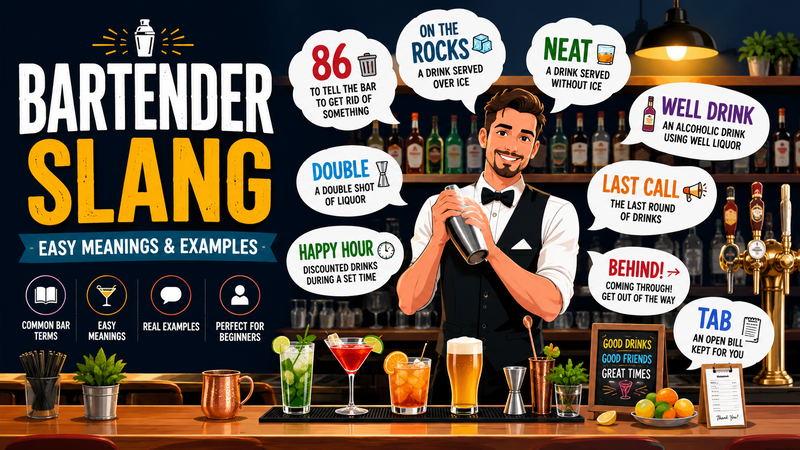
Bartender slang refers to the informal words, abbreviations, and phrases that bartenders, servers, and bar staff use to communicate quickly while working. These terms help staff prepare drinks, serve customers, and manage busy shifts more efficiently.
Many people search for bartender slang because they hear these expressions in bars, restaurants, TV shows, or on social media and want to know what they mean. Some terms are used only behind the bar, while others have become popular in everyday conversation.
In this guide, you’ll learn what bartender slang means, where it’s used, the most common bartender terms, when you should avoid using them, and practical examples that make them easy to understand.
Quick Answer: Bartender Slang
Bartender slang is a collection of informal words and phrases used by bartenders and restaurant staff to communicate quickly during service. It includes drink names, order shortcuts, customer descriptions, and workplace expressions that save time in busy bars.
What Does Bartender Slang Mean?
Bartender slang is the everyday language used behind the bar. Instead of speaking in long sentences, bartenders often use short expressions that coworkers immediately understand.
For example, rather than saying:
“Please prepare another drink for table six.”
A bartender might simply say:
“Refire table six.”
This type of communication is fast, practical, and easy for experienced staff to understand.
Is Bartender Slang an Internet Slang?
No. Bartender slang is workplace slang, not internet slang.
However, many bartender expressions now appear on platforms like:
- TikTok
- YouTube
People often share funny stories or behind-the-scenes videos where bartender slang is used naturally.
Common Bartender Slang Terms
The table below explains some of the most common bartender slang words.
| Bartender Slang | Meaning | Example |
| 86 | Remove an item or refuse service | “We’re 86 burgers tonight.” |
| On the Rocks | Served over ice | “Whiskey on the rocks.” |
| Neat | Alcohol served without ice or mixer | “I’ll take a bourbon neat.” |
| Well Drink | Made with the house’s basic liquor | “A well rum and Coke.” |
| Top Shelf | Premium liquor | “Make it top shelf.” |
| Double | Twice the normal amount of alcohol | “Vodka double, please.” |
| Virgin | Drink without alcohol | “Virgin mojito.” |
| Tab | Customer’s running bill | “Keep it on my tab.” |
| Cut Off | Stop serving alcohol to someone | “The bartender cut him off.” |
| Last Call | Final chance to order drinks | “Last call in five minutes.” |
Different Types of Bartender Slang
Bartender slang covers several areas of bar work.
Drink Preparation
These words describe how drinks should be made.
Examples include:
- Neat
- On the rocks
- Straight up
- Double
- Splash
- Twist
- Chaser
These instructions tell the bartender exactly how to prepare the drink.
Customer Service
Some slang describes customers or service situations.
Examples:
- Regular – a customer who visits often
- Tab – an unpaid running bill
- Walkout – a customer who leaves without paying
- Cut off – stop serving alcohol for safety reasons
Workplace Communication
Busy bars rely on short commands.
Examples include:
- Behind! (Someone is walking behind you.)
- Corner! (Warning when turning around a corner.)
- Refire (Remake an order.)
- Hands! (Food or drinks are ready to be served.)
These expressions improve safety and speed.
Where Is Bartender Slang Commonly Used?
You’ll hear bartender slang in many hospitality settings.
These include:
- Bars
- Restaurants
- Hotels
- Nightclubs
- Breweries
- Cocktail lounges
- Sports bars
- Cruise ships
It also appears in:
- TikTok bartender videos
- Instagram reels
- Reddit discussions
- Hospitality training videos
- Reality TV shows about restaurants
Is Bartender Slang Rude, Offensive, or Harmless?
Most bartender slang is harmless.
Words like neat, double, tab, and last call are simply professional terms.
However, some expressions that describe customers can sound rude if said publicly.
For example:
- Calling someone a “lightweight”
- Referring to difficult customers with insulting nicknames
- Using negative labels for intoxicated guests
These should stay as private workplace language and should never be used to embarrass customers.
Real-Life Examples of Bartender Slang
At a Bar
Customer:
“Can I get a whiskey on the rocks?”
Bartender:
“Coming right up.”
Restaurant
Server:
“Table twelve wants another margarita.”
Bartender:
“Got it.”
Busy Night

Manager:
“Last call in ten minutes.”
Bartender:
“I’ll let everyone know.”
Behind the Bar
Bartender:
“Behind!”
Another bartender:
“Thanks.”
This warning helps prevent collisions.
Customer Paying Later
Customer:
“Can you keep it on my tab?”
Bartender:
“Absolutely.”
Origin and History of Bartender Slang
Many bartender slang terms developed naturally inside restaurants, taverns, and pubs over many decades. Their main purpose was to help staff communicate clearly in noisy, fast-moving workplaces.
Some expressions have well-documented histories, while others have uncertain origins.
For example:
- 86 has been used in American restaurants and bars for many years, but experts disagree on exactly where it came from. Several origin stories exist, and none has been proven as the single correct explanation.
- Terms such as neat, on the rocks, and well drink became standard service vocabulary as modern cocktail culture grew during the 20th century.
Today, bartender slang continues to evolve, with new expressions spreading through the hospitality industry and social media.
Why Do Bartenders Use Slang?
Bartender slang helps employees work more efficiently.
Common reasons include:
- Faster communication
- Fewer mistakes
- Better teamwork
- Improved customer service
- Safer workplaces
- Easier handling of busy periods
Short phrases are much quicker than full explanations.
Similar Slang and Hospitality Terms.
| Term | Meaning |
| Mixologist | A bartender who specializes in crafting cocktails. |
| Happy Hour | A period with discounted drinks. |
| Cocktail | A mixed alcoholic drink. |
| House Pour | The standard liquor served unless another brand is requested. |
| Garnish | Decorative fruit, herbs, or other ingredients added to a drink. |
| Chaser | A drink consumed after a shot of alcohol. |
When Should You Avoid Using Bartender Slang
- During formal business meetings
- In school assignments unless you’re explaining the terms
- With people unfamiliar with bar culture
- When speaking to customers if the slang could confuse them
- When customer-related slang could sound disrespectful
In customer service, clear communication is usually better than insider language.
Can You Use Bartender Slang at Work?
If you work in a bar or restaurant, yes.
If you work in an office, hospital, school, or another professional setting, bartender slang may confuse people who are unfamiliar with hospitality terms.
Always consider your audience before using industry-specific slang.
Common Misunderstandings About Bartender Slang
It is not secret code.
Most bartender slang is simply professional shorthand used for efficiency.
It changes by location.
Different bars, restaurants, and countries sometimes use different terms. A phrase common in one region may be unfamiliar somewhere else.
Not every bartender uses the same words.
Each workplace develops its own habits, so vocabulary can vary between businesses.
Frequently Asked Questions
Q.1What does bartender slang mean?
Bartender slang is informal workplace language used by bartenders and bar staff to communicate quickly during service.
Q.2Is bartender slang the same everywhere?
No. Many terms are widely recognized, but some expressions vary by country, region, or individual workplace.
Q.3What does “86” mean in bartender slang?
“86” usually means an item is unavailable or that a customer should no longer be served. The exact meaning depends on the situation.
Q.4Is bartender slang professional?
Yes. Inside bars and restaurants, it is a normal part of professional communication.
Q.Is bartender slang used on social media?
Yes. Many bartenders use these terms in videos and posts on TikTok, Instagram, Reddit, and YouTube, often to share stories or explain life behind the bar.
Conclusion
Bartender slang is the everyday language of the hospitality industry. It helps bartenders and servers communicate quickly, prepare drinks accurately, and keep service running smoothly during busy shifts.
Most bartender slang is harmless and practical, but meanings can vary between workplaces and regions.
Learning common expressions like 86, neat, on the rocks, and last call makes it easier to understand in bars, restaurant kitchens, and online bartender communities. When you’re unsure about a term, always consider the setting, since context often determines its exact meaning.
Read more about!
Fire in Slang: Meaning, Uses, Examples & Origin

Daniel Brooks is an English vocabulary educator who creates simple, practical guides on slang, word meanings, and everyday English. His goal is to help students, writers, and English learners expand their vocabulary and communicate with confidence.