In British slang, “ta” means “thank you.” People in the UK use it as a short, friendly way to show thanks in daily life, text messages, and casual chats. For example, if someone gives you a drink, you can say, “Ta!” It is informal and usually polite.
Have you heard someone in the UK say “ta” and wondered what it means? In British English, “ta” is a casual way to say “thank you.” You may hear it at home, in shops, at school, or in a quick chat with a friend.
People often use this short word when someone gives them something or does them a small favor. For example, if a friend passes you a pen, you might say, “Ta!” instead of “Thanks!”
The word can also appear in text messages and online chats. Its meaning is simple, but the tone depends on the situation. It often sounds warm and relaxed, though it may seem too casual in a formal setting.
This guide explains what “ta” means, how to say it, where people use it, and how it differs from “thanks” and “cheers.”
Quick Answer Table
| Question | Answer |
| Meaning | Thank you |
| Tone | Casual and friendly |
| Used by | People who speak British English |
| Platforms | Text messages and online chats, as well as face-to-face talk |
| Offensive? | No, it is usually polite |
| Formal or informal? | Informal |
| Pronunciation | Usually “tah” |
What Does “Ta” Mean in British English?
“Ta” is a short way to thank someone. It is often used when the favor is small or the moment is casual.
For example, imagine someone holds a door open for you. You can smile and say, “Ta!” It works much like “Thanks!” or “Cheers!”
The word does not usually carry a hidden meaning. The speaker is simply showing gratitude. The exact tone comes from the voice, facial expression, and situation.
What Does “Ta Very Much” Mean?
“Ta very much” means “Thank you very much.” It is a friendly, informal way to show extra thanks.
Example:
- Person A: “Here’s your coffee.”
- Person B: “Ta very much!”
It can sound warm and genuine. Like many expressions, it can also sound sarcastic if said in a mocking tone.
How Do You Pronounce “Ta”?
“Ta” is usually pronounced “tah”, with one short syllable. It rhymes roughly with the first sound in “father” for many speakers, though accents can vary.
You do not need to stretch the word or add another syllable. Just say “ta” in a natural voice.
Where Did British Slang “Ta” Come From?
The exact story behind “ta” is not fully settled. Major dictionaries describe it as an informal expression linked to child speech or a shortened, altered form of “thank you.” Dictionary sources trace it back to the 18th century.
Today, “ta” is an established part of informal British English. It is not a new internet abbreviation, even though people may also type it in messages.
It is best to avoid claiming one exact person, place, or event invented the word. The evidence supports an older informal expression, but not a single confirmed inventor.
Where Is “Ta” Used?
People use “ta” in everyday speech and can also write it in casual messages. It is most natural when talking to friends, family, or people in relaxed situations.
| Platform or setting | How “ta” is used | Example |
| Face-to-face conversation | To thank someone quickly | “Ta for that!” |
| WhatsApp or text messages | To reply to a favor | “Ta, got it.” |
| Instagram comments | To thank someone casually | “Ta for sharing!” |
| TikTok comments | To show thanks in a short reply | “Ta for the tip!” |
| Discord chats | To thank another member | “Ta for helping with the settings.” |
| Shops or cafés | To thank someone who serves you | “Ta, have a good day.” |
These are examples of possible use, not a claim that “ta” is a major trend on every platform. Its main meaning stays the same across these settings.
Is “Ta” Polite or Rude?
“Ta” is usually polite, but informal. It is not a swear word or an insult. It is a simple way to thank someone.
- A friend passes you something.
- Someone helps you with a small task.
- A family member brings you a drink.
- Someone sends you useful information in a casual chat.
In a formal email, job interview, or serious business meeting, “thank you” is often the safer choice. “Ta” may sound too relaxed for the situation.
Tone also matters. A warm “Ta!” sounds friendly. A sharp or mocking “Ta, whatever” may sound annoyed because of the words and delivery around it.
Is “Ta” Still Used in the UK?
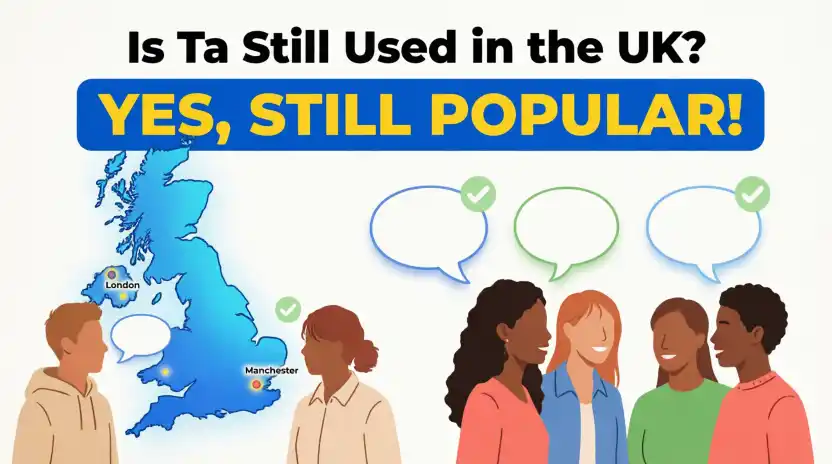
Yes. Dictionaries still list “ta” as an informal UK expression meaning “thank you.”It is an established expression rather than a new viral slang term. How often people use it can vary by person, family, and region. Some speakers say it naturally, while others prefer “thanks” or “cheers.”
You do not need to use “ta” to sound British. If it feels natural in your conversation, it is fine to use. If it feels unfamiliar, “thanks” works just as well.
“Ta” vs. “Thanks” vs. “Cheers”
These words can all express gratitude, but they do not sound exactly the same.
| Word | Meaning | Tone | Best use |
| Ta | Thank you | Very casual | Quick, friendly thanks |
| Thanks | Thank you | Casual to neutral | Most everyday situations |
| Thank you | Thank you | Polite and clear | Formal and informal situations |
| Cheers | Thanks, or sometimes a farewell or toast | Casual | Friendly UK conversations |
Example: A classmate gives you a pencil. You could say “Ta,” “Thanks,” or “Cheers.” All three can work, but “thank you” is a more neutral choice if you are unsure.
Remember that “cheers” can have other meanings depending on the setting. “Ta” is mainly used to express thanks.
Real-Life Examples of “Ta” in British English
Here are some simple examples of how the word can fit into daily life.
1. In a Text Message
Maya: “I sent you the notes.”
Oliver: “Ta! That helps a lot.”
Oliver uses “ta” to thank Maya for sharing the notes. The word keeps the reply short and friendly.
2. At Home
Dad: “Here’s your water.”
Zara: “Ta!”
Zara gives a quick thank-you for a small favor.
3. In a Shop
Shop worker: “Here’s your receipt.”
Customer: “Ta, cheers.”
The customer uses two casual expressions of thanks. This may sound natural to some speakers, though one is enough.
4. In an Online Chat
Aiden: “I found the link you wanted.”
Nina: “Ta, I’ll check it now.”
Nina shows appreciation without writing a long reply.
5. When Someone Helps You
Freddie: “I fixed the file for you.”
Amira: “Ta very much!”
“Ta very much” adds extra warmth and means “thank you very much.”
Common Mistakes When Using “Ta”
- Using it in every situation: “Ta” is informal. Choose “thank you” for formal or serious conversations.
- Thinking it is rude: It is usually a polite expression of thanks.
- Assuming “TA” always means thank you: In capital letters, “TA” can also be an abbreviation, such as “teaching assistant.” Context matters.
Thinking it is only used online: It is also used in spoken conversation.
Key Takeaways
- “Ta” means “thank you” in informal British English.
- It is usually pronounced “tah.”
- It is friendly and polite in casual situations.
- “Ta very much” means “thank you very much.”
- Use “thank you” instead when you need a more formal tone.
- “Ta-ta” can mean goodbye, so do not confuse the two expressions.
Frequently Asked Questions
1. What does “ta” mean in a British text?
In a British text, “ta” usually means “thank you.” Someone might write it after you send them a link, share a photo, or help them with a task. It is short, casual, and friendly. For example, “Ta for sending that over!” means “Thank you for sending that over!”
2. Do British people say “ta” instead of “thanks”?
Yes. Some British English speakers use “ta” instead of “thanks” in everyday conversations. Both expressions show gratitude, but “ta” can sound more informal. Usage varies between people and regions, so you may hear some speakers use it often and others choose “thanks” or “cheers.”
3. Is “ta” short for thank you?
“Ta” is an informal expression that means “thank you.” Dictionaries describe its origin as linked to child speech or as a shortened and altered form of thanks. The exact development is not completely certain. In modern conversation, you can use it as a complete expression without saying the full phrase.
4. What does “ta very much” mean?
“Ta very much” means “thank you very much.” It is a casual way to show extra appreciation. For example, if someone helps you carry a bag, you might say, “Ta very much!” It usually sounds friendly, but the speaker’s tone can make it sound sarcastic in some situations.
5. Is “ta” rude or offensive?
No. “Ta” is not normally rude or offensive. It is a common informal way to thank someone. Still, it may sound too casual in a formal email or professional meeting. If you are unsure how the other person will take it, “thank you” is a safe and polite option.
6. What is the difference between “ta” and “ta-ta”?
“Ta” usually means “thank you,” while “ta-ta” is an informal way to say “goodbye.” For example, you might say “Ta for the help” when someone assists you, then say “Ta-ta!” when leaving. The extra word changes the meaning, so the two expressions are not interchangeable.
7. Can you use “ta” in a work message?
You can use “ta” in a relaxed message to a colleague you know well, especially when thanking them for a small favor. For a formal email, a message to a client, or communication with someone you do not know well, “thanks” or “thank you” is usually a better choice.
8. Is “ta” used outside Britain?
Yes. The expression is also recorded in other English-speaking places, including Australia. However, its familiarity and frequency may vary by country and speaker. If someone from another country does not understand it, simply say “thanks.” That is widely understood and works in almost any everyday situation.
Conclusion
“Ta” is a simple but useful part of British English. It means “thank you” and helps people show appreciation in a quick, relaxed way. You may hear it when someone gives a friend a drink, helps a classmate, or passes something across a table.
The expression is informal, but it is not usually rude. “Ta very much” is a slightly fuller version that means “thank you very much.” Just remember that “ta-ta” has a different meaning: it is often used to say goodbye.
If you are learning British slang, start by noticing how people use “ta” in real conversations. You can use it with friends or in other casual settings, but choose “thank you” when you want to sound more formal. Both are correct; the best choice depends on the person and the situation.
Read more about!
- Bitchin Slang: Meaning, Origin, Examples & How to Use It
- BTK Meaning Slang: Is It Common in Text Messages?
- Grape Slang Meaning: What Does Grape Mean in Slang?
- Birdie Slang Meaning: Everything You Need to Know

Daniel Brooks is an English vocabulary educator and content editor with experience creating educational resources about English words, idioms, and everyday communication. He reviews language content for clarity, accuracy, and readability to ensure readers receive reliable and easy-to-understand information.