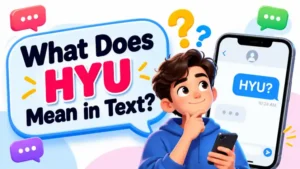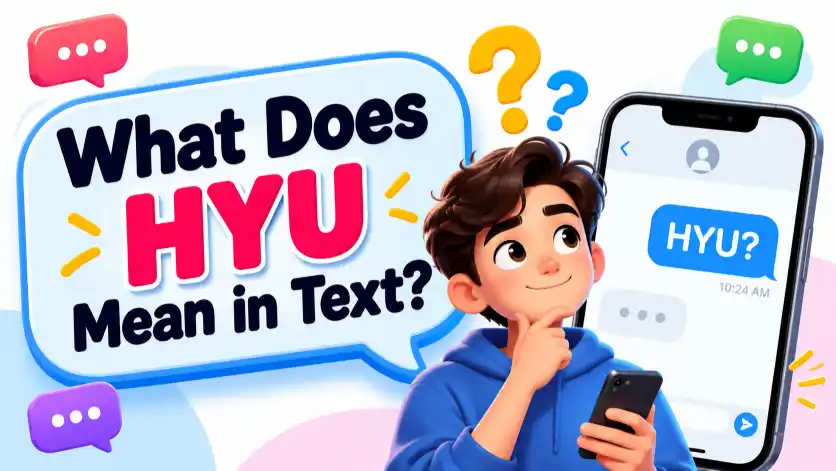
HYU usually means “Hit You Up” in texting. People use it to say they will contact someone later through a text, call, or social media message. However, HYU is not a widely standardized abbreviation, so its meaning can change with the conversation.
You might see HYU on Snapchat, Instagram, TikTok, WhatsApp, or in a regular text message. It often appears when friends make plans, promise to send updates, or want to continue a conversation later.
For example, someone might text, “I’ll HYU after school.” This usually means they plan to contact you when school finishes.
Quick Answer: HYU commonly stands for “Hit You Up.” It is an informal way to say “I’ll contact you,” “I’ll message you,” or “I’ll get in touch.” The abbreviation is less common than similar expressions such as HMU (Hit Me Up), so always check the context before deciding what someone means.
What Does HYU Mean in Text?
HYU is an informal texting abbreviation that can stand for “Hit You Up.” It describes contacting another person, usually by sending a message or making a call.
People use short forms like HYU because they want to type quickly. Instead of writing a complete sentence, they use a few letters to communicate the same idea.
However, HYU is not as familiar or widely documented as popular abbreviations such as LOL, BRB, or HMU.
HYU Meaning in Simple Words
The easiest way to understand HYU is:
HYU = Hit You Up = Contact You
Here are three simple examples:
- “I’ll HYU tonight.” — I’ll message you tonight.
- “Can I HYU tomorrow?” — Can I contact you tomorrow?
- “I’ll HYU when I’m free.” — I’ll get in touch when I have time.
In these examples, the person is talking about contacting someone.
HYU Full Form in Texting
The commonly interpreted full form of HYU is “Hit You Up.”
The expression “hit someone up” is informal English. It usually means to contact someone, often to talk, ask a question, or make plans.
For example:
Full sentence: “I’ll hit you up when I get home.”
Short version: “I’ll HYU when I get home.”
Both sentences communicate the same basic idea.
Still, some people may not recognize HYU. Writing the full phrase is clearer when you are talking to someone unfamiliar with internet slang.
Is HYU an Acronym or Abbreviation?
HYU is best described as an initialism or texting abbreviation.
Each letter represents the first letter of a word:
| Letter | Word |
| H | Hit |
| Y | You |
| U | Up |
People normally read HYU as individual letters rather than pronounce it as one word.
Quick Facts About HYU
| Question | Answer |
| What does HYU mean? | Hit You Up |
| What type of term is it? | Texting abbreviation |
| What does it express? | Contacting someone |
| Is it formal? | No |
| Is it offensive? | Usually no |
| Where might it appear? | Texts, Snapchat, Instagram, WhatsApp |
| Is it widely used? | Less common than HMU |
| Common tone | Casual and friendly |
The most important thing to remember is that HYU is context-dependent. Not every person uses or understands this abbreviation in the same way.
Why Do People Use HYU in Text Messages?
People often shorten words when they communicate online. Texting is fast, and abbreviations help make conversations shorter.
HYU can be useful when someone wants to promise future contact without writing a long sentence.
To Save Time While Texting
Imagine you are talking with a friend but need to leave.
Instead of writing:
“I will send you a message later when I finish my work.”
You might write:
“I’ll HYU later.”
The second message is much shorter.
However, because HYU is uncommon, the longer sentence may sometimes be easier to understand.
To Make Conversations Feel Casual
Internet slang often creates a relaxed tone.
For example:
Emma: Are you free tonight?
Noah: Not sure yet. I’ll HYU later.
Noah is simply saying that he will contact Emma when he knows his plans.
The abbreviation fits a friendly conversation because both people are speaking informally.
To Continue a Conversation Later

Sometimes people cannot answer a question immediately.
They might be studying, traveling, working, or spending time with family.
In these situations, HYU can show that they intend to continue the conversation.
For example:
“Busy right now, but I’ll HYU soon.”
The message suggests that the person plans to reconnect later.
It does not necessarily promise an exact time.
Where Do People Use HYU?
HYU may appear in private messages, group chats, and online conversations.
However, there is no strong evidence that HYU is a major trending abbreviation on any particular social media platform.
Its use depends on the people communicating.
HYU on TikTok
On TikTok, people often use short words and abbreviations in comments and direct messages.
Someone might write:
“I’ll HYU when I find the video.”
Here, HYU means the person plans to contact someone after finding the video.
TikTok users may understand the phrase from the surrounding conversation, even if they have never seen the abbreviation before.
HYU on Snapchat
Snapchat is known for quick conversations, photos, and short messages.
HYU may appear when someone wants to continue a conversation later.
Example:
“I have class now. I’ll HYU after.”
The person is saying they will message their friend after class.
However, HMU is a more recognizable abbreviation on Snapchat.
HYU on Instagram
Instagram users communicate through comments, stories, and direct messages.
HYU could appear when someone wants to discuss plans or send information.
Example:
“I’ll HYU when I post the photos.”
This means the person intends to contact someone after uploading the pictures.
The expression is casual and better suited to personal messages than professional communication.
HYU on WhatsApp
WhatsApp conversations often include short messages between friends, classmates, and family members.
For example:
“I’ll HYU after dinner.”
The meaning is simple: the sender plans to get in touch after eating.
If the recipient does not understand HYU, they can ask what it means.
HYU in SMS Text Messages
HYU can also appear in ordinary phone messages.
For example:
“Can’t talk right now. I’ll HYU tomorrow.”
The sender is saying they will contact the other person the following day.
Because SMS conversations may include people of different ages and communication styles, writing “I’ll text you tomorrow” is often clearer.
HYU Across Different Platforms
| Platform | Possible use | Example |
| TikTok | Continuing a conversation | “I’ll HYU later.” |
| Snapchat | Messaging a friend | “HYU after class.” |
| Sending an update | “I’ll HYU tonight.” | |
| Making plans | “I’ll HYU tomorrow.” | |
| SMS | Contacting someone | “I’ll HYU when I’m home.” |
These examples show how HYU could be used. They do not mean the abbreviation is equally popular on every platform.
10 Real Chat Examples of HYU in Text
Understanding slang becomes easier when you see it inside a conversation.
The following examples show natural situations where someone might use HYU to mean “Hit You Up.”
Example 1: After School
A: Are you coming to the library today?
B: Maybe. I need to finish something first.
A: Okay, I’ll HYU after school.
Here, the final message means the person will contact their friend after school.
Example 2: Making Weekend Plans
A: Do you want to hang out Saturday?
B: That sounds good, but I need to check.
A: No problem. I’ll HYU Friday.
The speaker plans to contact the other person on Friday to discuss Saturday’s plans.
Example 3: Talking About Homework
A: Did you understand the science question?
B: Not yet. I’m still working on it.
A: Same here. I’ll HYU if I figure it out.
The person promises to contact their classmate if they find the answer.
Example 4: Sharing a Video
A: Have you seen that funny cat video?
B: No! Send it to me.
A: I’ll HYU when I find it.
Here, the speaker intends to message their friend after locating the video.
Example 5: Gaming With Friends
A: Are you playing tonight?
B: Probably after dinner.
A: Cool. I’ll HYU when I’m online.
The message means the player will contact their friend when they are ready to play.
Example 6: Planning a Birthday Party
A: What time does the party start?
B: I think it’s at six.
A: I’ll HYU when I confirm.
The sender plans to share the correct information later.
Example 7: A Busy Afternoon
A: Can we talk now?
B: I’m helping my family.
A: That’s fine. I’ll HYU later.
The person understands that their friend is busy and will contact them later.
Example 8: Sending Photos
A: Did you take pictures at the event?
B: Yes, I took lots!
A: Nice. I’ll HYU about the photos tomorrow.
The sender wants to discuss the photos the next day.
Example 9: A Group Project
A: Have you finished your part of the presentation?
B: Almost. I need another hour.
A: Okay, I’ll HYU tonight.
The person plans to contact their classmate later to check the project’s progress.
Example 10: A Friendly Conversation
A: I have to go now.
B: Okay, talk soon!
A: Definitely. I’ll HYU tomorrow.
This is a friendly way to say that the conversation will continue the next day.
All ten examples share one idea: someone intends to contact another person.
How to Reply When Someone Says “HYU”
Your reply depends on the conversation.
If someone says, “I’ll HYU later,” they are usually telling you that they plan to contact you.
You do not need a complicated response.
Funny Replies to HYU
A funny response works well when you are joking with a close friend.
Examples:
- “Okay, don’t forget!”
- “I’ll be waiting for the big update!”
- “Only if you bring good news!”
- “Deal, but no spoilers!”
- “I’ll mark my calendar!”
These responses keep the conversation light.
Casual Replies to HYU
Casual replies are useful for everyday texting.
Examples:
- “Okay.”
- “Sounds good.”
- “Cool, talk later.”
- “Sure.”
- “No problem.”
You can use these when no extra explanation is needed.
Friendly Replies to HYU
A friendly reply shows that you are happy to continue talking later.
Examples:
- “Great, talk soon!”
- “Sounds good. Have a nice day!”
- “Okay, message me when you’re free.”
- “Sure, looking forward to the update.”
- “Take care until then!”
These replies work well in conversations with friends and classmates.
Neutral Replies to HYU
Sometimes you want to respond politely without sounding too casual.
Examples:
- “Understood.”
- “Thank you for letting me know.”
- “Okay, I’ll check my messages later.”
- “That works for me.”
- “Please send an update when possible.”
Neutral replies can be useful in school group projects or organized activities.
What If You Do Not Understand HYU?
You can ask the sender to explain.
For example:
A: I’ll HYU later.
B: Do you mean you’ll message me later?
A: Yes, exactly.
Asking is better than guessing, especially when an abbreviation has several possible interpretations.
Is HYU Rude or Offensive?
HYU, when used to mean “Hit You Up,” is generally not rude or offensive.
It describes contacting someone and does not normally contain an insult or disrespectful message.
However, tone and context still matter.
Is HYU a Bad Word?
No. HYU is not normally considered a bad word when it means “Hit You Up.”
For example:
“I’ll HYU tomorrow.”
This is a simple statement about contacting someone.
There is nothing offensive about the expression itself.
Can HYU Sound Rude?
The abbreviation is not automatically rude, but the surrounding message can change how it feels.
Compare these examples:
Friendly: “I’ll HYU later. Have a good day!”
Impatient: “I’ll HYU when I feel like it.”
The second message may sound unfriendly because of its wording, not because HYU is offensive.
Is HYU Appropriate at School?
HYU can be acceptable in casual conversations between classmates.
For example, students discussing a group project might use it in a private chat.
However, teachers may prefer clear, complete sentences in formal school communication.
Instead of writing:
“I’ll HYU about the assignment.”
You could write:
“I’ll contact you later about the assignment.”
The second sentence sounds more professional.
Is HYU Appropriate at Work?
HYU is not the best choice for professional emails or formal workplace messages.
Some coworkers may not recognize it.
Clear alternatives include:
- “I’ll contact you later.”
- “I’ll send you an update.”
- “I’ll follow up tomorrow.”
- “I’ll get back to you soon.”
These expressions are easy to understand and suitable for professional communication.
Who Uses HYU in Texting?
HYU may be used by people who enjoy informal online communication.
However, it is important not to assume that a particular age group uses it frequently.
There is limited reliable information about how common HYU is among different generations.
Do Gen Z Users Say HYU?
Some Gen Z users may recognize or use HYU because short texting abbreviations are part of online communication.
However, HYU is not a clearly established or widely documented Gen Z slang trend.
More familiar expressions include:
- HMU — Hit Me Up
- BRB — Be Right Back
- IDK — I Don’t Know
- TBH — To Be Honest
These abbreviations are generally easier for people to recognize.
Do Teenagers Use HYU?
Teenagers may use HYU when talking with friends, especially if their friend group understands the abbreviation.
For example:
“I’ll HYU when practice ends.”
This is a short way to promise future contact.
Still, many teenagers may prefer writing “I’ll text you” or using the more familiar abbreviation HMU in a different sentence.
Do Adults Use HYU?
Adults can also use internet abbreviations.
There is no age restriction on HYU.
However, someone who does not regularly use texting slang may not understand the letters.
In conversations with unfamiliar people, clear wording is usually the best choice.
How Popular Is HYU Online?
HYU appears to be less established than common abbreviations such as IDK, LOL, and BRB.
There is not enough reliable public usage data to give HYU a specific popularity ranking or to say that it is currently trending.
Its meaning and frequency may also differ between online communities.
Origin of HYU: Where Did It Come From?
The likely source of HYU, when it means “Hit You Up,” is the informal English expression “hit someone up.”
People have used this expression to describe contacting someone, making a request, or getting in touch.
Over time, online communication encouraged shorter forms of many everyday expressions.
The Expression “Hit You Up”
In casual English, “hit someone up” can mean to contact that person.
For example:
“I’ll hit you up after the game.”
This means:
“I’ll contact you after the game.”
The expression can also mean asking someone for something, depending on the sentence.
How HYU May Have Developed
HYU follows a common abbreviation pattern.
Each word in “Hit You Up” contributes its first letter.
That creates:
Hit + You + Up = HYU
This explanation is linguistically reasonable, but the exact person, community, or date that first used HYU is not established.
It would be misleading to claim that the abbreviation started on TikTok, Snapchat, or another specific platform without evidence.
Did Social Media Make HYU Popular?
Social media and texting have helped many abbreviations spread.
Short forms are convenient because people often type quickly on their phones.
However, there is no clear evidence that one social media platform made HYU popular.
It is more accurate to describe HYU as a possible informal abbreviation rather than a confirmed viral trend.
Is HYU New Slang?
The phrase “hit you up” is not new, but its shortened form HYU is less familiar.
Some people may encounter it for the first time and assume it has a special hidden meaning.
In many cases, the simplest explanation is that the sender shortened a common expression.
HYU vs. HMU: What Is the Difference?
HYU and HMU look similar, but they express different directions of communication.
This distinction is important because mixing them up can change the meaning of a message.
HYU Means “Hit You Up”
HYU refers to contacting the other person.
Example:
“I’ll HYU tonight.”
Meaning:
“I’ll contact you tonight.”
The speaker is the person who plans to make contact.
HMU Means “Hit Me Up”
HMU is a more widely recognized texting abbreviation.
It means that the sender wants someone else to contact them.
Example:
“HMU tonight.”
Meaning:
“Contact me tonight.”
Here, the sender is inviting the other person to start the conversation.
HYU vs. HMU Comparison
| Term | Meaning | Who contacts whom? |
| HYU | Hit You Up | The speaker contacts the other person |
| HMU | Hit Me Up | The other person contacts the speaker |
Consider this example:
Alex: I’ll HYU after dinner.
Alex is saying that Alex will contact someone after dinner.
Now compare:
Alex: HMU after dinner.
Alex is asking the other person to contact Alex.
One letter changes who is expected to send the next message.
HYU vs. IDK, IDC, IMO, and BRB
Texting abbreviations serve different purposes.
Some express opinions, while others explain feelings or describe future actions.
HYU belongs to the group of expressions related to communication.
Comparison Table
| Term | Meaning | Type | Usage | Popularity |
| HYU | Hit You Up | Informal initialism | Saying you will contact someone | Less established |
| IDK | I Don’t Know | Initialism | Expressing uncertainty | Very common |
| IDC | I Don’t Care | Initialism | Expressing a lack of concern | Common |
| IMO | In My Opinion | Initialism | Sharing an opinion | Common |
| BRB | Be Right Back | Initialism | Saying you will return soon | Very common |
Popularity descriptions are qualitative, not based on a measured 2026 usage ranking.
When Should You Use Each Term?
Use HYU when you want to say you will contact someone later, provided the recipient understands it.
Use IDK when you do not know an answer.
Use IDC when you want to express that something does not matter to you. Be careful because it can sometimes sound dismissive.
Use IMO when you are sharing your personal opinion.
Use BRB when you are leaving a conversation briefly and plan to return.
Although these abbreviations are short, they do not mean the same thing.
Common Mistakes People Make With HYU
Unfamiliar abbreviations can easily cause confusion.
HYU is especially easy to misunderstand because it resembles HMU.
Mistake 1: Thinking HYU Always Has One Meaning
HYU is not a universally standardized abbreviation.
It may mean “Hit You Up” in one conversation, but a sender could use the letters differently.
Always read the full message.
Mistake 2: Confusing HYU With HMU
This is one of the most important differences.
“I’ll HYU” suggests that the speaker will contact you.
“HMU” asks you to contact the speaker.
The difference matters when making plans.
Mistake 3: Using HYU in Formal Writing
Short forms are convenient in casual chats, but they may confuse readers in professional situations.
For example:
Less clear: “I’ll HYU about the meeting.”
Clearer: “I’ll contact you about the meeting.”
The second version works better in formal communication.
Mistake 4: Assuming Everyone Understands HYU
Even people who regularly use internet slang may not recognize HYU.
If your message is important, writing the full expression can prevent confusion.
Mistake 5: Assuming HYU Is a Viral Trend
Not every abbreviation that appears online is popular or trending.
HYU does not have enough documented usage evidence to support a claim that it is a major social media trend.
Real-World Usage of HYU
Imagine two friends, Daniel and Ryan, are planning to play an online game.
Daniel wants to start at 7 p.m., but Ryan is not sure if he will finish his homework in time.
Their conversation might look like this:
Daniel: Are you joining the game at seven?
Ryan: I’m still doing homework.
Daniel: No problem.
Ryan: I’ll HYU when I’m finished.
In this situation, Ryan is saying that he will contact Daniel when his homework is complete.
Daniel does not need to keep asking for updates.
The abbreviation helps Ryan explain his plan in a short message.
Another Everyday Situation
Imagine Sarah wants to share some photos with her friend Olivia.
Sarah has taken the pictures but has not uploaded them yet.
She sends:
“I’ll HYU when the photos are ready.”
Olivia understands that Sarah plans to contact her after preparing the pictures.
Both situations show the same basic meaning: getting in touch later.
When Should You Avoid Using HYU?
HYU can work in informal conversations, but it is not always the clearest option.
Some situations require direct language.
When Talking to Someone New
If you do not know someone understands internet slang, avoid unfamiliar abbreviations.
Instead of:
“I’ll HYU tomorrow.”
Write:
“I’ll message you tomorrow.”
This makes your intention clear.
In Important School Messages
When discussing assignments, deadlines, or other important information, complete sentences can help prevent mistakes.
For example:
“I’ll send you the project details tonight.”
This is clearer than using an unfamiliar abbreviation.
In Professional Communication
Formal emails and workplace updates should be easy for everyone to understand.
“I’ll follow up tomorrow” is a stronger professional choice than “I’ll HYU tomorrow.”
When the Meaning Could Be Confusing
If someone might mistake HYU for HMU, use the full phrase.
For example:
“I’ll contact you after lunch.”
This clearly identifies who will start the conversation.
Better Alternatives to HYU in Texting
You do not have to use an abbreviation to sound friendly.
Many everyday expressions communicate the same idea.
Casual Alternatives
These work well with friends:
- “I’ll text you later.”
- “I’ll message you soon.”
- “Talk later.”
- “I’ll get back to you.”
- “I’ll send you an update.”
Friendly Alternatives
These sound warm and natural:
- “I’ll check in with you tomorrow.”
- “I’ll let you know when I’m free.”
- “I’ll send you a message tonight.”
- “I’ll talk to you soon.”
Formal Alternatives
These are better for school, work, and other organized communication:
- “I’ll contact you tomorrow.”
- “I’ll follow up with you.”
- “I’ll provide an update later.”
- “I’ll get in touch when I have more information.”
All these alternatives are generally easier to understand than HYU.
Frequently Asked Questions About HYU
1. What Does HYU Mean in Text Messages?
HYU commonly stands for “Hit You Up,” meaning to contact someone by text, phone, or another messaging service. For example, “I’ll HYU tonight” means “I’ll contact you tonight.” However, HYU is not a widely standardized abbreviation, so context matters.
2. What Does HYU Mean on TikTok?
On TikTok, HYU may mean “Hit You Up” when someone is talking about contacting another person. For example, “I’ll HYU later” suggests that the sender plans to message someone later. There is no clear evidence that HYU has a separate, widely established TikTok meaning.
3. Is HYU Slang?
Yes. HYU can be considered informal texting slang or an initialism. It shortens the phrase “Hit You Up” into three letters. It is more suitable for casual messages than formal writing, and it is less familiar than abbreviations such as HMU.
4. Is HYU Rude or Offensive?
No, HYU is not normally rude or offensive when it means “Hit You Up.” It simply refers to contacting someone. However, the tone of the full message matters. A friendly sentence sounds polite, while an impatient message may sound unfriendly.
5. How Should You Reply to HYU?
If someone says, “I’ll HYU later,” you can reply with “Okay,” “Sounds good,” or “Talk soon.” If you do not understand the abbreviation, ask the sender what they mean. A simple question can prevent confusion.
6. Does HYU Mean the Same as HMU?
No. HYU can mean “Hit You Up,” while HMU means “Hit Me Up.” HYU suggests that the speaker will contact someone else. HMU invites the other person to make contact. HMU is also much more widely recognized in texting.
7. What Does HYU Mean on Snapchat?
On Snapchat, HYU may mean “Hit You Up” in a conversation about contacting someone later. For example, “I’ll HYU after school” means the sender plans to message you after school. The meaning depends on the conversation, and not all Snapchat users will recognize it.
8. Is HYU Popular With Gen Z?
Some Gen Z users may recognize HYU, but there is not enough reliable evidence to describe it as a major Gen Z trend. More established abbreviations, including HMU, IDK, and BRB, are generally more familiar. HYU usage can vary between friend groups.
Key Takeaways About HYU
Here are the most important things to remember:
- HYU can mean “Hit You Up.”
- It refers to contacting someone through a message, call, or online chat.
- It is an informal texting abbreviation, not a formal English expression.
- HYU may appear on Snapchat, TikTok, Instagram, WhatsApp, and SMS.
- It is usually friendly and not offensive.
- HYU and HMU have different meanings.
- HYU is less familiar than many common texting abbreviations.
- Its exact origin and popularity are not well documented.
- Context is important because the abbreviation is not universally standardized.
- For important messages, “I’ll contact you” is usually clearer.
Conclusion: What Does HYU Mean in Text?
HYU commonly means “Hit You Up” in texting. It is a short, informal way to say that someone plans to contact another person through a message, phone call, or online conversation.
For example, if a friend says, “I’ll HYU tomorrow,” they usually mean they will get in touch the next day.
You may come across HYU in Snapchat messages, Instagram chats, WhatsApp conversations, or ordinary texts. However, it is not as widely recognized as popular abbreviations such as HMU, LOL, or BRB.
The abbreviation is generally harmless and suitable for casual conversations when both people understand it.
Still, HYU is not a universally established slang term. Its meaning can depend on the sender and the situation.
If you are writing an important message, speaking with someone unfamiliar with slang, or communicating professionally, using “I’ll contact you” or “I’ll message you later” is a better choice.
The simplest rule is to read the full conversation before deciding what HYU means.
Read more about!
- Bitchin Slang: Meaning, Origin, Examples & How to Use It
- BTK Meaning Slang: Is It Common in Text Messages?
- Birdie Slang Meaning: Everything You Need to Know

Daniel Brooks is an English vocabulary educator and content editor with experience creating educational resources about English words, idioms, and everyday communication. He reviews language content for clarity, accuracy, and readability to ensure readers receive reliable and easy-to-understand information.