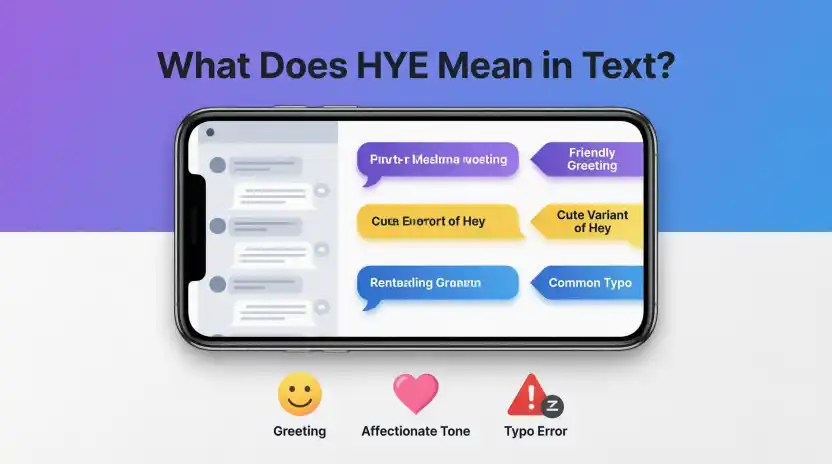
Have you received a message that says “Hye” and wondered what it means? You are not alone. This spelling can look like a new slang word, but it is usually a casual way to say “hi” or “hey.”
People may type “hye” when greeting a friend, starting a chat, or sending a quick message. You might see it in text messages or social media DMs. Some people use this spelling on purpose, while others may type it by mistake.
The meaning is usually simple, but context still matters. A short greeting does not always show how someone feels about you. It does not automatically mean the person is flirting or trying to send a secret message.
In this guide, you will learn what HYE means in text, how people use it, how to reply, and how to tell if it is a greeting or a typo.
Quick Answer Table
| Question | Answer |
| Meaning | Usually “hi” or “hey” |
| Tone | Casual and friendly |
| Used by | People chatting informally |
| Platforms | Text messages and social media DMs |
| Is it offensive? | Usually no |
| Is it an acronym? | Not usually in everyday texting |
| Is it flirty? | Not by itself |
What Does HYE Mean in Text Messages?
In everyday texting, HYE usually means “hi” or “hey.” It is an informal greeting used to start a conversation.
For example:
- “Hye, how are you?”
- “Hye! Are you free?”
- “Hey, hye 😊”
In these examples, the sender is most likely saying hello. The spelling may be intentional, or it may be a typing mistake.
Unlike common abbreviations such as LOL, HYE does not have one fixed, widely accepted meaning in everyday texting. If you see it in a special group or a work-related chat, the meaning may depend on that setting.
Is HYE an Abbreviation or a Typo?
It can be either.
Some people use “hye” as their own informal spelling of “hi” or “hey.” Others may simply mistype one of those words.
Look at how the person writes. If they often use unusual spellings, “hye” may be their normal texting style. If it appears only once, it could be a typo.
There is no need to assume that it has a hidden meaning.
Why Do People Write HYE Instead of Hey?
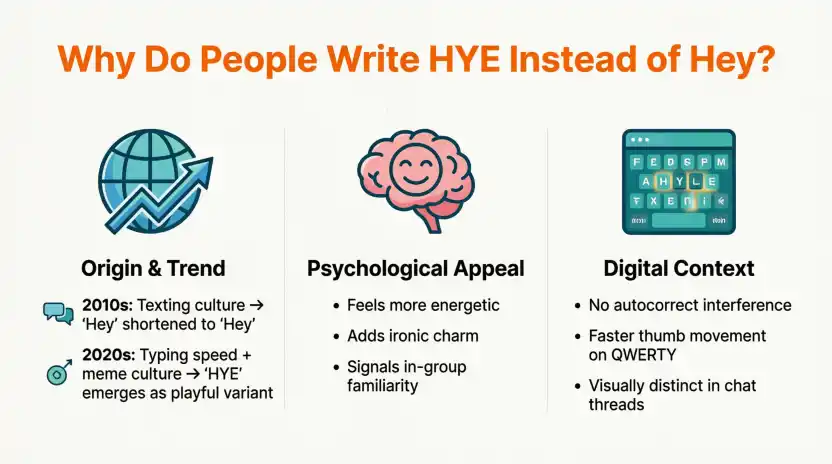
People use short, informal spellings for different reasons.
- Fast typing: They may type quickly and send the message without checking it.
- Personal style: They may prefer a spelling that looks different from the usual “hey.”
- Casual chatting: Friends often use relaxed language in private messages.
- Simple mistakes: They may press the wrong letters by accident.
The spelling alone cannot tell you why someone chose it. If the rest of the message is clear, you can usually respond to the greeting without worrying about the spelling.
Where Is HYE Used?
“Hye” may appear in casual online conversations. However, there is no reliable reason to claim that it has a special meaning on every social platform.
| Platform | Possible use | Example |
| Text messages | A casual greeting | “Hye, are you home?” |
| Instagram DMs | Starting a private chat | “Hye! Thanks for the follow.” |
| Snapchat | Greeting a friend | “Hye, what’s up?” |
| Opening a conversation | “Hye, are you free today?” | |
| Discord | Saying hello in a chat | “Hye everyone!” |
| TikTok comments | Greeting someone | “Hye 👋” |
These are examples of possible use, not proof that HYE is a popular or official abbreviation on each platform.
Does HYE Have a Flirty Meaning?
No, HYE is not automatically flirty. It usually works as a greeting.
The rest of the conversation gives you more information about the sender’s tone. A friendly greeting can be part of a normal chat between friends, family members, classmates, or new contacts.
For example:
Message: “Hye, how was your day?”
This is a simple greeting followed by a question. It does not prove romantic interest.
If someone uses warm words or emojis, the message may feel more playful, but one word is not enough to know what the person intends.
Is HYE Rude or Offensive?
HYE is generally not rude or offensive when used as an informal greeting. Most people will understand it as an attempt to say hello.
Still, it may not be the best choice in every setting. In a school email, a message to a teacher, or a formal work chat, use standard greetings such as “Hi” or “Hello.”
The issue is not that “hye” is a bad word. It is simply less standard than the usual spelling.
How Should You Reply to HYE?
You can reply in a natural way. You do not need to correct the sender’s spelling unless it causes confusion.
Here are a few simple replies:
| If they say… | You can reply… |
| “Hye” | “Hey!” |
| “Hye, how are you?” | “Hi! I’m good, thanks.” |
| “Hye 😊” | “Hey 😊” |
| “Hye, are you free?” | “Hi! What’s up?” |
| “Hye everyone” | “Hello everyone!” |
Choose a reply that fits your relationship with the person. A short greeting is usually enough.
HYE vs. HI vs. HEY
These spellings can all work as greetings, but they are not equally standard.
| Word | Meaning | Best use |
| HYE | Usually an informal spelling of hi or hey | Casual chats when the meaning is clear |
| HI | A standard greeting | Casual and formal conversations |
| HEY | A common, casual greeting | Friends, family, and informal messages |
| HELLO | A standard greeting | Most situations, including formal ones |
If you want your message to be clear to everyone, “hi” or “hey” is a safer choice than “hye.”
Real-Life Examples of HYE in Text
These examples show how someone might use the spelling in different situations.
1. Starting a Chat
Message:
“ Hye, what are you doing?”
Meaning: The sender is saying hello and asking what you are doing.
Why it fits: HYE works like a casual greeting at the start of the message.
2. Greeting a Friend
Message:
“ Hye! Long time no see.”
Meaning: The sender is greeting someone they have not spoken to for a while.
Why it fits: The rest of the message makes the friendly purpose clear.
3. Joining a Group Chat
Message:
“ Hye everyone, can I ask a question?”
Meaning: The sender is greeting the group before asking something.
Why it fits: The word is being used as an informal hello, not as a special acronym.
4. Sending a Quick Message
Message:
“ Hye, are we still meeting today?”
Meaning: The sender is opening the conversation and asking about plans.
Why it fits: The question that follows shows the purpose of the message.
Common Mistakes to Avoid
When you see HYE, keep these points in mind:
- Do not assume it has a secret full form. It usually works as an informal greeting.
- Do not assume the sender is flirting. A greeting alone does not prove romantic interest.
- Do not confuse HYE with every other abbreviation. Similar-looking letters can have different meanings in different settings.
- Do not treat it as a formal spelling. Use “hi” or “hey” when you need standard English.
- Do not assume it is popular everywhere. People have different typing habits, and usage can vary.
Key Takeaways
- HYE usually means “hi” or “hey” in casual messages.
- It can be an intentional spelling or a typing mistake.
- It is not automatically rude, offensive, or flirty.
- The surrounding message helps you understand the sender.
- Use “hi,” “hey,” or “hello” when you want a more standard greeting.
FAQs About HYE Meaning in Text
1. What does HYE stand for in text?
HYE does not have one widely accepted full form in everyday texting. It usually appears as an informal way to write “hi” or “hey.” If you see it in a special group or a work-related conversation, check the context before deciding what it means.
2. What does HYE mean from a girl?
If a girl sends you “hye,” she is usually saying “hi” or “hey.” The word alone does not show if she is interested in you romantically. Read the rest of the conversation and avoid making assumptions based on a short greeting.
3. What does HYE mean from a boy?
If a boy texts “hye,” it usually works as a casual greeting. He may be starting a conversation or checking if you are available to chat. It does not automatically mean he is flirting. The situation and the rest of his message matter more than the spelling.
4. Is HYE the same as HEY?
They can have the same purpose in a casual message. “Hey” is the standard spelling, while “hye” is an informal spelling or possible typo. If you want to write clearly, especially in formal messages, use “hey” or “hi” instead.
5. Is HYE a bad word?
No, HYE is not generally considered a bad word when it is used as a greeting. It usually means “hi” or “hey.” It may look unusual in a formal message, but that does not make it offensive. The context is important if the letters appear as part of a different expression.
6. Does HYE mean someone likes you?
Not by itself. A person can use HYE to greet a friend, classmate, family member, or someone they have just met. A single greeting cannot tell you how someone feels. Pay attention to the conversation as a whole rather than reading too much into one word.
7. How do you pronounce HYE?
When someone uses HYE to mean “hi” or “hey,” you would usually read it as the greeting they intended. The spelling itself does not have one fixed pronunciation in texting slang. If it appears in a special context, ask the sender what they mean.
8. Should I use HYE in a professional message?
It is better to use “Hi” or “Hello” in professional messages. These are standard greetings that work well when speaking to a teacher, employer, customer, or colleague. HYE may be understood in a casual chat, but it is less clear and less suitable for formal writing.
Conclusion
The meaning of HYE in text is usually simple: it is an informal way to say “hi” or “hey.” Someone may use it to start a chat, greet a friend, or send a quick message. It can also be a typing mistake, so there is no need to assume that every use has a special meaning.
Remember that HYE is not a widely standardized texting abbreviation. The surrounding words and the situation can help you understand it. It is generally friendly and not offensive, but it may look out of place in formal writing.
If someone sends you “hye,” a simple “hey!” or “hi!” is usually a natural reply. For clearer writing, stick to the standard spellings. If you enjoy learning about texting language, exploring related slang and common chat abbreviations can also help you understand online conversations more easily.
Read more about!
- Bitchin Slang: Meaning, Origin, Examples & How to Use It
- Grape Slang Meaning: What Does Grape Mean in Slang?
- Birdie Slang Meaning: Everything You Need to Know

Hi, I’m Ryan Mitchell. I write simple guides about slang, internet language, and everyday English to make modern expressions easy to understand. My goal is to help learners use real-life English with confidence.