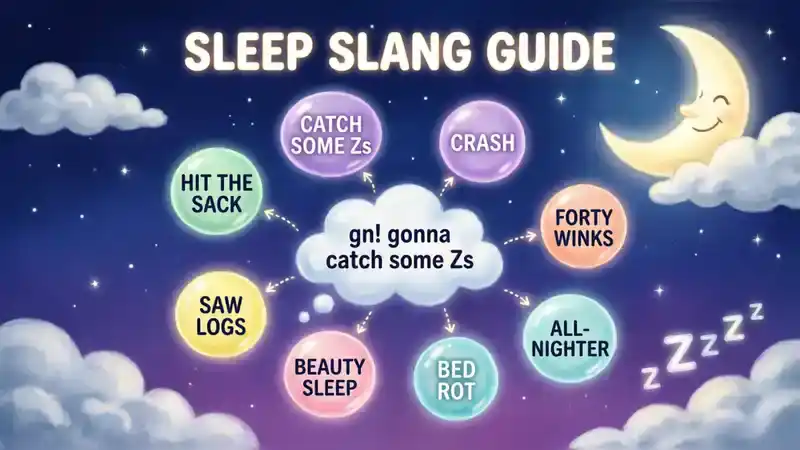
Sleep slang refers to informal words and phrases people use to talk about sleeping, being tired, going to bed, or taking a nap. If you see a sleep-related slang term in a text, its meaning often depends on the sentence and the speaker’s tone.
People search for sleep slang because casual conversations use shorter, funnier, and more relaxed expressions than formal English.
These terms can appear in texts, group chats, social media posts, gaming chats, and everyday conversations. Some expressions simply mean “go to sleep,” while others describe feeling very tired or sleeping for a long time.
This guide explains common sleep slang in simple English. You will learn what these expressions mean, where people use them, how their tone changes, and when a more formal phrase may be better.
Quick Answer: Sleep slang is informal language used to describe sleeping, feeling tired, going to bed, or taking a nap. The exact meaning depends on the expression and context.
What Does Sleep Slang Mean?
Sleep slang is a broad term for casual expressions connected with sleep and tiredness. It is not one specific slang word.
Common meanings
Depending on the phrase, sleep slang can describe:
- Going to bed
- Falling asleep
- Feeling very tired
- Taking a short nap
- Sleeping deeply
- Staying in bed
- Being too tired to do something
- Telling someone to go to sleep
For example, someone might say, “I’m crashing,” to mean they are very tired and are going to sleep soon.
Why context matters
The same sleep-related phrase can sound friendly, funny, casual, or slightly rude depending on who says it.
A friend saying “Go crash already!” may be joking. The same wording from a teacher or manager would not usually be suitable.
Callout: Always look at the whole sentence before deciding what a sleep slang expression means.
Popular Sleep Slang Words and Phrases
There are many informal expressions related to sleep. Some are common in everyday speech, while others are more playful.
“Crash”
“Crash” can mean going to sleep, especially because you are very tired.
Example:
“I’m exhausted. I’m going to crash.”
It is casual and common in conversations.
“Hit the hay”
“Hit the hay” is an informal way to say “go to bed.”
Example:
“It’s getting late, so I’m going to hit the hay.”
It is friendly and harmless, although it may sound more old-fashioned than newer internet slang.
“Knock out”
“Knock out” can describe falling asleep quickly or sleeping deeply.
Example:
“I was so tired that I knocked out on the couch.”
The phrase is informal and should be understood from context.
“Catch some Zs”
“Catch some Zs” means to get some sleep.
Example:
“I need to catch some Zs before school tomorrow.”
This expression is playful and informal.
“Doze off”
“Doze off” means to fall asleep, often unintentionally or for a short time.
Example:
“I dozed off while watching the movie.”
It is less slangy than some other expressions and works in many casual situations.
“Pass out”
In casual speech, “pass out” can mean falling asleep very quickly. However, it can also mean losing consciousness, so context matters.
Example:
“I was so tired I passed out on the couch.”
Because the phrase has another meaning, use it carefully when clarity matters.
Sleep Slang in Texting
Sleep slang is especially common in texting because people often want to communicate quickly.
Short messages
Someone might text:
- “I’m crashing.”
- “Gonna sleep.”
- “Need some Zs.”
- “I’m dead tired.”
- “I’m heading to bed.”
- “I’m out.”
These messages are usually understood as casual statements about being tired or going to sleep.
Tone in texting
Text messages do not include facial expressions or voice tone, so short slang can sometimes be misunderstood.
For example, “I’m out” could mean:
- I am going to sleep.
- I am leaving the conversation.
- I am leaving a place.
- I am no longer participating.
The surrounding conversation usually provides the answer.
Callout: In texting, context is often more important than the slang word itself.
Sleep Slang on Social Media
Sleep-related slang can appear on platforms such as TikTok, Instagram, Reddit, Discord, and Snapchat.
TikTok and Instagram
People may use informal sleep expressions in captions, comments, or short posts.
For example:
“I stayed up all night. I’m crashing.”
The wording gives the post a relaxed, conversational feel.
Discord and gaming chats

Gamers may use sleep slang when ending a late-night session.
For example:
“GG, I’m heading to bed.”
Or:
“I’m too tired to play. I’m logging off.”
The exact expression depends on the community and the speaker.
Reddit users may use ordinary informal English mixed with internet slang. Sleep-related phrases are usually easy to understand from context.
Callout: Sleep slang is generally casual language, not a special language used by one single social media platform.
Is Sleep Slang Rude or Offensive?
Most sleep slang is neutral or harmless. Words such as “crash,” “catch some Zs,” and “hit the hay” are normally casual rather than offensive.
When it sounds friendly
A friend might say:
“You should get some sleep.”
Or:
“Go crash. You look exhausted.”
The second example is more casual.
When it can sound rude
Telling someone “Go to sleep” can sound dismissive if they are trying to talk to you.
For example:
“Just go to sleep already.”
Depending on the relationship and tone, this could sound impatient.
Workplace use
Some sleep slang is too casual for professional communication.
Instead of:
“I’m gonna crash.”
A workplace message could say:
“I’m feeling tired, so I’ll continue this tomorrow.”
The second version is clearer and more professional.
Real-Life Examples of Sleep Slang
Different situations can change the tone of the same expression.
Friendly example
Person A: “Are you staying up for the movie?”
Person B: “Nope, I’m gonna crash.”
Here, “crash” simply means go to sleep.
Casual example
Person A: “Why are you still awake?”
Person B: “I’m trying to catch some Zs, but I can’t sleep.”
The phrase sounds playful and relaxed.
Tiredness example
Person A: “Want to play another round?”
Person B: “Not tonight. I’m dead tired.”
“Dead tired” means extremely tired. It is an exaggeration, not a literal statement.
Gaming example
Player A: “One more game?”
Player B: “Can’t. I’m logging off and hitting the hay.”
The phrase means the player is ending the session to go to bed.
Social media example
“I stayed up watching videos and now I’m ready to crash.”
The speaker is saying they feel very tired.
Callout: These examples show why sleep slang should be understood through the sentence, not by looking at one word alone.
Where Did Sleep Slang Come From?
Sleep slang does not have one single origin. Different expressions developed at different times and in different forms of everyday English.
Older expressions
“Hit the hay” is an older informal expression for going to bed. It is associated with earlier forms of everyday English and is much older than modern internet slang.
Modern expressions
Other terms, such as “crash,” became common in casual spoken English and later became normal in texting and online communication.
Internet influence
The internet did not create every sleep slang term. However, texting, social media, gaming, and online communities have helped informal expressions spread quickly.
It is better to avoid claiming that one generation or platform invented all sleep slang. Different expressions have different histories.
Sleep Slang vs Formal English
Sleep slang works well in relaxed conversations, but formal English may be better in school or work.
| Casual Sleep Slang | More Formal Alternative |
| I’m gonna crash. | I’m going to bed. |
| I need some Zs. | I need some sleep. |
| I’m dead tired. | I’m very tired. |
| Hit the hay. | Go to bed. |
| I knocked out. | I fell asleep quickly. |
| I’m out. | I’m going to sleep. |
Which one should you use?
Use slang when talking casually with people who understand the expression.
Use simple standard English when the message needs to be clear, professional, or formal.
Why Do People Use Sleep Slang?
People use sleep slang because it makes everyday communication shorter and more expressive.
It sounds natural
“I’m going to sleep” is clear.
“I’m gonna crash” sounds more relaxed and conversational.
It adds personality
Expressions such as “catch some Zs” can make a simple message sound playful.
It saves time
Texting encourages short messages. Informal phrases can communicate an idea quickly.
It shows familiarity
Friends may use casual language because it feels natural within their relationship.
Callout: Slang is often about tone and social connection, not just saving words.
When Should You Avoid Sleep Slang?
Sleep slang is usually harmless, but there are situations where standard English is a better choice.
School assignments
Avoid slang in formal essays unless the assignment specifically asks you to discuss slang or informal language.
Professional messages
A teacher, manager, client, or other professional contact may prefer clear and polite language.
Important conversations
If there is a chance the phrase could be misunderstood, use a direct expression.
For example, instead of “I’m out,” say:
“I’m going to bed now.”
That removes confusion.
With people unfamiliar with English slang
Language learners may not understand expressions such as “hit the hay” or “catch some Zs.”
A simple phrase like “I’m going to sleep” is easier for everyone.
Polite Alternatives to Sleep Slang
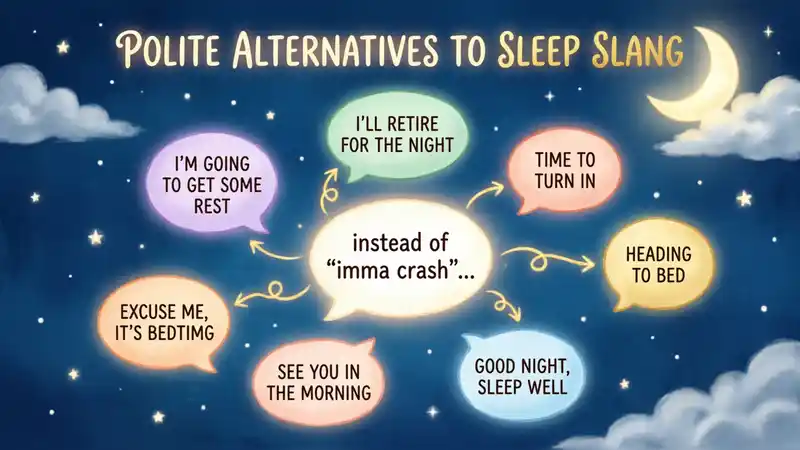
You do not need slang to sound friendly.
Casual but clear
- “I’m going to bed.”
- “I’m getting ready to sleep.”
- “I’m pretty tired.”
- “I think I’ll call it a night.”
- “I need to get some rest.”
More formal
- “I’m going to get some rest.”
- “I’ll continue this tomorrow.”
- “I need to get some sleep.”
- “I’m heading home to rest.”
These phrases work well when you want to be polite without sounding overly formal.
Common Misunderstandings About Sleep Slang
Some expressions can confuse people because they have more than one meaning.
“Pass out”
“Pass out” can mean falling asleep quickly in casual speech. It can also refer to losing consciousness.
The context tells you which meaning is intended.
“Knock out”
“Knock out” can refer to sleeping deeply in casual language, but it also has other meanings outside sleep.
“I’m out”
This can mean “I am going to sleep,” but it may also mean “I am leaving.”
For clear communication, use a more direct phrase when necessary.
Is Sleep Slang Safe for Social Media?
Most ordinary sleep slang is safe and harmless to use on social media.
Expressions about being tired, going to bed, or taking a nap generally do not create a safety issue. The main concern is understanding the context correctly.
Good practice
When posting publicly:
- Use slang that your audience understands.
- Avoid expressions that could easily have another meaning.
- Use clear wording for important information.
- Remember that slang can sound different across age groups and communities.
A casual phrase that feels normal among friends may not fit every audience.
Sleep Slang and Generational Differences
Different age groups may prefer different expressions.
Older expressions
Phrases such as “hit the hay” and “call it a night” have been used for many years.
Modern online language
Younger internet users may prefer shorter texting expressions, abbreviations, or playful phrases.
However, it is not accurate to say that every sleep expression belongs to one generation. Slang often crosses age groups, especially when people communicate online.
Similar Sleep-Related Expressions
Several phrases are closely related but do not mean exactly the same thing.
| Expression | Meaning | Tone |
| Crash | Go to sleep because you are tired | Casual |
| Hit the hay | Go to bed | Informal |
| Catch some Zs | Get some sleep | Playful |
| Doze off | Fall asleep briefly | Neutral |
| Call it a night | Stop an activity and go to bed | Casual |
| Dead tired | Very tired | Informal |
| Take a nap | Sleep for a short time | Neutral |
The key difference
Some expressions describe the act of sleeping, while others describe tiredness or the decision to stop an activity.
Frequently Asked Questions
1. What is sleep slang?
Sleep slang is informal language used to talk about sleeping, going to bed, taking a nap, or feeling tired.
2. What does “crash” mean in sleep slang?
“Crash” commonly means to go to sleep, especially because you are very tired.
3. What does “catch some Zs” mean?
“Catch some Zs” is a playful informal way to say “get some sleep.”
4. Is sleep slang rude?
Most sleep slang is not rude or offensive. However, some phrases can sound dismissive depending on the situation and tone.
5. Can I use sleep slang at work?
It is usually better to use clear, standard English in professional communication, especially with managers, clients, or formal contacts.
6. Is sleep slang used on social media?
Yes. Informal sleep expressions can appear in texts, captions, comments, gaming chats, and other online conversations.
Conclusion
Sleep slang includes casual expressions for sleeping, going to bed, feeling tired, or taking a nap. Common examples include “crash,” “hit the hay,” “catch some Zs,” and “doze off.”
The best way to understand sleep slang is to look at the context. A phrase may sound funny and friendly between friends but less suitable in school or professional communication. Most sleep slang is harmless, but some expressions can have other meanings, so context matters.
If you are unsure if someone understands the slang, a simple phrase such as “I’m going to bed” or “I need some sleep” is always clear.
Read more about!
- What Does Shark Mean in Slang? Meaning and Uses
- What Does Preppy Mean in Slang? Meaning, Origin & How People Use It
- Slang for Coke: Common Terms and Their Meanings
- Reckless in Italian Slang: Meaning and Common Words

Daniel Brooks is an English vocabulary educator and content editor with experience creating educational resources about English words, idioms, and everyday communication. He reviews language content for clarity, accuracy, and readability to ensure readers receive reliable and easy-to-understand information.