“I plead the fifth” means “I choose not to answer that question because my answer might get me into trouble.” In texting, people often use it as a joke when someone asks an awkward, personal, or embarrassing question.
For example:
Friend 1: “Did you eat the last slice of cake?”
Friend 2: “I plead the fifth 😂”
This means the person does not want to admit or deny anything.
What Does “I Plead the Fifth” Mean?
“I plead the fifth” comes from the Fifth Amendment to the United States Constitution. It protects people from being forced to give answers that could incriminate them in a criminal case.
In everyday conversations and text messages, the phrase is usually used in a much more casual way.
It can mean:
- I am not answering that.
- I do not want to reveal the truth.
- My answer could get me in trouble.
- I would rather keep that private.
- I am staying silent on this one.
The phrase is often humorous. It does not automatically mean that someone has done something wrong.
What Does “I Plead the Fifth” Mean in Text Messages?
In text messages, this phrase is a playful way to avoid answering a question.
Someone might use it when a friend asks about a secret, a crush, a mistake, or an embarrassing moment.
Example:
Person A: “Do you like someone in our class?”
Person B: “I plead the fifth.”
Here, Person B does not want to reveal their feelings.
The exact meaning depends on the conversation. Sometimes it is a joke, while other times it is a polite way to avoid sharing personal information.
Examples of “I Plead the Fifth” in Text
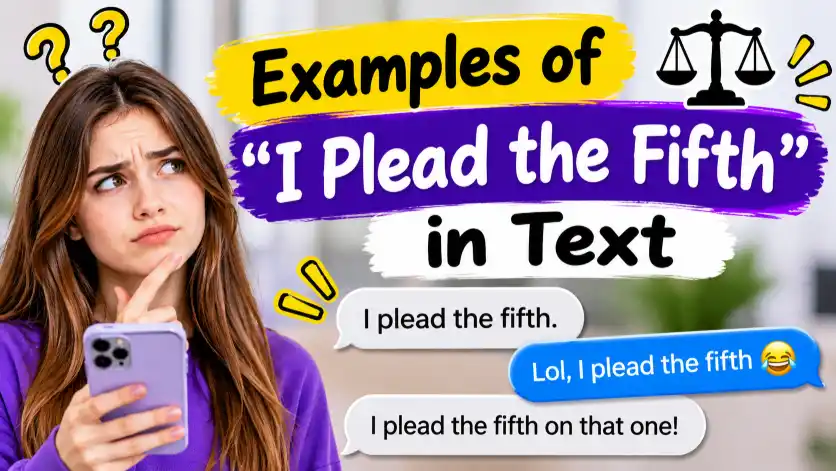
Here are some natural examples of how people may use this phrase in everyday chats.
Example 1:
Alex: “Who did you message last night?”
Sam: “I plead the fifth 😂”
Example 2:
Mia: “Did you have a crush on him?”
Lily: “I plead the fifth.”
Example 3:
Jake: “Who broke the classroom decoration?”
Noah: “I plead the fifth lol.”
Example 4:
Emma: “Did you watch the whole series without me?”
Sophie: “I plead the fifth 😭”
Example 5:
Ryan: “Why were you laughing during the meeting?”
Chris: “I plead the fifth.”
Example 6:
Ava: “Was that your account commenting on the post?”
Ella: “I plead the fifth 😂”
Example 7:
Ben: “Did you forget my birthday?”
Max: “I plead the fifth. Don’t make me answer.”
Example 8:
Olivia: “What did you say about my new haircut?”
Zoe: “I plead the fifth 😅”
Example 9:
Daniel: “Who finished all the snacks?”
Leo: “I plead the fifth.”
Example 10:
Grace: “Are you hiding something from us?”
Maya: “I plead the fifth for now.”
Why Do People Say “I Plead the Fifth”?
People use this expression for several reasons:
- To avoid an awkward question: They do not want to discuss a sensitive topic.
- To make a joke: They want to create a funny moment in a conversation.
- To keep a secret: They prefer not to reveal private information.
- To avoid admitting something: They do not want to confirm or deny what someone suspects.
- To change the subject: They want the conversation to move on.
It is a simple way to say, “I’m not telling you!”
How to Reply When Someone Says “I Plead the Fifth”
Your response can depend on the tone of the conversation.
Funny replies:
- “That sounds suspicious 😂”
- “I’ll take that as a maybe.”
- “The silence says a lot!”
- “Okay, secret agent.”
Casual replies:
- “Fair enough.”
- “No worries.”
- “You don’t have to tell me.”
- “I’ll respect your silence.”
Playful replies:
- “Your honor, I have more questions!”
- “Case closed for now.”
- “I knew you wouldn’t answer.”
- “That’s all I needed to know.”
If someone uses the phrase to avoid a personal question, it is best to respect their choice rather than pressure them.
Is “I Plead the Fifth” Rude?
No. The phrase is not usually rude or offensive.
It is often used in a funny or playful way between friends. However, the tone matters.
For example:
- Friendly: “I plead the fifth 😂” — a lighthearted response.
- Private: “I plead the fifth on that question.” — a way to protect personal information.
- Serious: “I prefer not to answer.” — a more direct way to set a boundary.
If someone uses it during a serious conversation, they may genuinely want to keep something private.
Is “I Plead the Fifth” Only Used in America?
The expression comes from the United States legal system, where the Fifth Amendment provides protection against being forced to give self-incriminating testimony.
However, people outside the United States may also use the phrase because it is familiar from American movies, TV shows, and online conversations.
Its casual meaning is widely understandable in English-language chats, but its legal meaning is specifically connected to U.S. law.
Is “I Plead the Fifth” Formal or Informal?
The phrase has both legal and casual uses.
| Situation | Meaning or suitability |
| Text messages | Informal and playful |
| Friends’ conversations | Commonly used as a joke |
| Social media | A humorous way to avoid answering |
| School conversations | Usually casual |
| Workplace chats | Can sound playful, depending on the situation |
| Legal settings | Has a specific legal meaning in the United States |
For professional conversations, “I’d prefer not to answer that question” may be clearer and more appropriate.
Difference Between “I Plead the Fifth” and Similar Phrases
These expressions can all help someone avoid answering, but they have slightly different meanings.
| Phrase | Meaning |
| I plead the fifth | I choose not to answer. |
| No comment | I do not want to give a statement. |
| That’s private | I do not want to share that information. |
| I’d rather not say | I prefer to keep the answer to myself. |
| Don’t ask me | I do not want to discuss the topic. |
| I’m not telling | I am keeping the information secret. |
The main difference is that “I plead the fifth” uses a legal expression in a casual or humorous way.
Common Mistakes About “I Plead the Fifth”
People sometimes misunderstand this phrase.
- Thinking it always means guilt: It does not prove that someone has done anything wrong.
- Assuming it is always serious: In texting, it is often just a joke.
- Thinking it means “I don’t know”: It usually means the person does not want to answer, not that they lack information.
- Using it as a legal guarantee: Its casual use in a chat does not automatically provide legal protection.
- Assuming it is offensive: The phrase is generally harmless, although its tone can sound dismissive in some situations.
Key Takeaways
- “I plead the fifth” means “I choose not to answer.”
- It comes from the Fifth Amendment to the U.S. Constitution.
- In texting, it is often used humorously.
- People use it to avoid awkward, personal, or uncomfortable questions.
- It does not automatically mean someone is guilty.
- It is generally informal and friendly, but context matters.
FAQs About “I Plead the Fifth”
1. What does “I plead the fifth” mean in simple words?
It means you do not want to answer a question. In casual conversations, people often say it when they want to keep a secret or avoid an awkward topic. It is similar to saying, “I’m not telling you.”
2. What does “I plead the fifth” mean from a girl?
If a girl texts “I plead the fifth,” she may be jokingly avoiding a question. For example, if you ask if she likes someone, she might use this phrase because she does not want to reveal her feelings. It does not have one special meaning based on who says it.
3. What does “I plead the fifth” mean from a guy?
If a guy says this in a text, he may not want to answer a personal or embarrassing question. He could be joking, keeping a secret, or simply avoiding the topic. The surrounding conversation helps you understand his intention.
4. Is “I plead the fifth” a slang phrase?
It is not originally slang. It is a legal expression connected to the Fifth Amendment in the United States. However, people commonly use it as an informal expression in texts, comments, and everyday conversations.
5. Does “I plead the fifth” mean someone is guilty?
No. It does not prove guilt. In casual texting, someone may say it just to be funny or protect their privacy. Even in its legal context, choosing not to answer is not the same as admitting wrongdoing.
6. Is “I plead the fifth” rude?
Usually, no. It is often playful and harmless between friends. However, it can sound dismissive if someone uses it during a serious conversation. Tone, timing, and the relationship between the people matter.
7. How should I respond to “I plead the fifth”?
You can reply with something playful like “That sounds suspicious 😂” or “I’ll take that as a maybe.” If the person seems serious, a simple “Fair enough” is a respectful response.
8. Can I use “I plead the fifth” in everyday texting?
Yes. You can use it when someone asks an awkward, personal, or funny question that you do not want to answer. Just remember that it is an informal expression, not a substitute for legal advice or a formal legal statement.
Conclusion
“I plead the fifth” means “I choose not to answer that question.” It comes from a U.S. legal protection but is often used jokingly in everyday texting.
When a friend sends this phrase, they may be avoiding an awkward question, protecting a secret, or simply having fun. The best way to understand it is to look at the conversation and the person’s tone.
Read more about!
- What Does HYO Mean in Text? Real Meaning, & Social Media Use
- What Does HYK Mean in Text? Real Examples & Social Media Use
- What Does HYYY Mean in Text? Social Media Use

Daniel Brooks is an English vocabulary educator and content editor with experience creating educational resources about English words, idioms, and everyday communication. He reviews language content for clarity, accuracy, and readability to ensure readers receive reliable and easy-to-understand information.