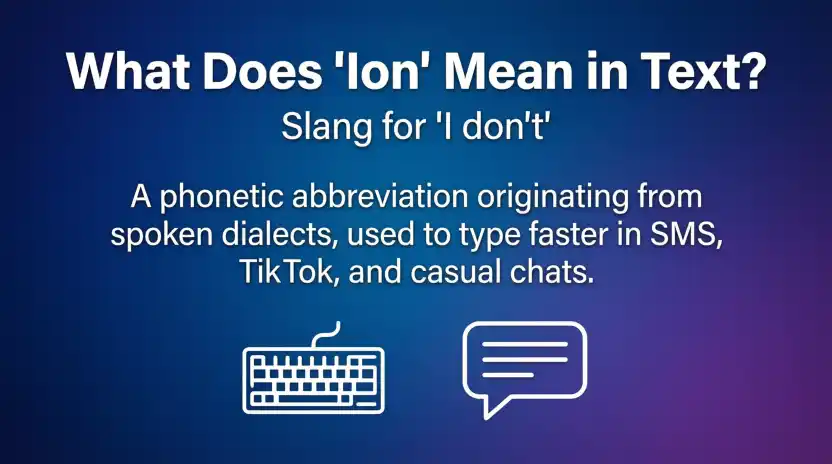
If someone sends you a message like “ion know,” “ion care,” or “ion wanna go,” you may wonder what “ion” means. In texting slang, “ion” usually means “I don’t.”
It is not normally an acronym like “LOL” or “BRB.” Instead, it is a casual spelling that represents the way “I don’t” can sound when spoken quickly. People may use it in texts, DMs, comments, captions, and group chats.
The meaning becomes easy to understand when you look at the word after “ion.” For example, “ion know” means “I don’t know,” while “ion want that” means “I don’t want that.”
There are other meanings of ION, too. In some messages, uppercase “ION” can mean “In Other News.” Outside slang, an ion is also a science term. Context tells you which meaning is intended.
Quick Answer Table
| Question | Answer |
| Meaning | Usually “I don’t” |
| Type | Informal texting slang |
| Pronunciation | Often read like “eye-on” |
| Tone | Casual, relaxed, sometimes dismissive |
| Used By | People using informal internet language |
| Common Places | Texts, DMs, comments, group chats, social media |
| Offensive? | No, but some sentences can sound rude |
| Formal English? | No |
| Other Meaning | “In Other News” in some contexts |
| Science Meaning | A charged atom or group of atoms |
The important part is that “ion” does not automatically mean one thing every time. If it appears directly before a verb, such as “ion know,” the “I don’t” meaning is usually clear. If it introduces a new topic, another interpretation may fit better.
What Does Ion Mean in Text?
“Ion” usually means “I don’t” in casual texting and internet slang.
It is commonly placed before a verb or verb phrase:
- “ion know” = “I don’t know”
- “ion care” = “I don’t care”
- “ion want it” = “I don’t want it”
- “ion like that” = “I don’t like that”
- “ion think so” = “I don’t think so”
The spelling is informal. It is meant to sound like casual speech rather than follow standard English spelling rules.
For example:
“ion know what happened”
means:
“I don’t know what happened.”
The word “ion” itself does not carry the whole meaning. The word that follows it helps complete the sentence.
Why Does “I Don’t” Become “Ion”?
When people speak quickly, the sounds in “I don’t” can blend together. In some varieties of informal speech, this can sound closer to “ion.”
Internet users began representing that sound in writing as “ion.”
That makes “ion” different from a normal acronym. It is better understood as a phonetic or speech-based spelling.
What Does “Ion” Stand For?
In the slang use, “ion” does not technically stand for a group of words in the way “IDK” stands for “I don’t know.”
Instead, “ion” is a written representation of “I don’t.”
This difference matters.
| Text form | Meaning | Type |
| ion know | I don’t know | Phonetic slang |
| ion care | I don’t care | Phonetic slang |
| IDK | I don’t know | Initialism |
| IDC | I don’t care | Initialism |
| I don’t know | I don’t know | Standard English |
So if someone asks, “What does ION stand for?” the simplest answer is: in casual slang, it usually represents “I don’t.”
How to Pronounce Ion in Text Slang
In slang messages, “ion” is commonly read approximately like “eye-on.”
For example:
“ion know”
can be read as:
“I don’t know.”
The slang pronunciation is different from what you might expect from a science lesson.
In science, “ion” has its own standard pronunciation and meaning. Cambridge Dictionary lists the scientific word as a term for an atom or small group of atoms with an electrical charge.
When you see “ion” in a casual message, do not assume the writer is talking about chemistry. Look at the surrounding words first.
Where Ion Is Used
“Ion” is mainly an informal online expression. The exact platform matters less than the type of conversation.
| Platform or Setting | How It May Be Used | Example |
| Text messages | Casual replies | “ion know yet” |
| TikTok comments | Short reactions | “ion even understand this” |
| Instagram DMs | Informal conversation | “ion wanna go” |
| Snapchat | Quick messages | “ion remember” |
| Discord | Casual group chat | “ion think that worked” |
| X | Informal posts or replies | “ion care what they say” |
| Casual chats | “ion got time rn” | |
| School chat | Friendly conversation | “ion know the answer” |
These examples show the same basic pattern. The platform does not normally change the core meaning.
What changes is the tone. A message between close friends may feel playful, while the same wording sent to a teacher or manager may look too informal.
Common Examples of Ion in Text
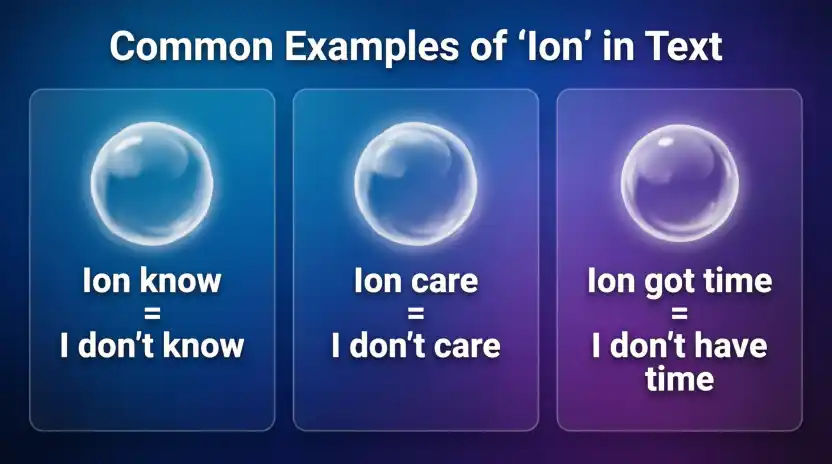
Here are some natural examples that show how the slang works.
“Ion Know”
Text:
“Are they coming tonight?”
Reply:
“ion know.”
Meaning:
“I don’t know.”
This is one of the easiest uses to understand because “ion” comes directly before “know.”
“Ion Care”
Text:
“Everyone is talking about the new update.”
Reply:
“ion care tbh.”
Meaning:
“I don’t care, to be honest.”
This one can sound more dismissive. The slang itself is not necessarily rude, but “I don’t care” can sound blunt depending on the conversation.
“Ion Want That”
Text:
“Do you want the blue one?”
Reply:
“ion want that one.”
Meaning:
“I don’t want that one.”
Here, “ion” simply replaces “I don’t.”
“Ion Think So”
Text:
“Do you think the game starts at eight?”
Reply:
“ion think so.”
Meaning:
“I don’t think so.”
This use can sound less harsh than “ion care” because it expresses uncertainty rather than dismissal.
“Ion Even Know”
Text:
“Why did he leave?”
Reply:
“ion even know.”
Meaning:
“I don’t even know.”
The word “even” adds emphasis. The writer is saying they really do not know the answer.
Does Ion Mean “I Don’t” or “I Don’t Know”?
Usually, “ion” itself means “I don’t.”
The next word completes the thought.
For example:
- “ion know” = I don’t know
- “ion care” = I don’t care
- “ion want” = I don’t want
- “ion like” = I don’t like
- “ion remember” = I don’t remember
So “ion” is not another spelling of “IDK.”
“IDK” is a complete abbreviation for “I don’t know.” “Ion” is more flexible because it can appear before many different verbs.
Ion vs IDK vs IDC
These terms are related, but they are not identical.
| Term | Meaning | Main Difference |
| ion | I don’t | Flexible slang form |
| IDK | I don’t know | Specifically expresses uncertainty |
| IDC | I don’t care | Specifically expresses lack of concern |
| I don’t | I do not | Standard English |
For example:
“ion know”
and
“IDK”
can communicate a similar idea.
But:
“ion care”
means something different from “IDK.”
Knowing this difference helps prevent misreading a short message.
Is Ion Rude?
“Ion” itself is not a rude word.
The tone depends on the full sentence.
For example:
“ion know”
usually sounds neutral or casual.
But:
“ion care”
can sound dismissive because the underlying phrase “I don’t care” may feel blunt.
Compare:
- “ion know, sorry 😭” → casual and uncertain
- “ion care” → potentially dismissive
- “ion think so” → usually neutral
- “ion wanna argue” → may sound firm
The spelling does not automatically make a message rude. The surrounding words, punctuation, emojis, and relationship between the people matter.
Is Ion Offensive?
No. The slang word “ion” is not generally an offensive term.
However, it can appear in a sentence that is insulting, dismissive, or unfriendly.
For example, the difference is between the slang form and the message itself:
“ion know” is not offensive.
“ion care what you think” may sound disrespectful depending on the situation.
If you are unsure how your message will sound, writing “I don’t” in full is clearer and safer.
Is Ion Formal or Informal?
“Ion” is informal.
It works well in casual conversations where people already use texting slang. It is not a good replacement for “I don’t” in formal writing.
Casual situations
You might see:
- Texting friends
- Group chats
- Social media comments
- Casual DMs
- Gaming chats
- Memes
- Informal posts
Situations to avoid it
Use standard English instead when writing:
- School assignments
- Job applications
- Formal emails
- Reports
- Academic work
- Professional messages
- Official documents
For example:
Casual:
“ion know what time it starts”
Formal:
“I don’t know what time it starts.”
The second version is clearer for professional or academic communication.
Does Ion Have an AAVE Connection?
The slang spelling “ion” is associated with African American English, including AAVE, and later became more visible across wider internet culture.
It is important not to treat the slang as simply a random internet typo. Its spelling reflects speech patterns and pronunciation.
The exact history of when the spelling first appeared online is not simple to establish from one date. Some online slang references trace written uses back to earlier internet culture, while newer social platforms helped spread the form more widely.
Because the history is not perfectly documented, it is better to avoid claiming that one specific platform or one exact year “invented” ion.
What Does ION Mean in Other Contexts?
Context is very important because “ion” has meanings outside texting slang.
ION = “In Other News”
In some informal writing, “ION” can mean “In Other News.”
Example:
“ION, did you finish your homework?”
Here, the writer is changing the subject.
This is different from:
“ion know the answer.”
In the second example, “ion” means “I don’t.”
Ion in Science
In chemistry and physics, an ion is an atom or small group of atoms with an electrical charge. That charge results from gaining or losing electrons.
Example:
“The sodium ion has a positive charge.”
That is not slang.
How to Tell Which Meaning Is Intended
Look at the sentence.
| Example | Likely Meaning |
| “ion know” | I don’t |
| “ion want it” | I don’t |
| “ION, did you see that?” | In Other News |
| “positive ion” | Science |
| “negative ion” | Science |
| “ions in the solution” | Science |
The words around “ion” usually give you the answer.
Common Mistakes When Reading Ion
Mistake 1: Thinking It Is Always Chemistry
The spelling looks exactly like the scientific word.
But “ion know” clearly is not about chemistry.
Read the complete sentence before deciding what the word means.
Mistake 2: Assuming Ion Means “I Don’t Know”
“Ion” does not always mean the full phrase “I don’t know.”
“Ion” + “know” gives you:
“I don’t know.”
But:
“ion care”
means:
“I don’t care.”
The following word matters.
Mistake 3: Treating Ion Like IDK
They can overlap in some sentences, but they are not the same type of abbreviation.
“Ion” can be used before many verbs.
“IDK” specifically means “I don’t know.”
Mistake 4: Using Ion in Formal Writing
Even if you understand the slang, that does not make it suitable for every setting.
If you are writing to a teacher, employer, customer, or professional contact, use “I don’t.”
Mistake 5: Assuming It Is Always Rude
“Ion” is not automatically rude.
The complete message determines the tone.
How to Reply When Someone Says Ion
Your reply depends on what comes after “ion.”
If someone says:
“ion know”
you can respond:
“Same, I’m confused too.”
If someone says:
“ion wanna go”
you could say:
“No worries.”
If someone says:
“ion think so”
you could ask:
“Are you sure?”
You do not need a special response to the slang itself. Simply respond to the meaning of the complete sentence.
Is Ion Still Used?
“Ion” remains recognizable in current informal internet and texting slang, but slang usage varies by community, age group, platform, and region.
It is better to describe it as a common informal expression in certain online communities than to claim that everyone uses it.
You may see it more often in casual posts, comments, DMs, and conversations influenced by internet slang and African American English.
Its frequency can change over time, so examples and usage should be reviewed when this article is updated.
What Emoji Goes With Ion?
There is no official emoji for “ion.”
The best emoji depends on the feeling of the sentence.
For example:
- “ion know 😭” → confusion or frustration
- “ion care 😂” → joking or playful dismissal
- “ion even remember 💀” → humorous disbelief
- “ion think so 🤷” → uncertainty
The emoji changes the tone rather than changing the basic meaning of “ion.”
Real-Life Ion Examples
Text Message
Maya: “Did you save the photo?”
Jordan: “ion think so 😭”
Meaning: “I don’t think so.”
The emoji makes the response feel more casual and expressive.
TikTok Comment
Comment:
“ion even understand this 😭”
Meaning: “I don’t even understand this.”
Here, the writer is reacting casually to confusing content.
Discord Chat
Leo: “Are we playing another round?”
Noah: “ion know, depends if everyone stays.”
Meaning: “I don’t know; it depends if everyone stays.”
The slang keeps the message relaxed and conversational.
Instagram DM
Aisha: “You want the black one?”
Nora: “ion want that one lol.”
Meaning: “I don’t want that one.”
The “lol” softens the message and makes it sound less serious.
School Conversation
Ethan: “Do you know what the homework was?”
Caleb: “ion remember.”
Meaning: “I don’t remember.”
This works in casual student conversation, but a formal school assignment should use standard English.
Workplace
A coworker might casually text:
“ion know if the meeting moved.”
In a professional email, it would be better to write:
“I don’t know if the meeting has been moved.”
The meaning stays the same, but the style changes.
Ion vs I Don’t: When Should You Use Each?
| Situation | Better Choice |
| Texting a close friend | ion |
| Casual group chat | ion |
| Social media comment | ion |
| Meme or informal post | ion |
| School assignment | I don’t |
| Formal email | I don’t |
| Job application | I don’t |
| Academic paper | I don’t |
| Official message | I don’t |
A simple rule works well:
Use “ion” when the conversation is clearly casual. Use “I don’t” when clarity or formality matters.
Key Takeaways
- “Ion” in texting usually means “I don’t.”
- It is a casual, speech-based spelling rather than a standard English form.
- “Ion know” means “I don’t know.”
- “Ion care” means “I don’t care.”
- “ION” can sometimes mean “In Other News.”
- In chemistry, an ion is a charged atom or group of atoms.
- The word after “ion” and the overall topic usually reveal the intended meaning.
- Avoid “ion” in formal school, academic, and professional writing.
FAQs
1. What does ion mean in text messages?
In text messages, “ion” usually means “I don’t.” It is an informal spelling based on casual pronunciation. For example, “ion know” means “I don’t know,” and “ion want that” means “I don’t want that.” It is mainly used in relaxed conversations rather than formal writing.
2. Is ion short for I don’t?
Yes, in the common slang use, “ion” represents “I don’t.” It is not a traditional acronym because the letters do not come from the first letters of “I don’t.” Instead, the spelling reflects how the phrase can sound when spoken quickly.
3. What does “ion know” mean?
“Ion know” means “I don’t know.” Someone may use it when they are unsure about something or simply do not have an answer. The phrase is casual and commonly fits texting, social media comments, DMs, and informal group chats.
4. What does “ion care” mean?
“Ion care” means “I don’t care.” Depending on the conversation, it can sound neutral, joking, or dismissive. The word “ion” itself is not rude, but the complete phrase can feel blunt if someone uses it to reject another person’s opinion.
5. Is ion the same as IDK?
No. “IDK” specifically means “I don’t know,” while “ion” usually means “I don’t” and can be followed by different verbs. For example, “ion care” means “I don’t care.” This makes “ion” more flexible than “IDK.”
6. Does ION mean “In Other News”?
Sometimes. In informal writing, uppercase “ION” can be used to mean “In Other News,” especially when someone is switching to a different topic. Context is important. “ION, did you see this?” differs from “ion know,” where the slang means “I don’t.”
7. Is ion rude or offensive?
“Ion” is not normally an offensive word. Its tone depends on the sentence. “Ion know” is usually neutral, while “ion care” may sound dismissive. If you are worried about sounding rude, writing “I don’t” in full can make your meaning clearer.
8. Can I use ion in school or work?
You can understand and use it in casual conversations, but standard English is usually better for school assignments and professional communication. Write “I don’t” in essays, formal emails, applications, reports, and other situations where clear and professional language matters.
Conclusion
If you were wondering what “ion” means in text, the answer is usually simple: it means “I don’t.” You will often see it before another verb, as in “ion know,” “ion care,” or “ion want.”
The key is to read the entire sentence. “Ion” can also have other meanings. In some informal messages, “ION” means “In Other News,” while in science, an ion is a charged atom or group of atoms.
For casual chats, “ion” can make a message sound relaxed and natural. It is not the right choice for every setting, though. In schoolwork, professional messages, and formal writing, “I don’t” is clearer.
Once you recognize the pattern, phrases such as “ion know” become much easier to understand. Context is the best guide.
Read more about!
- Dale Spanish Slang Meaning in Text
- What Is Mewing Slang Meaning in Text?
- Marple Definition Slang: Meaning in Text

Hi, I’m Ryan Mitchell. I write simple guides about slang, internet language, and everyday English to make modern expressions easy to understand. My goal is to help learners use real-life English with confidence.