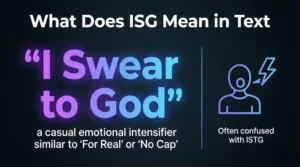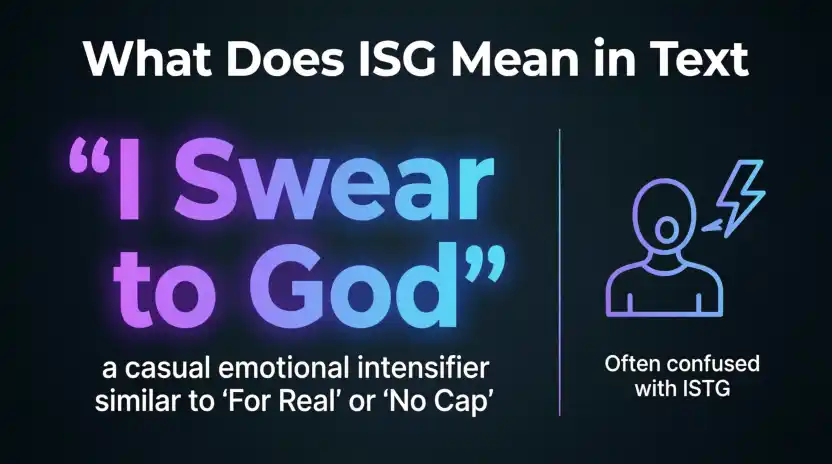
If someone texts you “ISG I’m telling the truth,” they are usually stressing that they are being honest. In casual online English, ISG commonly means “I Swear to God.” It works like an emphasis phrase that makes a statement sound stronger or more serious.
You may see ISG in text messages, group chats, DMs, comments, and other casual online conversations. It can show honesty, frustration, excitement, surprise, or strong feelings. For example, “ISG that was hilarious” means the person strongly agrees with or emphasizes what they just said.
There is one important detail: ISG is not as standardized as ISTG, which is the more widely recognized abbreviation for “I Swear to God.” Some people may also use ISG differently depending on their language or community.
This guide explains what ISG means, how people use it, how it differs from ISTG, and when you should avoid it.
Quick Answer: ISG Meaning in Text
| Question | Answer |
| Meaning | I Swear to God |
| Tone | Strong, serious, emotional, or playful |
| Used by | People in casual online conversations |
| Common places | Texts, DMs, group chats, comments |
| Formal? | No |
| Offensive? | Usually not, but it uses religious wording |
| Similar term | ISTG |
| Main purpose | Adds emphasis or sincerity |
The most useful clue is what comes after ISG. If someone writes “ISG I didn’t do it,” they are stressing that they are telling the truth. If they write “ISG that movie was amazing,” they are using it for strong emphasis rather than making a literal oath.
What Does ISG Mean in Text?
In casual English texting, ISG usually means “I Swear to God.”
It is used to make a statement sound stronger. Depending on the conversation, it can mean something like:
- “I promise.”
- “Believe me.”
- “I’m serious.”
- “I’m telling the truth.”
- “I really mean this.”
For example:
“ISG I left my phone at home.”
The sender is strongly saying that they really did leave their phone at home.
Another example is:
“ISG that was so funny.”
Here, ISG adds emotion to the opinion. The sender is not necessarily making a serious oath. They are simply emphasizing how funny they thought something was.
What Does ISG Stand For?
When used as texting slang, ISG stands for:
I Swear to God
The phrase is shortened into three letters. It is an informal form of digital communication.
You can think of ISG as an emphasis marker. It tells you that the sender wants extra weight placed on the statement.
How Is ISG Used in Text Messages?
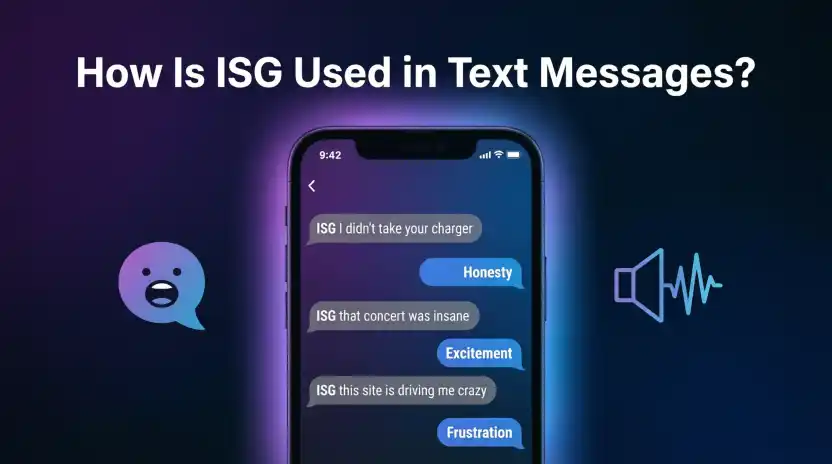
ISG can appear at the beginning or, less often, within a casual message.
At the Beginning
“ISG I didn’t know about the plan.”
This stresses the speaker’s honesty.
Before a Strong Opinion
“ISG this is the best song.”
The sender is showing strong feeling about the song.
During Frustration
“ISG why does this keep happening?”
Here, ISG makes the frustration stronger.
As a Reaction
“ISG 😭 that was wild.”
The emoji can make the message feel more playful or dramatic.
The exact feeling comes from the full message. ISG by itself does not tell you if the person is angry, joking, excited, or serious.
Why Do People Use ISG?
People use short forms because they are quick and fit naturally into casual online conversations.
ISG can also make a message feel more emotional. Compare these:
“That was funny.”
and
“ISG that was funny.”
The second message has more emphasis. It can sound more excited or dramatic.
ISG can also be useful when someone wants to defend a statement:
“ISG, I never said that.”
The abbreviation tells the reader that the sender wants their claim to be taken seriously.
ISG vs. ISTG: What’s the Difference?
ISG and ISTG are easy to confuse.
| Term | Meaning | Typical use |
| ISG | I Swear to God | Informal emphasis |
| ISTG | I Swear to God | Informal emphasis |
| FR | For Real | Showing agreement or sincerity |
| ONG | On God | Strong agreement or emphasis |
The main difference between ISG and ISTG is the extra “T” in ISTG.
ISTG is the more established and recognizable internet abbreviation for “I Swear to God.” ISG is also used by some people with the same meaning, but not everyone will interpret it that way.
If you are writing for people who may not know the abbreviation, spelling out the phrase is clearer.
Where ISG Is Used
ISG is mainly found in casual digital communication. Its meaning is generally similar when used in different social spaces, so there is no need to treat every platform as a separate slang system.
| Platform or setting | How ISG may appear | Example |
| Text messages | Strong emphasis | “ISG I forgot.” |
| Group chats | Defending a claim | “ISG nobody told me.” |
| Instagram DMs | Emotional reaction | “ISG that was funny.” |
| Snapchat chats | Casual emphasis | “ISG I’m almost there.” |
| TikTok comments | Strong reaction | “ISG this is hilarious.” |
| Discord | Casual conversation | “ISG I didn’t see it.” |
| Gaming chat | Reaction or frustration | “ISG that was close.” |
Usage is not identical for every person. Some people may use ISG often, while others may never use it.
Is ISG Rude or Offensive?
ISG is usually not considered a rude word by itself.
However, it contains the phrase “I Swear to God,” which uses religious language. Some people may prefer not to use expressions involving God or swearing.
Tone also matters.
“ISG, I forgot your birthday.”
This can sound apologetic or sincere.
“ISG STOP.”
This can sound annoyed or aggressive.
So the letters themselves are not necessarily offensive. The surrounding words and situation create much of the tone.
When Should You Avoid ISG?
Avoid ISG when you are writing something formal or speaking to someone who may not understand internet abbreviations.
For example, it is usually better to avoid it in:
- School assignments
- Formal emails
- Job applications
- Business documents
- Official messages
- Professional reports
In those situations, use clear words such as “I promise,” “I am certain,” or “I am being honest.”
Is ISG Positive or Negative?
ISG can be positive, negative, neutral, or playful.
Its meaning depends on the sentence.
| Example | Likely feeling |
| “ISG that was amazing.” | Excitement |
| “ISG I didn’t do it.” | Sincerity |
| “ISG why is this happening?” | Frustration |
| “ISG 😂 that was funny.” | Humor |
| “ISG I forgot.” | Admission or emphasis |
This is why it is risky to interpret ISG from the three letters alone.
Read the full message and the messages around it.
ISG Meaning in Different Contexts
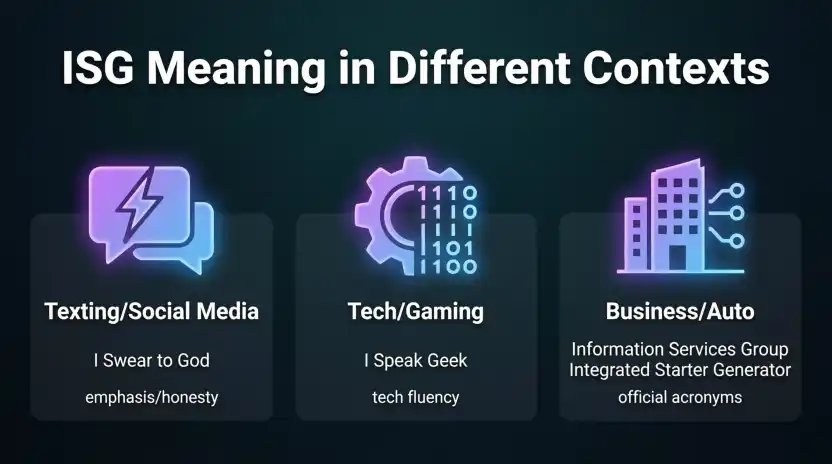
The same abbreviation can sound very different depending on what is being discussed.
ISG When Someone Is Defending Themselves
“ISG I wasn’t there.”
The person is emphasizing that their claim is true.
ISG When Someone Is Excited
“ISG this is the best news ever!”
The sender is showing strong excitement.
ISG When Someone Is Frustrated
“ISG I can’t deal with this again.”
The phrase adds emotional force.
ISG When Someone Is Joking
“ISG my cat thinks she owns the house.”
The statement may be exaggerated for humor.
The context gives ISG its emotional color.
Real-Life Examples of ISG in Text
Here are some natural examples showing how the abbreviation works.
Text Message
Maya: Did you really finish the whole project?
Noah: ISG, I finished it last night.
Here, ISG emphasizes that Noah is telling the truth.
Group Chat
Aiden: Who moved the meeting to Friday?
Priya: ISG nobody told me either.
Here, the phrase emphasizes Priya’s frustration and surprise.
TikTok Comment
“ISG this video made my whole day 😂”
The commenter is using ISG for strong, playful emphasis.
Discord Chat
Leo: Was that round really five minutes?
Zara: ISG, it felt like an hour.
Here, ISG adds exaggeration and emotion to the reaction.
School Conversation
Ethan: You forgot the homework again?
Sofia: ISG I finished it. I just left it at home.
The phrase strengthens Sofia’s explanation.
Casual Recommendation
“ISG you need to watch this movie.”
In this case, the sender strongly recommends the movie.
Common Mistakes With ISG
Mistake 1: Assuming ISG Always Has One Meaning
Not every person uses ISG in exactly the same way.
Context is important, especially when the message contains only three letters.
Mistake 2: Confusing ISG With ISTG
ISTG is the more familiar abbreviation for “I Swear to God.”
If you see ISTG, the meaning is usually easier to identify.
ISG can require more context.
Mistake 3: Treating ISG as Formal English
ISG is casual internet language. It does not belong in most formal writing.
Mistake 4: Thinking ISG Always Means Anger
It does not.
Someone can use ISG when they are happy, surprised, joking, frustrated, or simply trying to sound sincere.
Mistake 5: Reading Too Much Into It
ISG does not automatically reveal someone’s personality, feelings, or intentions.
Look at the complete conversation before deciding what the sender means.
Does ISG Have Other Meanings?
Yes. Context can change the meaning of an abbreviation.
For example, lowercase isg is also used in Dutch internet slang as a short form of “is goed,” meaning roughly “okay,” “sure,” or “all right.”
That is very different from the English texting use of “I Swear to God.”
ISG can also appear as an abbreviation for organizations, technical terms, or other phrases outside casual texting.
That is why the safest rule is simple:
If ISG appears in an English casual text, “I Swear to God” is a common interpretation, but check the surrounding words before deciding.
Is ISG Still Used?
ISG appears in current online slang and texting discussions, but it is not as universally recognized as some older abbreviations such as LOL, BRB, or the more established ISTG.
Usage can vary by person, age group, online community, and region.
If someone uses ISG with you and you are unsure what they mean, it is completely reasonable to ask:
“What do you mean by ISG?”
That is better than guessing when the context is unclear.
Is ISG an Acronym or Slang?
ISG is best described as an informal abbreviation or initialism when it means “I Swear to God.”
People may also call it texting slang or internet slang because it is used in casual digital communication.
Technically, ISG is normally read as separate letters rather than as one spoken word. In everyday conversation, though, people often use “acronym” and “abbreviation” loosely.
For a slang dictionary, texting abbreviation is a clear description.
When Should You Use ISG?
ISG works best when you are having a casual conversation with someone who understands internet shorthand.
It can fit in:
- Friendly texts
- Group chats
- Casual DMs
- Social media comments
- Informal online conversations
- Gaming chats
It is less suitable when clarity and formality matter.
If the other person may not know internet slang, writing “I swear to God” or simply “I promise” will usually be clearer.
Common Questions About ISG
1. What does ISG mean in text?
ISG commonly means “I Swear to God” in casual texting. People use it to emphasize a statement, show sincerity, or express strong emotion. The exact tone depends on the sentence. It may sound serious, excited, frustrated, surprised, or playful.
2. Is ISG the same as ISTG?
They can have the same meaning: “I Swear to God.” ISTG is the more established and recognizable texting abbreviation. ISG is a shorter form that some people use. Because ISG is less standardized, context is more important when interpreting it.
3. Is ISG rude?
ISG is not automatically rude. However, it includes the phrase “I Swear to God,” which some people may consider inappropriate in certain settings. It is best suited to casual conversations. Avoid it in formal writing or when speaking to someone who may dislike religious expressions.
4. What does ISG mean on social media?
On social media, ISG can commonly mean “I Swear to God.” It is used to add emphasis to a comment, reaction, or message. For example, “ISG this is hilarious” means the person strongly wants to emphasize how funny they found something.
5. What does ISG mean from a friend?
If a friend sends ISG in an English-language casual conversation, they may be using it to mean “I Swear to God.” It usually adds emphasis to whatever they say next. The exact feeling depends on the message, so read the complete sentence before interpreting the tone.
6. Does ISG mean “I swear”?
In many casual texts, yes. ISG can work as a shortened form of “I Swear to God,” which has a similar function to “I swear,” “I promise,” or “I’m serious.” It is mainly used to make the following statement feel stronger.
7. Can ISG have another meaning?
Yes. Abbreviations can have different meanings in different languages and communities. For example, lowercase “isg” is used in Dutch internet slang for “is goed,” meaning “okay” or “sure.” Technical and organizational uses of ISG also exist outside texting.
8. Should I use ISG in a formal email?
No. ISG is casual internet language and may not be understood by every reader. In a formal email, use clear wording such as “I promise,” “I am certain,” or “I am being honest.” Clear language is more appropriate for school, work, and official communication.
Key Takeaways
- ISG commonly means “I Swear to God” in casual English texting.
- It adds emphasis, sincerity, or strong emotion.
- ISTG is the more established abbreviation for the same phrase.
- ISG can sound serious, funny, excited, or frustrated depending on context.
- It is best for casual communication, not formal writing.
- Other meanings exist, so always consider the surrounding message.
Conclusion
So, what does ISG mean in text? In casual English online communication, ISG commonly means “I Swear to God.” People use it to add weight to a statement, show sincerity, or express a strong reaction.
The important thing to remember is that ISG does not always carry the same emotional tone. “ISG I didn’t do it” sounds defensive, while “ISG that was hilarious” sounds excited or playful. The surrounding words tell you how the abbreviation should be understood.
ISG is also less standardized than ISTG, so some readers may not recognize it immediately. In other languages and contexts, the same letters can have completely different meanings.
For everyday texting, the easiest approach is to read ISG together with the full message. If the meaning still is not clear, ask the sender rather than guessing.
Read more about!
- Dale Spanish Slang Meaning in Text
- What Is Mewing Slang Meaning in Text?
- Marple Definition Slang: Meaning in Text

Daniel Brooks is an English vocabulary educator and content editor with experience creating educational resources about English words, idioms, and everyday communication. He reviews language content for clarity, accuracy, and readability to ensure readers receive reliable and easy-to-understand information.