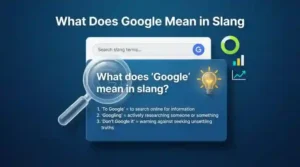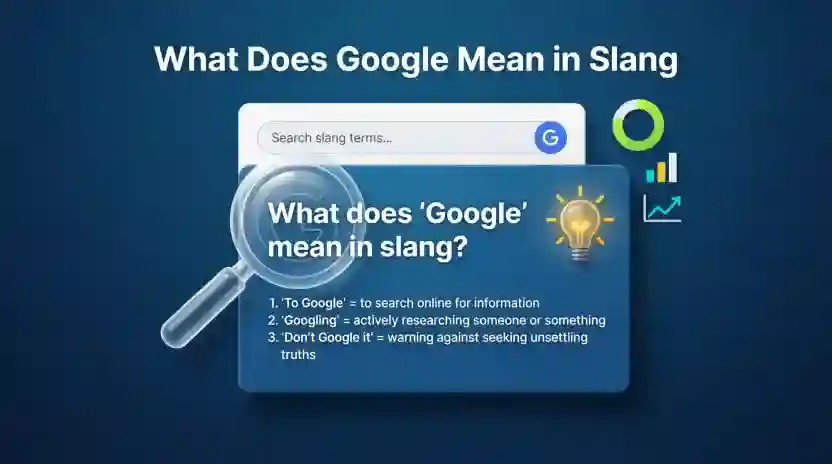
When people search for google meaning slang, they are usually trying to understand if “Google” has a special slang meaning or simply refers to the search engine. In most everyday conversations, google is an informal verb meaning to search for information online, usually with Google.
For example, if someone says, “Just google it,” they mean “Search for the answer online.” The phrase can sound casual, funny, or slightly impatient depending on the conversation.
There is also an important spelling difference to understand. Google with a capital G is the company and search engine, while google is commonly used as a verb in dictionary entries.
This guide explains the google meaning slang, its origin, how people use it in texting and conversation, British and American usage, common mistakes, and examples you can use in real life.
Google Meaning Slang – Quick Answer
The google meaning slang is simple: to google something means to search for information online, especially by using Google.
Common examples include:
- “I don’t know the answer. I’ll google it.”
- “Google the restaurant before you go.”
- “Did you google his name?”
The phrase “Google it” is also used as a casual instruction to look something up. Dictionary.com describes “google it” as an informal instruction to search for an answer using Google.
So, if you see google in a text message, comment, or casual conversation, the meaning is usually connected to searching the internet, not a hidden slang definition.
What Does Google Mean?
Google as a Noun
Google is the name of a major internet search engine. Cambridge Dictionary defines Google as the name of a search engine used to find information on the internet.
For example:
“I found the information on Google.”
Here, Google is a proper name.
Google as a Verb
The word google can also work as a verb.
To google something means to search for information about it online using Google. Oxford gives this meaning for both searching for something and searching for information about someone or something.
Examples:
“I googled the word before using it.”
“She googled the address.”
“You can google the answer.”
“Google It” in Slang and Casual Speech
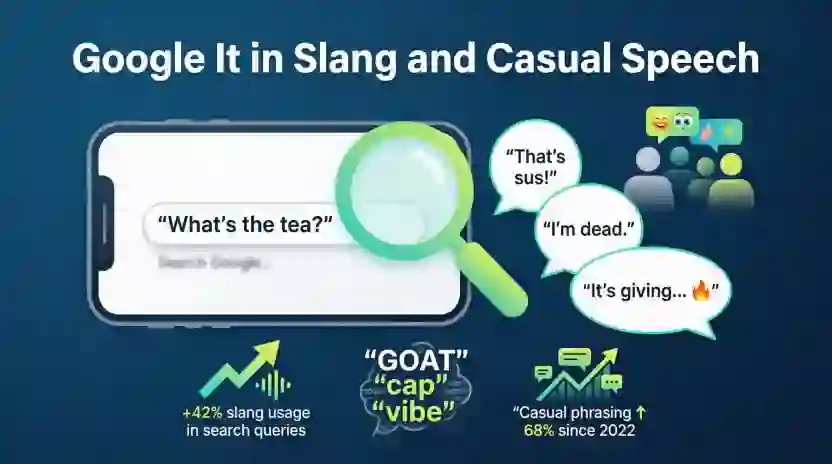
Google it is a casual phrase. Someone may say it when they believe the answer can easily be found through an online search.
For example:
Person A: “What time does the movie start?”
Person B: “Google it.”
Depending on the tone, this can be helpful, playful, or a little dismissive.
Does Google Have a Special Slang Meaning?
Usually, no.
The search phrase “google meaning slang” can make it seem as if Google has a special slang definition. In standard dictionaries, however, the informal verb simply refers to searching online.
The Origin of Google
The word Google began as a brand name rather than slang. The name is associated with googol, the mathematical term for the number 1 followed by 100 zeros.
As the search engine became widely known, its name entered everyday language.
People began using google as a verb:
“I need to google that.”
This is an example of a brand name becoming part of ordinary language as a verb.
Oxford traces the verb google to the 1990s and identifies its origin as the proprietary name of the popular search engine.
The informal verb became so established that major dictionaries now include it. Cambridge lists google as a verb meaning to search for something on the internet using Google.
Why Did “Google” Become a Verb?
The main reason is simple: people repeatedly used the brand name when talking about online searches.
Instead of saying:
“Search for that information using the Google search engine.”
People could simply say:
“Google it.”
That shorter expression became common in everyday speech.
British English vs American English
The basic meaning of google is the same in British and American English. The main differences are pronunciation, capitalization preferences, and small differences in everyday style.
| British English | American English | Example |
| Google / google | Google / google | “I’ll google it.” |
| “Google it” | “Google it” | “Google it to find out.” |
| Pronounced slightly differently | Pronounced slightly differently | Both refer to online searching |
| Informal verb | Informal verb | “She googled the address.” |
Cambridge lists the word in both UK and US English and gives the same basic verb meaning.
Is the Meaning Different in the UK?
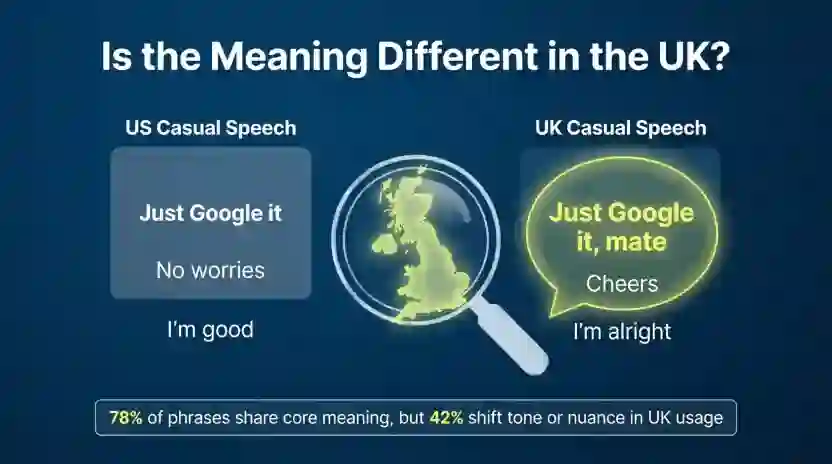
No major meaning difference exists.
A British speaker can say:
“I’ll google the train times.”
An American speaker can say:
“I’ll google the train times.”
The meaning is essentially the same.
Which Version Should You Use?
United States
In casual American English, google is widely understood as a verb.
Example:
“I’ll google the address.”
For formal writing, it may be better to use search online when you want a neutral expression.
United Kingdom
British English also uses google as an informal verb.
Example:
“I googled the restaurant before booking.”
Canada
Canadian readers generally understand both Google as the search engine and google as an informal verb.
Australia
Australian English also commonly understands the verb google in the same general sense.
International Writing
For an international audience, search online is often the clearest option because it does not depend on familiarity with the brand as a verb.
Academic Writing
Academic writing should usually favor precise wording.
Instead of:
“Google the answer.”
Use:
“Search online for the relevant information.”
If you are specifically discussing the Google search engine, writing Google as the proper name is appropriate.
Business Writing
In casual workplace messages, “Google it” may be understood.
In formal business communication, search online, look up, or search the company website can sound more neutral.
Common Mistakes
Mistake 1: Treating Google Only as Slang
Incorrect assumption:
“Google is always slang.”
Better understanding:
Google is a brand name, while google can also be an informal verb.
Memory tip:
Google = search engine.
google = search online.
Mistake 2: Using “Googled” Incorrectly
Incorrect:
“Yesterday I google the address.”
Correct:
“Yesterday I googled the address.”
The past tense of google is googled. Oxford lists “googled” as the past form.
Mistake 3: Assuming “Google It” Is Always Friendly
The words themselves are simple, but tone matters.
“You can google it if you want.”
This may sound neutral.
“Just Google it!”
This can sound impatient, depending on the situation.
Memory tip: Context and tone can change how a simple phrase feels.
Mistake 4: Confusing Google With Every Search Engine
People sometimes use google casually to mean searching online in general.
However, the strict dictionary meaning refers specifically to searching with the Google search engine.
Everyday Examples
In Emails
“I’ll google the address and send it to you.”
This is understandable in a casual email.
For a formal email:
“I’ll search online for the address and send it to you.”
In Business Writing
Casual:
“I googled the company before the meeting.”
More formal:
“I searched online for information about the company before the meeting.”
In News Headlines
News writing may use Google when referring specifically to the company or its products.
For general searching, writers may choose terms such as:
“Online searches increased…”
The exact wording depends on what the article is describing.
In Blogs
“Before buying the product, I googled its reviews.”
This sounds natural in a personal or conversational blog.
On Social Media
People may write:
“Just google it 😂”
or:
“I had to google what that word meant.”
These examples show the casual nature of the verb.
In Academic Writing
Informal:
“Google the topic.”
Formal:
“Search academic databases and reliable online sources for information about the topic.”
In Daily Conversation
“What does that word mean?”
“I’m not sure. Let me google it.”
This is one of the most natural everyday uses.
Google Trends & Modern Usage
The exact search volume for “google meaning slang” can change over time, and a single general source does not provide a reliable universal statistic for how often the exact phrase is searched.
The search itself likely comes from a common type of language question: people see Google, google it, googled, or Googling and want to know if the word has a special slang meaning.
Modern dictionary entries show that google has moved beyond being only a company name. It is now recognized as a verb for searching online.
People may also search related phrases such as:
- google meaning in slang
- what does google mean in text
- what does google it mean
- google meaning in chat
- is google a slang word
- what does googled mean
- what does googling mean
- google slang definition
The important point is that these searches generally lead back to the same core idea: searching for information online.
Quick Comparison Table
| Version | Meaning | Correct? | Region | Example |
| The search engine/company | Yes | International | “I found it on Google.” | |
| To search online using Google | Yes | International | “I’ll google it.” | |
| Googled | Searched using Google | Yes | International | “I googled the word.” |
| Googling | Searching using Google | Yes | International | “I’m googling the address.” |
| Google it | Search for it online | Yes | International | “Just Google it.” |
| Search online | Look for information online | Yes | International | “Search online for the answer.” |
Key Takeaways
- Google is the name of a major search engine.
- google is also used as an informal verb.
- To google something means to search for information online using Google.
- “Google it” is a casual instruction to look something up.
- The basic meaning is similar in British and American English.
- The word can be written as Google when referring to the brand.
- google is commonly written lowercase when used as a verb.
- Formal writing may prefer search online or look up.
- “Google meaning slang” does not usually describe a separate secret slang definition.
FAQs
What does Google mean in slang?
In casual language, google usually means to search for information online using Google. For example, “I’ll google it” means “I’ll search for it online.” It is better described as an informal verb than as a separate slang code. Major dictionaries recognize this verb usage.
What does “Google it” mean?
“Google it” means “search for the answer online using Google.” People often use the phrase when someone asks a question that can be answered through an internet search. Depending on tone, it can sound helpful, humorous, or impatient.
Is Google a slang word?
Google itself is primarily a brand name, not slang. However, google is also used informally as a verb meaning to search online. Because this verb is common in everyday speech, some people may describe it as slang, but “informal verb” is more precise.
What does “I’ll Google it” mean?
“I’ll Google it” means “I’ll search online for the information.” The speaker is saying they do not know the answer immediately but will look it up. In this sentence, Google is functioning as a verb in informal English.
What does “googled” mean?
Googled is the past tense of google. It means someone searched for information using Google. For example, “I googled the restaurant” means “I searched online for information about the restaurant.” Oxford lists googled as the past form of the verb.
Is “google” a verb?
Yes. Major English dictionaries list google as a verb. It means to search for information on the internet using the Google search engine. The verb can appear as google, googles, googled, and googling.
Is “Google it” rude?
Not automatically. The phrase can be completely casual, but tone matters. Saying “I’ll Google it” is neutral. Saying “Just Google it!” can sound impatient if someone uses it to dismiss another person’s question.
Should Google be capitalized?
When referring to the company or search engine, Google is capitalized. When using google as an informal verb, many dictionaries use lowercase. Dictionary.com, for example, lists the verb in lowercase while identifying Google as the trademarked search engine.
What is another word for Google it?
Depending on context, alternatives include search online, look it up, search for it, or check online. These alternatives can be useful in formal writing because they describe the action without using a brand name as a verb.
Does Google mean something different in British English?
The basic meaning is not significantly different. British and American English both use google as an informal verb for searching online. Pronunciation can differ slightly, but the meaning and common verb forms remain essentially the same.
Conclusion
The google meaning slang is much simpler than it may first appear. In most casual conversations, google means to search for information online using Google. The expression “Google it” is an informal way to tell someone to look something up.
The key distinction is between the brand and the verb. Google refers to the search engine or company, while google is commonly used as an informal verb. Dictionaries such as Oxford, Cambridge, and Collins recognize this verb usage.
The same basic meaning works across British and American English, although pronunciation and writing style can vary. For academic and formal business writing, phrases such as search online or look up may be clearer.
So, when someone says, “I’ll google it,” they usually mean one simple thing: they are going online to find the answer.
If you come across another confusing internet word or slang phrase, checking its context is often the fastest way to understand what the speaker really means.
Read more about!
- Big Meaning Slang: What Does “Big” Mean?
- Cho Meaning Slang: What Does “Cho” Mean?
- Cow Slang Meaning: What Does “Cow” Mean in Slang?

Hi, I’m Ryan Mitchell. I write simple guides about slang, internet language, and everyday English to make modern expressions easy to understand. My goal is to help learners use real-life English with confidence.