Slang words in the 90s were informal words and phrases people used in everyday conversations, music, movies, and school life during the 1990s. Expressions like phat, fly, da bomb, and as if! helped people express excitement, confidence, humor, and attitude.
Today, people search for 90s slang to understand old movies, explore retro culture, and bring classic expressions into modern conversations. These phrases also appear in TikTok videos, Instagram Reels, Snapchat posts, and online discussions about the 1990s.
The 1990s had a unique mix of hip-hop expressions, teen catchphrases, regional slang, and words passed down from earlier generations. Some phrases became famous through television and movies, while others were more common in particular communities.
In this guide, you’ll discover popular slang words from the 90s, what they mean, how people used them, and which expressions are still recognizable today.
Slang Words in the 90s: Meaning and Definition
Slang words in the 90s were casual expressions used by teenagers, adults, musicians, and different social groups during the 1990s. People used them to describe things, express feelings, joke with friends, and show excitement.
Unlike formal English, slang often depends on context. A word may sound friendly in one conversation but rude or sarcastic in another.
For example, someone might say, “Those shoes are fly!” to compliment a friend’s style. Another person might say, “As if!” to reject an idea with sarcasm.
Not every phrase associated with the decade was invented during the 1990s. Many expressions existed earlier but became more recognizable through music, movies, television, and youth culture.
Why Was 90s Slang So Popular?
The 1990s were an important period for music and entertainment. Hip-hop influenced popular culture, teen movies attracted large audiences, and television shows introduced catchphrases that people repeated in daily life.
Slang spread through several channels:
- Friends and school conversations.
- Rap music and radio stations.
- Teen magazines and popular movies.
- Television shows and celebrity interviews.
- Local communities and regional speech.
Different communities used different expressions. American slang, British slang, and slang from other English-speaking countries did not always overlap.
Popular Slang Words from the 90s and Their Meanings
Here are some recognizable expressions associated with 1990s culture. Their meanings and popularity varied by region and social group.
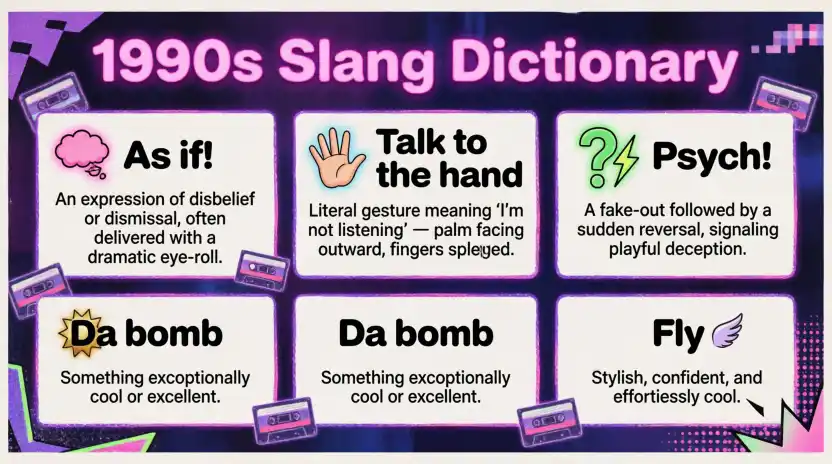
| Slang word or phrase | Meaning | Example |
| Phat | Excellent, cool, or impressive | “Those sneakers are phat!” |
| As if! | No way or I don’t believe you | “You think I’ll do that? As if!” |
| All that | Impressive, attractive, or important | “She thinks she’s all that.” |
| Talk to the hand | I don’t want to listen | “Talk to the hand!” |
| Da bomb | Really great or exciting | “That party was da bomb!” |
| Fly | Stylish or attractive | “Your jacket looks fly.” |
| Cool beans | Great or that’s good | “You got tickets? Cool beans!” |
| My bad | My mistake | “My bad, I sent the wrong message.” |
| Wack | Bad, disappointing, or uncool | “That excuse is wack.” |
| Booyah! | An expression of excitement or victory | “We won! Booyah!” |
| Home skillet | A playful way to address a friend | “What’s up, home skillet?” |
| Duh | That’s obvious | “Duh, I already knew.” |
| No duh | Obviously | “No duh, it was right there.” |
| Chill out | Relax or calm down | “Chill out; everything is fine.” |
| Psych! | Just kidding or I tricked you | “You owe me lunch. Psych!” |
| Tight | Cool, excellent, or impressive | “Those shoes are tight.” |
| Fresh | Stylish or new-looking | “That’s a fresh outfit.” |
| Word | I agree or understood | “Let’s leave early.” “Word.” |
| Buggin’ | Acting strangely or overreacting | “You’re buggin’ right now.” |
| Whatever | It doesn’t matter or I don’t care | “Whatever, let’s move on.” |
These phrases did not all originate in the 1990s. Some were already established expressions, while others became more recognizable through the decade’s music and entertainment.
1. Phat
Meaning: Excellent, cool, or impressive.
People used phat to compliment music, clothes, shoes, and other things they liked. The term became associated with some hip-hop and youth-culture settings.
Example: “That song is phat!”
The word was an informal way to show approval. Its use was not universal, and it may sound deliberately retro in modern conversations.
2. As If!
Meaning: No way, I don’t believe you, or that is not going to happen.
The phrase became strongly associated with the 1995 teen movie Clueless. It was used to reject suggestions or express disbelief in a sarcastic way.
Example: “You think I’m going to do your homework? As if!”
Today, people may use it when joking with friends or referring to 1990s pop culture.
3. All That
Meaning: Impressive, attractive, or very good.
The phrase can be positive, but it can also describe someone who acts as if they are better than everyone else.
Example: “He thinks he’s all that.”
The tone determines if the phrase sounds like praise or criticism.
4. Talk to the Hand
Meaning: I don’t want to listen to you.
This expression was a dismissive way to end an argument or show that someone was not interested in hearing more.
Example: “I’m done arguing. Talk to the hand!”
It was often used humorously, sometimes with a hand raised toward the other person. However, it can sound disrespectful in a serious conversation.
5. Da Bomb
Meaning: Really good, exciting, or impressive.
People used this expression to praise parties, songs, food, and experiences.
Example: “That concert was da bomb!”
The phrase is associated with informal speech and popular culture from the period. Its exact popularity varied between communities.
6. Fly
Meaning: Stylish, fashionable, or attractive.
The word has roots that predate the 1990s and became recognizable in hip-hop and fashion culture.
Example: “Those shoes look fly!”
It could describe someone’s outfit, hairstyle, or overall appearance.
7. Cool Beans
Meaning: Great, fine, or that’s good.
This playful expression communicates agreement or approval.
Example: “We’re meeting at six?” “Cool beans!”
It sounds friendly and informal. People may still use it today, sometimes for a nostalgic or humorous effect.
8. My Bad
Meaning: My mistake or I’m responsible for that.
People use this phrase to acknowledge a small mistake without making a formal apology.
Example: “I forgot to bring your notebook. My bad!”
The expression remains familiar in modern English and is useful in casual conversations.
9. Wack
Meaning: Bad, disappointing, or uncool.
People used wack to criticize something they disliked.
Example: “That movie ending was wack.”
Although it can be used playfully among friends, it may sound insulting if directed at someone personally.
10. Booyah!
Meaning: An expression of excitement, victory, or satisfaction.
People said booyah! after winning a game, completing a challenge, or achieving something exciting.
Example: “I passed the test. Booyah!”
The expression has appeared in sports and entertainment contexts and remains recognizable to many English speakers.
Where Were Slang Words in the 90s Used?
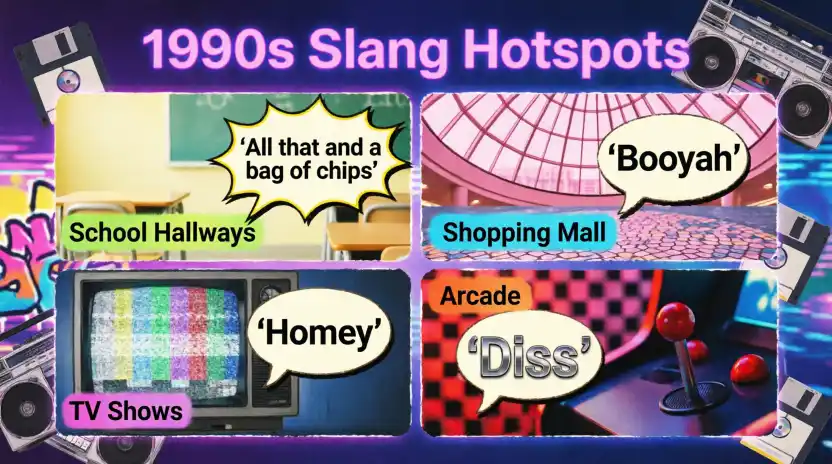
People used these expressions in many everyday situations. Their use depended on location, age, interests, and social group.
At School and With Friends
Teenagers often used slang to joke, compliment one another, and talk about music or fashion.
Examples included:
- “Your new shoes are fresh.”
- “That test was wack.”
- “Cool beans, I’ll see you later.”
- “My bad, I forgot your book.”
These expressions helped make conversations feel casual. Some also became a way for friends to share jokes or show that they followed the same trends.
In Music and Hip-Hop Culture
Hip-hop played an important role in spreading many expressions during the 1990s. Music, radio, performances, and fashion helped particular words reach audiences beyond their original communities.
Terms such as fly and phat became recognizable to many listeners. However, it is important to distinguish between a phrase’s origin and its wider popularization.
Some expressions originated in Black American speech communities before becoming more widely used through mainstream entertainment. Their histories should not be reduced to a single artist or song without evidence.
In Movies and Television
Movies and television shows helped make certain phrases memorable. Characters often used catchy expressions that viewers repeated in real conversations.
The 1995 film Clueless, for example, is closely associated with “As if!” and other stylized teen dialogue.
Entertainment did not always reflect how everyone spoke in real life. Writers sometimes exaggerated slang to make characters sound funny, confident, or distinctive.
In Text Messages and Online Chats
Texting developed during the 1990s, but it was not as convenient or widespread as modern messaging. Mobile phones, character limits, and numeric keypads encouraged people to keep messages short.
Abbreviations such as IDK and BRB became useful in digital conversations. However, these are different from spoken expressions such as fly or cool beans.
On TikTok, Snapchat, and Instagram Today
Modern social platforms have helped people rediscover older expressions. Creators use them in retro fashion posts, nostalgic videos, comedy clips, and discussions about old movies.
For example, a TikTok creator might use “As if!” in a sarcastic video. Someone on Instagram might describe a vintage outfit as “fly.”
These are modern uses of older slang. TikTok, Snapchat, and Instagram did not exist during the 1990s, so they did not play a role in the original spread of these expressions.
10 Real Chat Examples Using 90s Slang
The following conversations show how these expressions can fit into casual dialogue today.
Example 1: Complimenting an Outfit
A: Check out my new jacket.
B: That looks fly!
A: Thanks! I just got it yesterday.
Example 2: Rejecting an Idea
A: You should sing in front of the whole school.
B: As if!
A: Come on, you have a great voice.
Example 3: Talking About a Party
A: How was the party last night?
B: It was da bomb!
A: I knew I should’ve gone.
Example 4: Making a Mistake
A: You sent me the wrong picture.
B: My bad. I’ll send the right one.
A: No worries.
Example 5: Reacting to Good News
A: I passed my driving test!
B: Booyah! That’s awesome.
A: I’m so happy right now.
Example 6: Teasing a Friend
A: I’m the best player on this team.
B: You think you’re all that?
A: Just wait until the next game.
Example 7: Greeting a Friend
A: What’s up, home skillet?
B: Nothing much. Just listening to music.
A: Want to hang out later?
Example 8: Disagreeing With a Friend
A: That movie was amazing.
B: Nah, the ending was wack.
A: Really? I liked it.
Example 9: Confirming a Plan
A: We’re meeting at five, right?
B: Word. I’ll be there.
A: Cool, see you then.
Example 10: Ending a Playful Argument
A: You always take the last slice of pizza.
B: Whatever!
A: Fine, I’ll order another one.
These are illustrative conversations, not historical transcripts. They show how the phrases might work in casual dialogue rather than suggesting that every teenager used them in the same way.
How to Reply When Someone Uses 90s Slang
Your response depends on the phrase and the conversation. You do not have to copy the slang to reply naturally.
Funny Replies
If a friend uses an exaggerated or nostalgic phrase, you can respond with humor.
- “Are we time-traveling to 1995?”
- “Okay, retro legend!”
- “That phrase just unlocked a memory.”
- “You’re bringing back the whole decade!”
Casual Replies
Use a simple response when someone compliments you or shares good news.
- “Thanks!”
- “That’s awesome.”
- “For real?”
- “Sounds good to me.”
Friendly Replies
If someone says something positive, match their energy.
- “You too!”
- “Glad you liked it.”
- “Let’s go!”
- “That’s what I’m talking about!”
Neutral Replies
If you do not understand the expression, ask what it means.
- “What does that mean?”
- “Is that a 90s expression?”
- “I’ve heard that before, but what does it mean here?”
- “Are you joking, or do you mean it?”
Tip: Context matters more than the phrase itself. An enthusiastic “Booyah!” usually shows excitement, while a sarcastic “Whatever” can sound dismissive.
Is 90s Slang Rude or Offensive?
Most familiar expressions from 1990s culture are not inherently offensive. Words such as cool beans, fly, and booyah are generally harmless when used appropriately.
However, some phrases can sound dismissive, insulting, or disrespectful depending on how they are used.
| Expression | Possible tone | Appropriate use |
| Cool beans | Cheerful | Casual conversations |
| Fly | Complimentary | Friends and informal settings |
| As if! | Sarcastic | Jokes or informal disagreement |
| Talk to the hand | Dismissive | Playful situations, with care |
| Whatever | Annoyed or indifferent | Informal conversations |
| Wack | Critical or insulting | Casual opinions |
| My bad | Apologetic | Everyday mistakes |
Is 90s Slang Safe to Use at School?
Most of these expressions are fine in friendly conversations when they are not used to mock or embarrass someone.
However, teachers may expect more formal language in essays, assignments, and presentations. When discussing slang for schoolwork, explain its meaning and historical context rather than using it throughout formal writing.
Is It Appropriate at Work?
In a relaxed workplace, expressions such as “my bad” or “what’s up?” may sound natural. Other phrases may seem too casual for a professional email or meeting.
Choose language that fits the audience. If a phrase sounds sarcastic or confusing, a straightforward alternative is usually better.
Can Old Slang Be Offensive Today?
Some older expressions reflect stereotypes or outdated attitudes. Before repeating an unfamiliar phrase, check its meaning and cultural background.
A phrase that sounds harmless in a movie might feel different when directed at a real person. Avoid using slang to insult someone’s identity, background, appearance, or community.
Who Used Slang in the 90s?
People of different ages used slang during the 1990s, but teenagers and young adults were particularly associated with many youth-culture expressions.
Teenagers and Young Adults
Friends used slang to joke, compliment one another, discuss music, and express disagreement. Some expressions became closely associated with teen films and school settings.
Hip-Hop and Music Fans
Music fans encountered expressions through lyrics, interviews, radio, and performances. Some terms spread beyond their original communities as hip-hop reached wider audiences.
Movie and Television Fans
Popular entertainment helped spread catchphrases. Viewers sometimes copied a character’s speech because it sounded funny or memorable.
Do Gen Z and Gen Alpha Use 90s Slang?
Some younger people use these expressions today, particularly when making jokes, creating retro content, or exploring older pop culture. Others recognize the phrases without using them regularly.
Gen Z and Gen Alpha do not share one uniform way of speaking. Slang varies according to region, interests, online communities, and personal preference.
Are These Expressions Still Popular?
Some remain familiar in everyday English, including my bad, chill out, and what’s up? Others, such as home skillet and talk to the hand, may sound deliberately retro or humorous today.
There is no single reliable ranking that establishes how frequently every 90s expression is used in 2026. Familiarity and current usage differ across countries and communities.
Origin of 90s Slang Words
There is no single origin for all slang from the 1990s. The vocabulary developed through many sources, including earlier American English, regional speech, music, youth communities, television, and movies.
Influence of Earlier Generations
Many expressions associated with the decade existed before it began. Words and phrases can remain in use for years before becoming strongly associated with a particular period.
For example, whatever and chill out were not exclusive inventions of the 1990s. Their association with the decade comes partly from how people used them in entertainment and everyday conversations.
The Role of Hip-Hop
Hip-hop helped popularize numerous expressions and styles of speech. Artists, DJs, radio hosts, and fans influenced how language spread through music and youth culture.
It is important to distinguish between the origin of a phrase and its popularization. A term may originate in a particular community and later become widely recognized through mainstream entertainment.
Movies, Television, and Pop Culture
Films and television gave certain phrases a lasting cultural identity. Catchphrases were easy to remember and repeat, making them recognizable even to people who did not normally use the expressions.
Clueless is a well-known example of a movie that helped preserve the association between particular expressions and 1990s teen culture.
The Growth of Digital Communication
Email, online chat rooms, early internet communities, and SMS offered new ways to communicate. Abbreviations became useful when people wanted to type short messages or had limited space.
However, modern internet slang should not be confused with all slang from the 1990s. Many current abbreviations became popular later, and some older terms have changed meaning over time.
For individual expressions, the exact origin may be uncertain or disputed. It is better to acknowledge that uncertainty than to assign a definite inventor or date without reliable evidence.
90s Slang Compared With Modern Text Abbreviations
Not all slang is an abbreviation. Some expressions are ordinary words used informally, while others are shortened forms commonly found in messages.
The following table compares familiar 90s expressions with texting abbreviations.
| Term | Meaning | Type | Usage | Popularity |
| 90s slang | Informal expressions associated with the decade | Broad category | Conversation and pop culture | Varies by expression |
| IDK | I don’t know | Abbreviation | Texting and online chats | Widely recognized |
| IDC | I don’t care | Abbreviation | Casual messaging | Widely recognized |
| IMO | In my opinion | Abbreviation | Discussions and messages | Widely recognized |
| BRB | Be right back | Abbreviation | Chats and gaming | Widely recognized |
These terms are not all from the same period. IDK, IDC, IMO, and BRB are digital abbreviations rather than specific examples of spoken 90s slang. They are included to explain the difference between a slang expression and a texting abbreviation.
Real-World Example of 90s Slang
Imagine two friends watching a classic 1990s teen movie together.
One friend hears a character say “As if!” and asks what the phrase means. The other explains that it is a sarcastic way to reject an idea or show disbelief.
Later, one friend sees a stylish retro jacket and says, “That looks fly!” They are using an expression associated with older youth and music culture to compliment a modern outfit.
This situation shows how older slang can remain useful today. People may use it naturally, recognize it from movies, or repeat it for a nostalgic effect.
The key is understanding the meaning and tone rather than assuming every expression has exactly the same meaning in every situation.
Frequently Asked Questions
1. What do slang words in the 90s mean in text messages?
They are informal words and expressions associated with 1990s speech and culture. Some, such as my bad and whatever, still appear in modern texts, while others are used mainly for nostalgia or humor.
2. What does 90s slang mean on TikTok?
On TikTok, 90s slang usually refers to expressions from 1990s youth culture, movies, music, and everyday conversation. Creators may use these phrases in throwback videos, retro fashion posts, and comedy clips.
3. Is 90s slang still used today?
Yes. Some expressions remain familiar in everyday English, while others are less common. People also reuse older phrases when discussing retro culture or making nostalgic content.
4. Is 90s slang rude or offensive?
Most well-known expressions are harmless, but tone and context matter. Phrases such as talk to the hand and whatever can sound dismissive, while other expressions may have cultural meanings that deserve careful consideration.
5. How should you reply to 90s slang?
Reply according to the meaning and tone. You can say “That’s cool,” “For real?” or “What does that mean?” if you’re unsure. You do not need to use slang yourself to keep the conversation friendly.
Conclusion
Slang words in the 90s reflect the music, movies, friendships, and everyday conversations of that decade. Expressions such as phat, fly, da bomb, as if!, and cool beans help capture the informal language associated with 1990s culture.
Some phrases remain familiar today, while others are mainly used for humor or nostalgia. Their meanings can also change depending on the speaker and situation.
If you’re watching an old movie, creating a TikTok video, or learning about the 1990s, understanding these expressions helps you recognize the culture behind the words. Use them naturally, pay attention to context, and remember that not every phrase was used by everyone during the decade.
Read more about!
- Bitchin Slang: Meaning, Origin, Examples & How to Use It
- BTK Meaning Slang: Is It Common in Text Messages?
- Grape Slang Meaning: What Does Grape Mean in Slang?
- Birdie Slang Meaning: Everything You Need to Know
Hi, I’m Ryan Mitchell. I write simple guides about slang, internet language, and everyday English to make modern expressions easy to understand. My goal is to help learners use real-life English with confidence.