Charlie is a slang term commonly used for cocaine, an illegal stimulant drug. People may use this word in text messages, social media posts, music, and conversations to refer to the substance without naming it directly. However, the meaning can depend on the context.
You might see this term in a TikTok comment, an Instagram caption, a Snapchat message, or the lyrics of a song. Some people search for it because they have encountered the word online and want to understand what it means.
Unlike common texting abbreviations such as IDK or BRB, Charlie is not a standard internet acronym. It is a drug-related slang term, and its use may indicate that someone is discussing drugs rather than an ordinary topic.
Understanding the context matters. The word can have completely unrelated meanings when used as a person’s name or in everyday conversation. The surrounding words usually help you work out what the speaker means.
Charlie Drug Slang Meaning in Text
What Does Charlie Mean?
In drug-related slang, Charlie commonly refers to cocaine, a powerful stimulant that affects the brain and nervous system. Cocaine is an illegal drug in many places and carries serious health risks.
People may use the word in private conversations, song lyrics, online discussions, or news stories. It can be used as an indirect reference when someone does not want to say the drug’s name.
For example, if someone writes, “The song mentions Charlie,” they may be referring to a drug reference in the lyrics. You would need to read or hear the surrounding content to understand the exact meaning.
Is Charlie an Acronym or an Abbreviation?
No. In this context, Charlie is a slang word, not an acronym like LOL (laughing out loud) or an abbreviation like BRB (be right back).
It is also a common personal name. Therefore, seeing the word alone does not prove that someone is talking about drugs.
Here is a simple comparison:
- Drug slang: A reference to cocaine in a drug-related conversation.
- A person’s name: Someone named Charlie.
- An ordinary reference: A character, a pet, or a person mentioned in a story.
- A cultural reference: A word appearing in a song, film, or online discussion.
Always consider the complete message before deciding which meaning applies.
Why Do People Use This Word?
People sometimes use slang instead of a drug’s formal name because slang is familiar within certain social groups or cultural settings. It may also appear in music, films, and online conversations.
However, not everyone who uses the word is discussing personal drug use. Someone could be quoting a song, explaining a news story, or asking what a phrase means.
The safest approach is to avoid making assumptions about another person’s behavior based on one word.
Where People Use Charlie Drug Slang
The word may appear across different online platforms, but its presence does not mean that it is a widely used or trending term on every platform. Its meaning depends on the conversation.
Charlie on TikTok
On TikTok, people may encounter the term in song clips, comments, video captions, or discussions about drug-related language.
For example, a viewer might ask what a lyric means after hearing the word in a song. Another person might explain that it refers to cocaine in that context.
A short video or comment may not provide enough information to establish the intended meaning. If the post is about a person named Charlie, the word may have no connection to drugs at all.
Charlie on Snapchat
On Snapchat, the term might appear in a private message or a conversation about music, parties, or drug-related topics.
Because messages can be brief, the meaning may not be obvious. A sentence that includes the word could be referring to a person rather than a substance.
If a message makes you uncomfortable or seems to involve pressure to take drugs, you do not have to participate in the conversation. You can ask what the sender means or choose not to respond.
Charlie on Instagram
Instagram users may come across this term in captions, comments, music-related posts, or discussions about drug awareness.
For example, someone reviewing a song might explain that a particular lyric contains a reference to cocaine. In that case, the term is being discussed rather than necessarily used to describe someone’s actions.
Do not assume that a person uses drugs just because they mention a drug-related word in a post.
Charlie on WhatsApp
WhatsApp conversations can include personal messages, group chats, jokes, and discussions about music or current events.
If someone uses Charlie in a drug-related conversation, the term may refer to cocaine. However, a message that says, “Charlie is coming over,” would usually require no drug-related interpretation unless the surrounding conversation suggests otherwise.
Context is especially important in short messages because they often leave out details.
Charlie in SMS Text Messages
Traditional SMS messages can contain the same slang found in other messaging apps.
Someone might mention the term while discussing a film, asking about a song lyric, or talking about a drug-related situation. There is no special SMS meaning that makes the word different from its meaning elsewhere.
If you are unsure what a sender means, asking a straightforward question is usually more reliable than guessing.
10 Real Chat Examples of Charlie Drug Slang
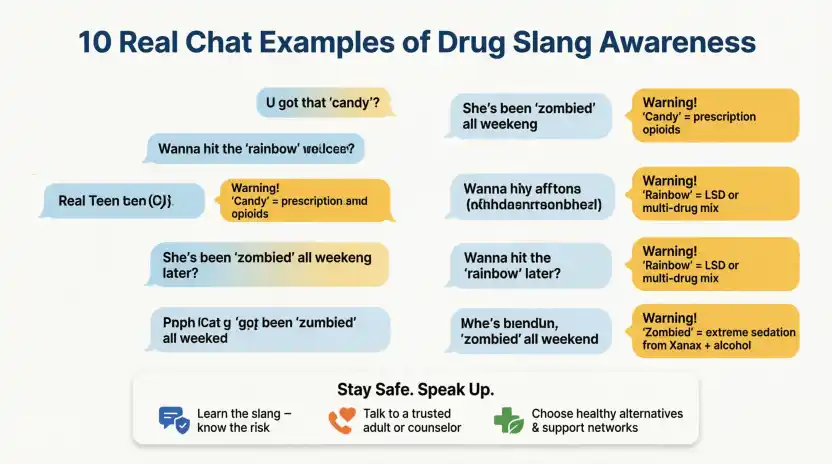
The following fictional conversations show how the word might appear in discussions about music, slang, news, and safety. They are intended to explain the language, not to encourage drug use.
Example 1: Understanding a Song Lyric
A: I heard the word Charlie in that song.
B: It can be slang for cocaine.
A: Oh, that explains the lyric.
Meaning: The speakers are discussing the meaning of a song, not necessarily describing real-life drug use.
Example 2: Asking About a Comment
A: Someone mentioned Charlie in the comments.
B: What was the post about?
A: A song with drug references.
Meaning: The topic of the post helps explain why the slang appeared.
Example 3: Learning New Slang
A: What does Charlie mean here?
B: In a drug-related context, it can mean cocaine.
A: Thanks, I didn’t know that.
Meaning: One person asks for a definition, and the other provides a neutral explanation.
Example 4: Discussing a Movie
A: That movie had a lot of drug references.
B: Yes, they even used the word Charlie.
A: I missed that part.
Meaning: The word appears as part of a fictional story.
Example 5: Talking About a News Report
A: The report mentioned Charlie as a slang term.
B: Was it talking about cocaine?
A: Yes, that was the context.
Meaning: The speakers are discussing terminology used in a report.
Example 6: Clarifying an Ambiguous Message
A: Someone texted me about Charlie.
B: Do you mean a person named Charlie or the slang?
A: I’m not sure yet.
Meaning: The conversation shows why context is necessary before assigning a meaning.
Example 7: Discussing Drug Awareness
A: Our class discussed drug-related slang today.
B: Did Charlie come up?
A: Yes, as a word associated with cocaine.
Meaning: The term is used in an educational discussion.
Example 8: Asking About Social Media
A: I saw Charlie in an online discussion.
B: Was it about drugs?
A: Yes, people were explaining the terminology.
Meaning: The surrounding topic makes the intended meaning clearer.
Example 9: Responding to Pressure
A: Someone is pressuring me to try a drug.
B: You don’t have to agree to anything that makes you uncomfortable.
A: I’m going to leave the situation.
Meaning: This conversation illustrates a safe response to drug-related pressure without giving instructions about drug use.
Example 10: Checking a Friend’s Meaning
A: You mentioned Charlie earlier. What did you mean?
B: I was explaining a word from a song.
A: Got it. I thought you meant a person.
Meaning: A simple clarification prevents a misunderstanding.
How to Reply When Someone Says Charlie
Your reply should depend on what the other person is discussing. You do not need to use drug slang yourself to understand or respond to it.
Funny Replies
If the conversation is clearly about a lyric or the meaning of slang, a light response can keep things casual without making drug use seem appealing.
- “That word has a meaning I didn’t know!”
- “This song needs a vocabulary guide.”
- “I definitely missed that reference.”
Keep jokes focused on the language or music rather than encouraging risky behavior.
Casual Replies
If someone mentions the term during an ordinary conversation, you can respond naturally.
- “Oh, I see what you mean.”
- “I didn’t know that was slang.”
- “Where did you hear that term?”
These responses work when you want to understand the conversation without making assumptions.
Friendly Replies
If a friend is explaining the word, you can acknowledge the explanation.
- “Thanks for explaining it.”
- “That makes more sense now.”
- “I appreciate the context.”
If the discussion becomes uncomfortable, it is fine to change the subject.
Neutral Replies
When you are unsure what the sender means, neutral questions are often the best option.
- “What do you mean by Charlie?”
- “Are you talking about the song?”
- “Can you explain the context?”
If someone is pressuring you to take a drug, a clear response such as “No, I’m not interested” is appropriate. You can leave the situation and talk to a trusted adult if you feel unsafe.
Is Charlie Drug Slang Rude or Offensive?
Is the Word Offensive?
The word itself is not generally a swear word or a direct insult. However, it refers to a serious subject when used as drug slang.
Some people may find casual references to illegal drugs inappropriate, especially in settings where the subject is unrelated or unwelcome. The reaction also depends on the speaker, audience, and situation.
Mentioning a drug in an educational article or a news report is different from pressuring someone to use it.
Is It Safe to Use in Everyday Conversation?
It is better to understand the word than to use it without knowing what it means. Drug slang can create confusion, particularly when people assume that everyone understands the same terms.
The word can also mean a person’s name, so using it carelessly may lead to misunderstandings.
If you are discussing drugs for educational purposes, clear language is often better than slang.
Is It Appropriate at School?
In a school setting, the term may be appropriate when discussing language, health education, literature, or drug awareness in a suitable context.
Using it to pressure classmates, promote drug use, or disrupt a lesson is different. Follow school rules and consider the audience before discussing sensitive topics.
Is It Appropriate at Work?
In most professional settings, there is little reason to use drug slang unless it is relevant to the discussion.
If you are writing a report, teaching a class, or discussing a news story, using the word cocaine directly may be clearer and more professional.
Practical tip: Understanding a slang term does not mean you need to repeat it. Choose words that fit the situation and the people you are speaking with.
Who Uses Charlie Drug Slang?
Age Groups and Communities
There is no reliable basis for claiming that one age group exclusively uses this term. It may appear in conversations among adults, in entertainment, and in online discussions about drug-related language.
The word’s presence in a message does not establish the sender’s age, personal habits, or intentions.
Does Gen Z Use This Term?
Members of Gen Z may encounter the term through music, films, social media, or conversations with friends. However, that does not mean it is unique to Gen Z or that most young people use it.
Drug slang can cross generations and communities. Some terms remain familiar for years, while others are more regional or tied to particular social settings.
Which Platforms Feature the Term?
The term can appear on TikTok, Snapchat, Instagram, WhatsApp, SMS, and other online spaces. It can also appear in music, television, news reports, and discussions outside social media.
Its appearance on a platform does not automatically make it a platform-specific expression.
How Common Is It Online?
Charlie is a recognized slang term for cocaine, particularly in some English-speaking contexts. However, the exact frequency of its use varies by location, community, and situation.
Without reliable platform-wide data, it would be misleading to describe it as one of the most popular or fastest-growing slang terms online.
For readers, the most useful fact is its possible meaning, not an unsupported popularity ranking.
Origin of Charlie Drug Slang
Where Did the Term Come From?
Charlie is an established informal name for cocaine in some English-speaking communities, particularly British slang. Its precise historical origin is not clearly documented in a way that supports one definitive explanation.
Drug slang often develops through spoken language and spreads through social groups, entertainment, and popular culture. Over time, a word can become familiar beyond the community where it was first used.
However, it is important to distinguish a recognized meaning from a verified explanation of how the term originated.
Did the Internet Create This Meaning?
The internet did not necessarily create this slang term. It can be encountered in older forms of popular culture and in spoken conversation, as well as in modern online content.
Social media can help existing slang reach new audiences. A person may first encounter the term in a short video or music clip without knowing that it has been used in other settings for much longer.
Is the Origin Completely Certain?
No single origin story should be presented as established fact without reliable historical evidence.
The association between Charlie and cocaine is recognized, but that does not prove exactly who first used the word, when it began, or how it spread into every community.
When explaining slang, it is more trustworthy to acknowledge these limits than to invent a date, person, or event.
Charlie vs. IDK, IDC, IMO, and BRB
Not all slang terms serve the same purpose. Charlie, when used in a drug-related context, refers to a substance. The other terms in this table are common texting abbreviations.
| Term | Meaning | Type | Usage | Popularity |
| Charlie | Cocaine in drug slang | Slang term | Drug-related conversations | Context-dependent |
| IDK | I don’t know | Abbreviation | Everyday texting | Common |
| IDC | I don’t care | Abbreviation | Casual chats | Common |
| IMO | In my opinion | Abbreviation | Sharing opinions | Common |
| BRB | Be right back | Abbreviation | Temporary pauses in chats | Common |
The main difference is that Charlie is a context-dependent slang word, while IDK, IDC, IMO, and BRB are commonly used to shorten everyday messages.
These terms are not interchangeable. Knowing which category a word belongs to can help you understand messages more accurately.
Real-World Usage Example
Imagine you are watching a film with friends, and a character uses the word Charlie during a conversation about drugs. You might not understand the reference at first.
After looking at the context, you learn that the character is referring to cocaine. Now the dialogue makes more sense, even though you have never heard the slang term before.
A similar situation could happen while reading a song review, watching a social media video, or seeing a discussion about drug-related language.
In each case, understanding the word helps you interpret the content. It does not mean that the person using it takes drugs or supports drug use.
If a real-life conversation involves someone offering you an unknown substance or pressuring you to try a drug, do not feel obligated to participate. You can decline, move away, and seek help from a trusted adult if necessary.
Common Mistakes When Understanding Charlie
Assuming It Always Means Cocaine
This is one of the easiest mistakes to make. Charlie is also a person’s name and can refer to a character or another subject.
Better approach: Read the surrounding sentence and identify the topic before deciding what the word means.
Thinking It Is a Texting Acronym
Charlie is not a standard abbreviation like LOL or IDK when used as drug slang.
Better approach: Treat it as a slang term whose meaning depends on context.
Assuming Everyone Uses It
Slang varies by region and social group. A word familiar to one community may be unfamiliar to another.
Better approach: Avoid claiming that everyone knows or uses the term.
Believing Every Online Mention Is About Drug Use
People may discuss the word in educational content, entertainment reviews, or conversations about language.
Better approach: Separate a discussion about a drug from an actual statement about drug use.
Confusing a Definition With an Origin Story
Knowing what a word means does not necessarily reveal when or where it first appeared.
Better approach: Use cautious wording when the history of a slang term is uncertain.
Frequently Asked Questions
What does Charlie mean in text messages?
In drug-related conversations, Charlie commonly means cocaine. However, it can also refer to a person named Charlie or another subject. Read the complete message to determine which meaning fits.
What does Charlie mean on TikTok?
On TikTok, Charlie may refer to cocaine in a drug-related video, caption, comment, or song lyric. It can also be a person’s name. The video’s subject and surrounding discussion help establish the intended meaning.
Is Charlie slang?
Yes. Charlie is a recognized slang term for cocaine in some English-speaking communities. It is not a standard texting acronym like IDK or BRB, and it has other ordinary meanings.
Is Charlie rude or offensive?
The word is not inherently an insult or swear word. However, its drug-related meaning may be inappropriate in some settings. Consider your audience and the purpose of the conversation before using it.
How should you reply to Charlie?
If you do not understand the word, ask, “What do you mean by Charlie?” If the conversation involves drug-related pressure, you can decline to participate and leave the situation.
Does Charlie always refer to cocaine?
No. Although it is a recognized drug slang term, Charlie can also be a person’s name or refer to something else. Context is necessary to identify the intended meaning.
Is Charlie a Gen Z slang term?
It is not exclusive to Gen Z. People may encounter it across different generations through entertainment, conversation, and online content. Its familiarity varies by community and location.
Where did Charlie drug slang originate?
The term is established in some English-speaking slang, particularly British usage. Its exact historical origin is uncertain, so a specific creator or starting date should not be stated as fact without reliable evidence.
Conclusion
Charlie is a recognized drug slang term that commonly refers to cocaine in certain English-speaking contexts. You may encounter it in text messages, music, TikTok videos, Instagram posts, or discussions about drug-related topics.
Remember that the word does not always have this meaning. It can also refer to a person or another subject, so context matters.
Understanding the term can help you interpret online conversations more accurately. Use clear language in formal settings, avoid making assumptions about others, and never feel pressured to participate in conversations or activities that make you uncomfortable.
Read more about!
- Bitchin Slang: Meaning, Origin, Examples & How to Use It
- BTK Meaning Slang: Is It Common in Text Messages?
- Grape Slang Meaning: What Does Grape Mean in Slang?
- Birdie Slang Meaning: Everything You Need to Know

Daniel Brooks is an English vocabulary educator and content editor with experience creating educational resources about English words, idioms, and everyday communication. He reviews language content for clarity, accuracy, and readability to ensure readers receive reliable and easy-to-understand information.