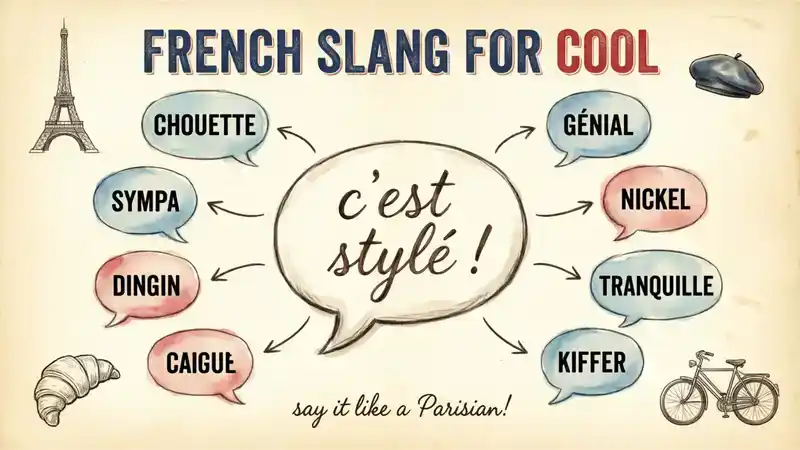
French slang for cool usually means informal French words used to say that something is nice, stylish, great, fun, or impressive. Common choices include sympa, chouette, stylé, génial, top, and ouf, but each has a slightly different tone.
People search for french slang for cool because the English word “cool” does not always have one perfect French equivalent.
The best choice depends on what you are describing. A friendly person may be “sympa,” while stylish clothes may be “stylées,” and an amazing experience may be “géniale” or “ouf.” This guide explains the most useful expressions, their tone, where they fit, and when to avoid them.
It also shows how french slang for cool differs between everyday conversation and more formal situations.
Quick Answer: French Slang for Cool
The most useful French slang and informal words for “cool” are sympa for nice, chouette for pleasant or great, stylé for stylish, génial for awesome, top for great, and ouf for something impulsive or amazing. The right word depends on the context.
What Does French Slang for Cool Mean?
French slang for cool refers to informal French expressions that can describe something as nice, enjoyable, stylish, impressive, or exciting.
There is no single French word that matches every use of the English “cool.” Instead, French speakers choose a word based on the exact idea they want to express.
Sympa = Nice or Cool
“Sympa” is a very common informal form of “sympathique.” It can describe a friendly person, a pleasant place, an idea, or an enjoyable experience.
Example:
“Ton frère est sympa.”
Meaning: “Your brother is nice.”
Stylé = Stylish or Cool-Looking
“Stylé” is useful when “cool” refers to style, appearance, or class. Larousse describes it as a familiar expression for having style or class.
Example:
“Ton nouveau sac est stylé.”
Meaning: “Your new bag is cool/stylish.”
Génial = Awesome or Great
“Génial” is a natural way to show strong approval.
Example:
“Le film était génial.”
Meaning: “The movie was awesome.”
Ouf =impulsive or Amazing
“Ouf” is much more informal. It can express a strong reaction to something surprising, intense, or amazing.
Example:
“C’était ouf !”
Full Meaning of the Main French Words for Cool
There are several useful choices, and they do not all have the same meaning.
1. Sympa
Meaning: nice, friendly, pleasant, or cool.
“Sympa” is one of the safest informal choices when talking about people, places, plans, or experiences. Larousse labels it as familiar and gives “sympathique” as its meaning.
Example:
“C’est un endroit sympa.”
Meaning: “It’s a nice place.”
2. Chouette
Meaning: nice, pleasant, great, or cool.
“Chouette” is a familiar French word that can describe a person, object, or experience. Larousse gives meanings including sympathetic, attractive, and pleasant.
Example:
“On a passé une chouette journée.”
Meaning: “We had a great day.”
It can also appear as an excited reaction:
“Chouette !”
This is similar to saying “Great!” or “Yay!”
3. Stylé
Meaning: stylish, classy, or cool-looking.
Use “stylé” when the focus is on appearance or style rather than simply being pleasant.
Example:
“Cette veste est stylée.”
Meaning: “This jacket is stylish/cool.”
4. Génial
Meaning: great, fantastic, or awesome.
This works well for ideas, activities, events, movies, trips, and experiences.
Example:
“Ton idée est géniale.”
Meaning: “Your idea is awesome.”
5. Top
Meaning: great, excellent, or cool.
“Top” is an informal expression used for positive reactions.
Example:
“Rendez-vous à six heures ?”
“Top !”
Meaning:
“Meet at six?”
“Great!”
6. Ouf
Meaning: impulsive, unbelievable, or amazing.
“Ouf” has a stronger slang feel than “sympa” or “chouette.” It is best suited to casual communication.
Example:
“Cette vue est ouf.”
Meaning: “This view is amazing.”
Different Meanings of “Cool” in French
The English word “cool” can describe several different things. French uses different words depending on the intended meaning.
Cool Meaning Friendly
Use sympa.
“Elle est vraiment sympa.”
“She is really nice.”
Cool Meaning Stylish
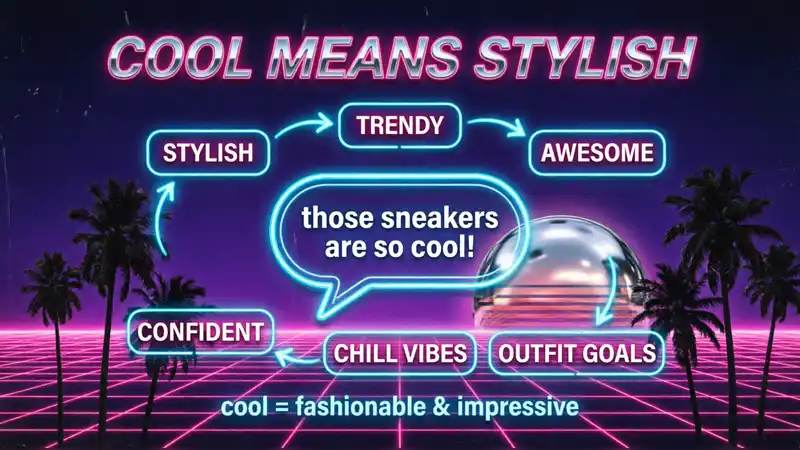
Use stylé.
“Ton look est stylé.”
“Your look is cool.”
Cool Meaning Excellent
Use génial or top.
“Le concert était génial.”
“The concert was awesome.”
Cool Meaning Pleasant
Use chouette or sympa.
“C’est un quartier sympa.”
“It’s a nice neighborhood.”
Cool Meaning impulsive Amazing
Use ouf in a very informal setting.
“C’est ouf !”
“That’s impulsive/amazing!”
This difference is important. Translating “cool” with the same French word every time can make the sentence sound unnatural.
Where Is French Slang for Cool Commonly Used?
These expressions are mainly useful in informal French.
Text Messages
Friends may use short expressions such as:
“Top !”
“C’est cool.”
“Trop stylé.”
These keep messages relaxed and natural.
Social Media
Informal words can appear in French comments, captions, and casual posts.
For example:
“Trop stylé !”
This can be a quick compliment about someone’s style, clothing, artwork, or design.
Gaming Chats
In a casual gaming conversation, “stylé,” “ouf,” or “cool” may describe a character, design, move, or game feature.
Example:
“Ton personnage est stylé.”
Meaning: “Your character looks cool.”
Everyday Conversation
Words such as “sympa,” “chouette,” and “génial” can be used naturally when speaking with friends or family.
The important distinction is that these are informal expressions, so they may not fit every setting.
Is French Slang for Cool Rude or Offensive?
Most common expressions for “cool” are not rude or offensive. They are generally positive.
| Expression | Tone | Usually appropriate? |
| Sympa | Friendly, informal | Yes, in casual settings |
| Chouette | Friendly, informal | Yes |
| Stylé | Casual, positive | Yes |
| Génial | Positive, informal | Yes |
| Top | Casual, positive | Yes |
| Ouf | Very informal | Best for casual settings |
| Cool | Informal | Yes, depending on setting |
The main issue is formality, not offensiveness.
A word such as “ouf” may sound too casual in a formal essay or professional message even though it is not inherently offensive.
French Slang for Cool in Real-Life Examples
Friendly Conversation
“Ton nouveau vélo est super stylé.”
Meaning: “Your new bike is really cool.”
The word “stylé” focuses on appearance.
Text Message
“On se retrouve samedi ?”
“Cool !”
Meaning:
“Are we meeting Saturday?”
“Cool!”
Talking About a Friend
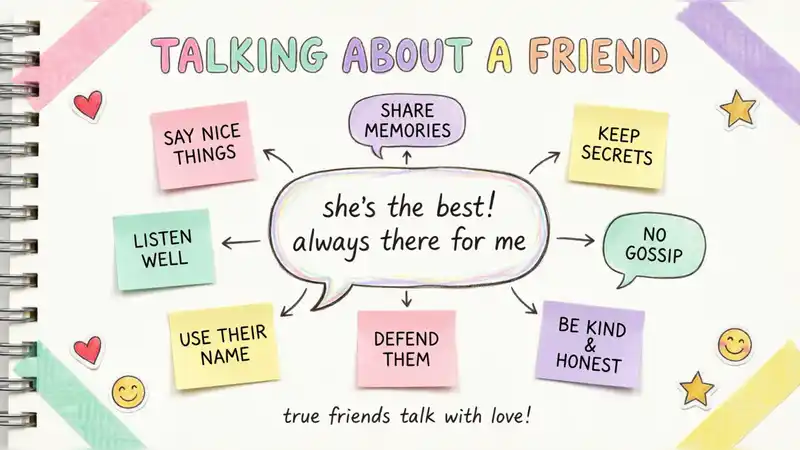
“Paul est vraiment sympa.”
Meaning: “Paul is really nice.”
Here, “sympa” describes personality.
Talking About a Movie
“Tu as aimé le film ?”
“Oui, il était génial.”
Meaning:
“Did you like the movie?”
“Yes, it was awesome.”
Talking About a Place
“Ce café est chouette.”
Meaning: “This café is really nice.”
Strong Informal Reaction
“Tu as vu cette photo ?”
“Oui, elle est ouf !”
Meaning:
“Did you see this photo?”
“Yes, it’s amazing!”
French Slang for Cool: Formal vs. Informal
Not every word that means “cool” has the same level of formality.
French dictionaries mark words such as “sympa” and “chouette” as familiar. Larousse also explains that familiar language is common in everyday speech but can be unsuitable in serious or formal writing.
Casual Setting
You can comfortably use:
- sympa
- chouette
- stylé
- génial
- top
- cool
More Formal Setting
A formal situation may call for words such as:
- excellent
- remarquable
- impressionnant
- agréable
- très bien
For example, instead of:
“C’est ouf !”
a more neutral option is:
“C’est impressionnant.”
That choice sounds more appropriate in formal communication.
Origin and Background
There is no single origin story for french slang for cool because the phrase covers several different expressions.
Some are ordinary familiar French vocabulary, while others have stronger slang associations.
Sympa
“Sympa” is a familiar abbreviation of “sympathique.” Larousse identifies it as the familiar form of that adjective.
Chouette
“Chouette” has long been used as a familiar adjective meaning pleasant, nice, or admirable.
Stylé
“Stylé” is connected to “style” and is used familiarly for someone or something that has style or class.
Ouf
“Ouf” belongs to French slang and is associated with verlan, a style of slang word formation. It is used as a strong informal reaction rather than as a general replacement for every meaning of “cool.”
Because slang changes over time, not every expression has the same level of popularity among all French speakers. A word may sound very natural to one speaker and more casual or dated to another.
Similar French Slang and Informal Words
Several other words can express positive reactions.
Super
“Super” is a familiar French adjective meaning extraordinary or excellent.
Example:
“C’est super !”
Meaning: “That’s great!”
Extra
“Extra” can mean excellent or extraordinary in familiar French.
Example:
“Le concert était extra.”
Meaning: “The concert was fantastic.”
Canon
“Canon” can be used informally to describe someone as very attractive. It is therefore more specific than “cool.”
Example:
“Elle est canon.”
Meaning: “She is gorgeous.”
It should not be treated as a general synonym for “cool.”
When Should You Avoid Using French Slang for Cool?
You do not need to avoid these words completely. Instead, match them to the situation.
Formal Writing
Avoid strongly informal expressions such as “ouf” in formal essays, reports, or official writing.
Professional Messages
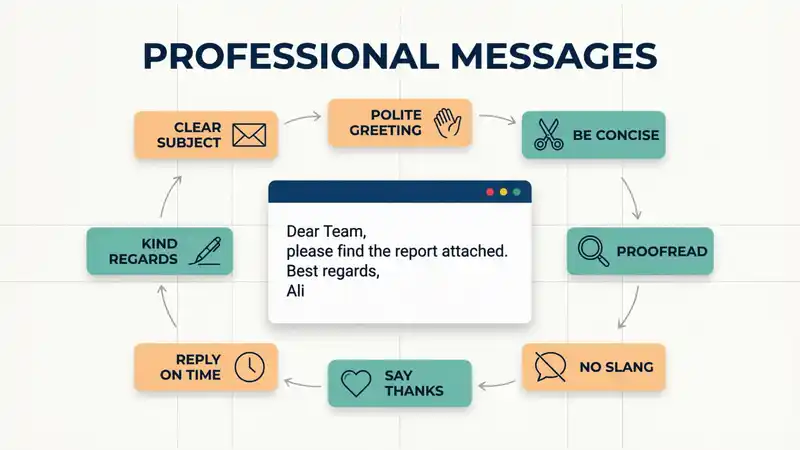
A workplace email usually benefits from neutral wording.
Instead of:
“C’est ouf !”
try:
“C’est impressionnant.”
Speaking to Someone You Do Not Know Well
If you are unsure about the right tone, choose a simple and neutral expression.
Academic Work
For school or academic writing, standard French is usually a better choice than heavy slang.
Why Do People Use These Expressions?
People use informal French expressions for “cool” because they make conversations feel relaxed and expressive.
To Show Approval
Words such as “génial,” “top,” and “super” clearly show positive feelings.
To Compliment Style
“Stylé” gives a more specific compliment about someone’s appearance or design.
To Describe a Nice Experience
“Sympa” and “chouette” can describe something pleasant without sounding overly formal.
To Show Strong Emotion
“Ouf” can make a reaction sound more intense and casual.
The choice of word helps show what kind of positive feeling the speaker has.
Common Misunderstandings
“Cool” Does Not Always Mean “Stylé”
If you say something is “cool” because it looks fashionable, “stylé” may be the better French choice.
“Sympa” Does Not Mean Stylish
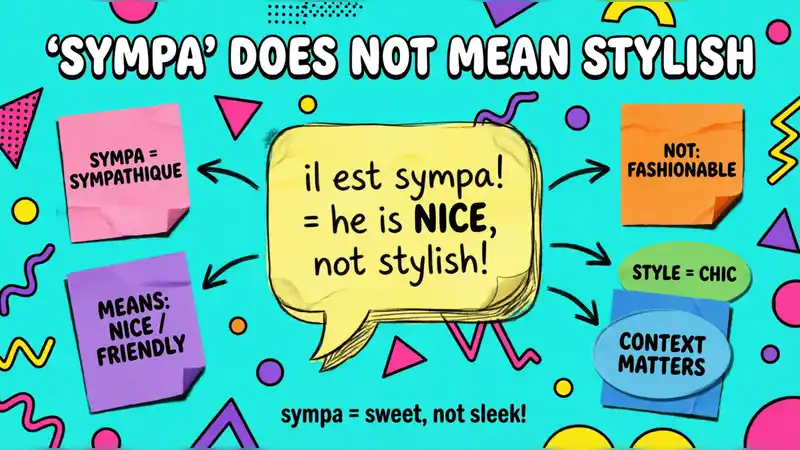
“Sympa” usually focuses on being nice or pleasant. It does not specifically mean fashionable.
“Ouf” Is Not the Best General Translation
“Ouf” has a stronger, more slang-heavy meaning. It can suggest that something is impulsiveor amazing.
“Chouette” Has More Than One Use
“Chouette” can describe something pleasant or attractive, and it can also be used as an interjection expressing satisfaction.
FAQs About French Slang for Cool
1. What is the most common French slang for cool?
“Sympa” is one of the most useful informal choices for “nice” or “cool,” while “cool” itself is also commonly used in French.
2. What does “stylé” mean in French slang?
“Stylé” means stylish, classy, or cool-looking. It is especially useful when talking about clothes, appearance, objects, or design.
3. What does “ouf” mean in French slang?
“Ouf” is a very informal expression used for something impulsive, surprising, intense, or amazing. It is best kept for casual communication.
4. Is “sympa” formal French?
No. “Sympa” is a familiar form of “sympathique.” It is common in everyday speech but is less suitable for formal writing.
5. Can I use “cool” in French?
Yes. “Cool” is commonly understood and used informally in French. However, another word may be more precise depending on what you mean.
6. What French word means cool and stylish?
“Stylé” is a strong choice when “cool” means fashionable or stylish. It is different from “sympa,” which usually means nice or pleasant.
Conclusion
French slang for cool includes several useful expressions rather than one fixed translation. Sympa means nice or pleasant, chouette can mean nice or great, stylé focuses on style, génial means awesome, top means great, and ouf gives a stronger slang-like reaction.
The safest approach is to choose the word based on your meaning. If you are talking about a friendly person, try “sympa.” For an excellent experience, “génial” or “top” works naturally.
For formal writing or professional communication, use more neutral French. The key is not simply knowing a slang word, but knowing when and why French speakers use it.
Read more about!
- Honey Badger Meaning Slang: Definition, Origin & Examples
- Bitchin Slang: Meaning, Origin, Examples & How to Use It
- BTK Meaning Slang: Is It Common in Text Messages?

Hi, I’m Nathan Collins. I create easy-to-understand English language content focused on internet slang, texting abbreviations, modern expressions, vocabulary, and word meanings. My goal is to help students, writers, professionals, and English learners communicate with confidence through clear explanations, practical examples, and reliable language guides.