The 1970s had a slang style of its own. From “groovy” and “far out” to “boogie,” “bummer,” and “10-4,” people used colorful words to talk about music, fashion, friends, parties, work, and everyday life.
When people search for slang from the 70s, they usually want to understand what these old expressions meant and how they were used.
Some 1970s slang is still familiar today, while other terms now sound old-fashioned or humorous. Also, not every word commonly linked with the 1970s was actually created during that decade. Some became popular in the 1970s after existing for years.
This guide explains common 70s slang words and phrases, their meanings, historical context, examples, and modern usage. It also shows which expressions are mainly associated with American English and which ones may be understood more broadly.
Slang From the 70s: Featured Snippet & AI Overview
Slang from the 70s includes informal words and phrases that became popular or strongly associated with the 1970s.
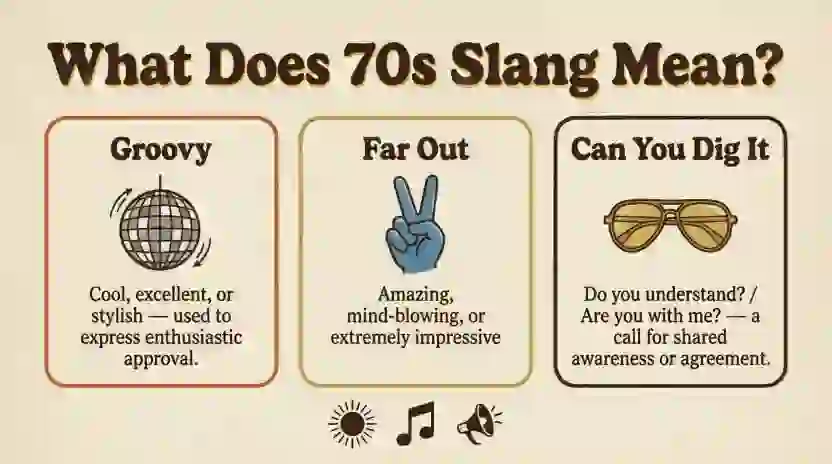
Common examples include “groovy” for something fashionable or enjoyable, “boogie” for dancing, “far out” for something impressive or unusual, “bummer” for something disappointing, and “10-4” for acknowledging a message.
Slang From the 70s: Quick Answer
The slang from the 70s reflected the decade’s music, youth culture, television, CB radio, fashion, and social changes.
Some well-known examples include:
- Groovy = fashionable, enjoyable, or interesting
- Far out = impressive, unusual, or exciting
- Boogie = dance
- Bummer = something disappointing
- Cool beans = something good or pleasing
- 10-4 = message received or understood
- The Man = people or institutions seen as holding authority
- Couch potato = someone who spends a lot of time watching TV
- Can you dig it? = Do you understand or agree?
- Keep on truckin’ = keep going
“Groovy” is still recognized today, but major dictionaries label it as old-fashioned or dated slang.
What Does Slang From the 70s Mean?
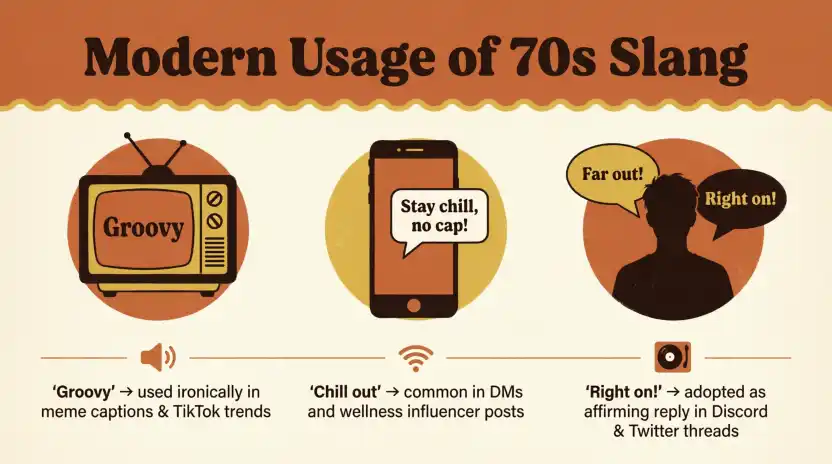
“Slang from the 70s” means informal vocabulary and expressions associated with the 1970s.
The phrase does not describe one single type of language. Instead, it covers many expressions connected with different parts of 1970s life.
For example, disco culture helped spread words such as “boogie,” while CB radio culture helped popularize expressions such as “10-4” and “What’s your 20?”
Popular 70s slang words
Here are some of the most recognizable examples:
| 70s Slang | Meaning | Example |
| Groovy | Fashionable or enjoyable | “That jacket is groovy.” |
| Far out | Very unusual or impressive | “That idea is far out.” |
| Boogie | Dance | “Let’s boogie.” |
| Bummer | A disappointment | “Missing the show was a bummer.” |
| Cool beans | That’s good | “You finished early? Cool beans.” |
| Fab | Fabulous or excellent | “That outfit is fab.” |
| Threads | Clothes | “I like your new threads.” |
| Pad | Home or apartment | “Come over to my pad.” |
| Crib | Home or place to live | “I’ll meet you at my crib.” |
| Stoked | Very excited | “I’m stoked about the weekend.” |
| Right on | Agreement or approval | “Right on, I agree.” |
| The skinny | The real information | “Give me the skinny.” |
| The Man | Authority or establishment | “Don’t let the Man stop you.” |
| Space cadet | A distracted or absent-minded person | “He’s such a space cadet.” |
| Couch potato | Someone who watches a lot of TV | “I was a couch potato all weekend.” |
Some of these terms were older than the 1970s but became widely associated with the decade. That distinction matters when discussing slang history.
The Origin of Slang From the 70s
There was no single source for 1970s slang. The decade’s informal language came from music, television, movies, youth culture, regional speech, African American English, counterculture, advertising, and CB radio.
The growth of mass media also helped slang travel beyond the communities where it first appeared. Radio, television, and movies gave people more chances to hear expressions and repeat them.
Music and dance
Music had a strong connection with 1970s vocabulary.
“Boogie,” for example, became strongly associated with dancing and disco during the decade. The word itself is older and developed from earlier musical uses, so calling it a word that was “invented” in the 1970s would be inaccurate.
CB radio
CB radio created another group of expressions that became widely recognized in the 1970s.
“10-4” meant that a message had been received or understood. “What’s your 20?” asked about someone’s location. These expressions moved beyond radio communication and entered popular culture.
Television and popular culture
Television also helped spread casual expressions.
“Couch potato,” for example, dates to the 1970s and described someone who spent a great deal of time sitting on a couch watching television.
Social and cultural change
Some expressions reflected the politics and social movements of the period.
“The Man” could refer broadly to authority or powerful institutions. Its history goes back earlier than the 1970s, but it became strongly connected with the counterculture of the 1960s and 1970s.
Not every “70s word” started in the 70s
This is one of the biggest points of confusion.
A word can be strongly associated with a decade without being invented during that decade. “Groovy,” for example, has a longer history, but it became a recognizable part of the popular image of 1960s and 1970s culture.
The Oxford and Cambridge dictionaries now describe “groovy” as informal and old-fashioned or dated slang.
British English vs American English
Most lists of 70s slang focus heavily on American English. This is because many famous expressions from the decade were connected with American music, television, CB radio, and popular culture.
| Feature | British English | American English | Example |
| Groovy | Understood, informal | Widely associated with US pop culture | “That sounds groovy.” |
| Far out | Understood | Strongly associated with US slang | “That’s far out.” |
| Boogie | Understood | Strongly associated with US music culture | “Let’s boogie.” |
| 10-4 | Less typical in everyday British speech | Strongly linked with US CB radio | “10-4, I understand.” |
| Pad | Understood in some contexts | Commonly associated with US slang | “Come to my pad.” |
| Threads | Understood | Used as slang for clothes | “Nice threads.” |
| Bummer | Understood | Commonly associated with American informal speech | “What a bummer.” |
These categories should not be treated as strict rules. Slang crosses borders through films, television, music, books, and online culture.
Which Version Should You Use?
Because 70s slang is historical and informal, the best choice depends on your purpose.
United States
American 1970s expressions work naturally when writing about US history, pop culture, music, or retro themes.
United Kingdom
Use expressions that your British readers will understand. If a phrase is strongly linked to American culture, explain it rather than assuming it is traditional British slang.
Canada
Many American expressions are recognizable in Canada, but regional language can differ. Context matters more than trying to label every phrase as strictly Canadian or American.
Australia
Australian readers may understand many famous American 70s expressions through popular culture, but they should not automatically be describe as traditional Australian slang.
International writing
Give the meaning directly. This is especially helpful for ESL learners.
For example:
“Groovy” is an old-fashioned slang word meaning fashionable, interesting, or enjoyable.
Academic writing
Use 70s slang only when it is relevant to the subject. Define the expression the first time you use it.
Business writing
Avoid using historical slang unless you are discussing language, culture, advertising, media, or a similar topic.
Common Mistakes
Mistake 1: Saying every 70s slang word was invent in the 1970s
Incorrect:
“Groovy was invent in the 1970s.”
Correct:
“Groovy became strongly associated with 1960s and 1970s popular culture.”
Why? A word can become popular during a decade without originating there.
Memory tip: Popularized does not always mean invented.
Mistake 2: Treating all 70s slang as current slang
Incorrect:
“People commonly say ‘groovy’ today.”
Correct:
“People still recognize ‘groovy,’ but it is generally considered old-fashioned slang.”
Cambridge and Oxford both identify “groovy” as old-fashioned or dated slang.
Mistake 3: Using slang without checking the context
Incorrect:
“Every American used 10-4 in the 1970s.”
Correct:
“10-4 became widely associated with CB radio culture in the 1970s.”
The second statement is more precise and avoids making a claim about everyone.
Everyday Examples
Historical slang can be useful in different types of writing, but it should match the context.
Emails
For a modern professional email, avoid most 70s slang.
Historical example:
“That sounds groovy.”
Modern professional alternative:
“That sounds great.”
Business writing
A business article about retro marketing might say:
“The campaign used 1970s expressions such as ‘groovy’ to create a nostalgic tone.”
News headlines
A historical feature might use:
“A Look Back at Popular Slang From the 1970s”
Blogs
A casual blog can use slang for a retro voice:
“The party had a groovy 70s feel.”
Social media
A nostalgia post might say:
“How many of these 70s slang words do you remember?”
Academic writing
An essay about language change could say:
“Several expressions associated with the 1970s later became dated.”
Daily conversation
You may hear historical slang used jokingly:
“That jacket is groovy.”
The speaker may be using the word for a retro or humorous effect rather than as ordinary modern slang.
Google Trends & Modern Usage
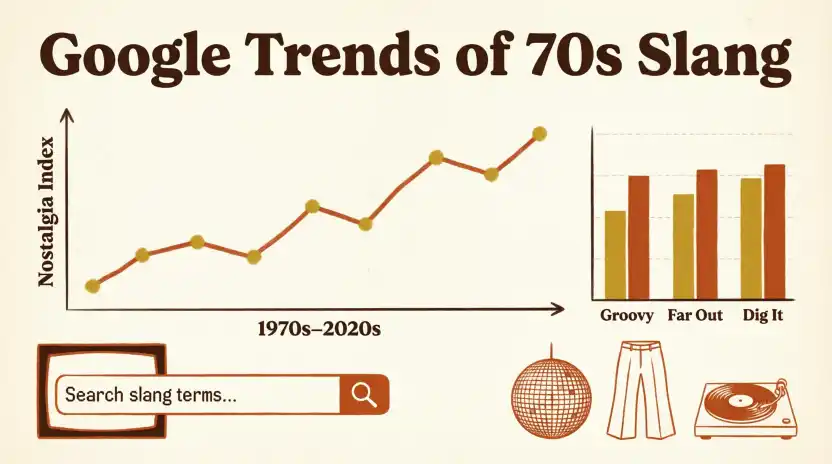
Search interest in “slang from the 70s” is best understood as a topic of historical and cultural interest rather than evidence that people commonly use these expressions in everyday speech.
People may search this topic when they are:
- researching the 1970s
- writing school assignments
- creating historical content
- looking for retro party ideas
- studying English slang
- watching older movies or television
- trying to understand an expression from the period
- comparing 70s slang with 80s or 90s slang
Modern dictionaries also show that some famous expressions have changed in status. “Groovy,” for example, remains understandable but is now mark as old-fashion or dat.
There is also an important difference between historical popularity and modern popularity. A phrase may appear often in articles about the 1970s without being common in everyday conversation today.
Exact Google Trends numbers are not includ here because they can change over time and require a specific location, date range, and search setting.
Quick Comparison Table
| Version | Meaning | Correct? | Region | Example |
| Groovy | Fashionable or enjoyable | Yes | Broadly understood | “That is groovy.” |
| Far out | Impressive or unusual | Yes | Mainly US-associated | “That is far out.” |
| Boogie | Dance | Yes | Broadly understood | “Let’s boogie.” |
| Bummer | Disappointment | Yes | Mainly US-associated | “That’s a bummer.” |
| 10-4 | Message received | Yes | US CB culture | “10-4, good buddy.” |
| Couch potato | Person who watches lots of TV | Yes | Broadly understood | “I’m being a couch potato.” |
| The skinny | The real information | Yes | US-associated | “Give me the skinny.” |
| Right on | Agreement or approval | Yes | Mainly US-associated | “Right on!” |
| Pad | Home or apartment | Yes | US-associated | “Come to my pad.” |
| Threads | Clothes | Yes | US-associated | “Nice threads.” |
These meanings are based on historical and dictionary references, but individual expressions could vary by community and context.
Key Takeaways
- Slang from the 70s includes informal words and phrases associated with 1970s culture.
- “Groovy,” “far out,” “boogie,” and “bummer” are among the best-known examples.
- “10-4” became strongly connected with CB radio culture.
- “Couch potato” dates to the 1970s and was link with television watching.
- Not every famous 70s expression was invente during the decade.
- Many expressions are now old-fashion, humorous, or mainly used for retro effect.
- Regional usage varied, so avoid claiming that everyone used a particular phrase.
- Historical context makes 70s slang easier to understand and use correctly.
FAQs
1. What was the most popular slang in the 70s?
There was no single slang word us by everyone in the 1970s. Commonly remembered expressions include “groovy,” “far out,” “boogie,” “bummer,” “right on,” and “10-4.” Different communities, regions, and age groups used different expressions, so popularity varied throughout the decade.
2. What did “groovy” mean in the 70s?
“Groovy” was us to describe something fashionable, enjoyable, interesting, or pleasing. It became strongly associated with the counterculture and popular culture of the 1960s and 1970s. Today, dictionaries generally mark it as old-fashioned or dated slang.
3. What did “far out” mean in the 1970s?
“Far out” could express approval, amazement, or surprise. It could describe something unusual or impressive. The expression is strongly associat with American counterculture and 1970s informal speech, although its history extends beyond one decade.
4. What did “10-4” mean in 70s slang?
“10-4” was a CB radio code meaning that a message had been received or understood. During the 1970s, CB radio culture helped move the expression into wider popular culture. It became especially recognizable through media connected with truckers and radio communication.
5. What did “boogie” mean in the 70s?
“Boogie” commonly meant to dance or move in a lively way. The word existed before the 1970s, but the decade strongly connected it with popular music and disco culture. “Let’s boogie” could therefore mean “Let’s dance” in a casual, playful way.
6. What did “bummer” mean in 70s slang?
“Bummer” meant something disappointing, unpleasant, or unfortunate. For example, someone might say, “Missing the concert was a bummer.” The word was not limit to the 1970s, but it became part of the informal language associat with that era.
7. What does “couch potato” mean?
A “couch potato” is a person who spends a lot of time sitting and watching television or otherwise being inactive. The expression dates to the 1970s and became closely connected with the rise of television-centered leisure.
8. Is 70s slang still us today?
Some expressions are still understood and occasionally us, especially for humor, nostalgia, or retro themes. However, many are no longer normal everyday slang. “Groovy,” for example, is still recogniz but is classifi as old-fashioned or dat by major dictionaries.
9. Why was slang important in the 1970s?
Slang helped people express identity, humor, approval, disagreement, and cultural belonging. Music, television, movies, youth culture, social movements, and CB radio all helped spread different expressions during the decade. Mass media also made it easier for local or group-specific language to reach wider audiences.
10. What is a good example of 70s slang?
“Groovy” is one of the clearest examples because it is strongly associat with the era and is easy to understand. Other examples include “far out,” “boogie,” “bummer,” “right on,” “10-4,” and “couch potato.” Their exact meanings depend on the sentence and historical context.
Conclusion
Slang from the 70s gives us a useful look at how informal English changes with culture. Words such as “groovy,” “far out,” “boogie,” “bummer,” and “right on” are closely link with the decade, while “10-4” shows how CB radio influenc popular language. Other expressions, such as “couch potato,” reflect the growing role of television in everyday life.
It is also important to avoid treating every 70s slang word as a word that was invent in the 1970s. Some expressions were older but became popular or strongly associated with the decade.
Today, many of these terms are best us when discussing history, nostalgia, entertainment, or retro culture. Some can also be used jokingly in modern conversation, but they may sound dat.
The simplest way to understand 70s slang is to look at both the meaning and the cultural setting.
A little context can turn an old slang word into a clear piece of history.
Read more about!
- Dale Spanish Slang Meaning in Text
- What Is Mewing Slang Meaning in Text?
- Marple Definition Slang: Meaning in Text

Daniel Brooks is an English vocabulary educator who creates simple, practical guides on slang, word meanings, and everyday English. His goal is to help students, writers, and English learners expand their vocabulary and communicate with confidence.