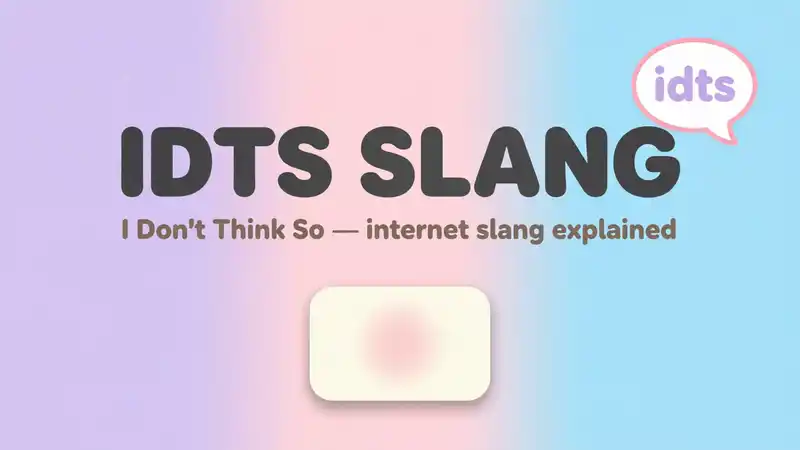
IDTS slang is a common texting abbreviation that can be confusing when you see it for the first time. People often use short forms like IDK, IMO, TBH, and IDTS to make messages faster and more casual. If someone sends you “IDTS,” they usually do not mean anything complicated.
In texting and online conversations, IDTS most commonly means “I Don’t Think So.” It is used when someone disagrees with an idea, doubts something, or wants to give a negative answer without sounding too direct.
You may see IDTS in texts, social media comments, messaging apps, gaming chats, and other casual online conversations. The tone can be neutral, doubtful, playful, or slightly dismissive depending on the conversation.
Quick Answer: IDTS means “I Don’t Think So.” It is a casual texting abbreviation used to show doubt, disagreement, or a negative response.
What Does IDTS Mean in Text?
IDTS means “I Don’t Think So” in text messages and online slang.
People use it when they do not agree with something or believe that something is unlikely to happen.
For example:
“Do you think Jake is coming tonight?”
“IDTS.”
Here, the person means:
“I don’t think so.”
The abbreviation saves time and fits the short, casual style commonly used in digital conversations.
IDTS Can Express Doubt
IDTS is not always a strong “no.” It can show uncertainty or doubt.
For example:
“Do you think it will rain tomorrow?”
“IDTS.”
The speaker is saying they do not believe it will rain, but they are not necessarily claiming to know for sure.
IDTS Can Express Disagreement
It can also be used when someone disagrees with another person’s opinion.
“That was the best movie this year.”
“IDTS 😭”
Here, IDTS means the person does not agree with that opinion.
IDTS Full Form and Definition
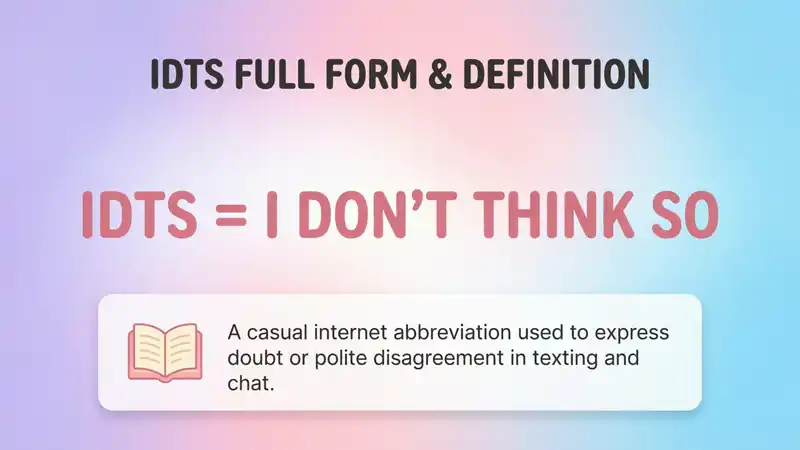
The IDTS full form is:
I Don’t Think So
Each letter represents the main words:
- I = I
- D = Don’t
- T = Think
- S = So
It is mainly used in informal communication.
Unlike a formal phrase such as “I disagree,” IDTS sounds shorter and more conversational.
What Does IDTS Stand For?
IDTS stands for “I Don’t Think So.”
It is generally used to respond to a question, statement, prediction, or suggestion.
For example:
“Are they going to win?”
“IDTS.”
This means:
“I don’t think they are going to win.”
Is IDTS Rude, Offensive, or Neutral?
IDTS is generally neutral and not offensive.
However, the tone can change depending on how it is written and what comes before or after it.
A simple “IDTS” can sometimes sound short or dismissive because it gives very little explanation.
Compare these:
Friendly:
“IDTS, but I could be wrong.”
Short:
“IDTS.”
More dismissive:
“IDTS lol.”
The abbreviation itself is not rude. The surrounding words, punctuation, emojis, and relationship between the speakers can affect how it feels.
When IDTS May Sound Dismissive
If someone shares a long explanation and receives only “IDTS,” they might feel that the response is too brief.
In a serious conversation, a clearer response may be better:
“I don’t think that’s correct because…”
This gives the other person more information.
Where Is IDTS Commonly Used?
IDTS is mainly used in informal digital communication.
You may encounter it in:
- Text messages
- Instagram messages
- Snapchat
- TikTok comments
- Reddit discussions
- Discord chats
- Gaming conversations
- Group chats
- Casual social media posts
It is less suitable for formal communication such as school assignments, professional emails, business documents, or official messages.
IDTS in Texting
Texting is one of the most natural places to use IDTS.
Example:
“Do you think Sam will come?”
“IDTS.”
The short form makes the response quick and easy.
IDTS on Social Media
On social platforms, IDTS can appear in comments or replies when users disagree with a statement.
Example:
“This is definitely the best song ever.”
Someone might reply:
“IDTS.”
The meaning is simply:
“I don’t think so.”
Real-Life Examples of IDTS
Understanding examples can help you recognize the tone of IDTS.
1. Friendly Example
“Do you think we have enough pizza?”
“IDTS 😂”
The person is casually saying they do not think there is enough pizza.
2. Casual Example
“Is Mia coming with us?”
“IDTS.”
This is a simple negative answer.
3. Doubtful Example
“Do you think the bus will arrive on time?”
“IDTS.”
The speaker is expressing doubt.
4. Opinion Example
“That was the funniest episode.”
“IDTS lol.”
The person disagrees in a casual way.
5. Gaming Example
“Do you think our team can win this round?”
“IDTS 😭”
Here, IDTS expresses doubt about the team’s chances.
6. Social Media Example
“This is the easiest level in the game.”
Reply:
“IDTS 💀”
The commenter disagrees with the statement.
IDTS Meaning in Different Tones
The same abbreviation can have different meanings in terms of emotion.
Neutral Tone
“Do you think he’ll be there?”
“IDTS.”
This simply means “I don’t think so.”
Friendly Tone
“Think I’ll finish this today?”
“IDTS 😂”
The response is playful.
Doubtful Tone
“Will they actually arrive on time?”
“IDTS.”
The speaker is uncertain or skeptical.
Playful Tone✌️
“I’m totally going to wake up early tomorrow.”
“IDTS 😭”
The person is joking that they probably will not wake up early.
Slightly Dismissive Tone
“I think this is obviously correct.”
“IDTS.”
Here, the short response may sound more direct.
What Is the Origin of IDTS?
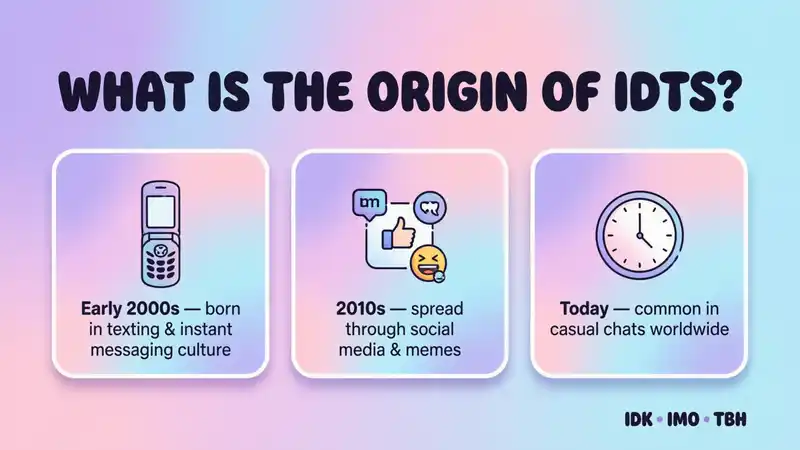
IDTS developed as part of the broader culture of internet and text-message abbreviations.
Online communication often favors short expressions because typing fewer characters makes conversations faster. Abbreviations such as IDK (“I Don’t Know”), IMO (“In My Opinion”), TBH (“To Be Honest”), and IDTS fit this style.
There is not necessarily one specific moment when IDTS was created. Instead, it belongs to the wider development of informal digital language.
The phrase “I don’t think so” existed long before texting. IDTS simply shortens it for digital communication.
IDTS vs. “I Don’t Think So”
The meaning is the same, but the style is different.
| Expression | Meaning | Tone |
| IDTS | I Don’t Think So | Casual |
| I don’t think so | I Don’t Think So | Neutral |
| Probably not | Probably no | Casual/neutral |
| I doubt it | I think it is unlikely | More doubtful |
| No | Negative answer | Direct |
| I don’t believe so | I don’t think that is true | More formal |
IDTS is useful when you want your message to sound quick and informal.
IDTS vs. IDK
These abbreviations can sometimes be confused.
IDTS = I Don’t Think So
IDK = I Don’t Know
They communicate different ideas.
Example With IDTS
“Do you think Alex will come?”
“IDTS.”
The speaker believes Alex probably will not come.
Example With IDK
“Do you think Alex will come?”
“IDK.”
The speaker does not know if Alex will come.
So, IDTS expresses an opinion or prediction, while IDK expresses uncertainty because the person does not know.
IDTS vs. IMO
Another useful comparison is IMO.
IDTS means:
“I Don’t Think So.”
IMO means:
“In My Opinion.”
For example:
“IDTS. I think the other team will win.”
The first part disagrees with a prediction.
You could also say:
“IMO, the other team is stronger.”
This introduces a personal opinion rather than directly answering a question.
When Should You Use IDTS?
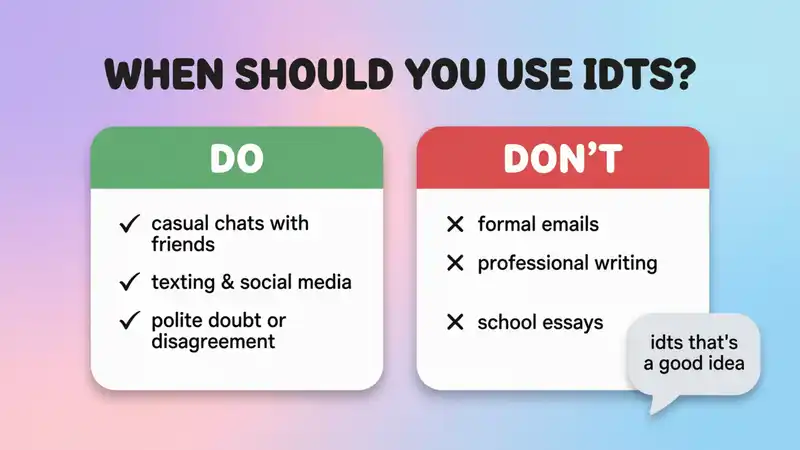
IDTS works best in casual conversations.
You can use it when:
- Answering friends
- Chatting in group messages
- Replying to social media comments
- Talking in gaming chats
- Responding to casual questions
- Giving a quick opinion
- Expressing doubt about a prediction
It is especially useful when the meaning is already clear from the conversation.
Example
“Think we’ll finish the project today?”
“IDTS.”
The short answer works because both people understand the context.
When Should You Avoid Using IDTS?
Although IDTS is harmless, it is not appropriate for every situation.
Avoid using it in formal writing such as:
- School essays
- Academic assignments
- Job applications
- Formal emails
- Business reports
- Official documents
Instead, write the complete phrase or use a more professional expression.
For example, instead of:
“IDTS this is correct.”
Use:
“I don’t think this is correct.”
Or:
“I do not believe this is correct.”
The complete version is clearer and more appropriate in formal settings.
Why Do People Use IDTS?
People use IDTS mainly because it is short, fast, and familiar.
Digital conversations often move quickly. Typing “I don’t think so” takes longer than typing four letters.
IDTS also matches the relaxed style of texting.
People may use it to:
- Save typing time
- Give a quick answer
- Express doubt
- Disagree casually
- Keep a conversation informal
- Add a playful tone
The abbreviation can also feel more natural in a fast-moving chat.
How Emojis Can Change the Tone of IDTS
Emojis can make the meaning easier to understand.
IDTS 😂
This may sound playful or humorous.
IDTS 😭
This can show dramatic or joking disagreement.
IDTS 🤔
This can emphasize doubt or uncertainty.
IDTS 👍
This may sound more definite, depending on the conversation.
The abbreviation remains “I Don’t Think So,” but the emoji helps communicate the speaker’s mood.
Is IDTS Safe for Social Media?
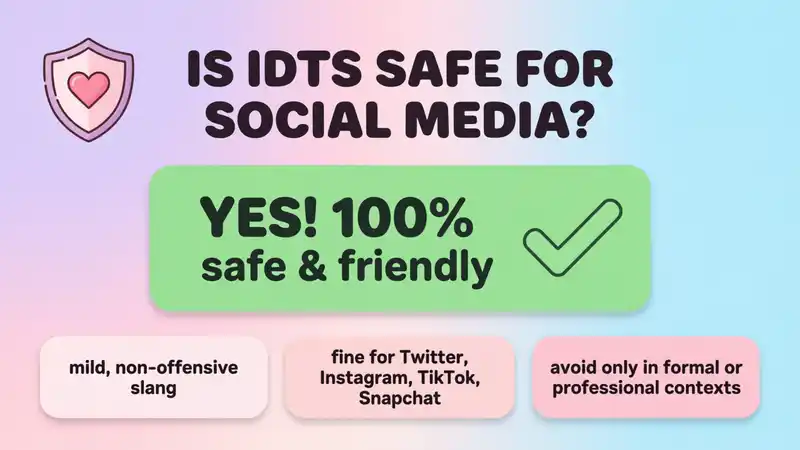
Yes. IDTS is generally safe and neutral for ordinary social media use.
It does not contain offensive language, and it is not inherently insulting.
However, like any disagreement, the way you use it matters.
A short response such as:
“IDTS.”
may be interpreted as blunt in some conversations.
If you want to sound friendlier, you can add a little context:
“IDTS, but I could be wrong.”
or:
“IDTS 😂 I think the other one was better.”
This makes your intention clearer.
Common Mistakes With IDTS
One common mistake is assuming that IDTS means “I don’t know.”
That is incorrect.
Correct
IDTS = I Don’t Think So
Different abbreviation
IDK = I Don’t Know
Another mistake is assuming that IDTS always means a strong “no.” Usually, it expresses an opinion or doubt rather than absolute certainty.
For example:
“Do you think it will happen?”
“IDTS.”
This means the speaker does not believe it will happen, but they may not know for certain.
FAQs About IDTS Slang
1. What does IDTS mean in texting?
IDTS means “I Don’t Think So.” It is a casual abbreviation used to express doubt, disagreement, or a negative response.
2. What does IDTS stand for?
IDTS stands for “I Don’t Think So.” It is commonly used in texts, chats, and social media conversations.
3. Is IDTS rude?
No. IDTS is generally neutral. However, replying with only “IDTS” can sometimes sound brief or dismissive depending on the situation.
4. Is IDTS the same as IDK?
No. IDTS means “I Don’t Think So,” while IDK means “I Don’t Know.” IDTS expresses an opinion or prediction, whereas IDK shows that the person does not know.
5. What does IDTS mean on social media?
On social media, IDTS usually means “I Don’t Think So.” People may use it to disagree with a statement or express doubt about a prediction.
6. Can I use IDTS in formal writing?
It is better to avoid IDTS in formal writing. Use “I don’t think so” or another complete expression instead.
Conclusion
IDTS slang meaning is simple: “I Don’t Think So.” It is a casual abbreviation used in texting, social media, gaming chats, and other informal online conversations.
People commonly use IDTS to express doubt, disagreement, or a negative opinion without giving a long response. Its tone can be neutral, friendly, humorous, or slightly dismissive depending on the context.
Remember that IDTS and IDK are not the same. IDTS means “I Don’t Think So,” while IDK means “I Don’t Know.” When you understand that difference, IDTS becomes easy to recognize and use.
For casual chats, IDTS is a simple and natural way to say “I don’t think so.” For formal communication, however, writing the full phrase is clearer and more appropriate.
Read more about!
- HP Meaning Slang: What Does HP Mean in Text, Gaming & Online?
- Slaying Meaning Slang: Definition, Origin, Examples
- Grape Slang Meaning: What Does Grape Mean in Slang?

Daniel Brooks is an English vocabulary educator and content editor with experience creating educational resources about English words, idioms, and everyday communication. He reviews language content for clarity, accuracy, and readability to ensure readers receive reliable and easy-to-understand information.