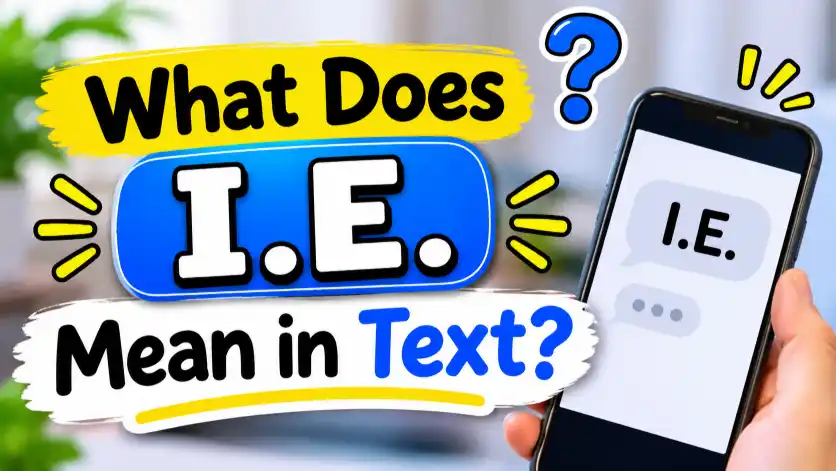
I.E. means “that is” or “in other words.” It comes from the Latin phrase id est. People use it in text messages and writing to explain something more clearly or give a specific meaning.
For example:
Friend: “I’ll be free tomorrow, i.e., after 3 PM.”
This means the person will be available tomorrow after 3 PM.
What Does I.E. Stand For?
I.E. stands for the Latin phrase id est, which means “that is.”
It is used when someone wants to explain or clarify what they have just said.
Unlike texting slang such as IDK or ISTG, i.e. is a standard abbreviation used in everyday writing, emails, messages, and academic work.
How Is I.E. Used in Text Messages?
People use i.e. to make a statement more specific or easier to understand.
Here are some common uses:
- To explain something: “I have one favorite subject, i.e., English.”
- To clarify a statement: “I’ll call you later, i.e., after dinner.”
- To give a specific meaning: “The meeting is virtual, i.e., online.”
- To avoid confusion: “Bring your ID, i.e., your student card.”
The abbreviation introduces an explanation of what came before it.
10 Examples of I.E. in Text Messages
Example 1:
Alex: “I’ll meet you in the evening, i.e., around 6 PM.”
Sam: “Okay, see you then.”
Example 2:
Mia: “I enjoy outdoor activities, i.e., hiking and cycling.”
Lily: “Those sound fun!”
Example 3:
Jake: “We need basic supplies, i.e., pens, paper, and notebooks.”
Noah: “I’ll bring them.”
Example 4:
Emma: “I’m working remotely today, i.e., from home.”
Sophie: “Got it.”
Example 5:
Ryan: “Choose a simple topic, i.e., something easy to explain.”
Chris: “I’ll do that.”
Example 6:
Ava: “I’ll be available this weekend, i.e., Saturday afternoon.”
Ella: “Perfect!”
Example 7:
Ben: “I need a quiet place, i.e., somewhere without noise.”
Max: “The library might work.”
Example 8:
Olivia: “Bring something warm, i.e., a jacket or sweater.”
Zoe: “Sure.”
Example 9:
Daniel: “I prefer digital books, i.e., ebooks.”
Leo: “Same here.”
Example 10:
Grace: “We have one main goal, i.e., finishing the project on time.”
Maya: “Let’s get started.”
What Is the Difference Between I.E. and E.G.?
I.E. and E.G. look similar, but they have different meanings.
- I.E. means “that is.” It introduces a clarification or a more exact explanation.
- E.G. means “for example.” It introduces one or more examples.
| Abbreviation | Full Latin Phrase | Meaning |
| I.E. | Id est | That is; in other words |
| E.G. | Exempli gratia | For example |
I.E. example:
“I work remotely, i.e., from home.”
This explains exactly what working remotely means in this sentence.
E.G. example:
“I enjoy outdoor activities, e.g., hiking and cycling.”
This gives examples of outdoor activities.
Is I.E. Formal or Informal?
I.E. can be used in both formal and informal writing. It is more common in written explanations than in casual conversations.
| Situation | Is I.E. Suitable? |
| Text messages | Yes |
| Emails | Yes |
| School assignments | Yes |
| Academic writing | Yes |
| Professional documents | Yes |
| Casual conversations | Yes, but less common |
In very casual messages, people may prefer phrases such as “that is,” “meaning,” or “in other words.”
Does I.E. Have a Different Meaning on Social Media?
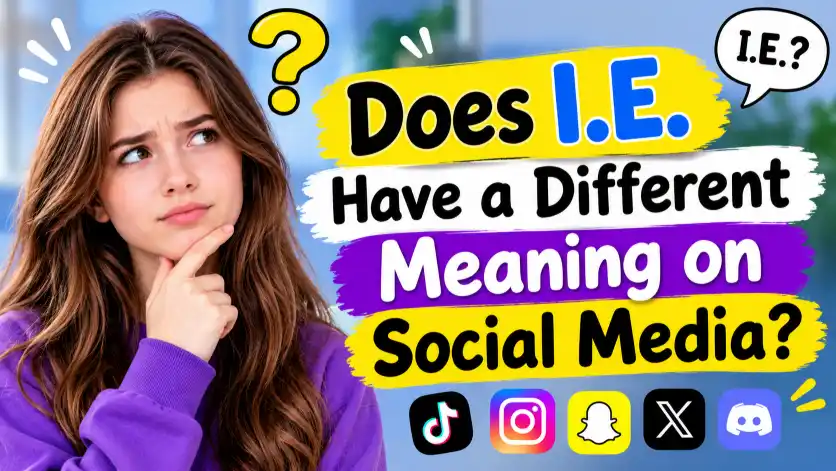
Usually, no. On platforms such as TikTok, Instagram, Snapchat, WhatsApp, and Discord, i.e. keeps its standard meaning: “that is” or “in other words.”
It is not a special TikTok or Gen Z slang term. Its purpose is to explain or clarify information.
Common Mistakes People Make About I.E.
- Confusing I.E. with E.G.: I.E. explains something, while E.G. gives examples.
- Thinking it means “for example”: That is the meaning of E.G., not I.E.
- Treating it as texting slang: It is a standard abbreviation with Latin origins.
- Using it without an explanation: The words after i.e. should clarify the statement.
- Writing it in every casual message: Sometimes “that is” sounds more natural.
Key Takeaways
- I.E. means “that is” or “in other words.”
- It comes from the Latin phrase id est.
- It is used to clarify or explain information.
- It is suitable for texts, emails, and formal writing.
- It is different from E.G., which means “for example.”
- It is a standard abbreviation, not internet slang.
FAQs About I.E. in Text
1. What does I.E. mean in a text message?
I.E. means “that is” or “in other words.” People use it to explain something more clearly or provide a specific meaning. For example, “I’ll arrive in the afternoon, i.e., around 2 PM” clarifies the expected arrival time.
2. What does I.E. stand for?
I.E. stands for the Latin phrase id est, which means “that is.” It is used in English writing to introduce an explanation or clarification. You may see it in text messages, emails, schoolwork, and professional documents.
3. Is I.E. the same as E.G.?
No. I.E. means “that is” and introduces a clarification. E.G. means “for example” and introduces examples. For instance, “I like citrus fruits, e.g., oranges and lemons” gives examples rather than explaining a specific meaning.
4. Is I.E. slang?
No. I.E. is a standard abbreviation with Latin origins. It is commonly used in written English and is not specific to texting, TikTok, or any particular online community.
5. How do you use I.E. in a sentence?
Use i.e. when you want to explain or clarify something. For example, “The event is online, i.e., you can attend from home.” The words after i.e. explain what the earlier statement means.
6. Does I.E. mean “for example”?
No. I.E. means “that is” or “in other words.” If you want to introduce examples, use E.G. instead. Remembering this difference helps you use both abbreviations correctly.
7. Should I write I.E. or i.e.?
Both forms are recognizable, but lowercase “i.e.” is the standard style in most modern English writing. It is usually followed by a comma when introducing a clarification within a sentence.
8. Can I use I.E. in casual texting?
Yes. You can use i.e. in casual messages when you want to explain something clearly. However, it may sound more formal than everyday texting language. Phrases such as “that is” or “meaning” can feel more natural with friends.
Conclusion
I.E. means “that is” or “in other words.” It comes from the Latin phrase id est and helps explain or clarify information in writing.
If you see i.e. in a text message, the sender is usually adding a clearer explanation. Just remember that i.e. explains something, while e.g. gives examples.
Read more about!
- What Does HYO Mean in Text? Real Meaning, & Social Media Use
- What Does HYK Mean in Text? Real Examples & Social Media Use
- What Does HYYY Mean in Text? Social Media Use

Hi, I’m Ryan Mitchell. I write simple guides about slang, internet language, and everyday English to make modern expressions easy to understand. My goal is to help learners use real-life English with confidence.