Last Updated: September 1, 2026
Early 90s slang brings back a time when words like “da bomb,” “phat,” “my bad,” and “as if!” were heard in everyday conversations, movies, music, and TV shows. If you have ever watched a 1990s movie or heard an old-school phrase and wondered what it meant, you are not alone. Many early 90s expressions had meanings that were very different from their literal words.
In this guide, we will explore popular early 90s slang, what each phrase meant, how people used it, and if it is still common today. You will also learn about the cultural background of these expressions and how 1990s slang differs from modern internet slang.
What Is Early 90s Slang?
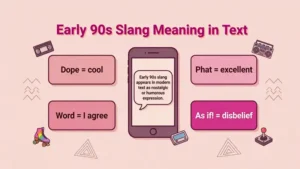
Early 90s slang refers to informal words and phrases that were popular or strongly associated with the early part of the 1990s. These expressions appeared in everyday conversations, school settings, music, television, movies, sports, and youth culture.
Some expressions were genuinely new or became popular around this time. Others existed earlier but became much more noticeable during the 1990s. For example, “bail,” “my bad,” “phat,” “da bomb,” “word,” and “booyah” are often associated with 1990s speech, but their histories are not identical.
If you are searching for early 90s slang because you heard an old phrase in a movie, TV show, song, or social-media post, this guide explains what these expressions meant, how they sounded, and if people still use them today.
Quick Answer
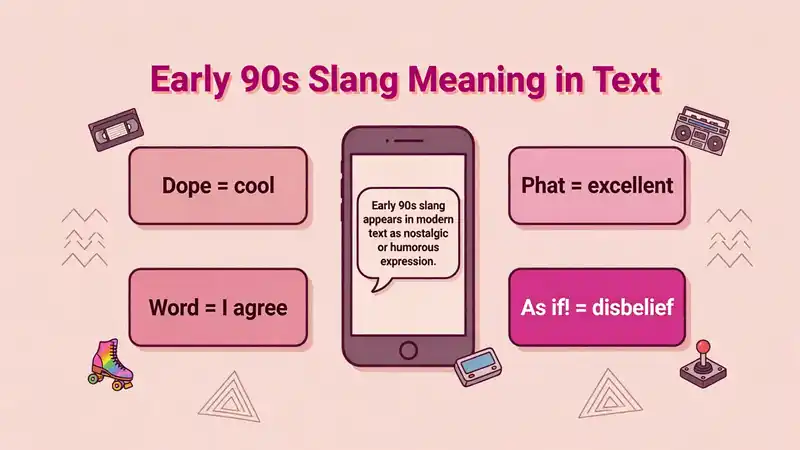
Early 90s slang means informal expressions commonly used or strongly associated with early-1990s culture. Popular examples include “my bad,” “da bomb,” “phat,” “word,” “booyah,” “bail,” and “as if!”
Popular Early 90s Slang Words and Their Meanings
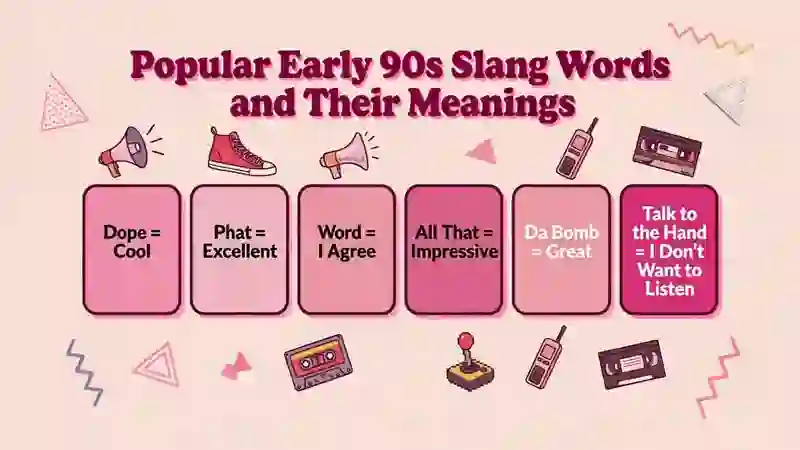
The easiest way to understand early 90s slang is to look at the expressions in context. A word could sound friendly in one conversation and sarcastic in another.
1. Word
Meaning: “Word” could express agreement, approval, or understanding.
By the 1990s, this use had become especially recognizable in informal American speech. Dictionary.com notes that this meaning peaked in usage during the 1990s.
Example:
“That movie was really good.”
“Word.”
Today, younger speakers may recognize the expression from older movies, music, or internet culture, but it can sound distinctly retro when deliberately used.
2. My Bad
Meaning: “My bad” means “my mistake” or “I take responsibility.”
It was useful because it offered a quick, casual apology without sounding overly formal.
Example:
“You sent me the wrong file.”
“My bad. I grabbed the old one.”
Unlike some 1990s expressions, my bad did not completely disappear. It can still sound natural in casual conversation.
3. Da Bomb
Meaning: Something extremely good, impressive, or exciting.
The expression became strongly associated with 1990s popular culture. Dictionary.com notes that Kris Kross’s 1993 song “Da Bomb” helped popularize the expression.
Example:
“That new pizza place is da bomb.”
The phrase is understandable today, but using it seriously may give your sentence a deliberately retro feel.
4. Phat
Meaning: Excellent, impressive, stylish, or very cool.
The spelling phat was used as a slang form of praise, especially in music and youth culture.
Example:
“Those sneakers are phat.”
It is important not to confuse this slang spelling with the ordinary adjective fat. The meaning depends entirely on context.
5. Booyah
Meaning: An excited expression used to celebrate success or victory.
The expression became strongly associated with sports and television personality Stuart Scott, who famously used it during the 1990s.
Example:
“We finally won the game. Booyah!”
The tone is energetic, playful, and celebratory.
Early 90s Slang for Something Cool or Impressive
Several expressions were used to praise something that looked, sounded, or felt impressive.
Da Bomb
Da bomb meant something was excellent or one of the best.
“That concert was da bomb.”
Phat
Phat could describe something stylish, impressive, or excellent.
“That jacket is phat.”
Fly
Fly was used to describe someone or something stylish, fashionable, or attractive.
“Those shoes are fly.”
All That
All that could describe someone or something impressive or special.
The longer expression “all that and a bag of chips” added an exaggerated, humorous twist.
“She thinks she’s all that.”
“That new car is all that and a bag of chips.”
The phrase became strongly connected with 1990s popular culture, although not every expression labeled “90s slang” was invented during that decade.
Early 90s Slang for Disbelief or Sarcasm
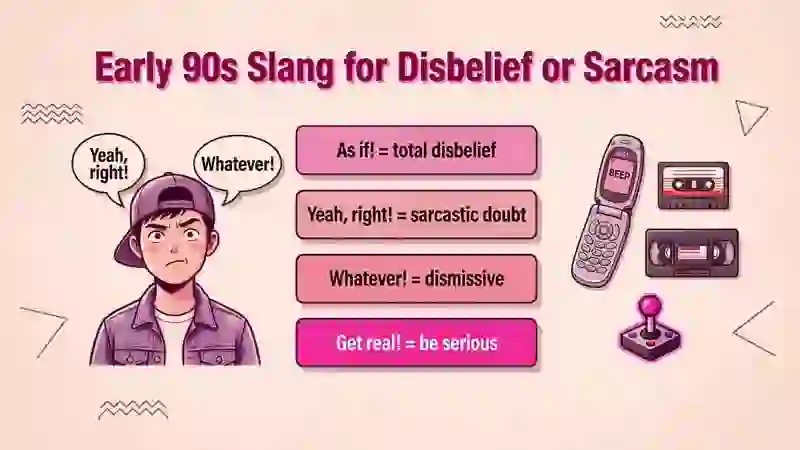
The 1990s also produced several memorable expressions for rejecting an idea or showing disbelief.
As If!
As if! was a sarcastic way to say “No way,” “Absolutely not,” or “I don’t believe that.”
The phrase became especially famous through the 1995 film Clueless, where Cher Horowitz used it as a dismissive response.
Example:
“You think I’m going to clean your room for you?”
“As if!”
The phrase is usually playful or sarcastic rather than genuinely aggressive.
Whatever
Whatever could show that someone did not care about an argument or did not want to continue discussing it.
Example:
“You should have listened to me.”
“Whatever.”
The tone matters. A relaxed “whatever” can sound harmless, while a sharp version can sound dismissive.
No Duh
No duh was used to say that something was obvious.
Example:
“It’s raining outside.”
“No duh. I can see it.”
This expression could be funny between friends but could also sound rude if directed at someone seriously.
Early 90s Slang for Ending a Conversation
Some expressions were designed to shut down an argument or show that the speaker was finished listening.
Talk to the Hand
Talk to the hand was a dismissive phrase meaning something like “I’m not listening” or “I’m done with this conversation.”
It was commonly paired with a raised-hand gesture. Dictionary.com describes it as a dismissive expression sometimes accompanied by that gesture.
Example:
“But you never let me explain!”
“Talk to the hand.”
Because it is dismissive, it can sound rude when used seriously.
Not!
Not! was used after a statement to suddenly reverse or mock what had just been said.
Example:
“I totally finished all my homework. Not!”
This style became memorable through 1990s comedy and youth culture.
Early 90s Slang for Friends
Not every expression was used to describe something cool or sarcastic. Some slang referred to friends or familiar people.
Homey
Homey was an informal term for a close friend or someone from one’s neighborhood or social circle.
Example:
“I’m meeting my homey after school.”
Its history is connected to broader community and cultural speech rather than simply being a word invented by teenagers in the 1990s. This is one reason it is better to describe it as 1990s-associated slang rather than claim that the decade created it.
Homie
Homie is a related spelling that became widely recognizable in informal speech.
Example:
“What’s up, homie?”
The term has roots in African American and regional speech and later became much more broadly recognized through music and popular culture.
Early 90s Slang for Leaving
Bail
Bail could mean leaving a place or situation.
Example:
“It’s getting late. Let’s bail.”
Historical slang records list bail with the informal meaning “to leave” among 1990-era slang.
This is an important example of why slang history can be complicated: the word itself is much older, but its informal “leave” sense became common in casual speech.
When Should You Avoid Early 90s Slang?
Music played a major role in spreading slang during the 1990s. Hip-hop, pop music, television, radio, and movies helped expressions move between different communities.
But it is not accurate to say that every popular slang term came from one source.
Some expressions were associated with:
- Hip-hop and Black American speech
- Teen and school culture
- Skate and street culture
- Television sitcoms
- Movies
- Sports broadcasting
- Regional American speech
- Early online communities
Some expressions that became mainstream had existed in particular communities before wider audiences adopted them. Treating all of these expressions as generic “internet slang” would erase important parts of their history.
How Early 90s Slang Was Different From Modern Internet Slang
Early 90s slang spread differently from today’s online expressions.
In the early 1990s
People often learned slang through:
- Friends and classmates
- Music
- Television
- Movies
- Radio
- Sports
- Magazines
- Local communities
The internet was still developing, so slang did not spread through today’s social-media systems.
Today
Modern slang can spread extremely quickly through:
- Short-form videos
- Memes
- Online communities
- Messaging
- Gaming
- Social platforms
That difference explains why some 1990s expressions feel strongly tied to a specific era.
Early 90s Slang vs. Modern Slang
| Early 90s expression | Meaning | Modern equivalent |
| Da bomb | Excellent | Amazing / fire |
| Phat | Cool or impressive | Fire / sick |
| My bad | My mistake | My fault |
| As if! | No way / disbelief | Yeah, right |
| Booyah | Excited celebration | Let’s go! |
| Word | Agreement | Facts |
| Bail | Leave | Dip / head out |
| Fly | Stylish | Drippy / stylish |
| Talk to the hand | Stop talking | I’m done |
| No duh | Obviously | Obviously / duh |
These are rough comparisons, not exact translations. Modern slang changes by platform, age group, and community.
Where Is Early 90s Slang Used Today?
Most early 90s slang is no longer part of everyday speech for everyone. However, these expressions can still appear in nostalgic or humorous settings.
Movies and TV
Older movies and television shows can preserve the slang of their period.
Social Media
People sometimes use 1990s expressions in retro posts, memes, throwback content, and discussions about 1990s culture.
Texting
A person might deliberately use “my bad,” “word,” or “as if” because the expression still feels understandable or because they want a nostalgic tone.
Writing
Writers may use period-specific slang when creating a character or scene set in the early 1990s.
Are Early 90s Slang Words Still Used?
Some are.
My bad, bail, word, and similar expressions can still be understood and sometimes used naturally.
Others, such as da bomb, talk to the hand, and all that and a bag of chips, are more likely to sound deliberately retro today.
That does not mean they are “wrong.” It simply means their social feel has changed.
A useful rule is:
If the expression sounds like something you would expect to hear in a 1990s movie, use it carefully unless you want that nostalgic effect.
Is Early 90s Slang Rude or Offensive?
Most early 90s slang is informal rather than offensive, but tone matters.
For example:
- My bad → usually friendly or casual
- Word → usually casual
- Da bomb → positive and playful
- As if! → sarcastic
- Whatever → potentially dismissive
- Talk to the hand → dismissive and potentially rude
- No duh → can sound insulting
Some expressions also have cultural histories that should not be ignored. A slang term may have started or developed within a particular community before becoming widely popular.
So it is better to understand where an expression came from and how it was used, rather than treating every 1990s phrase as a simple pop-culture joke.
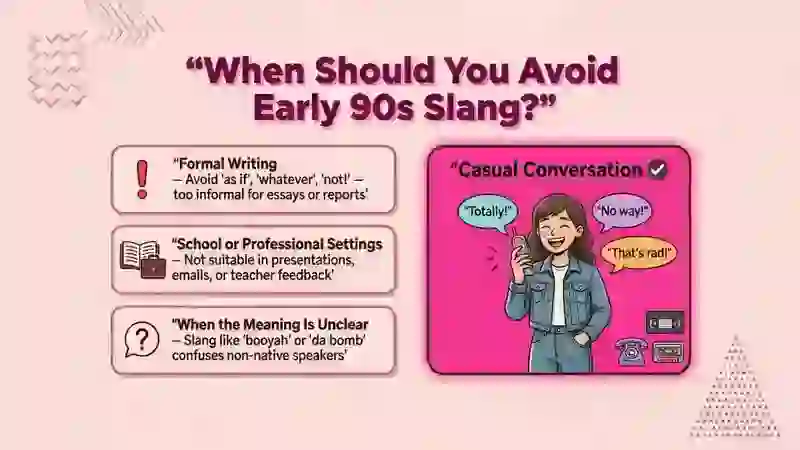
When Should You Avoid Early 90s Slang?
You do not need to avoid these expressions completely. Just choose the setting carefully.
Professional situations
Avoid strongly dated slang in formal emails, reports, interviews, or serious workplace communication.
Instead of:
“That presentation was da bomb.”
Use:
“That presentation was excellent.”
School assignments
Unless you are discussing 1990s language or writing dialogue for a period setting, formal English is usually a better choice.
Serious conversations
Sarcastic expressions such as “whatever” or “talk to the hand” can make a serious conversation worse.
With people unfamiliar with the expression
Someone who did not grow up with 1990s American culture may understand the words but miss the intended tone.
Why Do People Still Search for Early 90s Slang?
There are several reasons people look up these expressions.
Understanding old media
Someone may hear a phrase in an old movie or TV episode and want to know what it meant.
Writing realistic characters
Writers may need period-appropriate language for a character from the early 1990s.
Nostalgia
People who remember the decade may enjoy seeing familiar expressions again.
Social media
Retro content has brought many older expressions back into conversations.
Learning language history
Slang provides a useful way to see how informal English changes over time.
Common Misunderstandings About 90s Slang
Not every “90s slang” term was invented in the 90s
This is one of the biggest mistakes in online slang articles.
Some words were already used before 1990 but became more popular or culturally recognizable during the decade. Historical slang resources, for example, record earlier and 1990s uses of many expressions.
Not everyone used the same slang
American slang varied by region, community, age, and social group.
Movies did not create every expression
Films and television helped spread certain phrases, but they were not necessarily the original source.
“90s slang” is not one fixed language
It is better understood as a broad collection of informal expressions associated with the decade.
20 Early 90s Slang Words and Phrases to Know
Here is a quick reference list:
| Slang | Meaning |
| As if! | No way; disbelief |
| Da bomb | Excellent |
| Phat | Cool or impressive |
| My bad | My mistake |
| Word | Agreement |
| Booyah | Excitement or victory |
| Bail | Leave |
| Fly | Stylish or cool |
| Whatever | Dismissive response |
| No duh | Obviously |
| Talk to the hand | I’m not listening |
| Not! | Just kidding / reversal |
| Homey | Close friend |
| All that | Impressive or important |
| All that and a bag of chips | Extremely impressive |
| Props | Respect or credit |
| Dope | Cool or excellent |
| Fresh | Cool, stylish, or new |
| Tight | Cool or excellent |
| Wassup | What’s up? |
Several of these are widely documented as 1990s expressions, while others have longer histories or continued into later decades.
Frequently Asked Questions
1. What is early 90s slang?
Early 90s slang refers to informal words and phrases that were popular or strongly associated with the early 1990s. Examples include my bad, da bomb, phat, word, booyah, and as if!
2. What was the most popular slang in the early 90s?
There was no single slang word used by everyone. Expressions such as my bad, word, da bomb, phat, as if, and whatever became highly recognizable during the decade.
3. What does “da bomb” mean in 90s slang?
Da bomb means something is excellent, impressive, or very good. It became strongly associated with 1990s popular culture, including Kris Kross’s 1993 song of the same name.
4. What does “phat” mean in 90s slang?
Phat was an informal spelling used to describe something excellent, cool, stylish, or impressive. Its use was especially associated with 1990s youth and music culture.
5. What does “my bad” mean?
My bad is a casual way to admit a mistake or accept responsibility. Unlike many dated 1990s expressions, it is still understood and commonly used in informal English.
6. Is early 90s slang still used today?
Yes, but usage varies. Some expressions remain natural, while others are mostly used for nostalgia, humor, retro content, or period-style writing.
7. What does “as if!” mean?
As if! is a sarcastic way to express disbelief or reject an idea. Its strong association with the 1995 film Clueless helped make it one of the most recognizable 1990s phrases.
8. Is 90s slang appropriate at work?
Some mild expressions, such as my bad, may appear in relaxed workplace conversations, but strongly dated phrases such as talk to the hand or da bomb are better avoided in formal communication.
Conclusion
Early 90s slang gives us a useful look at how informal English changes with music, television, movies, youth culture, and social communities. Expressions such as my bad, word, da bomb, phat, as if, booyah, and talk to the hand remain recognizable because they became closely linked with 1990s culture.
However, not every expression began in the early 1990s. Some were older words that gained new popularity, while others came from particular cultural or regional communities before becoming more widely known.
If you use these expressions today, context is everything. They work well for nostalgia, humor, creative writing, and discussions about 1990s culture, but some may sound dated in everyday conversation.
The best way to understand early 90s slang is not simply to memorize a list. Look at who used the expression, what it meant in that setting, and how its tone has changed over time.
Read more about!
- Slaying Meaning Slang: Definition, Origin, Examples
- Grape Slang Meaning: What Does Grape Mean in Slang?
- What Does Baked Mean in Slang? Examples & Usage

Hi, I’m Nathan Collins. I create easy-to-understand English language content focused on internet slang, texting abbreviations, modern expressions, vocabulary, and word meanings. My goal is to help students, writers, professionals, and English learners communicate with confidence through clear explanations, practical examples, and reliable language guides.