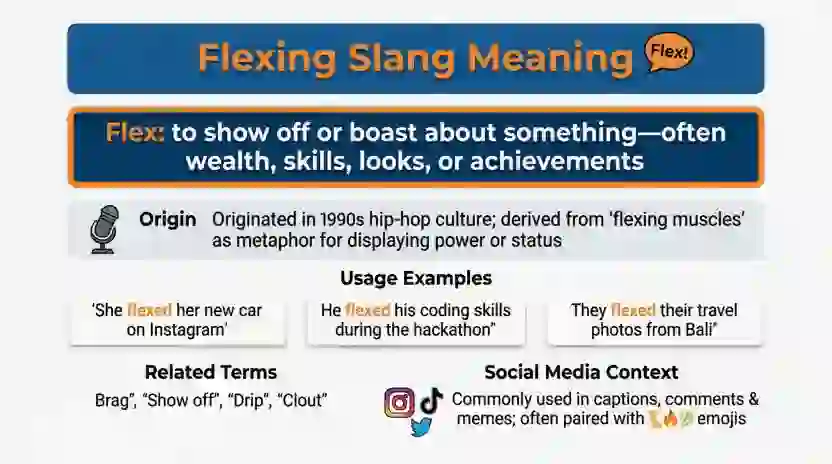
“Flexing” in slang means showing off or bragging about something you have, achieved, or can do. Someone might be flexing a new outfit, expensive item, achievement, skill, or success. The word can sound playful, proud, or critical depending on the situation.
People often search for the flexing slang meaning because “flex” has another older, literal meaning: bending or tightening a muscle. In slang, however, it usually has a social meaning connected with showing something off.
For example, if someone posts a photo of a new watch and clearly wants people to notice it, another person might say, “He’s flexing that new watch.” Likewise, “That’s a big flex” can mean that something is an impressive thing to show off.
This guide explains the meaning, origin, examples, regional usage, common mistakes, and related expressions such as “weird flex” and “no flex.” It also explains when “flexing” sounds natural and when a simpler word like “showing off” is better.
Flexing Slang Meaning: Featured Snippet & AI Overview
Flexing means showing off or bragging about something, such as money, possessions, achievements, skills, or status. In casual online speech, “flexing” can be serious, playful, or sarcastic. For example, “He’s flexing his new car” means he is showing his new car off to others.
Flexing Slang Meaning – Quick Answer
The flexing slang meaning is showing off, bragging, or proudly displaying something.
Common examples include:
- “She’s flexing her new shoes.”
- “He keeps flexing his grades.”
- “That new setup is a serious flex.”
- “Why are you flexing so hard?”
“Flexing” does not always mean someone is being arrogant. Friends may use it jokingly when someone proudly shows an achievement or possession.
Cambridge Dictionary defines the slang verb flex as showing that you are proud or happy about something you have done or own, often in a way that may annoy others.
What Does Flexing Slang Mean?
Simple Definition
In modern slang, flexing means showing off.
A person can flex by talking about something, posting a picture of it, or deliberately drawing attention to it. The thing being shown off can be almost anything.
For example:
“He’s flexing his new sneakers.”
This means he is showing his new sneakers in a way that makes people notice them.
What Can Someone Flex?
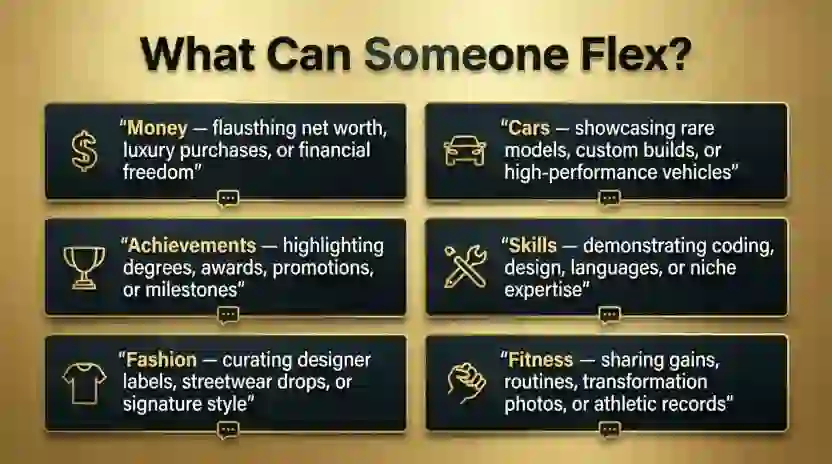
People may use “flex” for:
- Money
- Clothes
- Cars
- Electronics
- Achievements
- Skills
- Grades
- Travel experiences
- Personal style
- A new purchase
- A successful accomplishment
The slang can also describe something that is impressive without necessarily being a boast.
“My biggest flex is that I can speak three languages.”
Here, the speaker is proudly pointing out a skill.
Flex as a Verb
“Flex” can work as a verb:
- “Stop flexing.”
- “He likes to flex online.”
- “She was flexing her new phone.”
“Flexing” is the -ing form of flex.
Flex as a Noun
“Flex” can also be a noun meaning a boast, brag, or thing being shown off. Dictionary.com lists this slang noun sense as a boast or brag.
For example:
“That car is a huge flex.”
The speaker means the car is an impressive thing to show off.
Is Flexing Always Negative?
No.
The tone depends on context.
“Flexing” can sound:
- Playful
- Proud
- Impressive
- Teasing
- Sarcastic
- Annoying
If a friend posts a photo of an achievement, another friend might jokingly call it a flex. In a more critical sentence, “He is always flexing” may suggest that the person shows off too much.
The Origin of Flexing Slang
The word flex is much older than its modern slang meaning. Its basic English sense is connected with bending or tightening a muscle. Oxford traces the verb to the Latin flectere, meaning “to bend.”
The connection to modern slang is easy to understand. When someone flexes a muscle, the muscle becomes visible and is deliberately displayed. That physical idea provides a natural metaphor for displaying strength, possessions, success, or status.
The slang sense became strongly associated with hip-hop and rap language before spreading into wider internet and everyday speech. Historical slang records show the “show strength” or “show off” sense in hip-hop usage by the early 1990s.
It is important not to claim one exact person or date as the single creator of this slang meaning. Slang often develops through repeated community use rather than through one documented invention.
How Did Flexing Become Internet Slang?
Social media made “flex” especially useful because people can easily display purchases, achievements, outfits, trips, skills, and lifestyles through photos and posts.
The phrase “weird flex but OK” later became a recognizable internet expression. Dictionary.com describes it as a sarcastic response to an unusual or questionable brag and notes that the phrase gained traction on Twitter and other online spaces around 2018.
So the modern path can be understood simply:
physical flexing → displaying strength → showing off → social and internet slang
British English vs American English
There is no major spelling difference between British and American English for flex, flexing, or flexed.
The slang meaning is also broadly understood in both varieties of English. The main difference is not the word itself but the surrounding vocabulary and conversational style.
| British English | American English | Example |
| flex | flex | “He’s flexing his new trainers.” / “He’s flexing his new sneakers.” |
| flexing | flexing | “Why are you flexing?” |
| a flex | a flex | “That is quite a flex.” / “That’s a big flex.” |
| showing off | showing off | “She’s showing off her new bag.” |
| trainers | sneakers | “He’s flexing his new trainers/sneakers.” |
Cambridge lists the slang meaning of flex in both its British and American dictionary resources.
Does “Flex” Mean Something Else in British English?
Yes, depending on context.
In British English, flex can also mean an electrical cable or wire. Cambridge lists this as a UK noun meaning a wire covered in plastic that connects electrical equipment to a power supply.
That meaning is completely different from slang “flex.”
Which Version Should You Use?
United States
Use flex or flexing in casual speech, texts, comments, and social media when you mean showing off.
“He’s flexing his new sneakers.”
United Kingdom
“Flex” is also understood as slang. However, context matters because flex has other British English meanings.
“She’s flexing her new outfit.”
Canada
The slang form flex can be used in informal conversations and online communication. The intended meaning is usually clear from context.
Australia
“Flex” can be understood as informal slang, especially in online communication. For formal writing, “showing off” is usually clearer.
International Writing
If your audience includes English learners, showing off is easier to understand than flexing.
You can introduce the slang first:
“He is flexing, or showing off, his new car.”
Academic Writing
Avoid “flexing” when a formal word is more suitable.
Instead, use:
- displaying
- demonstrating
- emphasizing
- boasting
- highlighting
Business Writing
“Flexing” is usually too casual for professional documents.
Instead of:
“The company is flexing its success.”
Use:
“The company is highlighting its recent success.”
Common Mistakes
Mistake 1: Thinking Flex Always Means Bragging
Incorrect assumption:
“Flexing always means being arrogant.”
Better understanding:
Flexing means showing something off, but the tone can be playful or positive.
Memory tip:
Think “flex = display.” The attitude depends on context.
Mistake 2: Confusing Physical Flexing With Slang Flexing
Physical:
“The athlete flexed his muscles.”
Slang:
“He flexed his new shoes.”
The first describes muscle movement. The second means showing something off.
Mistake 3: Using Flexing in Formal Writing
Less suitable:
“The report is flexing the company’s achievements.”
Better:
“The report highlights the company’s achievements.”
Slang is usually best for casual communication.
Mistake 4: Assuming Every Post Is a Flex
Someone can share an achievement without trying to brag.
For example:
“I finally passed my exam!”
This could simply be sharing good news. Calling it a “flex” depends on the tone and context.
Everyday Examples of Flexing
In Text Messages
“Bro, you’re flexing again 😂”
Meaning: You are showing off again, probably in a joking way.
On Social Media
“She’s flexing her new camera.”
Meaning: She is proudly showing her new camera.
In Business Writing
“Flexing” is usually avoided in formal business writing.
Instead:
“The company highlighted its recent growth.”
In News Headlines
Formal news writing normally prefers clearer words such as showcases, displays, or highlights.
For example:
“Company showcases new technology.”
rather than:
“Company flexes new technology.”
In Blogs
A casual blog can use the slang naturally:
“This new laptop is a serious flex for any gamer.”
In Academic Writing
Use formal vocabulary:
“The study demonstrates the researcher’s technical expertise.”
In Daily Conversation
“That jacket is a flex.”
Meaning: The jacket is impressive and looks like something worth showing off.
Google Trends & Modern Usage
The exact search volume or regional Google Trends data for “flexing slang meaning” is not included here, so no specific popularity numbers should be assumed.
What is clear from current dictionary usage is that flex has an established slang meaning connected with showing pride or showing off. Cambridge currently labels this use as slang, while Dictionary.com also records flex as both a slang verb and noun.
People may search for “flexing slang meaning” because the word has several meanings. It can refer to:
- Bending a body part
- Tightening a muscle
- Adjusting or changing something
- Showing off in slang
Online communication adds another layer because expressions such as “weird flex but OK” can use “flex” in a humorous or sarcastic way.
The key point is that context determines the intended meaning.
Quick Comparison Table
| Version | Meaning | Correct? | Region | Example |
| Flex | Show off | Yes | Broad English use | “He likes to flex.” |
| Flexing | Showing off | Yes | Broad English use | “She is flexing her new shoes.” |
| Flexed | Showed off | Yes | Broad English use | “He flexed his new car.” |
| A flex | A boast or display | Yes | Informal | “That watch is a flex.” |
| Weird flex | An unusual boast | Yes | Internet slang | “Weird flex, but OK.” |
| Show off | Display proudly or boastfully | Yes | General English | “Stop showing off.” |
| Brag | Talk proudly about yourself | Yes | General English | “He keeps bragging.” |
| Flex muscles | Tighten muscles | Yes | Literal English | “He flexed his muscles.” |
Key Takeaways
- Flexing slang meaning is mainly showing off or bragging.
- “Flexing” can involve money, clothes, skills, achievements, or possessions.
- The slang meaning comes from the idea of physically flexing muscles to display strength.
- The word has strong historical connections with hip-hop and slang usage.
- “Flex” can be a verb or a noun.
- “A flex” means something that is being shown off.
- “Weird flex but OK” is a sarcastic internet expression.
- “Flexing” is casual, so formal writing often uses showing off, displaying, or highlighting instead.
FAQs About Flexing Slang Meaning
What does flexing mean in slang?
Flexing means showing off or proudly displaying something. It can involve possessions, money, clothes, achievements, skills, or status. For example, “He is flexing his new car” means he is showing the car off. The word can be playful or critical depending on the speaker and situation.
What does flex mean in texting?
In texting, flex usually means to show off or brag. Someone might write, “That’s a flex,” when a friend shares something impressive. It can also be used jokingly, especially between friends. The exact tone depends on the conversation and if the person is seriously showing off.
What does “flexing” mean on social media?
On social media, flexing means deliberately displaying something you are proud of or want other people to notice. This could be a new outfit, achievement, purchase, skill, or experience. A post does not automatically count as flexing, though. The context and intention help determine if it is a flex.
Is flexing a bad word?
No. Flexing is not inherently a bad or offensive word. It is informal slang. It can describe harmless joking between friends or criticism of someone who shows off too much. Because tone matters, “flexing” may sound positive, neutral, or negative depending on how it is used.
What is a flex?
A flex is something that a person shows off or is proud of. For example, someone might say, “My biggest flex is speaking three languages.” The noun can describe an achievement, possession, skill, or other quality that someone wants people to notice.
What does “weird flex but OK” mean?
“Weird flex but OK” is an internet expression used as a humorous or sarcastic response to an unusual boast. It basically means, “That is a strange thing to brag about, but okay.” The phrase became widely recognizable through online culture, especially social media.
Is flexing the same as bragging?
They are very close, but the tone can differ. Bragging usually means talking proudly about yourself or your achievements. Flexing often suggests displaying something so other people will notice it. A person can flex through a photo, purchase, achievement, skill, or comment without directly talking about themselves.
Where did the slang word flex come from?
The basic English word flex comes from Latin roots related to bending. The modern slang sense developed from the idea of displaying physical strength and became associated with hip-hop and broader slang usage before spreading through mainstream and internet communication. The exact development was gradual rather than tied to one confirmed inventor.
Can flexing be used in formal English?
The literal word flex is standard English, but the “showing off” meaning is informal slang. In academic, business, or highly formal writing, clearer words such as displaying, demonstrating, highlighting, or boasting are usually more appropriate.
What is another word for flexing?
Depending on the context, alternatives include showing off, bragging, boasting, flaunting, displaying, highlighting, and showcasing. They are not perfect substitutes in every sentence. “Flexing” is especially useful when describing casual speech, social media, or internet slang.
Conclusion
The flexing slang meaning is simple: showing off or proudly displaying something. A person can flex a possession, achievement, skill, outfit, or another quality they want people to notice.
The word has a literal meaning too. To flex can mean to bend or tighten a muscle. That physical idea helps explain how the slang sense developed into a metaphor for displaying strength, status, or success. Dictionaries now record the slang meaning alongside the traditional meanings.
In casual texts, social media posts, and conversations, “flexing” sounds natural. In academic and professional writing, clearer words such as “showing,” “displaying,” or “highlighting” are often better.
Remember one simple rule: when someone is flexing, they are putting something they are proud of on display.
For more clear explanations of internet slang and modern expressions, explore other slang guides on SlangWork.
Read more about!
- Hey in Spanish Slang: Meaning, Uses & Examples
- Steam Slang Meaning: What Does “Steam” Mean?
- ATP Meaning Slang Twitter: What Does ATP Mean?

Daniel Brooks is an English vocabulary educator who creates simple, practical guides on slang, word meanings, and everyday English. His goal is to help students, writers, and English learners expand their vocabulary and communicate with confidence.