Saying “hey” in Spanish is not as simple as choosing one word. The most common choice is hola, but Spanish speakers also use oye, ey, eh, and other expressions depending on if they are greeting someone, getting attention, or starting a casual conversation.
SpanishDictionary lists both hola and oye as common translations, with oye used especially to get someone’s attention.
This is why people searching for “hey in Spanish slang” may see several answers online. The right word depends on the situation, tone, and sometimes the Spanish-speaking region.
In this guide, you will learn what “hey” means in Spanish slang, when to use hola versus oye, how informal expressions work, and how to use them naturally in texts, social media, conversations, and everyday Spanish.
Hey in Spanish Slang: Featured Snippet & AI Overview
“Hey” in Spanish can be translated as hola, oye, ey, or eh, depending on context. Use hola as a casual greeting and oye when you want to get someone’s attention. For example, “Hey, how are you?” is ¡Hola! ¿Cómo estás?, while “Hey, listen!” can be ¡Oye, escucha!.
Hey in Spanish Slang – Quick Answer
The closest Spanish slang or casual equivalents of “hey” are:
- Hola = Hi / Hey
- Oye = Hey / Listen / Hey, you
- Ey = Hey
- Eh = Hey / Hey there, often to get attention
- Mira = Look / Hey, look
- Escucha = Listen / Hey, listen
The best choice depends on what “hey” is doing in the sentence.
For example:
- “Hey! How are you?” → ¡Hola! ¿Cómo estás?
- “Hey, look at this!” → ¡Oye, mira esto!
- “Hey, listen!” → ¡Oye, escucha!
- “Hey!” when calling someone’s attention → ¡Oye!
SpanishDictionary gives hola for “hey” as a greeting and oye when “hey” is used to attract attention.
What Does Hey in Spanish Slang Mean?
“Hey” is an informal English expression. It can be a greeting, a way to get someone’s attention, or an opening for a conversation.
Spanish does not have one word that matches every use of English “hey.” Instead, speakers choose different expressions based on the meaning.
Hola: Hey as a Greeting
Hola is the most natural choice when “hey” simply means “hi.”
Examples:
- “Hey, Maria!” → ¡Hola, María!
- “Hey, how are you?” → ¡Hola! ¿Cómo estás?
- “Hey, what’s up?” → ¡Hola! ¿Qué tal?
- “Hey there!” → ¡Hola!
This is usually the safest choice for casual greetings.
Oye: Hey to Get Attention
Oye is especially useful when “hey” means “listen,” “hey you,” or “can I get your attention?”
Examples:
- “Hey, look at this.” → Oye, mira esto.
- “Hey, can I ask you something?” → Oye, ¿puedo preguntarte algo?
- “Hey, what’s wrong?” → Oye, ¿qué pasa?
SpanishDictionary describes oye as an informal expression used to attract attention.
Ey: A Casual “Hey”
Ey is also used as a short attention-getting expression. It can feel close to the English “hey.”
For example:
- ¡Ey! Ven aquí. = Hey! Come here.
- ¡Ey! ¿Qué haces? = Hey! What are you doing?
- Ey, mira esto. = Hey, look at this.
However, do not assume that ey is always the best translation. Context still matters.
Eh: Another Attention Word
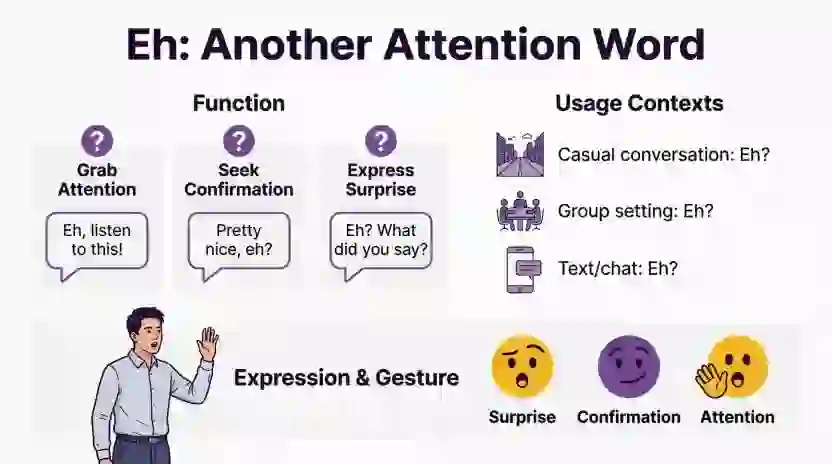
Eh can also express “hey” when someone wants another person’s attention.
For example:
¡Eh! ¿Me oíste?
“Hey! Did you hear me?”
SpanishDictionary includes eh among the possible conversational equivalents of English “hey.”
The Origin of Hey in Spanish
There is an important distinction between the origin of the English word “hey” and its Spanish equivalents.
The English hey is not simply a Spanish slang word translated directly into Spanish. Spanish speakers use their own interjections and greetings, such as hola, oye, eh, and ey, depending on the situation.
For learners, it is more useful to understand how each Spanish expression functions than to search for one exact Spanish word that always replaces “hey.”
The modern use of hola is associated with greeting someone, while oye comes from the Spanish verb oír, meaning “to hear,” and functions as an informal way to get someone’s attention.
This difference explains why a direct word-for-word translation can sometimes sound unnatural.
British English vs American English
The English word “hey” has essentially the same basic meaning in British and American English. The bigger difference appears when you translate it into Spanish, because Spanish choices depend more on context than on if the original English speaker is British or American.
| British English | American English | Example |
| Hey | Hey | “Hey, how are you?” |
| Hey | Hey | “Hey, look at this.” |
| Hey there | Hey there | “Hey there!” |
| Hey, you | Hey, you | “Hey, you!” |
In Spanish, these can change depending on meaning:
| English use | Spanish option | Meaning |
| Hey! Greeting | Hola | Hi / Hey |
| Hey, listen | Oye | Listen / Hey |
| Hey! Attention | Ey / Eh | Hey |
| Hey, look | Oye, mira | Hey, look |
| Hey there | Hola | Hi / Hello |
So the key issue is not British versus American English. It is the function of “hey” in the sentence.
Which Version Should You Use?
Different situations call for different Spanish expressions.
United States
If you are speaking Spanish in the United States, hola is a simple choice for a greeting.
Use oye when you want someone’s attention.
United Kingdom
The same general rule applies. Spanish does not change simply because the English speaker is from the UK.
Canada
For everyday Spanish, hola works well as a greeting, while oye works when calling someone’s attention.
Australia
The same basic distinction applies. Choose the Spanish expression according to the context.
International Writing
For international Spanish learners, hola is usually the easiest choice when “hey” means “hi.”
Use oye when “hey” is being used to get attention.
Academic Writing
Avoid casual expressions such as hey, ey, and oye unless you are discussing dialogue or language use.
Formal Spanish writing normally uses more neutral wording.
Business Writing
For a professional message, do not translate an English “hey” mechanically. A more appropriate Spanish greeting depends on the relationship and level of formality.
For example, Hola is generally much more neutral than using an attention-getting ¡Oye!
Common Mistakes
Mistake 1: Using Hola for Every Meaning of “Hey”
Incorrect:
Hola, mira esto.
This can be understandable, but if the intended English meaning is “Hey, look at this,” Oye, mira esto better captures the attention-getting function.
Correct:
Oye, mira esto.
Mistake 2: Thinking Oye Always Means “Hi”
Incorrect idea:
Oye = hi in every situation
Correct idea:
Oye is commonly used to get someone’s attention or introduce something you want them to hear.
Memory tip:
Hola = greeting.
Oye = attention.
Mistake 3: Using Informal Expressions in Formal Situations
A casual ¡Ey! may work with friends, but it is not automatically appropriate in every professional or formal setting.
Think about who you are speaking to before choosing an informal expression.
Mistake 4: Translating Word for Word
English “hey” can have several functions. Spanish does not need to use the same word for each function.
Always ask:
Is “hey” a greeting, or am I trying to get someone’s attention?
That simple question usually helps you choose the right expression.
Everyday Examples
Here are practical examples showing how “hey” changes in different situations.
Emails
Casual:
Hola, Ana. ¿Cómo estás?
“Hey, Ana. How are you?”
For professional communication, Hola can be used as a greeting, but the complete opening should match the level of formality.
Business Writing
Instead of trying to copy an informal English “Hey,” choose a suitable Spanish greeting.
Example:
Hola, señor García.
This is more neutral than starting a professional message with ¡Ey!
News Headlines
News writing usually avoids casual “hey” expressions unless they are part of a quotation, title, or direct speech.
Blogs
A Spanish-language blog aimed at a casual audience may use hola to welcome readers.
Example:
Hola, amigos. Hoy vamos a hablar de música.
Social Media
Social media often allows more informal language.
Examples:
- ¡Hola! ¿Qué tal?
- ¡Ey! Mira esto.
- Oye, ¿viste el video?
The exact expression depends on the intended tone.
Academic Writing
Formal academic writing normally does not use casual interjections such as “hey.”
If the word appears in a language example, explain its function instead.
Daily Conversation
This is where the differences become easiest to notice.
Hey, how are you?
→ ¡Hola! ¿Cómo estás?
Hey, listen to me.
→ Oye, escúchame.
Hey, look at that!
→ ¡Oye, mira eso!
Hey! Did you hear me?
→ ¡Eh! ¿Me oíste?
These examples show why there is no single Spanish translation for every use of “hey.”
Google Trends & Modern Usage

People searching for hey in Spanish slang are often trying to understand casual Spanish used in texts, conversations, social media, or videos.
The phrase can be confusing because translation tools may show several options. That happens because “hey” can function as either a greeting or an attention-getter.
Modern informal Spanish also varies across countries and communities. Some expressions may sound more natural in one region than another.
For example, SpanishDictionary lists ole and hala as regional options in Colombia and momentito as a regional option in Argentina for certain attention-getting uses of “hey.
There is no reliable reason to treat every slang equivalent as universal Spanish. If you are learning Spanish for international communication, start with the widely understood options:
- Hola for greetings
- Oye for getting attention
- Ey or eh for casual attention-getting contexts
Exact Google Trends numbers are not included here because no verified current dataset was used.
Quick Comparison Table
| Version | Meaning | Correct? | Region | Example |
| Hola | Hi / Hey | Yes | Broad Spanish use | ¡Hola! ¿Cómo estás? |
| Oye | Hey / Listen | Yes | Broad informal use | Oye, mira esto. |
| Ey | Hey | Yes | Informal | ¡Ey! Ven aquí. |
| Eh | Hey / Attention | Yes | Conversational | ¡Eh! ¿Me oíste? |
| Mira | Look / Hey, look | Yes | Conversational | Mira, tengo una idea. |
| Escucha | Listen / Hey, listen | Yes | Conversational | Escucha, por favor. |
SpanishDictionary confirms hola as a greeting equivalent and gives oye, eh, mira, and escucha for attention-getting uses.
Key Takeaways
- Hey in Spanish slang does not have one translation for every situation.
- Hola is the easiest choice when “hey” means “hi.”
- Oye is useful when “hey” is meant to get someone’s attention.
- Ey is a short, casual attention-getting expression.
- Eh can also be used to call attention.
- Mira means “look” and can introduce something you want someone to notice.
- Spanish usage can vary by country and context.
- Always consider if “hey” is a greeting or an attention-getter before translating it.
FAQs
1. How do you say “hey” in Spanish slang?
The most common casual options are hola, oye, ey, and eh. Use hola when “hey” is simply a greeting. Use oye when you are trying to get someone’s attention. Ey and eh can also work as informal attention-getting expressions.
2. What is the Spanish slang word for hey?
There is no single Spanish slang word that matches every use of “hey.” Hola works for a casual greeting, while oye is common when calling someone’s attention. Ey and eh can also be used in informal speech.
3. Does “hola” mean “hey” in Spanish?
Yes. Hola can translate to “hi” or “hey” when the English word is being used as a greeting. For example, “Hey, how are you?” can be translated as ¡Hola! ¿Cómo estás? SpanishDictionary lists hola as a greeting equivalent of “hey.”
4. What does “oye” mean in Spanish slang?
Oye is an informal way to get someone’s attention. Depending on the sentence, it can mean “hey,” “listen,” or “hey, you.” For example, Oye, ¿puedo preguntarte algo? means “Hey, can I ask you something?”
5. Is “ey” used in Spanish?
Yes. Ey can be used as an informal interjection similar to “hey.” It is often used to attract someone’s attention or begin a casual remark. For example, ¡Ey! ¿Qué haces? means “Hey! What are you doing?”
6. Is “hey” rude in Spanish?
Not necessarily. The tone and context matter. Hola is normally a friendly greeting. Oye, ey, or eh can be perfectly normal when used casually, but an abrupt attention-getting expression may sound stronger depending on the situation.
7. What is “hey you” in Spanish slang?
A common informal translation is oye, tú, which is close to “hey, you.” However, the phrase can sound direct depending on tone. If you simply want to greet someone, hola is usually more natural.
8. How do you say “hey, what’s up?” in Spanish?
A natural casual version is Hola, ¿qué tal? You can also hear Hola, ¿qué pasa? depending on the context. The exact wording can vary by region and personal speaking style.
9. What is the difference between “hola” and “oye”?
Hola is mainly a greeting, while oye is commonly used to attract someone’s attention. Compare Hola, Ana (“Hey, Ana”) with Oye, Ana, mira esto (“Hey, Ana, look at this”). This distinction is one of the most useful things to remember.
10. What is the most natural way to say “hey” in Spanish?
If you are simply greeting someone, hola is usually the clearest choice. If you are calling attention to something, oye may be more appropriate. For casual attention-getting, ey or eh can also work depending on context.
Conclusion
The meaning of hey in Spanish slang depends on what you are trying to say. English uses “hey” for several purposes, but Spanish uses different expressions for those functions.
If “hey” means “hi,” hola is the simple choice. If it means “listen” or “pay attention,” oye is often more suitable. Informal expressions such as ey and eh can also be used to get someone’s attention.
The most important lesson is not to translate “hey” word for word every time. Look at the role of the word in the sentence first.
For Spanish learners, a simple rule works well: use hola to greet and oye to get attention. Once you understand that difference, casual Spanish conversations become much easier to follow.
Keep the context in mind, and you will sound more natural when using informal Spanish.
Read more about!
- BTK Meaning Slang: Is It Common in Text Messages?
- Grape Slang Meaning: What Does Grape Mean in Slang?
- Birdie Slang Meaning: Everything You Need to Know

Daniel Brooks is an English vocabulary educator who creates simple, practical guides on slang, word meanings, and everyday English. His goal is to help students, writers, and English learners expand their vocabulary and communicate with confidence.