Looking for the meaning of “pig” in Spanish slang? Spanish has several words for a pig, and some are also used as insults. The most suitable word depends on what you mean and where the speaker is from.
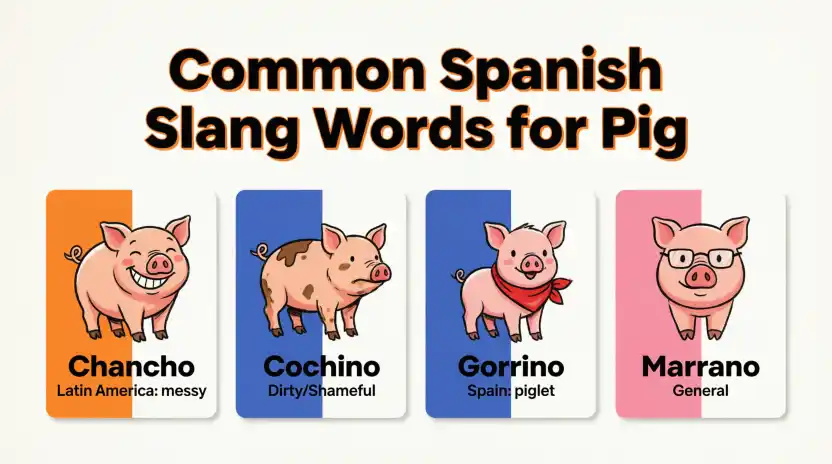
Cerdo is a common, fairly neutral word for the animal. Puerco and cochino can also mean pig, but they may describe a dirty or rude person. Chancho is another word used in several Latin American countries.
These words are not always insults. Someone may use them to talk about a farm animal, food, a messy room, or a person’s bad behavior. Tone matters, too. A joke between close friends may sound offensive when said to a stranger.
This guide explains common Spanish words for pig, how people use them in everyday speech, and which expressions you should use with care. It also includes simple Spanish examples with English translations.
Quick Answer Table
| Question | Answer |
| Common Spanish word for pig | Cerdo |
| Common informal alternatives | Puerco, cochino, chancho, marrano |
| Meaning as an insult | A dirty, rude, or unpleasant person |
| Tone | Neutral, playful, or insulting, depending on context |
| Used in | Everyday Spanish and regional speech |
| Is it offensive? | It can be when directed at a person |
The important difference is that a word for an animal is not automatically an insult. Before using one about a person, consider the situation, the relationship, and the local meaning.
What Does Pig Mean in Spanish Slang?
There is no single Spanish slang word for “pig” that works the same way in every country. Several words can refer to the animal, while some also have negative meanings when used about people.
Here are four common words to know:
- Cerdo (SEHR-doh): A common word for a pig. When aimed at a person, it can suggest that the person is dirty or behaves badly.
- Puerco (PWEHR-koh): Means pig and can also describe someone or something as dirty, nasty, or unpleasant.
- Cochino (koh-CHEE-noh): Means pig in some uses and can describe a person as dirty or messy.
- Chancho (CHAN-choh): Another word for pig used in parts of Latin America. Its tone depends on the place and context.
These words overlap, but they are not perfect substitutes in every sentence. Regional habits can affect which one sounds most natural.
Common Spanish Slang Words for Pig
1. Puerco
Puerco means “pig” and is used in several Spanish-speaking communities. It can also describe someone as dirty, nasty, or rude.
Example:
- Spanish: ¡No seas puerco!
- English: “Don’t be a pig!” or “Don’t be so gross!”
This phrase may be used when someone behaves in a messy or unpleasant way. Depending on the relationship and tone, it may sound teasing or insulting.
2. Cochino
Cochino can refer to a pig or describe someone or something as dirty or filthy. The feminine form is cochina.
Examples:
- Spanish: ¡Qué cochino!
- English: “How gross!” or “What a dirty person!”
- Spanish: No seas cochino.
- English: “Don’t be gross.”
People may use this word when someone makes a mess or behaves in a way they find unpleasant. It can be playful, but it can also hurt someone’s feelings.
3. Cerdo
Cerdo is a common Spanish word for the animal. When used about a person, it can be an insult that suggests dirty, selfish, or unpleasant behavior.
Example:
- Spanish: Se comportó como un cerdo.
- English: “He behaved like a pig.”
This sentence criticizes the person’s behavior rather than simply naming an animal. It can sound harsh, so use it carefully when talking to or about someone.
4. Chancho
Chancho means “pig” in several Latin American varieties of Spanish. In some places, it is a normal everyday word for the animal.
Example:
- Spanish: El chancho está en la granja.
- English: “The pig is on the farm.”
The word does not automatically insult anyone. If it is used about a person, the meaning depends on the speaker’s country, tone, and intended message.
5. Marrano
Marrano is another word for pig. It can also be used informally to describe someone as dirty or unpleasant.
Example:
- Spanish: No seas marrano; limpia la mesa.
- English: “Don’t be messy; clean the table.”
The tone can be direct or teasing. It is best not to assume that everyone will hear it the same way.
Where Are These Words Used?
Spanish varies across countries and communities. These are broad usage notes, not strict rules: people within the same country may choose different words.
| Word | General Usage Note | Possible Tone |
| Cerdo | Widely understood as a word for pig | Neutral for the animal; insulting about a person |
| Puerco | Common in some Latin American varieties, including Mexican Spanish | Neutral or negative, depending on use |
| Cochino | Used in different Spanish-speaking regions | Can suggest dirtiness or gross behavior |
| Chancho | Used in parts of Latin America | Often a straightforward animal name; context matters |
| Marrano | Used in various Spanish-speaking communities | Can be neutral or disparaging |
Do not use this table to guess someone’s nationality. The same speaker may use more than one of these words, and local preferences can vary.
What Does “Pig” Mean as an Insult in Spanish?
When a Spanish speaker calls someone a cerdo, puerco, or cochino, the person may be criticizing their behavior. The intended meaning could be “dirty,” “gross,” “rude,” or “disrespectful.”
For example:
- Eres un cerdo. — “You’re a pig.”
- Qué puerco eres. — “You’re so gross.”
- No seas cochino. — “Don’t be so dirty” or “Don’t be gross.”
These translations depend on context. They are examples of informal speech, not polite ways to address someone.
A person might use a phrase jokingly with a close friend. The same words could sound mean when directed at someone during an argument. If you are learning Spanish, it is safer to understand these expressions before trying them out.
Is “Pig” a Bad Word in Spanish?
Not always. Words such as cerdo, puerco, and chancho can simply name the animal. They may also appear in conversations about farms or food.
The tone changes when the word is aimed at a person.
- Neutral: El cerdo está en la granja. — “The pig is on the farm.”
- Critical: Se comportó como un cerdo. — “He behaved like a pig.”
- Informal warning: No seas cochino. — “Don’t be gross.”
These phrases do not all have the same strength. Still, calling someone a pig can be insulting, especially if you are criticizing their cleanliness or manners.
If you want to describe a messy room without insulting anyone, you can say La habitación está muy sucia, meaning “The room is very dirty.”
Real-Life Examples of Pig in Spanish Slang
These examples show how the words can work in everyday situations. Their tone may vary by region.
1. Talking About a Messy Room
Spanish
Lucía: ¡Qué cochino está tu cuarto!
Diego: Tienes razón. Voy a limpiarlo.
English
Lucía: “Your room is so messy!”
Diego: “You’re right. I’ll clean it.”
Here, cochino describes how dirty or messy the room is. It is not being used as the name of an animal.
2. Talking About Bad Manners
Spanish
Mateo: No seas puerco. Usa una servilleta.
Andrés: Está bien, perdón.
English
Mateo: “Don’t be gross. Use a napkin.”
Andrés: “Okay, sorry.”
In this example, puerco criticizes someone’s manners. Depending on their relationship, it could sound like a casual reminder or a rude comment.
3. Talking About an Animal
Spanish
Sofía: El chancho tiene mucha comida.
Elena: Sí, el granjero acaba de alimentarlo.
English
Sofía: “The pig has plenty of food.”
Elena: “Yes, the farmer just fed it.”
Here, chancho simply means the animal. There is no insult.
4. Criticizing Someone’s Behavior
Spanish
Rafael: Se burló de todos. Se comportó como un cerdo.
Inés: Sí, fue muy grosero.
English
Rafael: “He made fun of everyone. He behaved like a pig.”
Inés: “Yes, he was very rude.”
The comparison is about bad behavior, not physical appearance.
Spanish Words for Pig: Comparison Table
| Spanish Word | Basic Meaning | Can Describe a Person? | Usage Tip |
| Cerdo | Pig | Yes | Often neutral for the animal; can be insulting about a person |
| Puerco | Pig | Yes | Can suggest dirty or nasty behavior |
| Cochino | Pig; dirty or gross | Yes | May describe a person, object, or action as dirty |
| Chancho | Pig | Sometimes | Often names the animal; regional usage varies |
| Marrano | Pig | Yes | Can suggest someone is dirty or unpleasant |
If you simply want to name the animal, cerdo is a useful general choice. If you hear one of the other words, use the full sentence to work out if it is neutral, playful, or insulting.
Common Mistakes to Avoid
- Assuming every word is an insult: Cerdo and chancho can refer to a real animal without any negative meaning.
- Thinking all Spanish-speaking countries use the same word: Vocabulary and tone vary by region.
- Using an insult without knowing its strength: A phrase that sounds playful to one speaker may offend another.
- Confusing a dirty person with a dirty object: The sentence tells you what the word describes.
- Translating every phrase word for word: “Don’t be a pig” may be closer to “Don’t be gross” or “Don’t be messy” in some contexts.
When you are unsure, use a neutral word or ask a fluent speaker how the phrase sounds locally.
Key Takeaways
- Cerdo, puerco, cochino, chancho, and marrano can all refer to a pig.
- Some of these words can also insult a person or describe dirty behavior.
- The meaning and tone depend on the sentence, the speaker, and the region.
- Cerdo is a useful general word when you mean the animal.
- Be careful when using these words about people because they can sound rude.
FAQs About Pig in Spanish Slang
1. What is the most common Spanish slang word for pig?
There is no single slang word used everywhere. Cerdo is a widely understood word for the animal, while puerco, cochino, chancho, and marrano are used in different regions and contexts. Some are also used to describe people as dirty or unpleasant, so the best choice depends on what you want to say.
2. Does “puerco” mean pig or dirty person?
It can mean both. Puerco is a Spanish word for a pig, but it can also describe a person or thing as dirty or unpleasant. For example, No seas puerco can mean “Don’t be gross.” Read the full sentence to tell if the speaker is talking about an animal or criticizing someone’s behavior.
3. What does “cochino” mean in Spanish slang?
Cochino can mean “pig,” “dirty,” or “gross,” depending on how it is used. Someone may say No seas cochino to tell another person not to behave in a messy or unpleasant way. It can sound playful between people who know each other, but it may also sound rude.
4. Is “cerdo” an insult in Spanish?
Cerdo is not automatically an insult. It is a normal word for the animal. When someone calls a person a cerdo or says they behaved como un cerdo, it can criticize their manners or behavior. The tone is usually more negative when the word is directed at a person rather than an animal.
5. What is the difference between “cerdo” and “chancho”?
Both words can mean “pig.” Cerdo is widely understood across Spanish-speaking regions, while chancho is used in several parts of Latin America. Local habits affect which word sounds most natural. Neither word should automatically be treated as an insult when it refers to the animal.
6. How do you say “Don’t be a pig” in Spanish?
One option is No seas puerco or No seas cochino. Depending on the situation, these can mean “Don’t be gross” or “Don’t be so messy.” The expressions are informal and can sound rude if said sharply. A more polite choice is to describe the action directly, such as asking someone to clean up.
7. Is “marrano” rude in Spanish?
Marrano can mean a pig, and it can also describe someone as dirty or unpleasant. If it sounds rude depends on the context and local use. It is safest to avoid calling someone marrano unless you understand how the word is used in that person’s community and know that the tone is welcome.
8. Can I use these Spanish words as jokes with friends?
You can hear these words used jokingly, but that does not mean everyone likes being called a pig. Friends may understand the tone differently from strangers, and regional meanings can vary. If you are learning Spanish, listen to how fluent speakers use the words first. A neutral phrase is safer when you are unsure.
Conclusion
Spanish has several words for “pig,” and each can carry a slightly different tone. Cerdo is a useful general word for the animal. Puerco and cochino can also describe someone or something as dirty or gross, while chancho is common in parts of Latin America. Marrano is another word whose meaning depends on context.
The main thing to remember is that these words are not always slang or insults. A farmer talking about a pig is using an animal name. Someone saying No seas cochino may be criticizing another person’s behavior.
Spanish also varies by region, so a word that sounds normal in one place may sound stronger in another. If you are learning the language, focus on the full sentence and the speaker’s tone before deciding what a word means. When speaking to someone you do not know well, choose polite, clear wording instead of an insult.
Read more about!
- Bitchin Slang: Meaning, Origin, Examples & How to Use It
- BTK Meaning Slang: Is It Common in Text Messages?
- Grape Slang Meaning: What Does Grape Mean in Slang?
- Birdie Slang Meaning: Everything You Need to Know

Daniel Brooks is an English vocabulary educator and content editor with experience creating educational resources about English words, idioms, and everyday communication. He reviews language content for clarity, accuracy, and readability to ensure readers receive reliable and easy-to-understand information.