Quick Answer
Stomach in Spanish slang usually refers to informal words like panza, barriga, or guata, depending on the country
. These words often mean belly, tummy, or gut rather than the medical organ. They are common in everyday conversations among friends and family, while estómago is the standard and more formal word.
Many people search for stomach in Spanish slang because they hear these words in movies, social media, music, or conversations with native speakers.
The meaning can change by region, so knowing where a word is used helps you avoid confusion. In this guide, you’ll learn the most common slang terms, where they’re popular, if they’re rude, and how native speakers use them in real life.
What Does “Stomach” in Spanish Slang Mean?
Unlike English, Spanish has several informal words that can refer to the stomach or belly. The exact meaning depends on the country and the situation.
In most casual conversations, these slang words describe the outside belly area rather than the internal stomach organ. If someone says their panza hurts, they may simply mean their belly hurts, not necessarily their digestive system.
Here is a quick comparison.
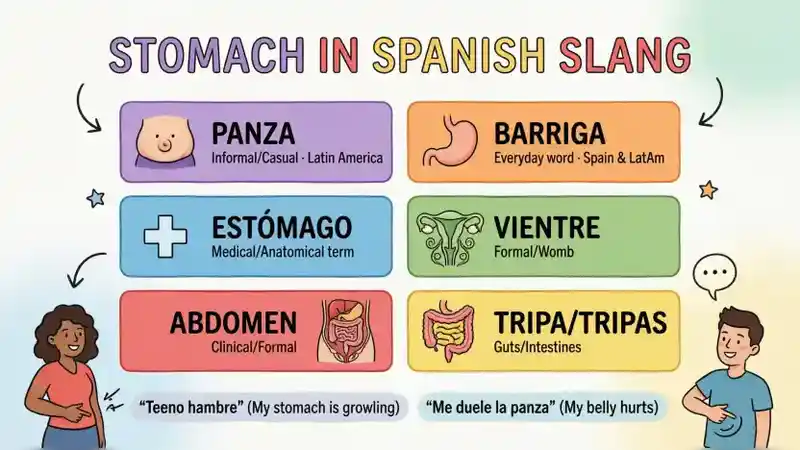
| Word | Meaning | Formal or Slang | Common Regions |
| Estómago | Stomach (medical term) | Formal | All Spanish-speaking countries |
| Panza | Belly, tummy, gut | Informal | Mexico, Central America, parts of South America |
| Barriga | Belly | Informal but widely accepted | Spain and Latin America |
| Guata | Belly, tummy | Regional slang | Chile |
| Tripa | Belly, gut | Informal | Spain and some Latin American countries |
The safest choice in formal situations is estómago, while the others fit relaxed conversations.
Full Meaning of “Stomach” in Spanish
The standard Spanish word for stomach is estómago. Doctors, teachers, textbooks, and news articles almost always use this word.
However, native speakers often replace it with everyday expressions when talking with friends or family. These alternatives usually sound warmer, more natural, and less formal.
For example:
- “Me duele el estómago.” → “My stomach hurts.” (formal)
- “Me duele la panza.” → “My belly hurts.” (casual)
- “Tengo la barriga llena.” → “My belly is full.” (casual)
Although these phrases describe a similar area of the body, the tone changes depending on the word you choose.
Different Meanings of Stomach in Spanish Slang
Panza
Panza is one of the best-known slang words for stomach in Spanish. It usually means belly, gut, or tummy.
People often use it when talking about eating too much, feeling hungry, or having a stomachache.
Examples
- “Después de la pizza me duele la panza.”
- “Mi panza está llena.”
The word is friendly and very common in Mexico and several Latin American countries.
Barriga
Barriga also means belly. It is widely understood across the Spanish-speaking world.
Depending on the context, it can describe:
- A person’s belly
- A pregnant belly
- A full stomach after eating
Examples
- “Tengo la barriga llena.”
- “El bebé está en la barriga de mamá.”
This word sounds natural and is generally not offensive.
Guata
In Chile, many people say guata instead of estómago or panza.
Examples include:
- “Me duele la guata.”
- “Tengo hambre, mi guata está vacía.”
Outside Chile, some people may not recognize this expression.
Tripa
Tripa literally means intestines in some contexts, but in everyday speech it can also mean belly or gut.
Examples:
- “Me duele la tripa.”
- “Tengo la tripa llena.”
It is especially common in Spain.
Where Is It Commonly Used?
The slang word you hear depends on the country.
| Country | Common Word |
| Mexico | Panza |
| Spain | Barriga, Tripa |
| Chile | Guata |
| Argentina | Panza, Barriga |
| Colombia | Barriga |
| Peru | Panza, Barriga |
| Guatemala | Panza |
| El Salvador | Panza |
Learning these regional differences helps you understand movies, YouTube videos, travel conversations, and social media posts more easily.
Is “Stomach” in Spanish Slang Rude, Offensive, or Harmless?
Most Spanish slang words for stomach are harmless. They are used in everyday conversations and are not considered offensive.
However, the tone depends on how and who you are talking to.
| Word | Tone | Safe to Use? |
| Estómago | Formal | ✅ Yes, everywhere |
| Panza | Casual | ✅ Yes, with friends and family |
| Barriga | Casual | ✅ Yes, widely accepted |
| Guata | Regional slang | ✅ Yes, mainly in Chile |
| Tripa | Informal | ✅ Yes, mostly in Spain |
Avoid using slang in formal situations such as:
- Business meetings
- Academic writing
- Medical reports
- Job interviews
- Official presentations
In these settings, estómago is the better choice.
Real-Life Examples of Stomach in Spanish Slang
Seeing these words in context makes them much easier to remember.
Friendly Conversation
Carlos: ¿Quieres otra hamburguesa?
Luis: No, mi panza ya está llena.
English: No, my belly is already full.
Family Conversation

Mamá: ¿Te duele la barriga?
Niño: Sí, creo que comí demasiado.
English:
Mom: Does your tummy hurt?
Child: Yes, I think I ate too much.
Text Message
“Después del buffet tengo la panza explotando 😂.”
English: After the buffet, my belly feels like it’s going to explode.
Social Media Caption
“Comida increíble. Ahora toca descansar porque la panza quedó feliz.”
English: Amazing food. Now it’s time to rest because my belly is happy.
Travel Conversation
Turista: Comí demasiado.
Amigo: Sí, se nota por tu panza.
English: Yeah, you can tell by your belly.
Origin and History
The formal word estómago comes from Latin and has been part of Spanish for centuries.
The informal words developed naturally in everyday speech.
Panza
- Used for many generations in Latin America.
- Common in Mexico, Guatemala, Peru, and Argentina.
- Often refers to the belly rather than the internal stomach.
Barriga
- An old Spanish word still widely used today.
- Common across Spain and Latin America.
- Frequently appears in family conversations.
Guata
- A regional expression mainly heard in Chile.
- Rare outside Chile.
Tripa
- Originally referred to the intestines.
- Over time, it also became an informal way to talk about the belly in everyday Spanish.
These words did not originate from internet slang. They are traditional regional expressions that have remained popular for many years.
Similar Slang or Related Terms
If you’re learning Spanish, you may also hear these related words.
| Word | Meaning | Common Region |
| Panza | Belly | Mexico, Latin America |
| Barriga | Belly | Spain & Latin America |
| Guata | Belly | Chile |
| Tripa | Gut, belly | Spain |
| Abdomen | Abdomen | Medical or formal |
| Estómago | Stomach | Standard Spanish |
Although some words overlap, each has its own tone and regional preference.
When Should You Avoid Using These Slang Words?
While these expressions are friendly, there are situations where formal language is a better option.
Avoid slang when:
- Speaking with a doctor.
- Writing school assignments.
- Preparing business documents.
- Giving professional presentations.
- Taking language proficiency exams.
Instead, use estómago, which is understood everywhere and sounds more professional.
Using the correct word for the situation shows respect and helps avoid misunderstandings.
Polite Alternatives
If you want neutral or formal Spanish, use these words instead.
| Informal Word | Better Formal Alternative |
| Panza | Estómago |
| Barriga | Estómago (medical context) |
| Guata | Estómago |
| Tripa | Estómago |
For children or casual family conversations, barriga is also a gentle and natural choice.
Why Do People Use Stomach in Spanish Slang?
People often choose slang words because they sound more natural in daily conversation than the formal word estómago.
Common reasons include:
- They are easier and quicker to say.
- They sound friendly and relaxed.
- They are common in family conversations.
- They fit casual texting and social media.
- They reflect local culture and regional speech.
For example, someone is much more likely to say “Me duele la panza” to a friend than “Me duele el estómago.”
Common Misunderstandings
Many Spanish learners think all words for “stomach” mean exactly the same thing. They do not.
Here are a few common mistakes.
| Mistake | Correct Explanation |
| Panza means the medical stomach | It usually means belly or tummy. |
| Every country uses the same slang | Different regions prefer different words. |
| Barriga is offensive | No. It is a common everyday word. |
| Guata is used everywhere | It is mainly heard in Chile. |
| Tripa always means intestines | In casual speech, it can also mean belly. |
Understanding these differences helps you sound more natural when speaking Spanish.
Frequently Asked Questions
1. What is the most common slang word for stomach in Spanish?
The most common slang word is panza, especially in Mexico and many Latin American countries. It usually means belly or tummy.
2. Is “panza” rude?
No. Panza is generally a friendly, everyday word. It is informal but not considered offensive.
3. What is the difference between estómago and panza?
Estómago is the formal and medical word for the stomach. Panza is an informal word that usually refers to the belly.
4. Which countries use “panza”?
You will commonly hear panza in Mexico, Guatemala, Peru, Argentina, and several other Latin American countries.
5. Is stomach slang different in Spain and Latin America?
Yes. Spain commonly uses barriga and tripa, while many Latin American countries prefer panza. Chile is well known for using guata.
6. Can I use these slang words at work?
It depends on the workplace. Casual conversations with coworkers may be fine, but estómago is the better choice for professional or formal communication.
7. What slang word means belly or tummy?
Words such as panza, barriga, guata, and tripa can all mean belly or tummy, depending on the region.
8. Is “barriga” slang?
Barriga is informal rather than true slang. It is widely accepted in everyday Spanish and is understood in many countries.
9. How do young people say stomach in Spanish?
Most young people use the same regional words as adults, such as panza, barriga, or guata. There is no universal Gen Z slang term for stomach.
10. Which word should beginners use?
Beginners should learn estómago first because it is the standard word understood everywhere. Then, learn regional words like panza or barriga for casual conversations.
Conclusion
The meaning of stomach in Spanish slang depends on the country and the situation. While estómago is the standard Spanish word, native speakers often use informal words such as panza, barriga, guata, and tripa in everyday conversations.
These expressions are friendly, widely understood within their regions, and generally harmless.
If you’re learning Spanish, start with estómago for formal situations and gradually add regional slang as you become more comfortable. Knowing when and where to use each word will help you understand native speakers, enjoy Spanish-language movies and social media, and communicate more naturally.
Read more about!
- UK Slang Words Roadman: Meaning, Popular Terms & Examples
- Bitchin Slang: Meaning, Origin, Examples & How to Use It
- BTK Meaning Slang: Is It Common in Text Messages?
- Grape Slang Meaning: What Does Grape Mean in Slang?
- Birdie Slang Meaning: Everything You Need to Know

Hi, I’m Olivia Harper. I create clear and easy-to-understand English language content, including word meanings, slang explanations, idioms, synonyms, and everyday vocabulary. My goal is to help students, writers, professionals, and English learners improve their communication skills with simple explanations, practical examples, and reliable language guides.