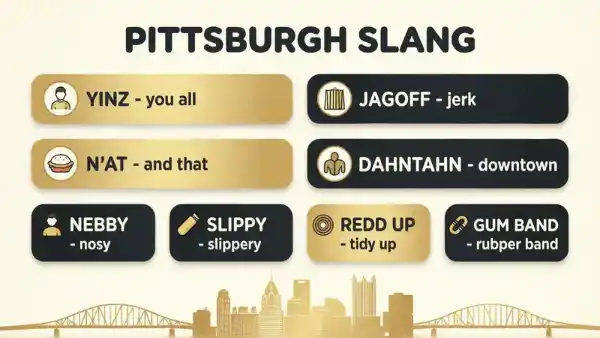
Pittsburgh slang refers to the distinctive words, expressions, and speech patterns associated with Pittsburgh and western Pennsylvania.
You may hear these terms in everyday conversations, local social media posts, sports discussions, and casual messages. Some expressions are so closely connected with Pittsburgh that they have become part of the city’s cultural identity.
If you have heard someone say “yinz,” “dahntahn,” “nebby,” “redd up,” or “n’at,” you may have wondered what these unusual words mean. They are part of what locals often call Pittsburghese, a regional variety of American English.
Pittsburghese is more than an accent. It includes vocabulary, grammar, pronunciation, and expressions that developed through the region’s history and communities. Some features have roots in Scots-Irish speech, while others became strongly associated with western Pennsylvania over time.
Quick Answer:
Pittsburgh slang is the collection of regional words and expressions used around Pittsburgh, Pennsylvania. Famous examples include yinz for “you all,” nebby for “nosy,” and redd up for “clean or tidy up.”
What Does Pittsburgh Slang Mean in Text?
In text messages, Pittsburgh slang usually refers to local words or spellings that represent Pittsburghese.
For example:
“Are yinz going dahntahn?”
A person unfamiliar with Pittsburghese might wonder what this means.
In standard English, it is roughly:
“Are you all going downtown?”
Here, yinz means “you all,” while dahntahn represents the local pronunciation of “downtown.”
Pittsburgh slang can appear in:
- Text messages
- Social media posts
- Local memes
- Sports conversations
- Online communities
- Casual conversations
- Pittsburgh-themed merchandise
Not every Pittsburgher uses every expression, and some terms are more strongly associated with older or traditional Pittsburgh speech. Linguists also note that several features commonly called Pittsburghese occur elsewhere in the broader Appalachian or regional American speech area.
What Is Pittsburghese?
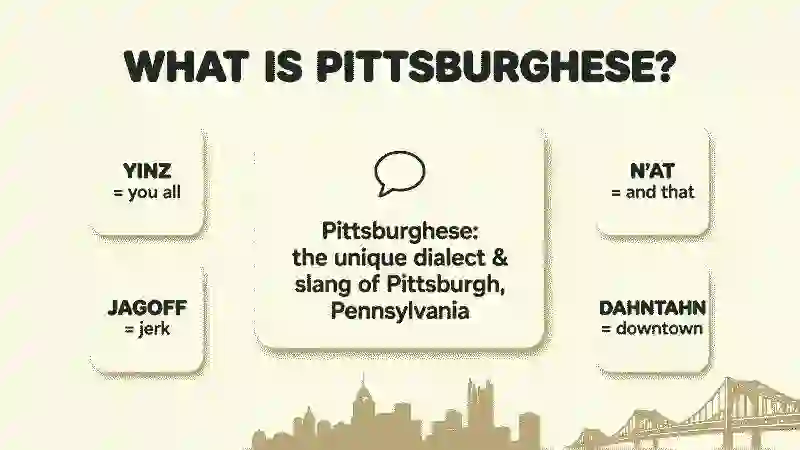
Pittsburghese is the name commonly used for the regional variety of English associated with Pittsburgh and southwestern Pennsylvania.
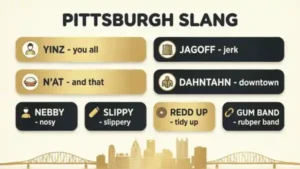
It includes distinctive vocabulary and pronunciation. Some famous examples include:
- Yinz — you all
- Nebby — nosy
- Redd up — clean or tidy
- Slippy — slippery
- N’at — and that / etc.
- Dahntahn — downtown
- Stillers — Steelers
The Pittsburgh accent and vocabulary developed over a long period. Linguistic research has connected many regional words and structures with Scots-Irish influence, while immigration from various European communities also helped shape Pittsburgh’s broader linguistic culture.
30+ Pittsburgh Slang Words and Their Meanings
1. Yinz
Meaning: You all or you guys.
Yinz is probably the most famous Pittsburgh word. It functions as a plural second-person pronoun, similar to “y’all” in parts of the American South.
Example:
“Are yinz coming to the game?”
Standard English: “Are you all coming to the game?”
Merriam-Webster identifies yinz as a Pittsburgh regional pronoun, while linguistic sources connect it with older Scots-Irish forms such as “you ones.”
2. Yinzer
Meaning: A person associated with Pittsburgh or Pittsburgh culture.
Yinzer comes from yinz and can refer to someone who strongly identifies with Pittsburgh.
The term can be used proudly by locals, although its tone can vary depending on context.
Example:
“He’s a proud Yinzer.”
It can describe someone who embraces Pittsburgh traditions, local speech, sports culture, and regional identity.
3. Jagoff
Meaning: A jerk, fool, or annoying person.
Jagoff is one of the best-known Pittsburgh insults. It is generally derogatory, but it can sometimes be used playfully between people who know each other well.
Example:
“Don’t be a jagoff.”
The word has a longer regional history and is connected with jag, meaning to poke or irritate. PBS identifies it as a Pittsburgh-area derogatory term for someone considered inconsiderateor inept.
4. Nebby
Meaning: Nosy or overly curious about other people’s business.
Example:
“Quit being so nebby.”
This means:
“Stop being so nosy.”
Nebby is one of the classic Pittsburgh words and is also found in broader southwestern Pennsylvania speech.
5. Redd Up
Meaning: Clean up or make something tidy.
Example:
“Redd up your room before your friends arrive.”
This means:
“Clean up your room before your friends arrive.”
The phrase is a particularly recognizable feature of Pittsburghese. Linguistic sources have connected it with Scots-Irish regional English.
6. N’at
Meaning: And that, and so on, or et cetera.
You may see n’at at the end of Pittsburgh-style sentences.
Example:
“We’re going downtown, n’at.”
It can have a loose meaning similar to:
“We’re going downtown and stuff.”
It does not always have a precise one-word translation. Its meaning depends on the sentence.
7. Dahntahn
Meaning: Downtown.
Dahntahn represents a characteristic Pittsburgh pronunciation of “downtown.”
Example:
“I’m heading dahntahn.”
Standard English: “I’m heading downtown.”
The spelling is often used online to imitate or represent the local pronunciation.
8. Slippy
Meaning: Slippery.
Example:
“Watch out. The sidewalk is slippy.”
This word is especially useful when discussing wet, icy, or otherwise slippery surfaces.
9. Gumband
Meaning: Rubber band.
Example:
“Can you give me a gumband?”
A gumband is simply what many other English speakers call a rubber band.
10. Sweeper
Meaning: Vacuum cleaner.
In Pittsburgh-area speech, sweeper can refer to a vacuum cleaner.
Example:
“The carpet needs cleaned. Get the sweeper.”
This is another example of regional vocabulary that can confuse someone who has learned only standard American English.
11. Pop
Meaning: Soda or soft drink.
Like many areas of the United States, Pittsburgh commonly uses pop for carbonated soft drinks.
Example:
“Do you want a pop?”
This usage is not unique to Pittsburgh, but it is common in the region.
12. Jimmies
Meaning: Sprinkles used on desserts.
Example:
“Can I get chocolate jimmies on my ice cream?”
The term appears in Pittsburgh-area vocabulary lists and is part of the region’s distinctive food-related language.
13. Chipped Ham
Meaning: Very thinly sliced ham.
Example:
“Let’s get some chipped ham for sandwiches.”
This is a well-known Pittsburgh food expression and is closely associated with local food culture.
14. Buggy
Meaning: Shopping cart.
In Pittsburgh and parts of western Pennsylvania, buggy can mean the cart used to carry groceries through a store.
Example:
“Grab a buggy before we start shopping.”
15. Crick
Meaning: Creek.
Example:
“We used to play near the crick.”
This pronunciation and vocabulary choice are associated with western Pennsylvania and other regional varieties of American English.
16. Spicket
Meaning: Outdoor water faucet or spigot.
Example:
“Turn off the spicket.”
The word is another regional feature sometimes associated with Pittsburgh speech.
17. Stillers
Meaning: The Pittsburgh Steelers.
Stillers is a pronunciation associated with the Pittsburgh accent.
Example:
“The Stillers are playing Sunday.”
The spelling represents the way the team’s name may sound in a strong local accent.
18. Pixburgh
Meaning: Pittsburgh.
Pixburgh is an informal spelling used to imitate the local pronunciation of Pittsburgh.
It can appear online, especially in humorous or affectionate references to the city.
19. Aht
Meaning: Out.
For example:
“Let’s go aht.”
This represents the Pittsburgh pronunciation of “out.”
20. Dahn
Meaning: Down.
Example:
“I’m going dahn to the store.”
It is commonly seen as part of written attempts to represent Pittsburgh pronunciation.
21. Howzabaht
Meaning: How about?
Example:
“Howzabaht we get something to eat?”
The spelling imitates the way the phrase can sound in a Pittsburgh accent.
22. Jeet?
Meaning: Did you eat?
Example:
“Jeet yet?”
In casual Pittsburgh-style speech, the words can be compressed so much that the phrase sounds like one short word.
23. Sammich
Meaning: Sandwich.
Sammich is an informal pronunciation sometimes associated with Pittsburgh speech and casual American English.
Example:
“I’m making a sammich.”
24. Jumbo
Meaning: Bologna.
In Pittsburgh-area vocabulary, jumbo can refer to bologna.
Example:
“I’ll have a jumbo sandwich.”
This is another example of how regional food vocabulary can become part of local identity.
25. Haus
Meaning: House.
Haus represents a Pittsburgh-style pronunciation rather than a completely different word.
Example:
“We’re going back to the haus.”
26. Grauge
Meaning: Garage.
This spelling represents a local pronunciation.
Example:
“The car is in the grauge.”
27. Meer
Meaning: Mirror.
Meer is another spelling used to represent a Pittsburgh pronunciation.
Example:
“Look in the meer.”
28. Maul
Meaning: Shopping mall.
Example:
“We’re meeting at the maul.”
The spelling is intended to capture a regional pronunciation.
29. Ahrn City
Meaning: Iron City.
Ahrn City refers to the familiar Pittsburgh-style pronunciation of Iron City, a name strongly connected with local culture.
30. Howzcome
Meaning: How come?
Example:
“Howzcome you’re late?”
It is a casual regional pronunciation represented in Pittsburghese writing.
Is Pittsburgh Slang Rude or Offensive?
Most Pittsburgh slang is neutral or informal, but some terms have a stronger tone.
For example:
- Yinz — neutral
- Redd up — neutral
- Nebby — mildly negative
- Jagoff — insulting
- N’at — casual
- Dahntahn — regional pronunciation
- Gumband — neutral
- Slippy — neutral
The main word to watch is jagoff because it is used as an insult.
Even then, its strength depends on the relationship between the speakers and the situation. It is generally not treated like a severe profanity, but it is still inappropriate in many formal situations.
Where Is Pittsburgh Slang Commonly Used?
Pittsburghese is associated primarily with Pittsburgh and southwestern Pennsylvania.
You may encounter it in:
- Everyday conversations
- Local family conversations
- Pittsburgh sports discussions
- Social media
- Local businesses
- Memes
- Regional merchandise
- Comedy and entertainment
Pittsburgh-themed expressions have become part of the city’s public identity, appearing on shirts, mugs, souvenirs, and online content.
Pittsburgh Slang in Social Media and Texting
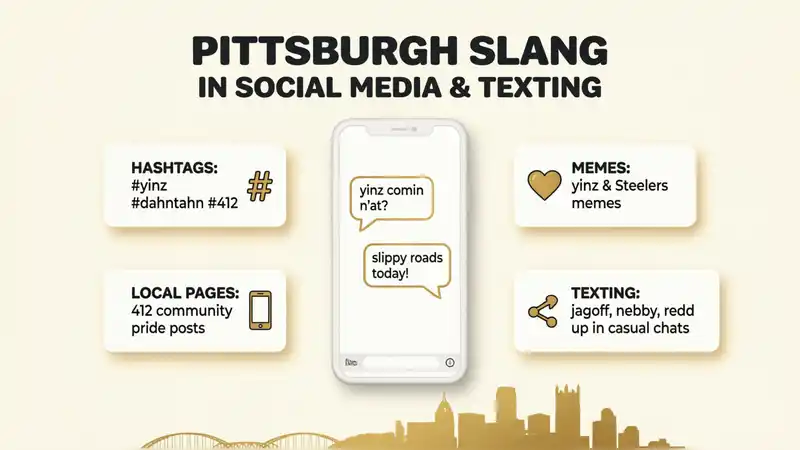
Online, Pittsburgh slang is often used to show local identity.
Someone might write:
“Yinz ready for the game?”
Or:
“Going dahntahn n’at.”
These spellings do not always represent formal writing. Instead, they intentionally capture how a local expression sounds.
Social media has also helped regional expressions reach people who do not live in Pittsburgh.
Pittsburgh Slang Examples in Different Contexts
Friendly Example
“Yinz wanna grab lunch?”
Meaning:
“Do you all want to get lunch?”
Casual Example
“I gotta redd up the kitchen.”
Meaning:
“I need to clean up the kitchen.”
Teasing Example
“Don’t be such a jagoff.”
This can be playful among friends, but it is still an insult and should not automatically be used with strangers.
Local Identity Example
“A true Yinzer knows what yinz means.”
This emphasizes Pittsburgh identity.
Weather Example
“Careful, the sidewalk’s slippy.”
This simply means the sidewalk is slippery.
Pittsburgh Slang vs. Standard American English
| Pittsburgh Slang | Standard English |
| Yinz | You all / you guys |
| Nebby | Nosy |
| Redd up | Clean up |
| N’at | And that / etc. |
| Dahntahn | Downtown |
| Slippy | Slippery |
| Gumband | Rubber band |
| Sweeper | Vacuum cleaner |
| Crick | Creek |
| Buggy | Shopping cart |
| Jeet? | Did you eat? |
| Sammich | Sandwich |
| Jagoff | Jerk / annoying person |
| Stillers | Steelers |
| Pop | Soda / soft drink |
These are approximate equivalents. Regional expressions can carry cultural meaning that disappears in a direct translation.
Where Did Pittsburgh Slang Come From?
Pittsburgh’s regional speech developed through a mixture of historical and social influences.
Linguists have identified strong connections between some Pittsburghese vocabulary and Scots-Irish English. Expressions such as redd up, nebby, slippy, and yinz have connections to wider regional speech traditions.
Pittsburgh also received large numbers of immigrants from different parts of Europe during its industrial growth. These communities adopted and influenced the regional English spoken around them.
As a result, Pittsburgh speech developed its own recognizable combination of vocabulary, pronunciation, and grammatical patterns.
Importantly, not every feature called “Pittsburghese” is unique to Pittsburgh. Some occur elsewhere in Appalachia or other parts of the United States. What makes Pittsburghese distinctive is the particular combination and its strong connection to local identity.
Why Do People Use Pittsburgh Slang?
People use regional language for several reasons.
1. Local Identity
Pittsburgh slang can signal that someone is familiar with the city and its culture.
2. Family and Community
People often learn regional expressions naturally from parents, relatives, friends, and neighbors.
3. Humor
Written forms such as dahntahn and Stillers are often used humorously online.
4. Convenience
Words such as yinz provide a simple way to address multiple people.
5. Tradition
Regional expressions preserve parts of Pittsburgh’s linguistic history.
When Should You Avoid Pittsburgh Slang?
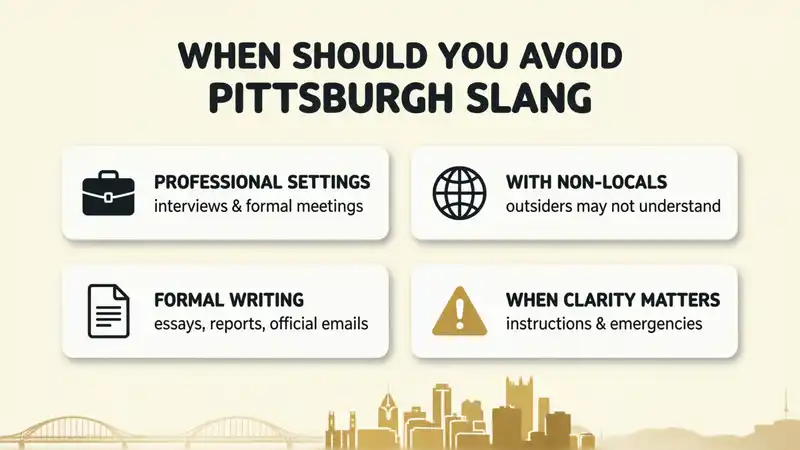
There is no need to avoid regional language completely. The important thing is knowing your audience.
Use standard English in situations such as:
- Formal school writing
- Professional applications
- Official documents
- Academic work
- Formal presentations
Casual Pittsburgh expressions work better in:
- Conversations with friends
- Informal messages
- Local social media
- Personal conversations
- Cultural discussions
You should also be careful with jagoff, because it is an insult even when used jokingly.
Is Pittsburgh Slang Safe for Social Media?
Ordinary Pittsburgh slang is generally fine for social media.
Words such as yinz, nebby, redd up, gumband, and dahntahn are regional expressions rather than inherently unsafe language.
However, context still matters. Some expressions may be misunderstood by people outside western Pennsylvania.
If you are writing for a broad audience, it can help to explain a local term the first time you use it.
For example:
“Are yinz ready? (‘Yinz’ means ‘you all’ in Pittsburghese.)”
That makes the meaning clear without removing the local flavor.
Frequently Asked Questions
1. What is Pittsburgh slang called?
The regional speech of Pittsburgh is commonly called Pittsburghese. It includes distinctive vocabulary, pronunciation, and grammatical features.
2. What does yinz mean in Pittsburgh slang?
Yinz means “you all” or “you guys.” It is a plural second-person pronoun strongly associated with Pittsburgh and western Pennsylvania.
3. What does jagoff mean?
Jagoff is a Pittsburgh-area insult meaning a jerk, fool, or inept person. It can sometimes be used playfully, but it remains derogatory.
4. What does nebby mean?
Nebby means nosy or overly interested in someone else’s business.
5. What does redd up mean?
Redd up means to clean, organize, or make a place tidy.
6. What does n’at mean?
N’at is a Pittsburgh expression related to “and that” and is often used at the end of a sentence with a meaning similar to “and so on” or “etc.”
Conclusion
Pittsburgh slang is much more than a collection of funny words. It is part of the linguistic identity of Pittsburgh and western Pennsylvania.
Words such as yinz, nebby, redd up, n’at, slippy, gumband, dahntahn, and jagoff help distinguish Pittsburghese from other varieties of American English. Some expressions are completely neutral, while others are informal or insulting, so understanding the context is important.
The most famous example is probably yinz, meaning “you all.” But learning Pittsburgh slang also means discovering local pronunciation, food vocabulary, expressions, and cultural history.
Whether you are studying regional English, visiting Pittsburgh, researching American slang, or simply wondering what a Pittsburgher means when they say “yinz,” these expressions offer a useful look into how language reflects local culture and identity.
Read more about!
- HP Meaning Slang: What Does HP Mean in Text, Gaming & Online?
- Slaying Meaning Slang: Definition, Origin, Examples
- Grape Slang Meaning: What Does Grape Mean in Slang?
- Trenches Slang Meaning in Text: What Does “Trenches” Mean?

Daniel Brooks is an English vocabulary educator and content editor with experience creating educational resources about English words, idioms, and everyday communication. He reviews language content for clarity, accuracy, and readability to ensure readers receive reliable and easy-to-understand information.