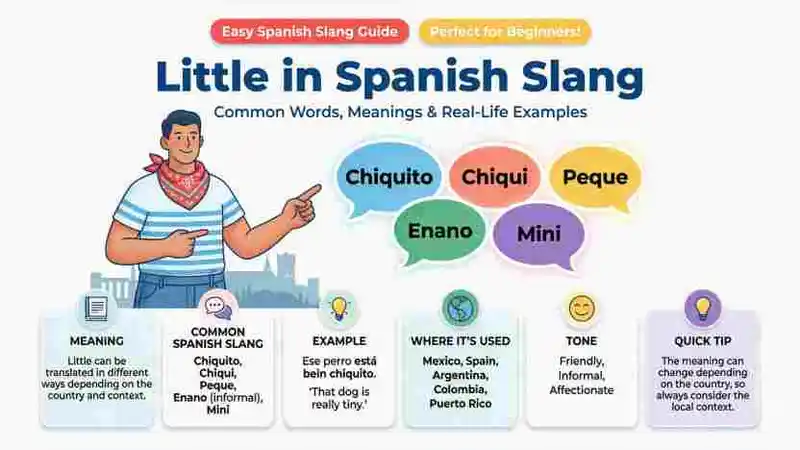
Little in Spanish slang usually refers to affectionate words such as chiquito, chiquita, peque, or chiqui, which can mean “small,” “young,” “cute,” or “dear” depending on the context. These terms are often used as nicknames rather than literal descriptions of size.
Many people search for little in Spanish slang after hearing Spanish speakers use words that seem to mean “little” but sound more affectionate than the standard translation.
In Spanish-speaking countries, these words often carry warmth, friendliness, or affection. Understanding them can help you follow conversations on social media, in text messages, and in everyday life.
In this guide, you’ll learn what little in Spanish slang means, which words are commonly used, where they’re used, and how to understand them correctly.
Quick Answer: Little in Spanish Slang
Little in Spanish slang is often expressed through affectionate terms such as chiquito, chiquita, peque, and chiqui. These words can describe someone small, young, cute, or loved. The exact meaning depends on the situation and region.
| Spanish Term | Common Meaning | Tone |
| Chiquito | Little, small, cute | Friendly |
| Chiquita | Little girl, dear | Affectionate |
| Peque | Little one | Warm |
| Chiqui | Cutie, little one | Playful |
| Mini | Very small | Casual |
What Does Little Mean in Spanish Slang?
In Spanish slang, little is not always about physical size.
Many Spanish speakers use words meaning “little” as affectionate nicknames for friends, children, partners, or family members. The word can show closeness, kindness, or affection.
For example, if someone says:
“Hola, chiquita.”
They may not be commenting on a person’s height. Instead, they may simply be greeting someone warmly.
Because Spanish slang varies by country, the exact meaning can change slightly from place to place.
The Basic Meaning
The literal meaning of little is:
- Small in size
- Young in age
- Tiny in appearance
However, slang often adds emotional meaning.
Common Slang Uses
Spanish speakers may use “little” words to mean:
- Cute
- Adorable
- Young
- Dear
- Loved one
- Friend
- Child
These meanings are usually positive.
Affectionate vs Literal Meaning
| Usage | Meaning |
| “Mi chiquita” | My dear or sweetheart |
| “El niño es chiquito” | The child is small |
| “Hola, peque” | Hi, little one |
| “Mi chiqui” | My cutie |
This difference is important because many learners translate the words too literally.
Common Spanish Slang Words That Mean “Little”
Spanish speakers use several informal words that can mean “little.”
Chiquito / Chiquita
Chiquito and chiquita are among the most common slang-style words for “little.”
Depending on context, they can mean:
- Small
- Cute
- Dear
- Young
Examples
- “Hola, chiquita.”
- “Ven aquí, chiquito.”
- “Mi chiquita siempre me hace reír.”
These words are widely understood across many Spanish-speaking regions.
Peque
Peque comes from pequeño (small).
It is commonly used as a nickname for children or loved ones.
Examples
- “¿Cómo estás, peque?”
- “Buenas noches, peque.”
This term is usually warm and affectionate.
Chiqui
Chiqui is a playful nickname used in some Spanish-speaking communities.
It often means:
- Cutie
- Little one
- Sweet person
Examples
- “Hola, chiqui.”
- “Gracias, chiqui.”
This version sounds especially friendly and informal.
Chaparro / Chaparra
In some countries, chaparro or chaparra refers to someone who is short.
The tone can be friendly among friends and family.
Examples
- “Mi amigo es chaparro.”
- “Hola, chaparra.”
if it sounds positive depends on the relationship between the speakers.
Mini
The word mini is sometimes used casually in Spanish just as it is in English.
Examples:
- “Mini versión.”
- “Mini fiesta.”
It simply emphasizes that something is small.
Different Meanings of Little in Spanish Slang
The meaning changes depending on context.
Referring to Someone’s Size
Sometimes the meaning is literal.
Example:
“Es muy chiquito.”
Translation:
“He is very small.”
A Cute Nickname
Many people use these words as nicknames.
Examples:
- Chiquita
- Chiqui
- Peque
In these cases, the focus is affection rather than size.
Talking About Young Age

Parents and grandparents often use these terms for children.
Examples:
- “Mi peque.”
- “Mi chiquito.”
The meaning is similar to “little one.”
Origin and History
Perhaps the most common slang use is expressing affection.
The speaker may be showing:
- Love
- Care
- Warmth
- Friendliness
This is why many of these words appear frequently in text messages and social media comments.
Where Is Little in Spanish Slang Commonly Used?
These slang terms appear in many everyday situations.
| Platform | Common Usage |
| Text Messages | Affectionate nicknames |
| Friendly comments and captions | |
| TikTok | Cute or playful content |
| Snapchat | Casual chats |
| Family Conversations | Terms of affection |
| Everyday Speech | Friendly nicknames |
Unlike many internet slang terms, these expressions existed long before social media and remain popular in daily conversation.
Is Little in Spanish Slang Rude or Offensive?
Most Spanish slang words meaning “little” are friendly and affectionate. They are commonly used with family, friends, children, and romantic partners. However, the tone depends on the word, the country, and the relationship between the speakers.
Quick Overview
| Word | Tone | Offensive? | Common Use |
| Chiquito / Chiquita | Friendly | No | Family, friends, partners |
| Peque | Warm | No | Children, loved ones |
| Chiqui | Playful | No | Friends, couples |
| Mini | Casual | No | Everyday conversations |
| Chaparro / Chaparra | Context-dependent | Sometimes | Referring to a short person |
Most of these words are safe to use when you know the person well. However, avoid using nicknames with strangers or in professional settings unless you’re sure they’re appropriate.
Real-Life Examples of Little in Spanish Slang
Here are realistic examples of how these words are used in everyday life.
Friends
Carlos: ¡Hola, chiqui! ¿Cómo estás?
Ana: ¡Muy bien! ¿Y tú?
English:
Carlos: Hi, cutie! How are you?
Ana: I’m great! And you?
Family
Mom: Ven aquí, peque.
Child: ¡Ya voy!
English:
Mom: Come here, little one.
Child: I’m coming!
Text Message
Luis: Buenos días, chiquita. 😊
Sofia: ¡Buenos días!
English:
Luis: Good morning, sweetheart.
Sofia: Good morning!
Instagram Caption
“Mi peque siempre me hace sonreír. ❤️”
Translation:
“My little one always makes me smile.”
TikTok Caption
“Mi chiqui favorita. 🥰”
Translation:
“My favorite cutie.”
School
Teacher: ¿Cómo está mi peque hoy?
Translation:
“How is my little one today?”
Teachers sometimes use affectionate language with young children in informal classroom settings.
Everyday Conversation
A: ¿Quién es esa chiquita?
B: Es mi hermana menor.
Translation:
A: Who is that little girl?
B: She’s my younger sister.
Origin and History

The idea of using words meaning “little” as affectionate nicknames has existed in Spanish for centuries.
Many of these expressions come from standard Spanish words such as:
- Pequeño (small)
- Chico (boy/small)
- Chica (girl)
Over time, speakers created shorter and friendlier forms like:
- Chiqui
- Peque
- Chiquito
- Chiquita
These forms became common in families, neighborhoods, and everyday conversations.
Unlike many internet slang terms, these expressions did not begin online. Social media has simply made them more visible around the world.
Regional Differences
Spanish slang varies by country, so some words are more common in certain places.
| Country/Region | Common Terms |
| Mexico | Chiquito, Chiquita |
| Spain | Peque, Chiqui |
| Argentina | Chiquito, Peque |
| Colombia | Chiquita, Chiquito |
| Puerto Rico | Chiqui, Chiquita |
The meanings stay generally positive, but local preferences can differ.
Where Are These Slang Words Used Today?
These expressions appear both online and offline.
| Platform | Popularity | Typical Meaning |
| Texting | ⭐⭐⭐⭐⭐ | Affectionate nickname |
| ⭐⭐⭐⭐⭐ | Cute captions and comments | |
| TikTok | ⭐⭐⭐⭐☆ | Playful videos |
| Snapchat | ⭐⭐⭐⭐☆ | Friendly chats |
| ⭐⭐⭐⭐☆ | Family posts | |
| Everyday Speech | ⭐⭐⭐⭐⭐ | Warm everyday language |
Text Messages
People often use these words instead of someone’s name.
Examples:
- “Buenas noches, peque.”
- “Hola, chiquita.”
These words frequently appear in captions about family, children, pets, or romantic partners.
Example:
“Mi chiquita favorita.”
TikTok
Creators often use these expressions in wholesome or humorous videos.
Examples:
- “Mi peque hoy.”
- “Chiqui vibes.”
Snapchat
Friends and couples sometimes use affectionate nicknames while chatting.
Similar Spanish Slang Terms
Here are other common affectionate Spanish expressions.
| Word | Meaning | Tone |
| Nene / Nena | Baby, little one | Warm |
| Cariño | Darling | Loving |
| Amor | Love | Romantic |
| Mi Vida | My life | Affectionate |
| Corazón | Sweetheart | Warm |
| Gordo / Gorda | Chubby (often affectionate) | Depends on context |
| Flaco / Flaca | Skinny (nickname) | Casual |
These aren’t exact translations of “little,” but they are commonly used as affectionate nicknames.
Why Do People Use Little in Spanish Slang?
People use these words because they make conversations feel warmer, friendlier, and more personal.
Common reasons include:
- Showing affection
- Talking to children
- Greeting close friends
- Speaking to romantic partners
- Creating a relaxed atmosphere
- Expressing kindness
Using these words can make everyday conversations sound more natural and caring.
Common Misunderstandings
Misunderstanding 1: They Always Mean “Small”
Not true.
Many of these words express affection rather than physical size.
Misunderstanding 2: They’re Internet Slang
No.
These expressions existed long before social media.
Misunderstanding 3: They’re Always Romantic
Not necessarily.
Parents, grandparents, teachers, siblings, and friends also use these words.
Misunderstanding 4: They’re Used the Same Everywhere
No.
Spanish slang changes from one country to another. While chiquito, chiquita, and peque are widely understood, some nicknames are more popular in certain regions than others.
When Should You Avoid Using Little in Spanish Slang?
Although these words are usually friendly, there are times when you should avoid them.
Formal Situations
In workplaces, business meetings, or official emails, use standard Spanish instead of affectionate slang.
Instead of: “Hola, chiquita.”
Use: “Hola, señora.” or simply “Hola.”
Speaking With Strangers
Calling someone chiquita, chiquito, or peque without knowing them may sound too personal or overly familiar.
It’s best to use these expressions only after you know the person well.
Regional Differences
Not every Spanish-speaking country uses the same slang.
For example:
- Peque is especially common in Spain.
- Chiquito and chiquita are widely understood across Latin America.
- Some local nicknames may be common in one country but unusual in another.
When talking to native speakers from a different region, pay attention to the words they naturally use.
Polite Alternatives
If you’re unsure if slang is appropriate, choose one of these neutral alternatives.
| Informal Slang | Polite Alternative |
| Chiquita | Señorita |
| Chiquito | Joven |
| Peque | Niño / Niña |
| Chiqui | Friend’s name |
| Mini | Pequeño / Pequeña |
These words are better for professional, academic, or formal situations.
Frequently Asked Questions
Q1. What does “little” mean in Spanish slang?
It usually refers to affectionate words like chiquito, chiquita, or peque, which can mean little one, cute, dear, or small, depending on the context.
Q2. Is “chiquito” a slang word?
Chiquito is a common informal word based on standard Spanish. While it literally means “small,” many people also use it as an affectionate nickname.
Q3 .Is little in Spanish slang rude?
No. Most words meaning little in Spanish slang are friendly and positive. However, using them with strangers or in formal settings may sound too familiar.
Q4. Which Spanish slang word for “little” is the most common?
Some of the most common expressions include:
- Chiquito
- Chiquita
- Peque
- Chiqui
The most popular choice depends on the country and situation.
Q5 .Can I use these words at work?
Generally, no.
In professional environments, it’s better to use formal greetings and avoid affectionate nicknames unless you know the workplace culture well.
Q6 .Are these words common on social media?
Yes. You’ll often see them on:
- TikTok
- Snapchat
People use them in captions, comments, and private messages to show affection.
Q7. Do these words always refer to someone’s height?
No.
In many conversations, they simply express affection and have nothing to do with a person’s physical size.
Conclusion
Little in Spanish slang usually refers to affectionate words like chiquito, chiquita, peque, and chiqui. While these words literally relate to being small, they often mean little one, cutie, dear, or someone you care about.
The exact meaning depends on the relationship between the speakers, the situation, and the country where the conversation takes place. In most cases, these expressions are warm, friendly, and harmless, making them common in family conversations, text messages, and social media.
If you’re learning Spanish, understanding these slang terms will help you recognize natural, everyday conversations and communicate more confidently with native speakers.
Read more about!
- UK Slang Words Roadman: Meaning, Popular Terms & Examples
- Bitchin Slang: Meaning, Origin, Examples & How to Use It
- BTK Meaning Slang: Is It Common in Text Messages?
- Birdie Slang Meaning: Everything You Need to Know
Hi, I’m Ryan Mitchell. I write simple guides about slang, internet language, and everyday English to make modern expressions easy to understand. My goal is to help learners use real-life English with confidence.