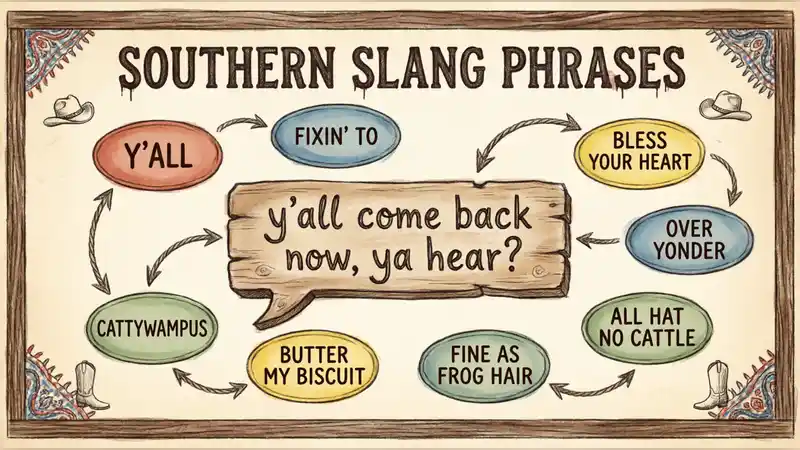
Southern slang phrases are informal words and expressions commonly heard in the Southern United States
They can make conversations sound friendly, relaxed, humorous, or strongly regional. If you have heard phrases like “y’all,” “fixin’ to,” or “over yonder” and wondered what they mean, you are not alone.
People often search for southern slang phrases to understand conversations, movies, social media posts, text messages, or everyday Southern speech
. Some phrases have simple meanings, while others can change depending on tone and context. In this guide, you will learn the meanings, examples, origins, and proper use of popular Southern expressions in clear and simple English.
Quick Answer: Southern slang phrases are informal expressions associated with Southern American speech. They are often used to sound casual, friendly, humorous, or regional.
Southern Slang Phrases Meaning in Text
Southern slang phrases are casual words and expressions commonly associated with the Southern United States. They often reflect friendliness, humor, local culture, and a relaxed way of speaking. Some phrases are also used online, in texts, and on social media.
What Are Southern Slang Phrases?
Southern slang phrases are informal expressions linked to Southern American speech. They can be used to show friendliness, surprise, agreement, affection, or humor.
Some expressions are strongly regional, while others have spread far beyond the South. Their meaning can also change slightly depending on the speaker, situation, and tone.
Common Southern Slang Phrases
| Phrase | Simple Meaning | Typical Tone |
| Y’all | You all / everyone | Friendly |
| Howdy | Hello | Casual |
| Yonder | Over there | Casual |
| Fixin’ to | About to | Informal |
| Ain’t | Is not / are not / have not | Informal |
| Bless your heart | Kind or critical, depending on context | Context-dependent |
| All get-out | Very / extremely | Informal |
| Hit the road | Leave or start traveling | Casual |
| Might could | Might be able to | Regional |
| Over yonder | Over there | Casual |
Southern Slang Phrases and Their Meanings
Southern expressions can be confusing if you have never heard them before. The following examples explain what they usually mean in everyday speech.
1. Y’all
“Y’all” means “you all” or “you people.”
It is one of the most recognizable Southern expressions and can refer to two or more people.
Example:
“Are y’all coming over tonight?”
It can sound warm and casual rather than rude.
2. Howdy
“Howdy” is a casual way to say hello.
It is associated with Southern and Western American speech and often has a friendly, relaxed feel.
Example:
“Howdy! How’s your day going?”
3. Fixin’ to
“Fixin’ to” means “about to” or “getting ready to.”
Example:
“I’m fixin’ to head home.”
This expression is strongly associated with Southern American English.
4. Yonder
“Yonder” means a place that is over there or some distance away.
Example:
“The store is over yonder.”
The word often gives a sentence a distinctly regional Southern flavor.
5. Bless Your Heart
“Bless your heart” can be sincere, sympathetic, humorous, or sarcastic.
The context matters greatly.
A person might say:
“Bless your heart, you must be exhausted.”
That can express sympathy. In another situation, the phrase can soften criticism.
Because the meaning changes with tone, you should not assume it always means something positive.
6. Ain’t
“Ain’t” is an informal contraction used in several varieties of English, including Southern speech.
Depending on context, it can stand for forms such as “isn’t,” “aren’t,” or “haven’t.”
Example:
“I ain’t going today.”
It is common in casual speech but is generally avoided in formal writing.
7. All Get-Out
“All get-out” is used to emphasize something.
For example:
“That test was hard as all get-out.”
It means the test was extremely hard.
8. Might Could
“Might could” is a regional Southern construction meaning something like “might be able to.”
Example:
“I might could help you tomorrow.”
It is informal and may sound unusual to speakers from other regions.
Where Are Southern Slang Phrases Used?
Southern expressions are mainly heard in everyday speech across parts of the Southern United States.
In Conversation
Friends and family may use regional phrases naturally during everyday conversations.
In Text Messages
People may write expressions such as “y’all,” “howdy,” or “fixin’ to” to keep the same casual style they use when speaking.
On Social Media
Southern expressions sometimes appear in captions, comments, memes, and short videos. Some phrases have also become familiar to people outside the South.
In Gaming and Online Communities

Gamers may use Southern expressions as part of their normal speech or as a playful way to show regional identity. However, not every Southern phrase is specifically gaming slang.
Are Southern Slang Phrases Rude?
Most Southern slang phrases are not inherently rude. Their meaning depends on the specific expression, relationship between speakers, and tone.
For example, “y’all” is usually neutral or friendly. “Bless your heart,” however, can have very different meanings depending on how it is said.
Tone Matters
The same phrase can communicate:
- Warmth
- Humor
- Sympathy
- Sarcasm
- Mild criticism
- Regional identity
When you are unsure, look at the surrounding conversation instead of judging the phrase by itself.
Real-Life Examples of Southern Slang
Here are natural examples showing different situations.
Friendly Example
“Y’all want to grab something to eat?”
Here, “y’all” simply means “you all.”
Casual Example
“I’m fixin’ to watch a movie.”
The speaker means they are about to watch a movie.
Regional Example
“The gas station is over yonder.”
“Over yonder” means over there.
Humorous Example
“That dog is cute as all get-out.”
The phrase adds emphasis and humor.
Sympathy Example
“Bless your heart. That sounds like a rough day.”
Here, the phrase expresses sympathy.
Southern Slang vs. Standard English
Southern slang does not always represent a completely different language. Many expressions are simply regional or informal ways of saying something familiar.
| Southern Expression | More General Expression |
| Y’all | You all |
| Howdy | Hello |
| Fixin’ to | About to |
| Yonder | Over there |
| Ain’t | Is not / are not |
| Might could | Might be able to |
These differences are often about style, region, and social setting.
Where Did Southern Slang Come From?
Southern American English developed through many historical and cultural influences. Southern speech includes features that developed in different communities and regions over time.
It is important not to treat every Southern expression as having one single origin. Some words are older English forms, while others developed or became common through regional speech communities.
Southern language also varies widely. Speech in Texas may differ from speech in Appalachia, Louisiana, Georgia, or the Carolinas.
Because of this variation, calling every expression simply “Southern slang” can sometimes hide important regional differences.
Why Do People Use Southern Slang?
People use Southern expressions for many reasons.
To Sound Friendly
Expressions such as “y’all” can make speech feel natural and conversational.
To Show Regional Identity
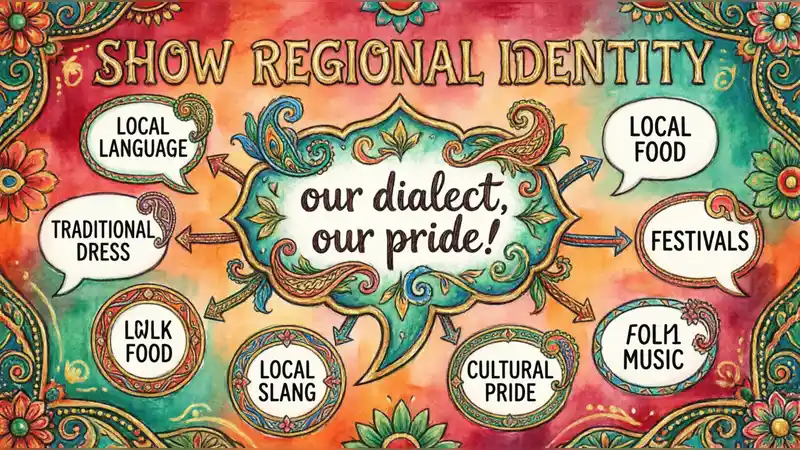
Southern vocabulary can help speakers express where they are from or their connection to a particular community.
To Add Humor
Some phrases have a playful sound that makes ordinary statements more entertaining.
To Sound Natural
For many speakers, regional expressions are simply part of everyday speech rather than something they consciously choose as slang.
When Should You Avoid Southern Slang?
Most expressions are harmless, but informal language is not appropriate for every setting.
Consider avoiding strongly informal expressions when:
- Writing a formal school paper
- Writing a business report
- Sending a formal professional email
- Speaking in a very formal presentation
- Applying for a job
- Writing official documents
This does not mean regional speech is “bad English.” It simply means different situations call for different communication styles.
Polite Alternatives
If you need a more formal version, you can replace casual Southern expressions with standard alternatives.
| Casual Expression | Formal Alternative |
| Y’all | You all |
| Howdy | Hello |
| Fixin’ to | About to |
| Over yonder | Over there |
| Ain’t | Is not / are not |
| Might could | Might be able to |
In everyday conversation, the casual version may sound more natural.
Southern Slang in Modern Social Media
Southern expressions are not limited to spoken conversation. They can appear in TikTok captions, Instagram posts, memes, comments, and text messages.
Some expressions are also used by people who are not from the South because they recognize them from movies, television, music, or online content.
However, using a Southern expression does not automatically make someone a Southern speaker. Context and personal language habits matter.
Common Misunderstandings About Southern Slang
“Y’all” Is Not Always Very Informal
Although it is casual, “y’all” is widely understood and can be useful when addressing a group.
“Bless Your Heart” Is Not Always an Insult
It can be sincere or sarcastic. The surrounding context and tone help determine the meaning.
Southern Speech Is Not the Same Everywhere
The Southern United States contains many different accents, dialects, and local expressions.
Southern Slang Is Not Automatically Outdated
Some expressions remain common in everyday speech, while others may sound old-fashioned or strongly regional.
Southern Slang Phrases vs. Modern Internet Slang
Southern expressions and internet slang can overlap, but they come from different places.
Internet slang often develops through online communities, texting, gaming, and social media.
For example, “y’all” is a regional expression that is also common online, while many newer internet abbreviations were created or popularized through digital communication.
Frequently Asked Questions
1. What are Southern slang phrases?
Southern slang phrases are informal words and expressions associated with speech in parts of the Southern United States.
2. What does “y’all” mean?
“Y’all” means “you all” and is commonly used when speaking to two or more people.
3. What does “fixin’ to” mean?
“Fixin’ to” means “about to” or “getting ready to do something.”
4. Is Southern slang rude?
Usually not. Most Southern expressions are casual, but a phrase such as “bless your heart” can have different meanings depending on tone and context.
5. Can I use Southern slang in text messages?
Yes. Expressions such as “y’all” and “howdy” can work naturally in casual texts.
6. Is Southern slang appropriate at work?
Some expressions are fine in relaxed workplace conversations, but more formal situations may call for standard English.
Conclusion
Southern slang phrases add regional flavor, humor, and personality to everyday communication. Expressions such as “y’all,” “howdy,” “fixin’ to,” and “over yonder” are useful examples of how Southern speech can differ from more general American English.
The key is context. A phrase that sounds friendly in a conversation may not fit a formal document, and expressions such as “bless your heart” can change meaning based on tone
. Understanding these differences helps you recognize Southern language without assuming that every phrase has the same meaning everywhere.
Read more about!
- What Does Shark Mean in Slang? Meaning and Uses
- Stomach in Spanish Slang: Meanings, Words, and Everyday Use
- What Does Preppy Mean in Slang? Meaning, Origin & How People Use It
- Mofongo Slang Explained: Meaning, Origin, and Usage

Hi, I’m Olivia Harper. I create clear and easy-to-understand English language content, including word meanings, slang explanations, idioms, synonyms, and everyday vocabulary. My goal is to help students, writers, professionals, and English learners improve their communication skills with simple explanations, practical examples, and reliable language guides.