Have you ever received a message that simply says “SU?” and wondered what the person meant? The meaning can change depending on the conversation, the platform, and the words around it.
So, what does SU mean in slang? In casual texting, “SU” can commonly mean “shut up,” often as a playful reaction to surprising or funny news. It can also be used as a shortened form of “sup,” meaning “what’s up?” In social media contexts, “SU” or “S/U” may refer to “swipe up.”
This makes SU a context-based abbreviation rather than a slang term with one fixed definition. For example, “SU, no way!” has a very different meaning from “SU?” at the start of a conversation.
This guide explains the common meanings of SU, how to tell them apart, when the expression sounds friendly or rude, and how to use it naturally.
Featured Snippet: What Does SU Mean in Slang?
“SU” in slang can mean several things. In casual texting, it often means “shut up,” especially as a playful reaction. It can also mean “sup” or “what’s up?” when starting a conversation. On social media, “SU” may mean “swipe up.” The surrounding words and context usually reveal the intended meaning.
What Does SU Mean in Slang? Quick Answer
The meaning of “SU” depends on how someone uses it.
Common meanings include:
- SU = “Shut up”
- SU = “Sup?” or “What’s up?”
- SU = “Swipe up”
- SU = “See you,” in some casual texting
- SU = “Sign up,” when talking about registration
The most important clue is the sentence around “SU.”
For example:
- “SU! You actually won? 😂” = “Shut up!” as a surprised reaction.
- “Hey, SU?” = “What’s up?”
- “SU for the details” = “Swipe up.”
- “Okay, SU tomorrow.” = potentially “See you tomorrow,” although this is less common.
Because the same abbreviation can have different meanings, it is better to read the entire message before deciding what “SU” means.
What Does SU Mean in Slang?
“SU” is a short form used in casual digital communication. Unlike a normal English word, it does not have one universal meaning.
SU Means “Shut Up”
This is one of the most common meanings in casual texting.
When friends use “SU,” they may not literally be telling someone to stop talking. It can express surprise, disbelief, excitement, or playful teasing.
Example:
“I just won tickets to the concert.”
“SU! No way 😂”
Here, “SU” means “shut up,” but the speaker is likely expressing disbelief rather than giving a serious command.
However, “shut up” can also sound rude. If someone sends “SU” during an argument, it may be a direct way of telling another person to stop talking.
SU Means “Sup?” or “What’s Up?”
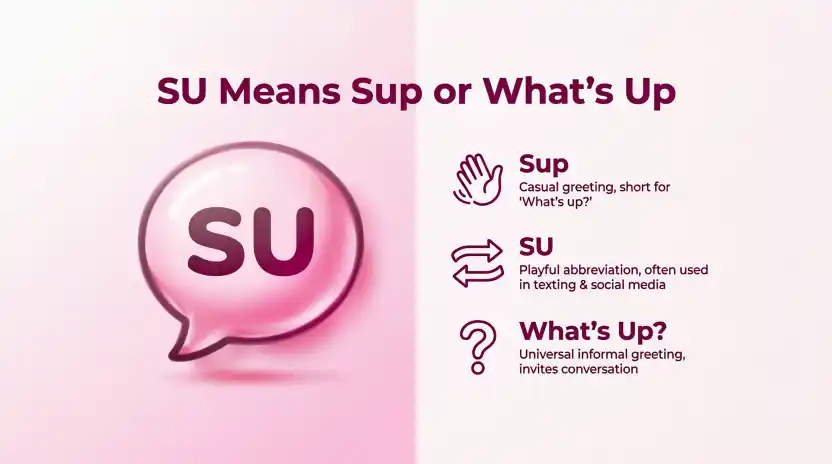
Some people use “SU” as an extremely short version of “sup,” which itself is an informal form of “what’s up?”
Example:
“Hey, SU?”
This usually works as a casual greeting.
The person may be asking:
- What’s up?
- How are you?
- What are you doing?
- What’s going on?
This use is especially easy to recognize when “SU” appears at the beginning of a conversation and has a question mark.
SU Means “Swipe Up”
In social media language, “SU” or “S/U” can mean “swipe up.”
For example:
“SU for the full video.”
Here, the writer is telling viewers to use the social media link or story action.
This meaning is closely connected with older story-based social media language. The phrase may still appear even when a platform’s interface has changed.
SU Means “See You”
“SU” can sometimes be interpreted as “see you,” although this is less common than the other meanings.
For example:
“Okay, SU tomorrow.”
The intended meaning could be “See you tomorrow.”
However, “CU” or simply “see you” is clearer, so you should not automatically assume that SU means “see you.”
SU Means “Sign Up”
In promotional or online registration contexts, “SU” may be shorthand for “sign up.”
For example:
“SU today for the free event.”
Here, the surrounding words make the meaning clear.
This is not usually the first people think of when they see SU in casual texting.
The Origin of SU
There is no single, clearly documented origin for every use of “SU.” Different meanings developed from different phrases and communication settings.
Texting and online chat encourage people to shorten words. Abbreviations save typing time and make messages feel informal.
“Shut up” can naturally be shortened to its first letters, “SU.” Likewise, “sup” developed as a casual shortening of “what’s up?” and may sometimes be shortened further in fast chats. Online sources discussing current usage show that these meanings overlap in modern texting.
The social media meaning “swipe up” comes from a different context. In that case, SU is connected to an action rather than a conversational reaction.
Because these uses come from different phrases, “SU” does not have one simple origin story.
British English vs American English
There is no major British-versus-American spelling difference for the slang abbreviation “SU.” The abbreviation is mainly driven by online context rather than regional spelling.
| Context | British English | American English | Example |
| Casual texting | SU | SU | “SU, seriously?” |
| Greeting | SU / sup | SU / sup | “Hey, SU?” |
| Social media | SU / S/U | SU / S/U | “SU for details” |
| Formal writing | Avoid SU | Avoid SU | Write the full phrase |
| Academic writing | Avoid slang | Avoid slang | Use clear formal English |
The same basic advice applies in both varieties of English: look at the context before interpreting the abbreviation.
For formal writing, it is better to write the complete phrase instead of relying on SU.
Which Version Should You Use?
Your choice depends more on the situation than your country.
United States
“SU” can work in casual texts, chats, and conversations with friends when the meaning is clear.
United Kingdom
The same general online usage can appear in casual communication. Avoid assuming that SU has one fixed British meaning.
Canada
Casual digital communication may use the same abbreviations found in wider English-language internet culture.
Australia
SU may appear in informal online communication, but the surrounding message should determine its meaning.
International Writing
For international readers, avoid unexplained abbreviations. Writing “shut up,” “what’s up,” or “swipe up” is much clearer.
Academic Writing
Avoid “SU” as slang in essays, assignments, and research papers unless you are specifically discussing slang or quoting a message.
Business Writing
Use complete words and phrases. “SU” can easily be misunderstood in professional communication.
Common Mistakes
Mistake 1: Assuming SU Always Means “Shut Up”
Incorrect:
“They wrote SU, so they must be angry.”
Correct:
“They wrote SU, so I should check the context.”
Explanation: SU can express surprise or teasing, but it can also mean something else.
Memory tip: Two letters do not tell the whole story.
Mistake 2: Treating “SU?” and “SU!” the Same Way
“SU?” at the start of a chat may suggest “what’s up?”
“SU!” after surprising news may suggest “shut up!” as a reaction.
Punctuation is not a perfect rule, but it can provide a useful clue.
Mistake 3: Using SU in Formal Writing
Incorrect:
“SU for more information.”
Correct:
“See the website for more information.”
Explanation: Short slang abbreviations are best kept to informal communication.
Mistake 4: Ignoring the Platform
A social media post about a link may use SU differently from a private text between friends.
Memory tip: Check the platform, sentence, and relationship before interpreting SU.
Everyday Examples
Text Message
“I got an A on the test!”
“SU! 🎉”
Meaning: “Shut up!” as a playful expression of surprise.
Casual Conversation
“Hey, SU?”
Meaning: “What’s up?”
Social Media
“SU for the full details.”
Meaning: “Swipe up.”
In a casual email between friends:
“SU when you get home.”
The meaning may be unclear, so writing the full phrase is better.
Business Writing
Instead of:
“SU for registration.”
Use:
“Sign up for registration.”
Clear language reduces confusion.
News Headlines
News writing normally avoids unexplained slang abbreviations unless the abbreviation itself is part of the story.
Blog Writing
A slang article may use “SU” because the term is the topic being explained. A general informational article should explain the abbreviation the first time it appears.
Academic Writing
Instead of:
“Students often write SU online.”
A more precise version is:
“Students may use the abbreviation ‘SU’ in informal online communication.”
Daily Conversation
“You met them yesterday?”
“Yeah.”
“SU, really?”
Here, the phrase can express surprise.
Google Trends & Modern Usage
Search interest around “what does SU mean in slang” comes from a basic problem: the abbreviation has multiple possible interpretations.
Current online explanations commonly identify “shut up,” “what’s up?” or “sup,” and “swipe up” among the meanings associated with SU.
There is no reliable basis here for assigning an exact popularity percentage to each meaning. Usage can also vary by platform, age group, community, and conversation.
A useful way to understand modern SU usage is to look for clues:
- “SU?” at the beginning of a chat may mean “what’s up?”
- “SU, no way!” may mean “shut up!” as a reaction.
- “SU for the link” may mean “swipe up.”
- “SU tomorrow” could mean “see you tomorrow,” but this is less common.
The surrounding words are usually more useful than the abbreviation itself.
Quick Comparison Table
| Version | Meaning | Correct? | Region | Example |
| SU | Shut up | Yes, in context | International | “SU, no way!” |
| SU? | What’s up? / Sup? | Yes, in casual chat | International | “Hey, SU?” |
| SU / S/U | Swipe up | Yes, in social media context | International | “SU for details” |
| SU | See you | Possible, less common | Informal | “SU tomorrow” |
| SU | Sign up | Possible, context-based | Informal/promotional | “SU today” |
The key point is that “correct” depends on context. There is no single definition that works for every SU message.
Key Takeaways
- “SU” has several possible meanings in slang.
- “Shut up” is a common meaning in casual texting.
- “SU?” can sometimes mean “what’s up?” or “sup?”
- “SU” or “S/U” can refer to “swipe up” in social media contexts.
- “See you” and “sign up” are possible but less universal interpretations.
- Tone can change “shut up” from playful to rude.
- The surrounding words are the best clue.
- SU is best avoided in academic and professional writing unless the context specifically requires it.
FAQs
What does SU mean in slang?
SU can mean different things depending on the context. In casual texting, it often means “shut up,” sometimes as a playful reaction to surprising news. It can also mean “what’s up?” or “sup?” when used as a greeting. On social media, SU may refer to “swipe up.”
What does SU mean in text?
In text messages, SU commonly means “shut up,” but it is not always rude. Friends may use it to show surprise, disbelief, or amusement. If someone sends “SU?” at the beginning of a conversation, it may instead mean “what’s up?” The surrounding message helps identify the intended meaning.
What does SU mean on social media?
On social media, SU or S/U can mean “swipe up.” It is usually connected with a post, story, link, product, video, or other content that the sender wants people to open. However, SU can also have conversational meanings, so the words around the abbreviation should be checked before interpreting it.
Is SU a rude word?
SU can be rude when it is intended as a direct command meaning “shut up.” Among friends, however, it may be used playfully to express surprise or disbelief. For example, “SU, you actually won!” can sound like an excited reaction rather than an insult. Tone and relationship matter.
Does SU mean “what’s up”?
Sometimes. In casual texting, some people use “SU?” as a shortened form of “sup?” or “what’s up?” It is more likely to have this when it appears at the start of a conversation. For example, “Hey, SU?” is likely a casual greeting rather than a command.
What does SU mean on Snapchat?
The meaning depends on the message. In social media contexts, SU can refer to “swipe up,” while in a direct chat it may mean “shut up” or “what’s up?” Look at the words around SU and if the person is discussing a link or simply starting a conversation.
What does SU mean on TikTok?
On TikTok, SU can have different meanings because comments and messages use informal abbreviations. It may mean “shut up” as a reaction or “what’s up?” in a conversation. The intended meaning cannot be determined from the two letters alone.
Can SU mean “see you”?
Yes, but this is a less common interpretation. Some people may use SU as a very short form of “see you,” particularly in informal messages. Because this meaning is not universal, writing “see you” is clearer when you want to avoid confusion.
Should I use SU in formal writing?
Usually, no. SU is informal and can have multiple meanings. In academic, business, or professional writing, use the complete phrase instead. Clear wording is especially important when your audience may not know the abbreviation or could interpret it in a different way.
How can I tell what SU means?
Check three things: the surrounding words, the platform, and the tone of the conversation. “SU?” at the start of a chat may mean “what’s up?” while “SU, no way!” may mean “shut up!” A message about a social media link may use SU for “swipe up.”
Conclusion
“SU” is a small abbreviation with several possible meanings. In casual texting, one common meaning is “shut up,” especially when someone uses it as a playful reaction to surprising or funny information. In other conversations, “SU?” may mean “what’s up?” or “sup?” On social media, SU or S/U can also refer to “swipe up.”
The important thing is not to treat every SU message the same way. Look at the sentence, the platform, the punctuation, and the relationship between the people communicating.
If you are writing for school, work, or a broad audience, avoid using SU without explanation. Full phrases are clearer and prevent misunderstandings.
For casual chats with friends, SU can be fine when everyone understands the intended meaning.
The easiest rule to remember is this: “SU” does not have one fixed meaning, so context is your best clue.
Read more about!
- Hey in Spanish Slang: Meaning, Uses & Examples
- Steam Slang Meaning: What Does “Steam” Mean?
- ATP Meaning Slang Twitter: What Does ATP Mean?

Hi, I’m Ryan Mitchell. I write simple guides about slang, internet language, and everyday English to make modern expressions easy to understand. My goal is to help learners use real-life English with confidence.