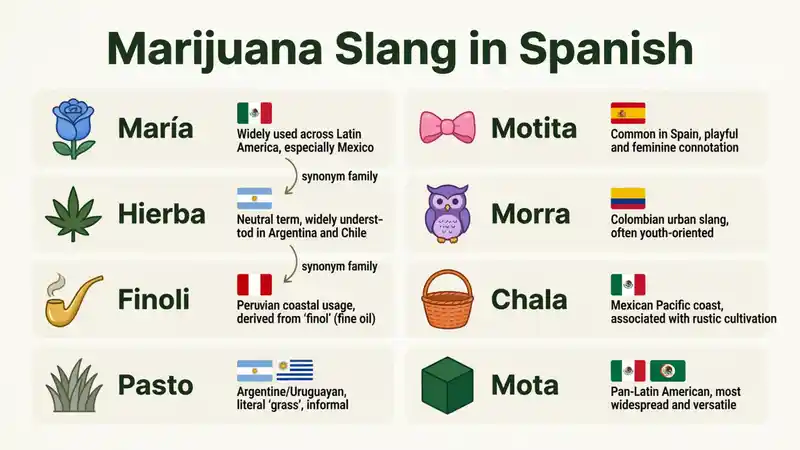
Weed in Spanish slang usually refers to marijuana or cannabis, but the exact slang word depends on the country.
Spanish speakers use different informal names in Mexico, Spain, Argentina, Colombia, and other regions. Some words are friendly, while others are vulgar or very local. Understanding the context helps you avoid confusion.
People search for “weed in Spanish slang” because they hear these words in songs, movies, social media, or conversations
. Unlike English, there is no single slang term used everywhere. Each Spanish-speaking country has its own popular expressions. In this guide, you’ll learn the most common slang words for weed, where they are used, if they are rude, and when you should avoid using them.
Quick Answer: Weed in Spanish Slang
The meaning of “weed” in Spanish slang changes by country. Common slang terms include “mota” (Mexico), “porro” (Spain), “hierba,” “maría,” and “faso” (Argentina and Uruguay). All generally refer to marijuana, but some are more regional than others.
What is the simplest answer?
“Weed” in Spanish slang means marijuana or cannabis. The slang word changes depending on the country and local culture.
Is there one universal Spanish slang word?
No. Spanish has many regional slang words, so the same word may be common in one country and rarely used in another.
Quick comparison table
| Slang Word | Common Country | Meaning | Tone |
| Mota | Mexico | Marijuana | Informal |
| Porro | Spain | Marijuana joint | Informal |
| María | Spain | Marijuana | Casual |
| Hierba | Many countries | Weed | Neutral informal |
| Faso | Argentina | Marijuana cigarette | Informal |
What Does Weed in Spanish Slang Mean?
The slang meaning depends on where Spanish is spoken. In general, it refers to cannabis, marijuana, or a marijuana cigarette.
General meaning
Most Spanish slang words for weed describe:
- Marijuana
- Cannabis
- A joint
- Smoking weed
Why are there so many different words?
Spanish is spoken in more than 20 countries. Like English slang, each country develops its own informal vocabulary.
For example:
- Someone in Mexico may say “mota.”
- Someone in Spain may say “porro.”
- Someone in Argentina may say “faso.”
All refer to weed, but locals usually prefer their regional term.
Common Spanish Slang Words for Weed
Different countries use different slang. Learning the most common ones makes conversations easier to understand.
Mota
“Mota” is one of the most common Mexican slang words for marijuana.
Example:
“Dicen que encontraron mota en el coche.”
Porro
In Spain, “porro” usually means a marijuana joint rather than the plant itself.
Example:
“Estaban fumando un porro.”
María
“María” is another informal Spanish term for marijuana, especially in Spain.
Example:
“Algunas personas llaman María a la marihuana.”
Hierba
“Hierba” literally means “grass” or “herb,” but many people also use it to mean weed.
Example:
“Esa palabra puede referirse a hierba.”
Faso
“Faso” is commonly heard in Argentina and Uruguay.
Example:
“Escuché esa palabra en una canción argentina.”
Different Meanings by Country
The same slang word may not have the same meaning everywhere.
Mexico
The most common slang is “mota.”
Spain
People often use “porro” for a joint and “maría” for marijuana.
Argentina
“Faso” is widely recognized in casual speech.
Colombia
People may use “bareto” in some regions, although usage varies.
Chile
Several local slang terms exist, but usage differs between cities and age groups.
Is Weed in Spanish Slang Offensive or Harmless?
Most weed-related slang is informal rather than offensive, but it is not appropriate in every situation.
Is it rude?
Usually not. However, these words refer to drugs, so they can sound inappropriate in formal conversations.
Can you use it at work?
No. Avoid using weed slang in workplaces, schools, business meetings, or professional writing.
Can children use these words?
Children may hear these terms online or in music, but they should understand them as vocabulary rather than words to use in everyday conversation.
Real-Life Examples
These examples show how Spanish slang for weed appears in everyday conversations. The wording changes by country, so always pay attention to the location and context.
Friendly Conversation
Friend 1: “Have you ever heard the word ‘mota’?”
Friend 2: “Yes, people in Mexico use it to mean weed.”
Text Message
Alex: “What does ‘porro’ mean?”
Sam: “In Spain, it usually means a marijuana joint.”
Social Media
“I learned today that every Spanish-speaking country has different slang for weed.”
Movie Dialogue
“The character kept saying ‘faso,’ so I looked it up and found out it is Argentine slang for weed.”
School Discussion
“Our Spanish teacher explained that slang words change depending on the country.”
Origin and History
The history of weed slang in Spanish is different from country to country. Most terms developed locally instead of coming from one common source.
Regional Development

As Spanish spread across Latin America and Spain, local communities created their own informal words for marijuana.
Influence of Popular Culture
Movies, music, television, and social media helped many slang terms become widely recognized outside their original regions.
Is the Origin Certain?
Not always. While some words have documented histories, the exact origin of many slang terms remains uncertain because slang changes naturally over time.
Similar Slang or Related Terms
Many Spanish words are connected to marijuana or cannabis culture.
Marihuana
The standard Spanish spelling used in many countries.
Cannabis
The scientific and formal term.
Canuto
A Spanish slang word that may refer to a marijuana cigarette in some regions.
Bareto
Used in parts of Colombia and a few neighboring areas.
Churro
In some places, this slang refers to a marijuana joint. It should not be confused with the popular fried pastry.
Where Is It Commonly Used?
Spanish weed slang appears mostly in casual conversations and entertainment.
Music
Many Latin music genres include regional slang words.
Movies and TV Shows
Characters often use local slang to sound natural.
Social Media
Users on TikTok, Instagram, Reddit, and X may use different regional terms depending on where they live.
Online Forums
People discussing cannabis culture often use local slang instead of formal vocabulary.
Why Do People Use Weed Slang?
People usually choose slang because it sounds more natural than formal language.
Everyday Speech
Friends often use informal words during casual conversations.
Regional Identity
Move Paragraph block from position 121 up to position 120
Move Paragraph block from position 121 down to position 122
Displays more block tools
Many slang terms show where a speaker comes from.
Cultural Expression

Slang reflects local culture, humor, and community identity.
Shorter Communication
Many slang words are quicker and easier to say than the formal word “marihuana.”
Common Misunderstandings
Spanish weed slang can confuse learners because the same word may not mean the same thing everywhere.
One Word Does Not Fit Every Country
A term common in Mexico may sound unfamiliar in Spain.
Literal Meanings Can Be Different
Words like “hierba” literally mean “grass” or “herb,” but the meaning changes with context.
Some Words Have Multiple Meanings
Certain slang terms can refer to marijuana in one conversation but have a different everyday meaning in another.
When Should You Avoid Using It?
Knowing the meaning of slang does not mean you should use it in every situation.
Professional Settings
Avoid weed slang during work meetings, interviews, or business emails.
School Assignments
Use formal vocabulary instead of slang unless you are specifically discussing language or culture.
Speaking With People You Do Not Know
Some people may consider drug-related slang inappropriate or disrespectful.
Formal Writing
Choose “cannabis” or “marijuana” instead of slang in reports, articles, or academic work.
Frequently Asked Questions
Q 1Is there one Spanish word for weed?
No. Different Spanish-speaking countries use different slang words. For example, “mota” is common in Mexico, while “porro” is more common in Spain.
Q.2 What is the most common Spanish slang for weed?
There is no single answer because slang varies by region. However, “mota,” “porro,” “hierba,” “maría,” and “faso” are among the best-known terms.
Q.3 Is “hierba” the same as weed?
Sometimes. “Hierba” literally means “grass” or “herb,” but in casual conversation it can also refer to marijuana when the context is clear.
Q.4 Is weed slang offensive?
Most weed slang is informal rather than offensive. However, because it relates to drugs, it may be inappropriate in professional, academic, or family settings.
Q.5 Can I use these words while learning Spanish?
It is helpful to recognize them, especially when watching movies, listening to music, or reading social media. However, beginners should use formal words like “cannabis” or “marihuana” in most conversations.
Q.6 Which countries use “mota”?
“Mota” is most commonly associated with Mexico, although people in other Spanish-speaking communities may also understand it.
Q.7 What does “porro” mean?
In Spain, “porro” usually refers to a marijuana joint rather than the cannabis plant itself.
Q.8 Are these words used on social media?
Yes. Many of these slang terms appear on TikTok, Instagram, Reddit, YouTube, and other online platforms, especially in posts created by native Spanish speakers.
Conclusion
The meaning of “weed in Spanish slang” depends on the country and the situation. While all the common slang words relate to marijuana or cannabis, each region has its own preferred expressions
. Words like “mota” in Mexico, “porro” and “maría” in Spain, and “faso” in Argentina show how diverse Spanish slang can be.
If you are learning Spanish, the best approach is to understand these words without assuming they are used everywhere
. Pay attention to the speaker’s country, the conversation, and the setting before using any slang yourself. Knowing the regional differences will help you understand Spanish-language movies, music, social media, and everyday conversations more naturally.
Read more about!
- UK Slang Words Roadman: Meaning, Popular Terms & Examples
- Bitchin Slang: Meaning, Origin, Examples & How to Use It
- BTK Meaning Slang: Is It Common in Text Messages?
- Grape Slang Meaning: What Does Grape Mean in Slang?
- Birdie Slang Meaning: Everything You Need to Know

Hi, I’m Ryan Mitchell. I write simple guides about slang, internet language, and everyday English to make modern expressions easy to understand. My goal is to help learners use real-life English with confidence.