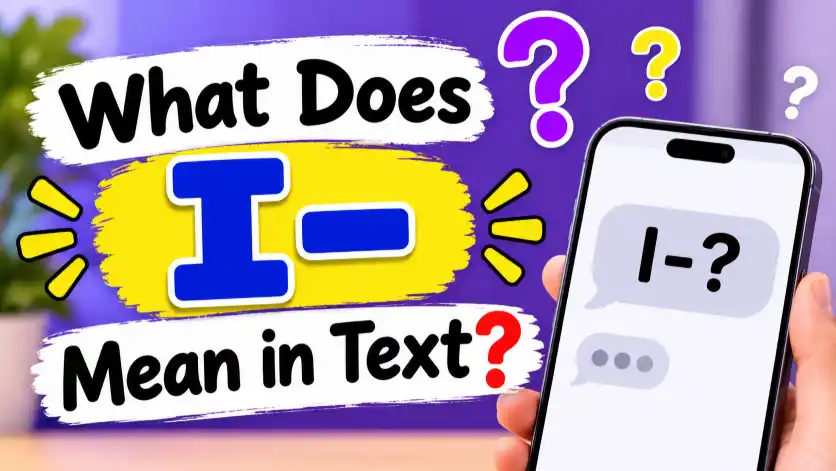
“I-” in text usually shows surprise, shock, awkwardness, or speechlessness. People use it when they do not know what to say after hearing something unexpected. It is often a playful way to show that a message has left them confused or caught off guard.
For example:
Friend: “I told everyone about your secret.”
You: “I- WHAT?!”
Here, “I-” shows surprise and disbelief.
What Does I- Mean in Text?
“I-” is an informal internet expression that represents a person starting to speak but stopping because they are shocked, confused, embarrassed, or unable to find the right words.
The dash (-) is important because it creates the feeling of an interrupted sentence.
Unlike abbreviations such as IDK or ISTG, “I-” does not have a full form. It is a way of showing a reaction in written conversations.
People may use it to express:
- Surprise or shock
- Confusion
- Awkwardness
- Embarrassment
- Disbelief
- Amusement or speechlessness
Its exact meaning depends on the message and the conversation.
Why Do People Type “I-” Instead of a Full Sentence?
People often type “I-” when a normal response does not seem strong enough for what they just heard.
It makes a chat feel more like a real conversation. Someone might begin typing “I…” and then use a dash to show that they have stopped speaking.
For example:
Person A: “I accidentally sent that message to the wrong group.”
Person B: “I- NO WAY 😭”
The response shows shock and amusement.
The dash creates a dramatic pause, making the reaction feel more expressive.
What Does “I-” Mean on TikTok, Snapchat, and Instagram?
The expression generally has the same meaning across social media platforms. People use it in comments, captions, direct messages, and replies.
| Platform | Common Use |
| TikTok | Reacting to surprising or funny videos |
| Snapchat | Showing shock in private chats |
| Responding to unexpected messages or posts | |
| Discord | Reacting to funny or confusing conversations |
| Expressing surprise or awkwardness | |
| Text Messages | Showing that someone does not know what to say |
For example, someone might comment “I- 😭” under a surprising TikTok video. In a private chat, they might send “I- what did you just say?”
10 Examples of “I-” in Text Messages
Here are some simple examples that show how people use this expression.
Example 1:
Alex: “I finished the entire project in one night.”
Sam: “I- HOW?”
Example 2:
Mia: “He said he likes you.”
Lily: “I- WHAT?”
Example 3:
Jake: “I accidentally wore two different shoes.”
Noah: “I- 😭”
Example 4:
Emma: “I forgot we had a test today.”
Sophie: “I- GOOD LUCK!”
Example 5:
Ryan: “She knows about the surprise party.”
Chris: “I- WHO TOLD HER?”
Example 6:
Ava: “I watched that movie five times.”
Ella: “I- WHY? 😂”
Example 7:
Ben: “I sent the screenshot to the wrong person.”
Max: “I- THAT’S AWKWARD.”
Example 8:
Olivia: “He just called me his best friend.”
Zoe: “I- THAT’S SO SWEET.”
Example 9:
Daniel: “I ate all the snacks before everyone arrived.”
Leo: “I- YOU DID WHAT?”
Example 10:
Grace: “I got the highest score.”
Maya: “I- CONGRATULATIONS!”
What Does “I-” Mean From a Girl or a Guy?
“I-” does not have a special meaning based on gender. Anyone can use it to show a strong reaction.
When a Girl Uses “I-”
If a girl sends “I-” in a message, she may be surprised, embarrassed, confused, or amused.
For example:
You: “I think you are really talented.”
Her: “I- thank you 😭”
She may be surprised or unsure how to respond to the compliment.
When a Guy Uses “I-”
If a guy sends “I-,” he may be reacting to something unexpected or funny.
For example:
You: “I finished the game without losing.”
Him: “I- HOW DID YOU DO THAT?”
He is showing surprise and curiosity.
The expression alone does not reveal if someone is flirting or has romantic feelings.
Is “I-” Rude or Offensive?
No. “I-” is generally harmless and is not considered an offensive expression.
It is usually used as a playful reaction between friends or in casual online conversations.
However, context matters:
- Friendly: “I- you’re so funny 😂”
- Surprised: “I- WHAT JUST HAPPENED?”
- Confused: “I- I don’t understand.”
- Awkward: “I- okay, that’s embarrassing.”
In a formal conversation, it may look confusing or unprofessional. A complete sentence is usually better.
How to Reply When Someone Sends “I-”
Your response depends on what the other person is reacting to.
Funny Replies
- “You heard me 😂”
- “I know, right?”
- “Don’t act surprised!”
- “I knew you’d react like that.”
Casual Replies
- “What happened?”
- “Are you okay?”
- “Why are you speechless?”
- “Let me explain.”
Playful Replies
- “Take your time 😭”
- “Words are hard, huh?”
- “I got you speechless!”
- “That was unexpected, wasn’t it?”
If the person seems genuinely confused, give them a clear explanation instead of assuming they are joking.
Difference Between “I-,” “I’m-,” and “I…”
These expressions look similar, but they can communicate slightly different reactions.
| Expression | Meaning |
| I- | A sudden pause caused by shock, surprise, or awkwardness |
| I’m- | An interrupted start to a longer statement, often showing disbelief |
| I… | A pause that may show hesitation, uncertainty, or difficulty responding |
| I mean | A phrase used to explain or clarify a thought |
| IDK | Short for “I Don’t Know” |
| WTF | An informal expression of strong surprise or confusion |
For example:
- I-: “I- WHAT?”
- I’m-: “I’m- I don’t even know what to say.”
- I…: “I… don’t know how to explain this.”
The punctuation and surrounding words help communicate the intended tone.
Common Mistakes People Make About “I-”
Here are some common misunderstandings:
- Thinking it is an abbreviation: “I-” is not a shortened phrase with a full form.
- Thinking it always means anger: It can show surprise, embarrassment, confusion, or amusement.
- Confusing it with “I’m”: “I’m” is a contraction of “I am,” while “I-” is often an interrupted reaction.
- Assuming it is rude: It is generally a harmless informal expression.
- Taking it too literally: The person usually is not trying to write a complete sentence. They are showing an emotional reaction.
When Should You Use “I-” in Text?
You can use “I-” when you want to show that something has caught you off guard.
It works well when:
- A friend tells you something surprising.
- Someone makes an unexpected joke.
- You feel embarrassed or confused.
- You are speechless after reading a message.
- You want to create a funny or dramatic reaction.
Avoid using it in formal emails, school assignments, or professional messages because its meaning may not be clear to everyone.
Key Takeaways
- “I-” usually shows surprise, shock, confusion, or speechlessness.
- It represents an interrupted sentence or thought.
- The dash creates a dramatic pause.
- It is common in informal texting and social media conversations.
- It is not an abbreviation and does not have a full form.
- It is generally harmless but not suitable for formal writing.
FAQs About “I-” in Text
1. What does I- mean in a text message?
“I-” usually means someone is surprised, shocked, confused, or speechless. It represents a person starting to speak but stopping because they do not know what to say next. For example, “I- WHAT?” shows that the sender is caught off guard.
2. Is I- a slang word?
“I-” is an informal internet expression rather than a traditional slang word. People use it in texting and online conversations to show reactions. It does not have a specific full form like ISTG or IDK.
3. What does I- mean on TikTok?
On TikTok, “I-” is often used in comments and replies when someone sees something surprising, funny, awkward, or unexpected. For example, “I- 😭” can show that a video left the viewer speechless or amused.
4. What does I- mean from a girl?
When a girl texts “I-,” she may be surprised, embarrassed, confused, or unsure how to respond. For example, if you give her an unexpected compliment, she might reply “I- thank you.” The expression alone does not prove romantic interest.
5. What does I- mean from a guy?
When a guy uses “I-,” he is usually showing an unexpected reaction. He might be shocked by something you said, amused by a joke, or unsure what to say. The rest of the conversation helps explain his meaning.
6. What does I- with a crying emoji mean?
“I-” followed by a crying emoji often shows that someone is overwhelmed, amused, embarrassed, or speechless. For example, “I- 😭” may mean that something is so funny or unexpected that the person cannot find the right words.
7. Is I- rude or offensive?
No. “I-” is generally not rude or offensive. It is a casual way to show a reaction in online conversations. However, if someone uses it during a serious discussion, it may seem unclear or dismissive.
8. What is the difference between I- and IDK?
“I-” usually shows shock, surprise, or speechlessness, while IDK means “I Don’t Know.” For example, “I- WHAT?” shows surprise, but “IDK what happened” means the sender does not know what happened.
Conclusion
“I-” in text usually shows that someone is surprised, shocked, confused, or speechless. It represents an interrupted thought and is often used to make a reaction more dramatic or funny.
If someone sends you “I-,” check the rest of the conversation to understand their reaction. In most casual chats, it simply means they do not know what to say next.
Read more about!
- What Does HYO Mean in Text? Real Meaning, & Social Media Use
- What Does HYK Mean in Text? Real Examples & Social Media Use
- What Does HYYY Mean in Text? Social Media Use
Daniel Brooks is an English vocabulary educator and content editor with experience creating educational resources about English words, idioms, and everyday communication. He reviews language content for clarity, accuracy, and readability to ensure readers receive reliable and easy-to-understand information.