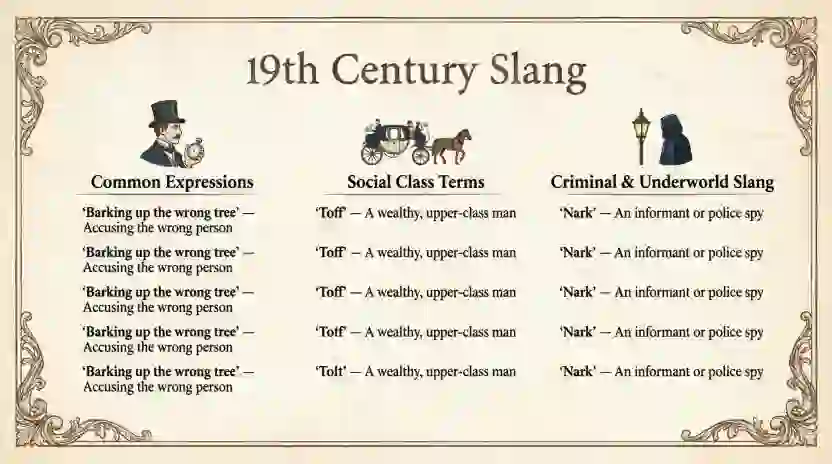
The 19th century was a time of rapid change in English. Cities grew, newspapers expanded, new forms of entertainment became popular, and people from different social groups developed their own expressions.
As a result, 19th century slang included colorful words for money, work, friendship, fashion, food, places, and everyday life.
People often search for 19th-century slang because they want to understand old books, historical letters, Victorian dialogue, or period dramas. The tricky part is that not every word used in the 1800s was slang, and some expressions existed before the century or continued long afterward.
This guide explains what 19th-century slang means, where it came from, how it differed across social groups and regions, and which expressions are useful to recognize today. It also separates well-documented historical usage from uncertain word origins.
19th Century Slang: Quick Answer
19th-century slang was the informal language people used in the 1800s, especially in cities, workplaces, entertainment, and particular social groups.
Some examples include:
- Dandy: a fashionable man who paid great attention to his appearance.
- Swell: a fashionable or stylish person, especially a man.
- Doss: a place to sleep, especially a cheap lodging place.
- Copper: slang for a police officer.
- Skedaddle: to leave or run away quickly.
- Blighty: Britain or home, especially in later military usage.
- Rummy: strange, unusual, or odd.
The exact date and location of a slang term matter. A word popular in Victorian London should not automatically be described as common throughout the English-speaking world.
What Does 19th Century Slang Mean?
19th century slang means informal vocabulary and expressions associated with the 1800s.
The term covers a wide range of language. It was not one single style spoken by everyone.
Street and Working-Class Slang
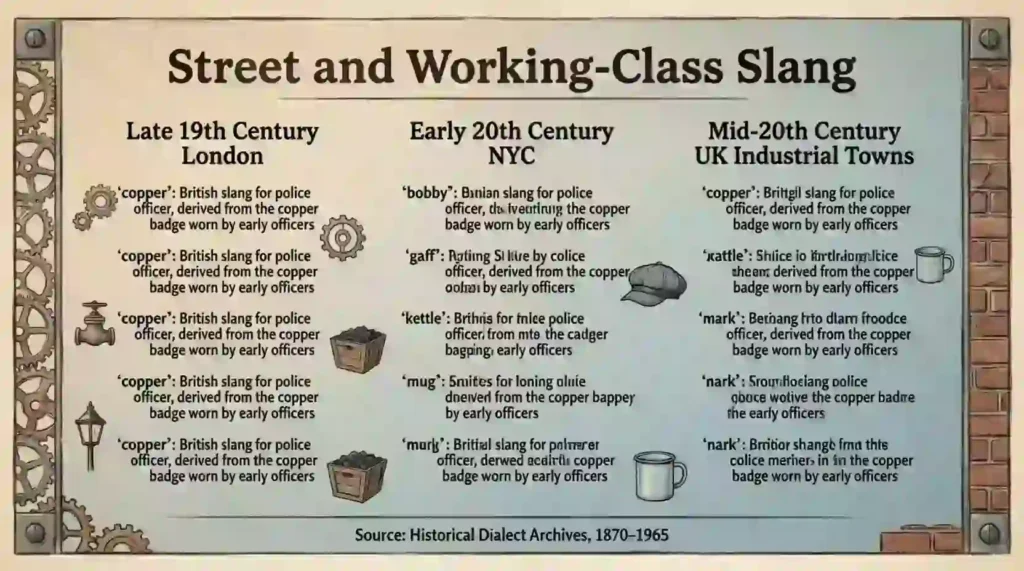
Urban communities created expressions that reflected daily life. London was especially important because its large population brought together people from many backgrounds.
Historical sources show that 19th-century slang dictionaries recorded language associated with streets, workplaces, universities, Parliament, entertainment, and other social settings.
Fashionable Slang
Some expressions were linked with fashionable society.
Words such as dandy and swell could describe people who were considered stylish or socially impressive.
Occupational Slang
Workers also developed vocabulary connected with their trades.
A term could be familiar inside a workplace without being common in everyday speech.
Cant and Criminal Slang
19th-century slang also overlapped with cant, a term historically associated with secret or specialized language.
Hotten’s 1859 dictionary included sections on cant, fashionable slang, workers’ slang, back slang, and rhyming slang.
This shows why “Victorian slang” should not be treated as one uniform vocabulary.
The Origin of 19th Century Slang
There was no single source for 19th-century slang.
It developed from many places, including:
- London street culture
- Trades and workplaces
- Universities
- The military
- Popular entertainment
- Regional dialects
- Newspapers and printed literature
- Rhyming slang
- Older cant and informal language
One valuable historical source is John Camden Hotten’s A Dictionary of Modern Slang, Cant, and Vulgar Words, first published in 1859. The book specifically documented contemporary slang and included material on fashionable, workplace, back, and rhyming slang.
The survival of a word does not always mean its original meaning stayed the same.
For example, some expressions became ordinary vocabulary, while others disappeared from everyday speech.
Why Did Some Slang Words Disappear?
Slang is closely connected with fashion and social groups.
When a popular expression stops being fashionable, younger speakers may replace it with something new. Some words survive because they move into standard English, while others become historical curiosities.
This is one reason old novels can contain expressions that sound unusual to modern readers.
Popular 19th Century Slang Words and Their Meanings
Here are several historical expressions worth knowing.
| Slang word | Meaning | Historical context |
| Dandy | A fashionable, appearance-conscious man | Fashion and social life |
| Swell | A fashionable or stylish person | Social and fashionable speech |
| Doss | A place to sleep or cheap lodging | Urban life |
| Copper | Police officer | British informal speech |
| Skedaddle | Leave or run away quickly | Informal speech |
| Rummy | Strange or unusual | Informal American usage |
| Blighty | Britain or home | Later 19th-century military context |
| Larrikin | A rough or unruly young person | Australia and New Zealand |
| East Ender | Person from London’s East End | 19th-century London |
| Crapping ken | Historical slang for a toilet | Victorian London |
Historical context matters for these terms. For example, East Ender was reportedly coined in the 1880s and initially carried a negative social meaning.
The historical record also shows that crap was documented as slang well before the famous Thomas Crapper story. A 19th-century source, A Dictionary of Modern Slang, Cant, and Vulgar Words, recorded the word in 1859.
British English vs American English
19th-century slang was not identical on both sides of the Atlantic.
British and American speakers shared many English words, but regional vocabulary developed differently. Some terms became strongly associated with London or Britain, while others became established in the United States.
| British English | American English | Example |
| Doss | Lodging/room | “He found a doss for the night.” |
| Copper | Policeman | “The copper arrived.” |
| Blighty | Home/Britain | “He hoped to return to Blighty.” |
| Swell | Stylish person | “He looked like a swell.” |
| Skedaddle | Also used in American English | “They decided to skedaddle.” |
This table should not be read as a strict translation list. Historical slang often crossed borders, and some words had different levels of popularity in different places.
For example, skedaddle became strongly associated with American English, while Blighty developed a distinctly British context.
Australian and New Zealand English also developed their own informal vocabulary. The expression larrikin, for example, was used in Australia and New Zealand for a rough or unruly young person.
Which Version Should You Use?
If you are writing historical fiction, a school project, or an article about old English, the safest approach is to match the language to the setting.
United States
Use historically documented American expressions when writing about 19th-century American characters.
Do not automatically give American characters London slang.
United Kingdom
For Victorian London, British historical slang is usually more appropriate.
Words such as copper, doss, swell, and dandy can help establish a period setting when used accurately.
Canada
Check the specific historical setting. Canadian English developed through both British and North American influences.
Australia
Australian historical slang deserves separate treatment because local expressions developed in a distinct social and cultural setting.
International Writing
If your audience is international, explain an unfamiliar historical term the first time you use it.
Academic Writing
Avoid using slang as if it were formal historical vocabulary. Give the date, location, and source when making a specific historical claim.
Business Writing
19th-century slang generally belongs in historical discussion, creative writing, or quotations rather than modern professional communication.
Common Mistakes
Mistake 1: Calling Every Old Word Slang
Incorrect:
“Every unusual Victorian word was slang.”
Correct:
“Some unusual Victorian words were slang, while others were dialect, formal vocabulary, or older English.”
Explanation:
Age alone does not make a word slang.
Memory tip:
Old does not always mean slang.
Mistake 2: Assuming Everyone Used the Same Slang
Incorrect:
“All Victorians used the same slang.”
Correct:
“Slang varied by region, occupation, class, age, and social group.”
Explanation:
Historical dictionaries themselves divided slang into different categories, including fashionable and workers’ slang.
Mistake 3: Treating Uncertain Origins as Facts
Incorrect:
“This phrase definitely came from one specific person.”
Correct:
“The exact origin is uncertain, although several explanations have been proposed.”
Explanation:
Popular etymologies are sometimes repeated for years without strong historical evidence.
Everyday Examples
Historical slang can still be useful today when you are reading or writing about the 1800s.
Emails
Modern email:
“I’ll leave now.”
Historical-style writing:
“I shall skedaddle shortly.”
This is a playful historical imitation, not normal modern business English.
Business Writing
A historical novel might say:
“The young swell entered the office.”
This creates a period feel but would sound unusual in modern professional writing.
News Headlines
A historical article might use:
Victorian “Swell” Describes a Fashionable Man
This helps modern readers understand the term.
Blogs
A history blog could write:
“Dandy was more than a word for stylish clothing. It could describe a man strongly focused on fashion and appearance.”
Social Media
A history-themed post might say:
“Learning old slang can make Victorian novels much easier to understand.”
Academic Writing
Academic writing should explain the term:
“The word ‘dandy’ was used in discussions of fashionable men’s appearance and behavior.”
Daily Conversation
You might say:
“That old slang word is fascinating.”
There is no need to use historical slang in ordinary modern conversation unless you are deliberately being playful.
Google Trends & Modern Usage
Interest in 19th century slang is mainly educational and historical.
People may search for it when they are:
- Reading Victorian novels
- Studying English history
- Writing historical fiction
- Researching old expressions
- Watching period dramas
- Looking for unusual old words
- Creating historical content
- Learning how English changed
Exact Google Trends numbers are not included here because popularity changes over time and depends on the selected country, date range, and search category.
Modern interest does not mean that these expressions are commonly used today. A historical slang word can be well known while remaining rare in everyday modern English.
The existence of historical slang dictionaries also shows that slang was actively documented during the period itself. Hotten’s 1859 work included several different categories of slang rather than treating slang as one simple vocabulary.
Quick Comparison Table
| Version | Meaning | Correct? | Region | Example |
| 19th-century slang | Informal language from the 1800s | Yes | International term | “The book explains 19th-century slang.” |
| Victorian slang | Slang associated with the Victorian era | Yes | Mainly Britain | “Victorian slang appears in historical sources.” |
| British slang | Informal British vocabulary | Yes | Britain | “Some British slang was documented in London.” |
| American slang | Informal American vocabulary | Yes | United States | “American slang developed along its own path.” |
| Historical slang | Slang from an earlier period | Yes | General | “The novel uses historical slang.” |
Key Takeaways
- 19th century slang means informal language associated with the 1800s.
- It was not one single language used by everyone.
- London produced many forms of documented street and social slang.
- Different occupations and social groups had their own expressions.
- British, American, Australian, and other varieties could differ.
- John Camden Hotten’s 1859 dictionary is an important historical source for studying slang of the period.
- Some old slang survived into modern English, while other terms became obsolete.
- Always consider the date, region, and social setting before calling a word 19th-century slang.
FAQs About 19th Century Slang
What is 19th century slang?
19th century slang is informal language used during the 1800s. It included fashionable expressions, street vocabulary, workplace terms, regional words, cant, and other informal language. The slang varied greatly by location and social group, so there was no single list that everyone in the 19th century used.
What are some examples of 19th century slang?
Examples include dandy, swell, doss, copper, and skedaddle. Some expressions were strongly associated with particular places or groups. Their meanings also changed over time, so a historical source should be checked before assuming that a word had one fixed meaning throughout the entire century.
What did Victorians call a friend?
There was no single Victorian slang word that universally meant “friend.” Informal terms varied by region, class, occupation, and social group. Historical slang sources contain many words for people and social relationships, but the exact meaning depends on the period and context.
What did 19th-century slang sound like?
It could sound playful, colorful, humorous, rude, fashionable, or highly local. London street slang, workers’ slang, university slang, and fashionable slang could sound quite different. Historical dictionaries such as Hotten’s show how varied the vocabulary was.
Was Victorian slang the same as 19th-century slang?
Not exactly. The Victorian era covered much of the 19th century in Britain, but 19th-century slang is a broader term. It can include language from Britain and other countries and can refer to the entire 1800s, while Victorian slang specifically relates to the period of Queen Victoria’s reign.
What is a Victorian slang word for stylish?
Dandy is one well-known historical term associated with a man who paid close attention to fashion and appearance. Swell could also refer to a fashionable or stylish person. The precise meaning and social tone depended on the period and context.
Did Americans use 19th-century slang?
Yes. The United States developed its own informal vocabulary during the 19th century. Some expressions crossed between Britain and America, while others were more regional. Therefore, historical American slang should be studied separately when the setting is specifically the United States.
Why is 19th-century slang useful today?
It can help readers understand historical novels, newspapers, letters, diaries, and other sources. It is also useful for writers creating believable historical dialogue. However, writers should research a term’s date and location instead of assuming that any old-sounding expression was common everywhere.
Where can I research old slang?
Historical dictionaries, digitized books, university collections, and major dictionary resources are useful starting points. Hotten’s 1859 slang dictionary is particularly relevant because it was published during the 19th century and organized material into several types of slang.
Did 19th-century slang become modern English?
Some historical slang survived and became ordinary vocabulary, while other expressions disappeared. Language changes through time, and words can move from slang into common usage or become obsolete. That is why modern readers may recognize some old expressions but find others completely unfamiliar.
Conclusion
19th century slang gives us a useful window into everyday language during the 1800s. It was not limited to one social class or one country. People developed informal expressions through city life, work, fashion, entertainment, regional culture, and different social groups.
Historical sources make this clear. John Camden Hotten’s 1859 dictionary included fashionable slang, workers’ slang, cant, back slang, and rhyming slang, showing how varied informal language could be.
When using old slang today, context matters most. A word used in Victorian London should not automatically be presented as universal 19th-century English. Check its date, location, meaning, and historical source whenever accuracy matters.
If you are studying English, reading an old novel, or writing historical fiction, learning these expressions can make the language of the 1800s much easier to understand.
The best way to understand old slang is to learn not only what a word meant, but also who used it, where, and when.
Read more about!
- Big Meaning Slang: What Does “Big” Mean?
- Cho Meaning Slang: What Does “Cho” Mean?
- Cow Slang Meaning: What Does “Cow” Mean in Slang?

Hi, I’m Ryan Mitchell. I write simple guides about slang, internet language, and everyday English to make modern expressions easy to understand. My goal is to help learners use real-life English with confidence.