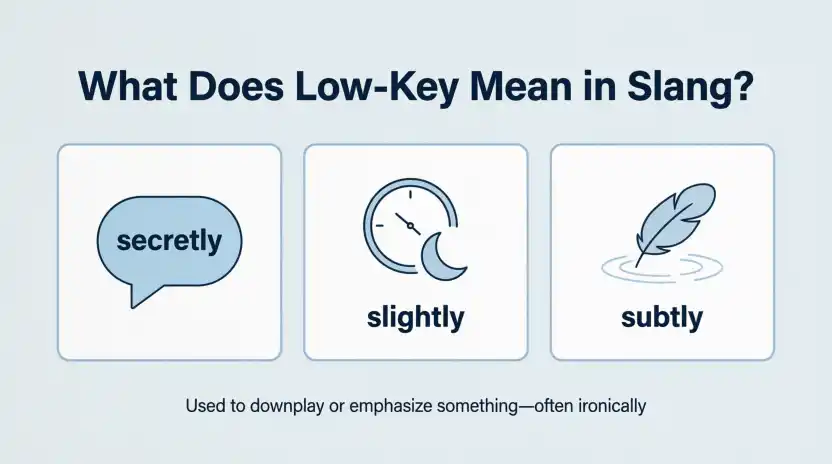
You may have seen someone write, “I lowkey love this,” “I’m lowkey tired,” or “That was lowkey funny.” If you are wondering what does low key mean in slang, the short answer is: it usually makes a statement feel softer, less dramatic, or more private.
For example, “I love this song” sounds direct. “I lowkey love this song” sounds more casual and slightly downplayed. The speaker still likes the song, but they are not making a huge announcement about it.
“Lowkey” is common in texting, social media posts, comments, memes, and casual conversation. Cambridge Dictionary lists the slang form as lowkey and explains that it can be used when giving an opinion without emphasizing it too much.
The word can be confusing because it has more than one related use. It can mean “somewhat,” “quietly,” or “secretly,” while the older phrase “low-key” can also mean calm, simple, or restrained. This guide explains the differences so you can understand it from context.
Quick Answer Table
| Question | Answer |
| Meaning | Somewhat, quietly, secretly, or without much attention |
| Tone | Casual, soft, relaxed, sometimes playful |
| Used By | People in casual speech and online communication |
| Platforms | Texting, TikTok, Instagram, Snapchat, Reddit, Discord, YouTube, X, and more |
| Offensive? | No. “Lowkey” is normally neutral and not offensive |
| Pronunciation | LOH-kee |
| Common spelling | Lowkey, low-key, or low key |
| Opposite | Highkey |
The most important point is that lowkey does not always mean “secret.” Sometimes it simply makes an opinion less strong or less dramatic. The sentence around it tells you which meaning fits best.
What Does Low Key Mean in Slang?
In modern slang, lowkey often means “somewhat,” “kind of,” “quietly,” or “I feel this, but I am not making a big deal about it.”
Consider these examples:
- “I lowkey want pizza.”
- “That movie was lowkey amazing.”
- “I’m lowkey nervous.”
- “She lowkey knows everyone here.”
- “I lowkey miss summer.”
The speaker is usually expressing a real thought or feeling. The word lowkey simply makes the statement sound more relaxed or understated.
It can also suggest that the speaker does not want to make the feeling too obvious. For example, “I lowkey have a crush on him” can suggest that the speaker has those feelings but is not openly announcing them.
Cambridge describes the slang adverb as something used when expressing an opinion without emphasizing it too much. Dictionary.com similarly defines the slang use as doing or feeling something in a restrained, discreet, or limited way.
Simple Definition of Lowkey
A very simple way to remember lowkey is:
Lowkey = “I mean it, but I’m keeping it casual.”
Depending on context, it can also mean:
- a little
- somewhat
- quietly
- secretly
- subtly
- without drawing attention
- in a relaxed way
- not making a big deal about it
These meanings overlap, but they are not always identical.
For example:
“I lowkey like this song.”
Here, lowkey may mean “I kind of like this” or “I quietly like this.”
“We had a low-key weekend.”
Here, it means the weekend was calm, simple, and relaxed.
That difference is important when reading the word.
Lowkey vs. Low-Key vs. Low Key
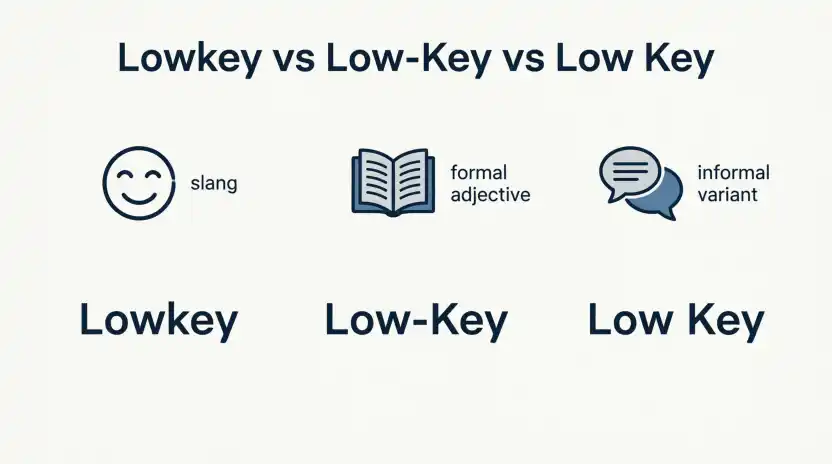
You may see the expression written in three ways:
- lowkey
- low-key
- low key
They are closely related, but the spelling can reflect how the word is being used.
Lowkey is especially common in informal slang and online writing.
Low-key is also a standard English form and can work as an adjective. For example, “It was a low-key party” means the party was simple, relaxed, or not very elaborate.
Low key may also appear as two words, especially in casual writing.
Dictionary.com lists lowkey as a variation of low-key, while Cambridge specifically lists the slang adverb as “low-key” and “lowkey.”
For a slang article, lowkey is the spelling you will often see in texts and social posts.
How Do You Pronounce Lowkey?
Lowkey is pronounced:
LOH-kee
It sounds like the normal words “low” + “key” said together.
There is no special slang pronunciation. The difference is mainly in how the word is being used.
Where Did Lowkey Come From?
The slang use of lowkey did not appear from nowhere. The phrase low-key existed in English long before texting and social media.
Dictionary.com traces the older expression back to meanings connected with a low or quiet tone. It notes examples from the 1800s and explains that the expression later developed meanings such as quiet, restrained, modest, and understated.
The modern slang use developed from this older idea of keeping something quiet or understated. By the late 2000s and early 2010s, lowkey was being used as an adverb in informal online communication to express feelings, opinions, and desires in a less forceful way. Dictionary.com documents examples of this online use from the late 2000s.
There is no single confirmed person, post, or platform that can be credited as the inventor of the modern slang meaning. It is better to describe the change as a gradual shift from the older meaning of “quiet” or “restrained” into a casual way of softening statements.
Why Do People Say Lowkey?
People use lowkey because it changes the feeling of a sentence.
Compare:
“I want to go home.”
with:
“I lowkey want to go home.”
The second sentence feels less forceful. It may sound more casual, personal, or slightly hesitant.
The word can also make a strong opinion sound playful:
“That was lowkey the best pizza I’ve ever had.”
The speaker may genuinely think the pizza was excellent, but lowkey makes the statement feel less dramatic.
In many cases, the word acts almost like a social cushion. It lets someone share an opinion without sounding too serious or intense.
What Does Lowkey Mean in Text Messages?
In texting, lowkey is usually used before a feeling, opinion, desire, or description.
Examples include:
- “I lowkey miss that place.”
- “I lowkey wanna stay home.”
- “That was lowkey weird.”
- “I’m lowkey excited.”
- “You’re lowkey right.”
In these examples, lowkey can mean “somewhat,” “quietly,” or “I admit this, but I am saying it casually.”
The exact meaning depends on the sentence.
For example:
“I lowkey love this.”
This may mean:
“I really like this, but I am saying it in a relaxed way.”
“I’m lowkey worried.”
This usually means:
“I am somewhat worried, but I am not making a big deal about it.”
“He lowkey told everyone.”
This can mean:
“He told everyone, but in a subtle or not very obvious way.”
Where Lowkey Is Used
Lowkey is not tied to just one social platform. It is general informal slang, so people can use it wherever casual conversation happens.
| Platform | How It Is Used | Example |
| TikTok | Comments, captions, reactions, and jokes | “This is lowkey so good.” |
| Captions, comments, Stories, and DMs | “Lowkey miss this place.” | |
| Snapchat | Messages and casual Snaps | “I lowkey want food.” |
| Discord | Casual chat and reactions | “That update is lowkey nice.” |
| Opinions, jokes, and comments | “This is lowkey my favorite part.” | |
| YouTube | Video comments and reactions | “That ending was lowkey funny.” |
| X | Short opinions and reactions | “This song is lowkey great.” |
| Private chats and group messages | “I’m lowkey tired today.” |
These examples show the normal slang pattern rather than a special platform-specific definition. The meaning usually stays the same across platforms.
Is Lowkey Positive or Negative?
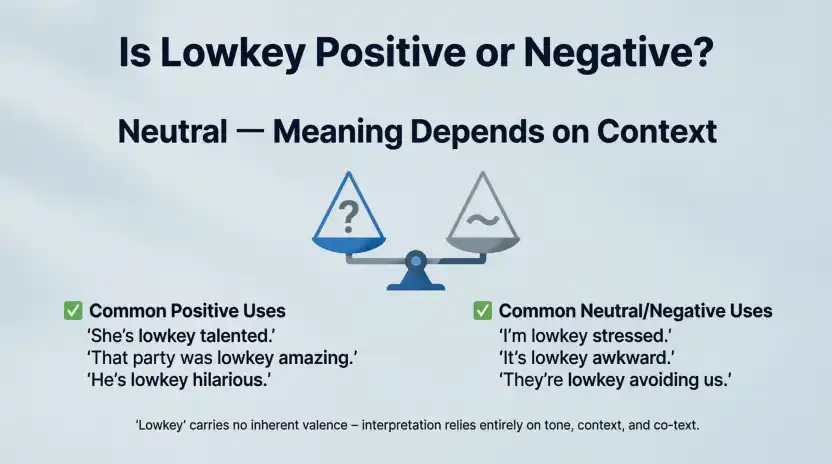
Lowkey can be positive, negative, or neutral. The word itself does not decide the emotion.
Positive:
“That game was lowkey amazing.”
Negative:
“I’m lowkey annoyed right now.”
Neutral:
“I’m lowkey tired.”
Funny:
“I lowkey ate the whole pizza.”
The word mainly changes how strongly or openly the speaker presents the idea.
That is why you should look at the words around lowkey instead of treating lowkey as a positive or negative slang term.
Does Lowkey Mean Secretly?
Sometimes, yes.
For example:
“I lowkey want to go.”
This could suggest that the speaker wants to go but is not saying it loudly or openly.
Another example:
“She lowkey likes him.”
This may suggest that she likes him but does not openly show it.
Still, “secretly” is not the meaning in every sentence.
Consider:
“That was lowkey funny.”
This usually does not mean the joke was secretly funny. It means something closer to “that was kind of funny” or “that was quietly/funnily better than expected.”
So remember:
Lowkey can suggest secrecy, but it often simply softens a statement.
Is Lowkey the Same as “Kind Of”?
Not always, but they can be very close.
For example:
“I kind of like it.”
and
“I lowkey like it.”
Both can show a mild or understated opinion.
But lowkey can add another idea: the person may be keeping the feeling quiet or not making it obvious.
Compare:
- Kind of: focuses more on degree.
- Lowkey: can focus on degree, subtlety, privacy, or a relaxed tone.
That small difference is why replacing lowkey with “kind of” does not work perfectly in every sentence.
Lowkey vs. Highkey
The most common slang comparison is lowkey vs. highkey.
| Lowkey | Highkey |
| Subtle | Obvious |
| Quiet | Open |
| Somewhat | Strongly |
| Understated | Unmistakable |
| Casual | Very direct |
| “I lowkey like it.” | “I highkey love it.” |
For example:
Lowkey: “I lowkey want to see that movie.”
This sounds casual or slightly understated.
Highkey: “I highkey want to see that movie.”
This sounds much more open and strong.
“Highkey” is often used as the informal opposite of lowkey, although real-life usage can be flexible.
Lowkey vs. Secretly
These words can overlap, but they are not exact synonyms.
Secretly means something is hidden or not known by others.
Lowkey can mean secretly, but it can also mean somewhat, subtly, or without making a big deal about something.
Example:
“I secretly bought a gift.”
The gift is hidden from someone.
“I lowkey bought a gift.”
This sounds more like the purchase was done quietly or without making much attention around it. Context matters.
Lowkey vs. Quiet
These words also overlap, but they describe different things.
Quiet usually relates to little or no noise.
Lowkey usually relates to low attention, low intensity, or a relaxed and understated situation.
For example:
“The room is quiet.”
This describes sound.
“The party is lowkey.”
This describes the style or mood of the party.
A lowkey party may still have music and people talking. It is simply not a huge or flashy event.
Is Lowkey Rude or Offensive?
No. Lowkey is normally not rude or offensive.
It is a casual slang expression that can be used for positive, negative, or neutral statements.
For example:
“I lowkey love your idea.”
That is positive.
“I’m lowkey annoyed.”
That is negative, but the word itself is not offensive.
The main issue is formality, not politeness. In a school essay, formal report, business letter, or professional document, it is usually better to use standard wording such as:
- somewhat
- slightly
- quietly
- privately
- subtly
- to some extent
In a casual message to a friend, lowkey is completely natural.
Is Lowkey Still Used?
Yes. Lowkey remains a common informal expression in modern English, especially in casual online communication and speech.
Current dictionary resources still recognize its slang use. Cambridge lists lowkey as a slang adverb, while Dictionary.com continues to document both the slang and standard uses.
It is better to call lowkey common informal slang than to claim it is currently “trending” without reliable usage data. Slang popularity can vary by age, community, and platform.
Who Uses Lowkey?
Lowkey is strongly associated with internet and casual communication, but it is not limited to one age group.
You may see it used by:
- teenagers
- young adults
- social media users
- gamers
- meme communities
- people who use casual texting language
- adults familiar with online slang
It is also common enough that people may use it outside social media.
The important distinction is that lowkey is informal, not that it belongs exclusively to one generation.
Can Adults Use Lowkey?
Yes.
There is no rule that says only young people can use lowkey. Adults can use it in casual conversation, texts, comments, and social media.
For example:
“I lowkey need a coffee.”
That sounds casual and natural.
It may sound less suitable in a formal workplace email, such as:
“I lowkey need this report by Friday.”
A more professional version would be:
“I would appreciate having this report by Friday.”
So the issue is the setting, not the speaker’s age.
Lowkey in School and Work
Lowkey is usually fine in casual conversation with friends or classmates.
Examples:
School:
“I lowkey hope we don’t have a test tomorrow.”
Work:
“That meeting was lowkey stressful.”
The second example may be fine in a casual chat with a coworker, but it would not be the best wording for a formal report.
For professional writing, replace lowkey with a clearer formal phrase.
Instead of:
“The project was lowkey difficult.”
Write:
“The project was somewhat difficult.”
Instead of:
“I lowkey disagree.”
Write:
“I have some concerns about that approach.”
Real-Life Examples of Lowkey
Text Message Example
Maya: “Are you coming to the movie?”
Jordan: “Lowkey thinking about it.”
Here, Jordan is saying they are considering going but have not made a firm decision. The word makes the reply sound casual.
TikTok Comment Example
Comment: “This recipe is lowkey amazing.”
The commenter thinks the recipe is very good but presents the reaction in a relaxed way.
Instagram Caption Example
Caption: “Lowkey one of my favorite days.”
This suggests the day was special to the person, but the caption keeps the emotion understated.
Discord Chat Example
Eli: “Did anyone else think that update was lowkey good?”
Here, Eli is sharing an opinion without presenting it as a huge or dramatic claim.
School Conversation Example
Nora: “I’m lowkey nervous about tomorrow’s test.”
Nora is saying she feels nervous, but the word makes the statement sound less intense and more conversational.
Workplace Conversation Example
Marcus: “That new system is lowkey easier to use.”
In a casual workplace conversation, Marcus means the new system is somewhat easier or surprisingly easier than expected.
Common Phrases With Lowkey
Lowkey appears in many sentence patterns.
“I lowkey…”
This is one of the most common patterns.
Examples:
- “I lowkey want to leave.”
- “I lowkey miss summer.”
- “I lowkey love this.”
- “I lowkey forgot.”
It usually introduces a personal thought or feeling.
“That’s lowkey…”
This pattern describes something.
Examples:
- “That’s lowkey funny.”
- “That’s lowkey impressive.”
- “That’s lowkey weird.”
- “That’s lowkey scary.”
“Lowkey obsessed”
This is a common casual phrase.
“I’m lowkey obsessed with this show.”
It usually means the speaker really likes the show, while saying it in a playful or less serious way.
“Lowkey want”
This often expresses a desire without making it sound too strong.
“I lowkey want some ice cream.”
The person wants ice cream but is saying it casually.
Common Mistakes With Lowkey
Mistake 1: Thinking It Always Means “Secretly”
Lowkey can mean secretly, but it can also mean somewhat, subtly, or without much emphasis.
Always read the full sentence.
Mistake 2: Thinking It Means “Quiet” Every Time
The slang use is broader than sound or volume.
“I lowkey love this” is not about being quiet. It is about expressing the feeling in an understated way.
Mistake 3: Using It in Every Sentence
Lowkey is useful when the softer tone adds meaning. Adding it everywhere can make your writing sound unnatural.
Compare:
“I lowkey went to the store and lowkey bought a drink and lowkey came home.”
That sounds forced.
Mistake 4: Assuming It Is Always Positive
Lowkey can describe good, bad, funny, boring, stressful, or neutral things.
The sentence determines the emotion.
Mistake 5: Using It in Formal Writing
Lowkey is informal slang. It is usually better to avoid it in essays, official reports, formal applications, and professional documents.
People Also Ask About Lowkey
Does lowkey mean “a little”?
Often, yes. In slang, lowkey can mean “a little,” “somewhat,” or “kind of.”
For example, “I’m lowkey tired” can mean “I’m somewhat tired.” However, lowkey can also suggest that a feeling is being expressed quietly or without much attention.
Does lowkey mean secretly?
It can. If someone says, “I lowkey like that person,” they may be saying they like the person without openly admitting it. But lowkey does not always mean secret. In “That movie was lowkey funny,” it usually means somewhat or surprisingly funny.
What is the opposite of lowkey?
The common slang opposite is highkey. Lowkey suggests something subtle, understated, or not heavily emphasized. Highkey suggests something obvious, strong, or openly expressed. These are informal expressions, so their exact meaning can shift with context.
Is lowkey a bad word?
No. Lowkey is not a swear word or inherently offensive term. It is casual slang. The statement containing it could be rude or negative, but lowkey itself is normally neutral.
Is lowkey one word or two?
Both forms can appear. Lowkey is common in slang and online writing. Low-key is an established standard spelling, especially when used as an adjective. Low key also appears in informal writing. The form often depends on the sentence and style.
What emoji goes with lowkey?
There is no official lowkey emoji. People may pair it with emojis such as 🤫, 😭, 👀, 😅, or 😂 depending on the meaning. For example, 🤫 can suggest “secretly,” while 😭 can make a lowkey confession sound funny or dramatic.
Can I use lowkey in a formal email?
It is better to avoid it in formal emails. Use clearer phrases such as “somewhat,” “slightly,” “quietly,” or “to some extent.” Lowkey works best in casual texts, chats, social posts, and conversations.
Is lowkey still popular?
Yes. Lowkey remains a common informal expression in online and casual English. Major dictionary resources continue to recognize its slang use. Its exact frequency can vary by age group, platform, and community, so it is more accurate to call it common informal slang than to claim it is universally trending.
Key Takeaways
- Lowkey usually means somewhat, quietly, subtly, or without making a big deal about something.
- It can also suggest that a feeling or action is being kept private.
- The meaning depends on context.
- Lowkey is casual slang and is common in texting and online communication.
- Highkey is commonly used as its informal opposite.
- Lowkey is not offensive, but it is usually not suitable for formal writing.
- The expression existed in English before its modern internet-slang use.
Conclusion
So, what does low key mean in slang? In most casual conversations, it means somewhat, quietly, subtly, or without making a big deal about something. It often lets a person share a real thought or feeling in a softer way.
When someone says, “I lowkey love this,” they usually mean they really like it but are keeping the statement casual. When someone says, “I lowkey want to leave,” they may be expressing a desire without sounding too direct. And when someone says, “We’re keeping the party low-key,” the phrase describes a relaxed, simple event.
The word is flexible, so context matters. It can mean “kind of,” “secretly,” “quietly,” or simply “in an understated way.” It is common in informal speech, texting, and social media, but formal writing usually calls for clearer standard English.
If you understand the tone around the word, you can usually understand exactly what the speaker means.
Read more about!
- 19th Century Slang: Popular Words & Phrases From the 1800s
- What Does IONK Mean in Text? Meaning, Uses & Examples
- What Does Ion Mean in Text? Slang Meaning, Examples & Usage
Hi, I’m Ryan Mitchell. I write simple guides about slang, internet language, and everyday English to make modern expressions easy to understand. My goal is to help learners use real-life English with confidence.