What’s a fade slang meaning? If you have seen phrases like “catch a fade” or “throw me the fade” online, you may wonder if the word refers to a haircut, an argument, or something else.
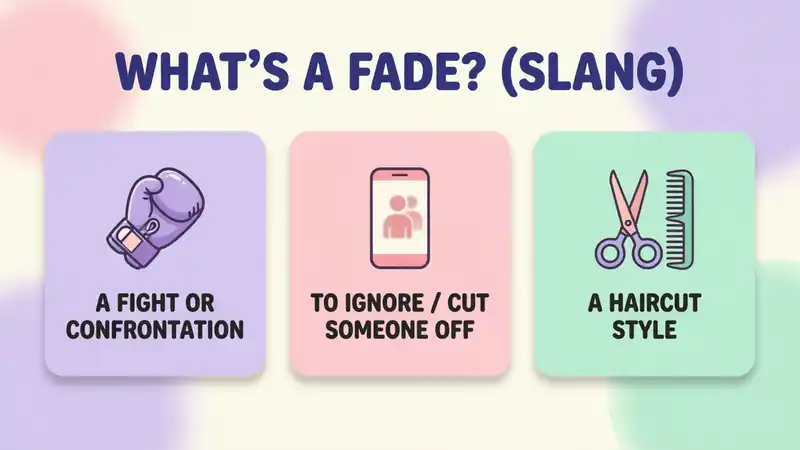
The meaning depends heavily on the sentence and the people using it. In modern informal English, “fade” can refer to a confrontation or fight, especially in the phrase “catch a fade.”
However, “fade” also has completely different meanings in everyday English, including a popular haircut style and something gradually disappearing. Because slang can change across communities, understanding the surrounding context is important.
This guide explains the common slang meanings of “fade,” where you may see them, how the expressions sound, and when a different phrase would be clearer.
Quick Answer
In slang, “a fade” can mean a confrontation or physical fight, especially in expressions such as “catch a fade.” The exact meaning depends on context, because “fade” also has non-slang meanings, including a type of haircut.
What Does “Fade” Mean in Slang?
In informal slang, “fade” often refers to a confrontation or fight.
The most common expression is “catch a fade.” When someone says that another person might “catch a fade,” they are usually talking about facing a confrontation.
For example:
“He kept arguing, so they told him he might catch a fade.”
Here, “fade” does not refer to a haircut. It is being used as slang for a confrontation.
The expression can also appear in statements such as:
- “He wants a fade.”
- “Are you trying to catch a fade?”
- “They were talking about catching a fade.”
- “He said he would throw the fade.”
The tone can range from playful teasing to a serious threat of conflict, so context matters.
What Does “Catch a Fade” Mean?
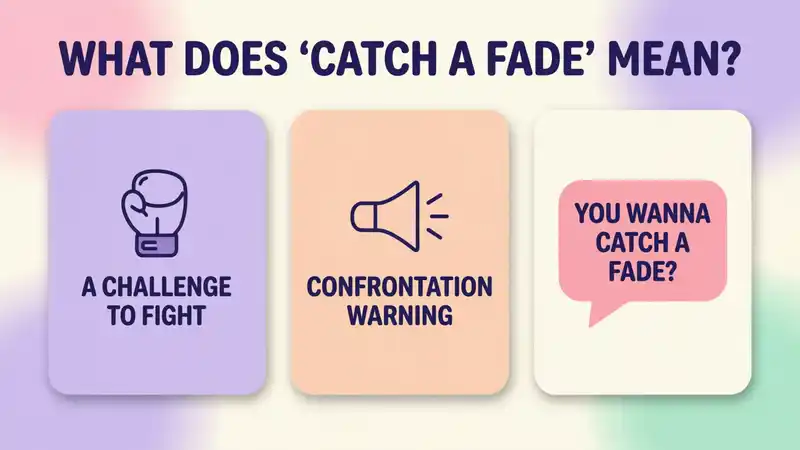
“Catch a fade” is an informal expression meaning to face a confrontation or fight.
The phrase is often used dramatically or jokingly online, especially when people are arguing. However, it can also be intended seriously.
For example:
“You keep talking like that, and you’ll catch a fade.”
This suggests that the speaker is warning the other person about a confrontation.
On social media, people may use the phrase without intending an actual physical conflict. Someone might say:
“I almost caught a fade over the last slice of pizza.”
In that example, the speaker is exaggerating a minor disagreement for humor.
Important Context
Because “catch a fade” can describe physical conflict, it is not always harmless slang. You should consider the relationship between the speakers and the situation before interpreting it as a joke.
Does “Fade” Have a Full Form?
No. “Fade” is not normally an acronym or abbreviation in this slang usage.
People sometimes search for a “fade full form” because many internet slang terms are shortened words. In this case, fade is a regular English word that has developed additional informal meanings.
So:
Fade full form: There is no special slang full form.
The meaning comes from the context in which the word is used.
Is “Fade” Rude, Offensive, or Neutral?
The word “fade” itself is not inherently rude or offensive.
Its tone depends on how it is used.
Neutral Use
“Fade” can simply describe something becoming less visible or weaker.
Example:
“The colors will fade in the sunlight.”
This is completely neutral.
Haircut Use
A fade is also a common haircut style in which the hair gradually becomes shorter toward the sides and back.
Example:
“He got a fresh fade before school.”
Again, this is not offensive.
Slang Use
When “fade” refers to a confrontation, the expression can sound aggressive.
Example:
“He told me to catch a fade.”
That statement may suggest that the speaker is being challenged to a confrontation.
Therefore, the slang meaning can be more serious than the ordinary meanings of the word.
Where Is “Fade” Slang Commonly Used?
You may encounter this slang in several informal settings, including:
- Text messages
- Social media comments
- TikTok discussions
- Instagram captions or comments
- Reddit conversations
- Discord chats
- Gaming communities
- Informal conversations
- Memes and reaction posts
The expression is particularly easy to find in online arguments, jokes, sports discussions, and memes.
However, slang does not have one fixed meaning across every community. Some people may use “fade” mainly to mean a confrontation, while others may immediately think of a haircut.
That is why the surrounding words are important.
“Fade” in Texting
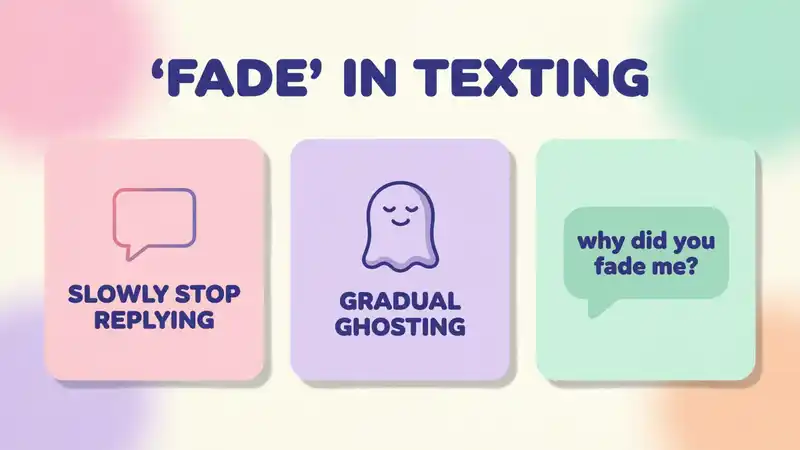
In texting, the meaning usually becomes clear from nearby words.
Consider these examples:
“He said I could catch a fade.”
This likely refers to a confrontation.
Compare that with:
“I’m getting a fade tomorrow.”
Here, the meaning is clearly a haircut.
Another example:
“That old picture is starting to fade.”
This refers to something losing color or becoming less visible.
A Simple Rule
If “fade” appears with words such as “catch,” “throw,” or “want” in an argumentative context, it may be slang for a confrontation.
If it appears with words such as “haircut,” “barber,” “hair,” or “sides,” it probably refers to a hairstyle.
Real-Life Examples of “Fade”& Slang
Understanding the tone is important because the same phrase can be serious, humorous, or exaggerated.
1. Friendly or Playful
“Bro, you almost made me catch a fade over that game!”
This can be playful exaggeration between friends. The speaker may not literally mean a fight.
2. Casual
“He was talking like he wanted a fade.”
This describes someone who appeared to be looking for a confrontation.
3. Argumentative
“Stop making things worse. Nobody needs a fade over this.”
Here, the word suggests that an argument could become a confrontation.
4. Social Media Context
“The comments got so heated that everyone started talking about a fade.”
This describes an online argument using slang.
5. Gaming Context
“That match was so frustrating I thought my teammate wanted a fade.”
In gaming, this may be humorous exaggeration about an intense disagreement.
6. Haircut Context
“That fade looks really clean.”
Here, “fade” has nothing to do with confrontation. It refers to the haircut.
What Does “Throw a Fade” Mean?
“Throw a fade” is another informal expression connected with “fade.”
Depending on context, it can suggest engaging in a confrontation or fight.
For example:
“He was acting like he wanted to throw a fade.”
The phrase has an aggressive tone when used literally.
However, online speakers sometimes use it jokingly to exaggerate an argument. You should not automatically assume that every use represents a serious intention.
What Does “Want a Fade” Mean?
The phrase “want a fade?” can be interpreted as a challenge to a confrontation.
For example:
“You want a fade?”
The meaning is very different from:
“You want a fade haircut?”
The first can sound confrontational. The second is simply about getting a hairstyle.
This is a good example of why context matters more than the individual word.
Origin and Background of “Fade” meaning Slang
The slang expression “fade” is associated with African American English and American informal speech, particularly in expressions involving confrontation.
Over time, phrases such as “catch a fade” became more widely recognized through music, entertainment, sports culture, internet communities, memes, and social media.
The expression should not be treated as a universal synonym for “fight,” because usage varies by speaker and community. In some situations, “catch a fade” is used seriously; in others, it is exaggerated for humor.
The word itself is much older than its slang meaning. English has long used “fade” to describe something gradually becoming weaker, lighter, or less visible. The slang expression represents a separate informal development.
“Fade” vs. “Catch a Fade”
These expressions are closely related but do not always function in exactly the same way.
| Expression | Common meaning | Tone |
| Fade | A confrontation or fight in slang | Can be aggressive |
| Catch a fade | Face a confrontation | Often confrontational |
| Throw a fade | Engage in a confrontation | Aggressive or joking |
| Want a fade? | Challenge someone to a confrontation | Usually confrontational |
| Get a fade | Get a fade haircut | Neutral |
| Fade away | Gradually disappear | Neutral |
This table shows why you should read the whole sentence rather than translating “fade” by itself.
Fade vs. Fight
Although “fade” can refer to a fight, the words are not interchangeable in every situation.
Fight is a standard English word and is much clearer.
Fade is informal slang and may carry extra attitude, humor, or cultural context.
For example:
- “They got into a fight.” — direct and neutral
- “They caught a fade.” — informal slang
If you are writing something formal, “fight” or “confrontation” is usually clearer than “fade.”
Fade vs. Beef
Another related slang term is “beef.”
Beef usually refers to an ongoing disagreement, conflict, or personal dispute.
Fade is more closely connected to the idea of a confrontation.
| Slang | General idea |
| Beef | Ongoing disagreement or conflict |
| Fade | Confrontation, often physical in slang |
| Drama | Conflict, tension, or controversy |
| Argument | A disagreement between people |
For example:
“They have beef.”
This tells you there is a conflict.
“He wants to catch a fade.”
This suggests a more direct confrontation.
When Should You Avoid Using “Fade” Slang?
Because the slang meaning can sound aggressive, it is best avoided in situations where your words could be misunderstood.
Be careful using it:
- In school or professional settings
- With teachers or supervisors
- In formal writing
- With people unfamiliar with slang
- During serious disagreements
- When communicating with strangers
- When a message could be interpreted as a threat
Even if you intend the phrase as a joke, another person may not understand your intention.
Better Choices in Formal Communication
Instead of:
“They were trying to catch a fade.”
You could say:
“They were having a serious disagreement.”
Or:
“The situation became confrontational.”
These phrases are clearer and more appropriate in formal contexts.
Why Do People Use “Fade” as Slang?
Slang often makes communication shorter, more expressive, or more connected to a particular community.
People may use “fade” because it:
- Sounds informal
- Adds personality to a message
- Fits internet culture
- Can make an exaggerated statement humorous
- Signals familiarity with slang
- Works well in memes and casual conversations
Online, a phrase such as “catch a fade” can communicate a strong reaction without a long explanation.
Still, slang is highly dependent on context. A phrase that sounds funny among friends may sound hostile when used with someone unfamiliar with it.
The Impact of Using “Fade” in Communication
Using slang can make a conversation feel more relaxed and natural, especially among people who understand the same expressions.
However, slang can also create confusion.
Someone unfamiliar with the phrase might not know if:
- You are joking.
- You are describing an actual disagreement.
- You are talking about a haircut.
- You are using a meme expression.
This is especially important in text messages because written communication does not always show facial expressions or tone of voice.
If your meaning needs to be completely clear, use standard language instead.
Is “Fade” Safe for Social Media?
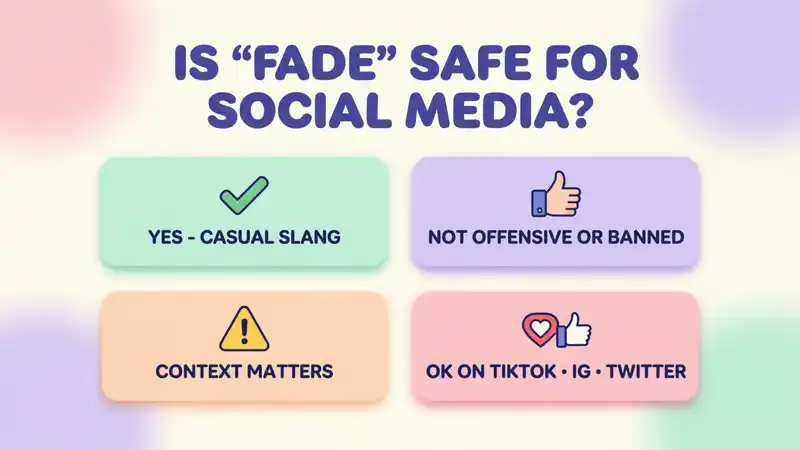
The word “fade” is not inherently unsafe or offensive, but its slang meaning can describe confrontation.
On social media, context matters.
A casual joke among friends may be interpreted differently from a direct statement aimed at another person. Avoid using confrontational slang to threaten, intimidate, or escalate an argument.
If a conversation is becoming heated, clear and calm language is usually a better choice.
Common Meanings of “Fade”
The easiest way to understand the word is to separate its major meanings.
1. Fade as Slang
A confrontation or fight.
Example:
“He said he wanted to catch a fade.”
2. Fade as a Haircut
A hairstyle where the hair gradually becomes shorter toward certain areas.
Example:
“His new fade looks great.”
3. Fade as an Ordinary English Verb
To gradually become less strong, bright, clear, or noticeable.
Example:
“The writing began to fade.”
These meanings are unrelated in many sentences, so context is essential.
Frequently Asked Questions
1. What does “fade” mean in slang?
In slang, “fade” can mean a confrontation or fight, especially in expressions such as “catch a fade.”
2. What does “catch a fade” mean?
“Catch a fade” is informal slang for facing a confrontation, sometimes referring to a physical fight. It can also be used jokingly online.
3. Is “fade” a rude word?
Not by itself. “Fade” is a normal English word and also describes a haircut. Its slang use can sound aggressive depending on the context.
4. What does “throw a fade” mean?
“Throw a fade” is informal slang connected with entering or challenging a confrontation. The expression may be serious or exaggerated for humor.
5. Does “fade” mean haircut?
Yes. A fade is a popular haircut style. This is completely different from the slang meaning connected with confrontation.
6. Is “fade” appropriate in formal writing?
Usually, no when you mean the slang expression. In formal writing, words such as “confrontation,” “disagreement,” or “conflict” are clearer.
Conclusion
“What’s a fade slang” usually refers to an informal expression where “fade” means a confrontation or fight, especially in phrases like “catch a fade” and “throw a fade.” However, the word has several other meanings. It can describe a popular haircut or the gradual loss of color, strength, or visibility.
The most important clue is context. If the conversation involves a barber or hairstyle, “fade” probably means a haircut. If the conversation involves an argument and phrases such as “catch a fade,” it is likely confrontation-related slang.
Because this slang can sound aggressive, use it carefully. In formal or unclear situations, simple words such as “conflict,” “argument,” or “confrontation” can communicate your meaning more clearly.
Read more about!
- UK Slang Words Roadman: Meaning, Popular Terms & Examples
- Bitchin Slang: Meaning, Origin, Examples & How to Use It
- Grape Slang Meaning: What Does Grape Mean in Slang?
- Birdie Slang Meaning: Everything You Need to Know

Daniel Brooks is an English vocabulary educator and content editor with experience creating educational resources about English words, idioms, and everyday communication. He reviews language content for clarity, accuracy, and readability to ensure readers receive reliable and easy-to-understand information.