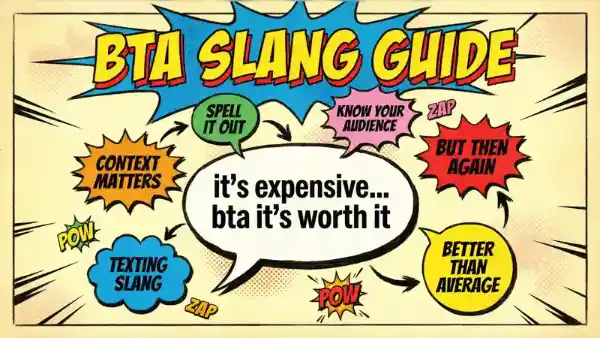
BTA slang can be confusing because the abbreviation may have different meanings depending on where you see it.
In texting and online conversations, BTA most commonly means “But Then Again,” a phrase people use to add another thought, change their view, or introduce a different side of an argument. However, abbreviations can vary between communities, so the surrounding message is important.
People may search for “bta slang” after seeing the term in a text, comment, social media post, or online chat.
Understanding the context helps you know If the writer is adding a new point, correcting an earlier thought, or using BTA for something completely different. This guide explains the common meaning, examples, tone, usage, and situations where BTA may or may not fit.
Quick Answer: In texting and online slang, BTA usually means “But Then Again.” It is used to introduce another thought, opinion, or possibility that may change or balance what was just said.
What Does BTA Mean in Text?
BTA usually means “But Then Again” in casual texting and online communication.
People use it when they want to add another idea after making a statement. It can show that the writer has reconsidered something or wants to point out another side.
For example:
“I thought the movie was boring. BTA, the ending was pretty good.”
Here, BTA introduces a different thought about the movie.
The abbreviation saves typing time and fits the short style often used in messages and online chats.
What Is the Full Form of BTA Slang?
The most common texting expansion of BTA is:
BTA = But Then Again
The phrase “but then again” is used when someone adds a second thought that may contrast with or qualify the first idea.
Simple Meaning
In simple English, BTA can mean:
- “On the other hand”
- “However, thinking about it again”
- “There is another way to look at it”
- “I should also consider this”
The exact feeling depends on the sentence around it.
How Is BTA Used in a Conversation?
BTA normally appears before an additional thought.
Example 1: Changing Your Mind
“I don’t think I’ll go. BTA, my friends will be there.”
The writer first says they may stay home, then gives a reason they might change their mind.
Example 2: Adding Another Side
“The game was difficult. BTA, that’s what made it fun.”
The second sentence gives another perspective.
Example 3: Casual Texting
“I wanted pizza tonight. BTA, we had pizza yesterday.”
The writer adds a reason to reconsider the original idea.
Is BTA Rude, Offensive, or Neutral?
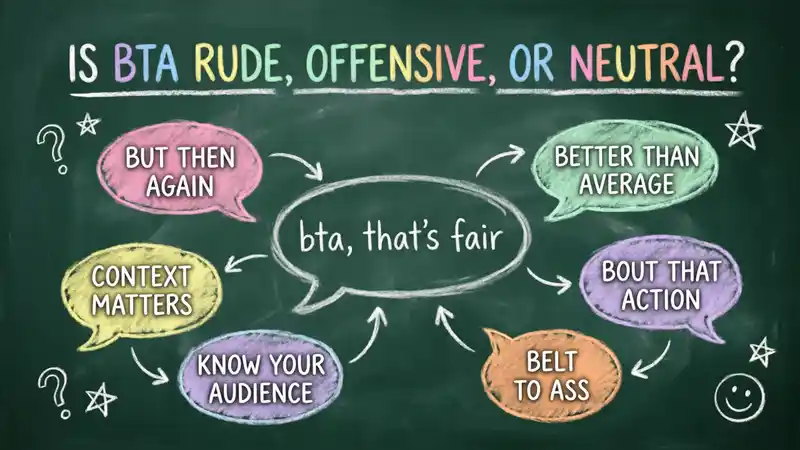
BTA is generally neutral and harmless when it means “But Then Again.”
It does not normally contain an insult or offensive meaning. The tone comes from the message surrounding the abbreviation.
Friendly Tone
“BTA, you did a great job on that project.”
This sounds supportive.
Casual Tone
“BTA, maybe we should wait until tomorrow.”
This simply adds another option.
Argumentative Tone
“You said it was easy. BTA, you didn’t even finish it.”
Here, the words around BTA create a more challenging tone.
So, BTA itself is not rude. The context determines how the complete message sounds.
Where Is BTA Commonly Used?
BTA can appear in informal digital communication where people use abbreviations to type quickly.
Text Messages
Friends may use BTA when discussing plans, opinions, or decisions.
Social Media
It may appear in comments, captions, or replies when someone wants to add another point.
Online Chats
People can use abbreviations like BTA in casual group conversations.
Discord and Gaming Chats
If someone is discussing a game, strategy, or decision, BTA can be used to add a different viewpoint.
However, BTA is not one of the most universal internet abbreviations. If the meaning is unclear, read the surrounding conversation before assuming what it means.
Real-Life Examples of BTA
Here are some natural examples of how BTA can work in casual communication.
Friendly Example
“I don’t think we need another player. BTA, having one more could make the game easier.”
Casual Text Example
“I was going to stay home. BTA, the weather looks really nice.”
Social Media Example
“The new update looks strange. BTA, I like some of the new features.”
Gaming Example
“That strategy seems risky. BTA, it worked last round.”
Conversation Example
“I thought the restaurant was too expensive. BTA, the food was really good.”
These examples show the main purpose of BTA: adding another thought that balances or changes the first statement.
BTA in Different Contexts
The meaning and tone of an abbreviation can depend on the setting.
| Context | Possible Use of BTA | Tone |
| Texting | But Then Again | Casual |
| Social media | Adding another point | Informal |
| Online chat | Changing or balancing an opinion | Casual |
| Gaming | Adding another strategy or view | Informal |
| School writing | Usually avoid | Formal |
| Business email | Usually avoid | Professional |
BTA is best suited to informal communication.
BTA vs. Similar Abbreviations
BTA is related to several expressions used to connect ideas, but they are not always interchangeable.
| Expression | Meaning | Main Use |
| BTA | But Then Again | Adds another thought |
| TBH | To Be Honest | Gives an honest opinion |
| BTW | By The Way | Adds extra information |
| IDK | I Don’t Know | Shows uncertainty |
| IMO | In My Opinion | Introduces an opinion |
| OTOH | On The Other Hand | Presents another viewpoint |
BTA vs. BTW
BTA introduces another thought or perspective.
BTW usually introduces additional information that may not directly contrast with the previous point.
Example:
“The game is hard. BTA, that makes it more exciting.”
Compared with:
“The game is hard. BTW, it has a new update.”
BTA vs. OTOH
OTOH means “On The Other Hand.”
It is often used when comparing two sides of an issue.
BTA means “But Then Again” and often sounds more like a person reconsidering or adding a second thought.
For example:
“I want to buy it. BTA, I don’t really need it.”
The writer is reconsidering the decision.
When Should You Avoid Using BTA?
BTA is mainly an informal abbreviation, so it is not ideal for every setting.
Avoid using it in:
- Formal essays
- Academic assignments
- Official reports
- Job applications
- Formal business letters
- Important professional communication
Instead, write the full phrase “but then again” or use a clearer formal transition such as “however” or “on the other hand.”
This makes your writing easier for all readers to understand.
Why Do People Use BTA?
People use abbreviations like BTA because they make casual communication faster.
To Save Time
Typing three words as an abbreviation can be quicker in a fast conversation.
To Sound Casual
Abbreviations can make a message feel relaxed and conversational.
To Add a Second Thought
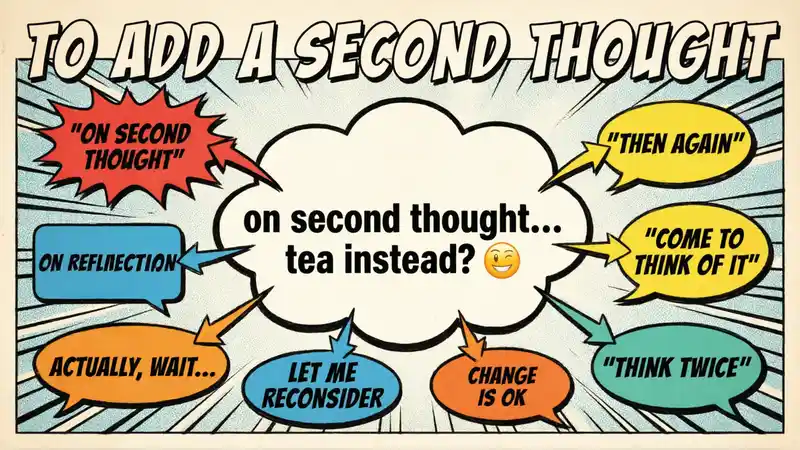
BTA is useful when someone wants to rethink something without writing a long explanation.
To Keep Messages Short
Online conversations often favor short expressions, especially when people are responding quickly.
Is BTA Safe for Social Media?
Yes. When BTA means “But Then Again,” it is generally a harmless abbreviation.
It does not normally refer to dangerous or offensive content. Still, abbreviations can sometimes have different meanings in different communities.
If someone uses BTA in an unusual sentence, do not automatically assume the meaning. Look at the surrounding words and conversation.
Common Misunderstandings About BTA
BTA Does Not Always Have One Universal Meaning
Internet abbreviations can have multiple expansions. The context should always be considered.
BTA Is Not the Same as BTW
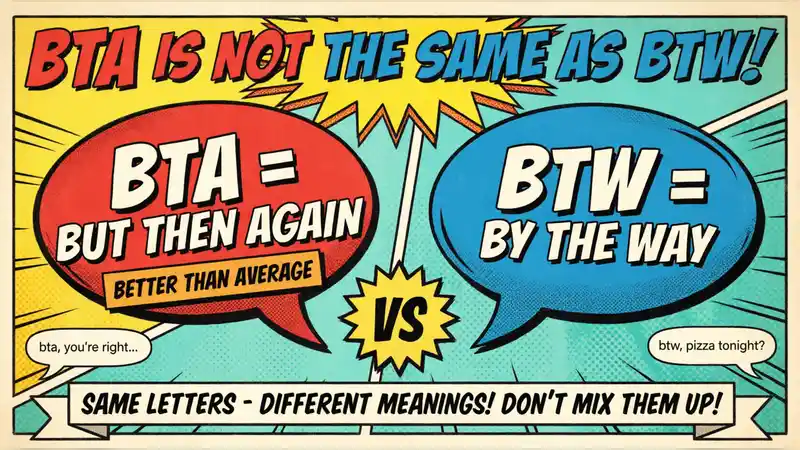
The two abbreviations look similar, but they serve different purposes.
- BTA: But Then Again
- BTW: By The Way
BTA Is Not Formal English
Although readers may understand it, BTA is better suited to casual digital communication.
Capitalization May Vary
People may write BTA, bta, or sometimes Bta. The capitalization usually does not change the intended meaning.
How to Respond When Someone Uses BTA
If someone writes BTA to introduce another thought, you can simply respond to the new point.
For example:
Person A: “I don’t think we should go tonight. BTA, tomorrow might be even busier.”
Person B: “Good point. Let’s go tonight.”
The abbreviation does not require a special response. Just understand the second idea and continue the conversation.
Is BTA Used by a Specific Age Group?
BTA is mainly suited to casual digital communication, but it should not be treated as an abbreviation used by one specific age group.
Texting habits vary from person to person. Some people use many abbreviations, while others prefer to type words fully.
It is therefore better to describe BTA by context rather than assigning it to a particular generation.
Frequently Asked Questions
1. What does BTA mean in slang?
BTA commonly means “But Then Again.” It is used to introduce another thought, possibility, or viewpoint.
2. What does BTA stand for in texting?
In casual texting, BTA can stand for “But Then Again.”
3. Is BTA rude?
No. When used as “But Then Again,” BTA is normally neutral and harmless.
4. What is the difference between BTA and BTW?
BTA means “But Then Again,” while BTW means “By The Way.” BTA usually adds a contrasting or reconsidered thought.
5. Can I use BTA in formal writing?
It is better to avoid BTA in formal writing. Write “but then again” instead.
6. Does BTA have other meanings?
Yes. Abbreviations can have different meanings in different fields and communities. The surrounding context should be checked before deciding what BTA means.
Conclusion
BTA slang usually means “But Then Again” in casual texting and online conversations. People use it when they want to add another thought, reconsider an opinion, or show a different side of a situation.
The abbreviation is generally neutral and safe for casual communication. You may see it in texts, social media conversations, online chats, and other informal settings. However, it is not the best choice for formal school or professional writing.
If you are unsure what BTA means in a particular message, always check the surrounding context. That is the easiest way to understand internet abbreviations accurately.
Read more about!
- What Does Shark Mean in Slang? Meaning and Uses
- Stomach in Spanish Slang: Meanings, Words, and Everyday Use
- What Does Preppy Mean in Slang? Meaning, Origin & How People Use It
- Mofongo Slang Explained: Meaning, Origin, and Usage

Daniel Brooks is an English vocabulary educator and content editor with experience creating educational resources about English words, idioms, and everyday communication. He reviews language content for clarity, accuracy, and readability to ensure readers receive reliable and easy-to-understand information.