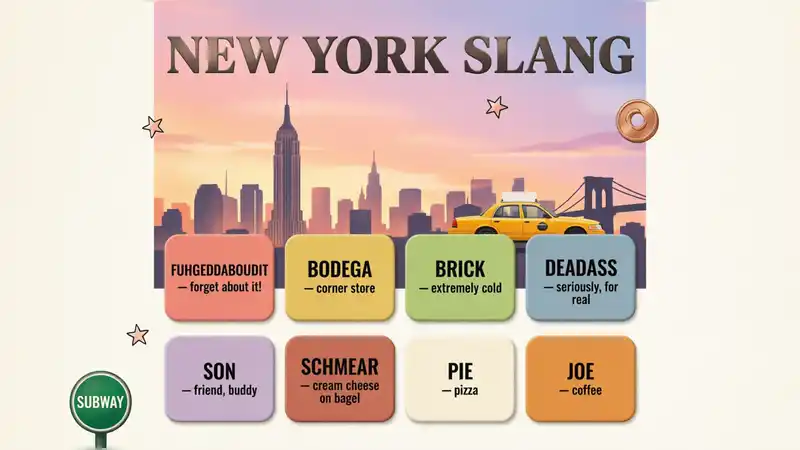
New York slang refers to informal words and phrases strongly associated with New York City speech and culture.
Common examples include deadass (seriously), mad (very/a lot), brick (extremely cold), bodega (a neighborhood convenience store), and son (a casual way to address someone). The exact meaning can change with context, neighborhood, age, and community.
New York has a long history of mixing languages, cultures, and local speech styles. That is one reason its slang can sound different from general American English. People may search for new york slang because they hear a phrase in a conversation, movie, song, social-media post, or text and want to know what it means.
This guide explains common New York expressions, how they are used, their tone, and when they may not be appropriate.
Quick Answer
New York slang is informal language associated with New York City and its many communities. Words such as deadass, mad, brick, bodega, son, and OD can have meanings that differ from standard English depending on context.
What Does New York Slang Mean in Text?
New York slang in text means informal expressions associated with New York City that people may use in messages, social media, conversations, and online communities.
Some expressions are especially recognizable as New York speech, while others are shared with speakers in nearby areas or across the United States.
For example:
- Deadass = seriously / genuinely
- Mad = very / a lot
- Brick = extremely cold
- Bodega = a small neighborhood store
- Son = a casual way to address someone
- OD = excessively / very much
- Whack = bad, disappointing, or unfair
- Frontin’ = pretending or acting like something is true
- Schmear = a spread, especially cream cheese on a bagel
The meaning is often easy to understand once you know the situation.
New York Slang Full Definition
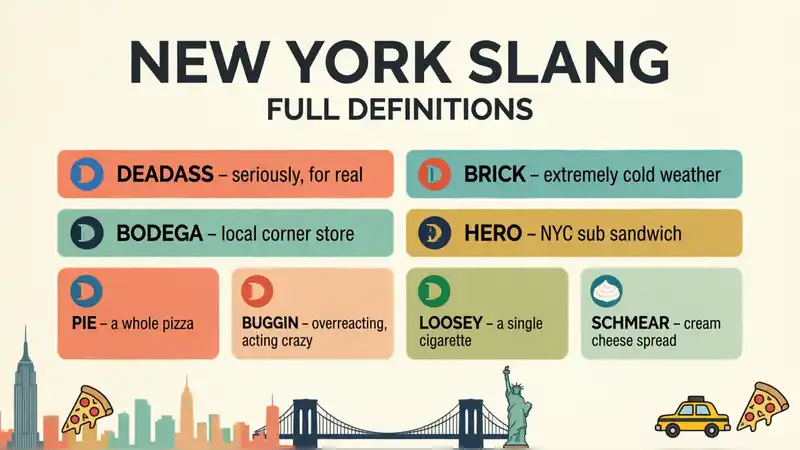
There is no single “full form” for new york slang because it is a broad category, not an abbreviation.
Instead, the phrase describes a collection of informal expressions connected with New York City speech.
New York Slang Can Come From Different Communities
New York City has many neighborhoods and communities, so there is no single New York accent or slang vocabulary.
Expressions associated with New York can reflect influences from:
- African American English
- Caribbean communities
- Jewish American culture
- Italian American communities
- Puerto Rican and other Latino communities
- Hip-hop culture
- New York street culture
- Youth and internet culture
Not every expression belongs exclusively to one group or to New York itself. Some have spread far beyond the city.
That distinction is important when learning new york slang. A word may be strongly associated with New York but still be used elsewhere.
Popular New York Slang Words and Phrases
1. Deadass
Meaning: Seriously, honestly, or genuinely.
“Deadass” is one of the most recognizable expressions associated with New York speech.
Example:
“Deadass, I forgot my phone.”
Meaning:
“Seriously, I forgot my phone.”
It can also be used at the end of a sentence for emphasis.
“You really did that, deadass?”
Meaning:
“You really did that, seriously?”
Tone: Very informal.
2. Mad
Meaning: Very or a lot.
In New York-style informal speech, “mad” can work as an intensifier.
Example:
“That place is mad crowded.”
Meaning:
“That place is very crowded.”
Another example:
“I have mad homework tonight.”
Meaning:
“I have a lot of homework tonight.”
This use is different from the standard meaning of “mad,” which can mean angry.
3. Brick
Meaning: Extremely cold.
When someone says:
“It’s brick outside.”
they mean:
“It’s extremely cold outside.”
This is especially useful in conversations about New York winters.
Tone: Informal.
4. Bodega
Meaning: A small neighborhood convenience store or local grocery.
“Bodega” is closely associated with New York City and its neighborhood culture.
Example:
“I’m stopping at the bodega before I go home.”
A bodega may sell snacks, drinks, basic groceries, and other everyday items.
The word is also used outside New York, but it has a strong connection to New York City life.
5. Son
Meaning: A casual way of addressing another person.
“Son” does not necessarily mean someone’s actual child.
Example:
“Son, what are you talking about?”
Here, “son” is a casual form of address.
Its tone depends heavily on the relationship and situation. Among friends, it can sound playful or familiar. In an argument, it can sound confrontational.
6. OD
Meaning: Extremely, excessively, or a lot.
In informal New York speech, “OD” can be used as an intensifier.
Example:
“That movie was OD funny.”
Meaning:
“That movie was extremely funny.”
Another example:
“He was OD excited.”
Meaning:
“He was extremely excited.”
This usage should not automatically be confused with other meanings of “OD.” Context matters.
7. Whack
Meaning: Bad, disappointing, unfair, or strange.
Example:
“That rule is whack.”
Meaning:
“That rule is unfair or bad.”
It can also describe something that simply does not seem good.
“The food was whack.”
Meaning:
“The food was bad.”
8. Frontin’
Meaning: Pretending, exaggerating, or acting as if something is true when it is not.
Example:
“Stop frontin’. You know you liked the song.”
Meaning:
“Stop pretending. You know you liked the song.”
This expression is strongly informal and has roots in broader American slang and African American English rather than being exclusively New York.
9. Tight
Meaning: Close, good, or sometimes upset, depending on context.
Example:
“We’re tight.”
Meaning:
“We’re close friends.”
But “tight” can have other meanings in American English, so the surrounding sentence matters.
10. Schlep
Meaning: To carry, drag, or travel with effort.
“Schlep” comes from Yiddish and became part of American English, especially in areas with strong Jewish cultural influence.
Example:
“I had to schlep all the way across town.”
Meaning:
“I had to make a tiring trip across town.”
It is not exclusive to New York, but it is strongly familiar in New York Jewish-influenced speech.
New York Slang Examples in Real Life
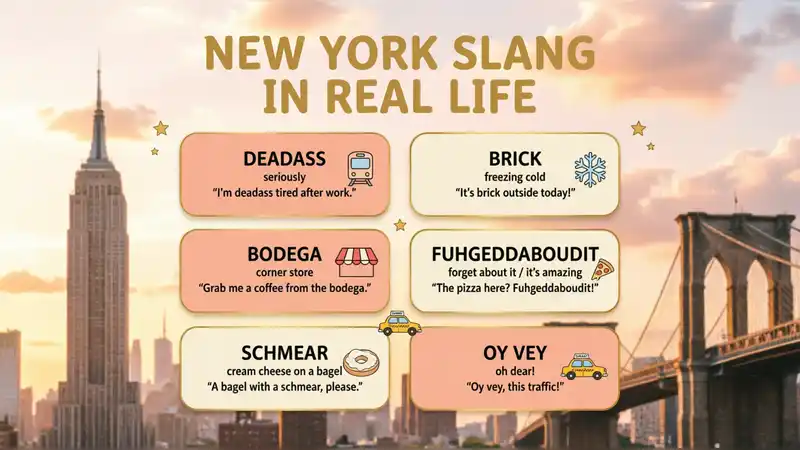
Different situations can change the tone of the same word.
Friendly Conversation
“Deadass, that was the best pizza I’ve had.”
Here, “deadass” emphasizes that the speaker is being serious.
Casual Texting
“It’s brick today 😭”
This means the weather is extremely cold.
Social Media
“That outfit is mad clean.”
Here, “mad” works as an intensifier meaning “very.”
Gaming Conversation
“That boss was OD difficult.”
Meaning:
“That boss was extremely difficult.”
Argument
“Stop frontin’.”
This can sound sharper because the speaker is accusing someone of pretending.
Talking About Friends
“We’re tight.”
This means the people have a close friendship.
New York Slang by Meaning
| Slang | Meaning | Example |
| Deadass | Seriously | “Deadass, I’m tired.” |
| Mad | Very / a lot | “It’s mad cold.” |
| Brick | Extremely cold | “It’s brick outside.” |
| Bodega | Neighborhood store | “I’m going to the bodega.” |
| Son | Casual address | “Son, listen.” |
| OD | Extremely / excessively | “That’s OD expensive.” |
| Whack | Bad / unfair | “That movie was whack.” |
| Frontin’ | Pretending | “You’re frontin’.” |
| Tight | Close friends | “We’re tight.” |
| Schlep | Travel or carry with effort | “I had to schlep my bags.” |
Where Is New York Slang Commonly Used?
Texting
Friends may use New York expressions in casual texts because slang makes messages shorter and more personal.
Words such as “deadass,” “mad,” and “brick” can appear naturally in messages.
Social Media
New York slang can appear in captions, comments, memes, and short videos.
However, a person using a slang word online does not necessarily mean they are from New York. Many expressions have spread nationally through music, entertainment, and social media.
TikTok and Instagram
Some New York expressions are used online as part of humor, cultural references, or regional identity.
The tone can be playful, but using a word does not automatically make someone sound authentically New York.
Discord and Gaming
Informal expressions can also appear in gaming chats, especially when friends already share a casual style of communication.
Workplace Communication
This is different.
Words such as “deadass,” “OD,” and “brick” may be understandable, but they are generally too informal for formal workplace writing.
Why Do People Use New York Slang?
Most New York slang is not inherently offensive.
However, some expressions can sound aggressive, disrespectful, or confrontational depending on tone.
For example, “son” can be friendly between close friends:
“Son, that’s hilarious.”
But the same word can sound confrontational during an argument:
“Son, don’t talk to me like that.”
The important lesson is that tone and relationship matter.
Generally Casual
- Mad
- Brick
- Deadass
- Bodega
- Tight
- Schlep
Can Sound Confrontational
- Son
- Frontin’
- Whack, depending on how it is used
A word being associated with New York does not automatically make it rude.
Origin and Background of New York Slang
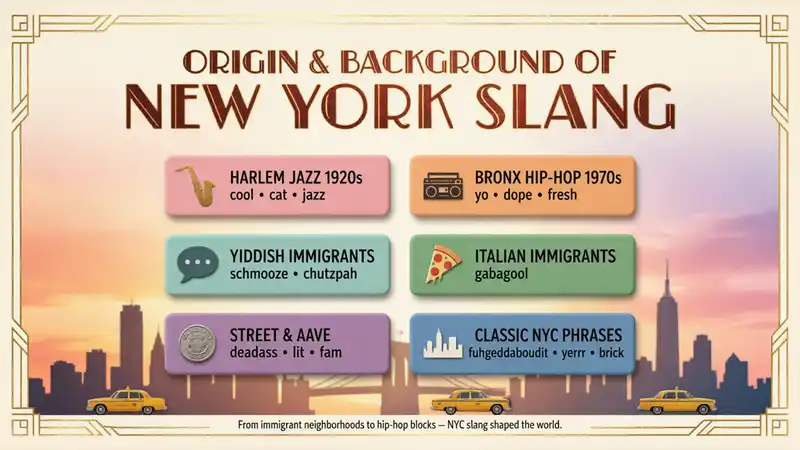
New York slang does not have one single origin.
The city has developed through generations of immigration, migration, neighborhood communities, music, and cultural exchange.
African American English and Hip-Hop
Some expressions commonly associated with New York slang have connections to African American English and hip-hop culture. They should not simply be labeled as “New York inventions” when their history is broader.
Yiddish Influence
Words such as “schlep” became part of American English through Yiddish-speaking communities. New York’s large Jewish population helped make many Yiddish-derived expressions familiar in the region.
Caribbean and Latino Influence
New York’s Caribbean and Latino communities have also contributed to the city’s rich language environment.
However, individual words have different histories. It is better to research a specific term’s origin than to claim that all New York slang comes from one source.
Hip-Hop and Popular Culture
New York hip-hop played a major role in spreading some regional expressions beyond the city.
Music, movies, television, and later social media have helped New York vocabulary travel across the United States.
New York Slang vs. General American Slang
Not every expression people call “New York slang” is unique to New York.
| Expression | Strong New York association? | Used elsewhere? |
| Deadass | Yes | Yes |
| Mad | Yes | Yes |
| Brick | Yes | Yes |
| Bodega | Strong | Yes |
| Son | Regional/cultural | Yes |
| OD | Yes in some usage | Yes |
| Whack | No | Widely used |
| Frontin’ | No | Widely used |
| Schlep | Regional association | Yes |
This is one of the most important points for readers: New York slang is not a closed dictionary of words that only New Yorkers use.
When Should You Avoid Using New York Slang?
You do not need to avoid slang altogether. The better approach is to consider your audience.
Formal Writing
Avoid heavy slang in:
- School essays
- Academic papers
- Formal reports
- Job applications
- Official documents
Professional Messages
Instead of:
“That’s mad good.”
a professional message could simply say:
“That’s very good.”
With People You Do Not Know
If you do not know someone’s communication style, neutral English is usually safer.
When You Are Copying a Regional Style
Using one or two slang words does not necessarily make your speech sound naturally New York.
Slang is connected to culture, community, tone, and lived experience. It is better to understand an expression than to force it into every sentence.
Why Do People Use New York Slang?
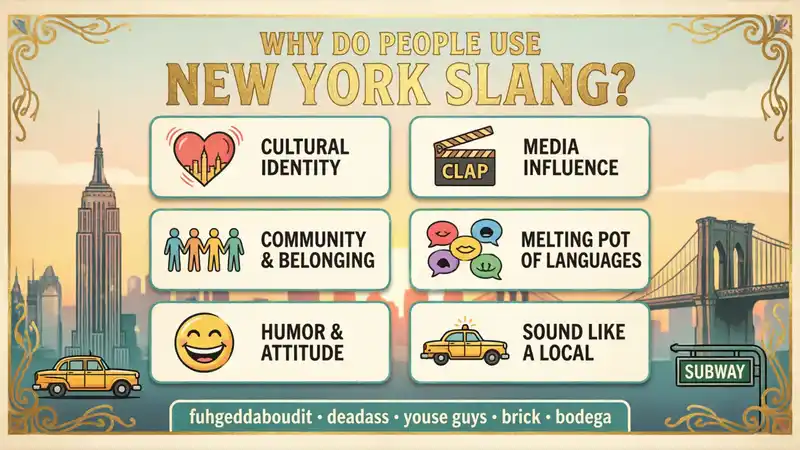
People use regional slang for several reasons.
To Show Identity
Local expressions can signal where someone is from or which communities they identify with.
To Sound Casual
Slang can make a conversation feel more relaxed.
To Express Emotion
Words such as “deadass” can add emphasis that standard English might not capture as naturally.
To Build Connection
Shared expressions can create a sense of familiarity between speakers.
To Be Funny or Playful
Some slang becomes popular online because it sounds expressive or memorable.
Common Misunderstandings About New York Slang
“Deadass” Does Not Mean Dead
In slang, “deadass” means seriously or honestly. It is not normally a reference to death.
“Mad” Does Not Always Mean Angry
In expressions such as:
“That’s mad expensive.”
“mad” means “very” or “a lot.”
“Son” Does Not Necessarily Mean Child
In casual New York-style speech, “son” can be a form of address between people.
“Bodega” Is Not Just Another Word for Any Store
A bodega usually refers to a neighborhood convenience store or small local shop, especially in the New York context.
Not Every New Yorker Uses the Same Slang
New York City is highly diverse. Slang can differ by neighborhood, age, community, and social group.
Is New York Slang Safe for Social Media?
Generally, common New York slang is safe to use in ordinary social-media conversations.
Words such as “deadass,” “mad,” “brick,” and “bodega” are not inherently harmful.
Still, context matters.
A phrase that sounds funny between friends can sound disrespectful when directed at a stranger. Strong slang can also be misunderstood by people who are unfamiliar with the expression.
For public posts, use slang when you understand both its meaning and tone.
FAQs About New York Slang
1. What is New York slang?
New York slang is a broad group of informal words and expressions associated with New York City and its diverse communities. Examples include “deadass,” “mad,” “brick,” and “bodega.”
2. What does “deadass” mean in New York slang?
“Deadass” means seriously, honestly, or genuinely. It is used to emphasize that someone is being truthful or serious.
3. What does “brick” mean in New York slang?
“Brick” means extremely cold when describing the weather.
Example:
“It’s brick outside.”
This means:
“It is extremely cold outside.”
4. What does “mad” mean in New York slang?
“Mad” can mean “very” or “a lot.”
Example:
“That’s mad expensive.”
Meaning:
“That is very expensive.”
5. What does “son” mean in New York slang?
“Son” can be a casual way to address another person. It does not necessarily mean that the person is your child.
6. Is New York slang only used in New York?
No. Many expressions associated with New York have spread through music, entertainment, social media, and everyday American speech.
Conclusion
New York slang is a broad and changing collection of informal expressions connected with New York City’s diverse communities. Words such as deadass, mad, brick, bodega, son, OD, and whack can add local flavor and strong emotion to casual conversations.
The most important thing is context. “Deadass” can emphasize honesty, “mad” can mean “very,” and “brick” can describe freezing weather. At the same time, not every word is unique to New York, and not every New Yorker uses the same expressions.
If you are learning new york slang, focus on the meaning, tone, and situation rather than simply memorizing a list. That will help you understand these expressions without using them in ways that sound forced or inappropriate.
Read more about!
- What Does Shark Mean in Slang? Meaning and Uses
- What Does Preppy Mean in Slang? Meaning, Origin & How People Use It
- Slang for Coke: Common Terms and Their Meanings
- Reckless in Italian Slang: Meaning and Common Words

Daniel Brooks is an English vocabulary educator and content editor with experience creating educational resources about English words, idioms, and everyday communication. He reviews language content for clarity, accuracy, and readability to ensure readers receive reliable and easy-to-understand information.