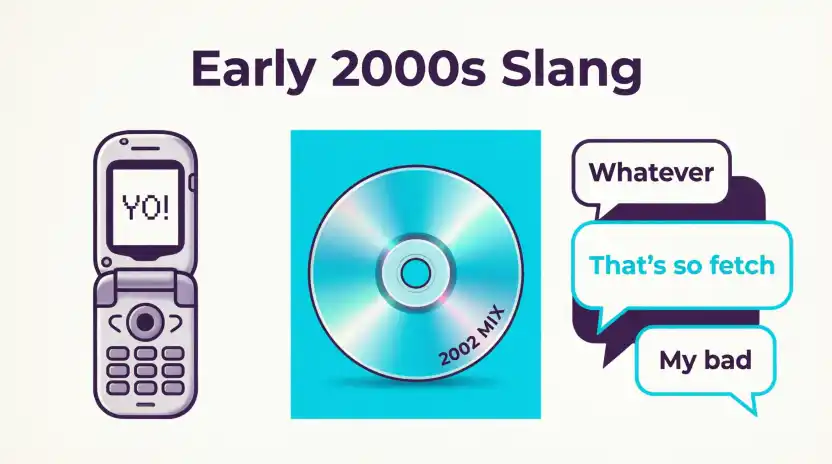
The early 2000s had a slang style all its own. From “bling” and “da bomb” to “fo’ shizzle” and “phat,” many early 2000s slang words came from hip-hop, pop culture, TV, movies, and everyday youth speech.
Some terms were already older but became widely popular during this era, while others were strongly linked to the culture of the time.
If you are searching for early 2000s slang words, you may want to understand what these terms meant, where they came from, and if people still use them today.
This guide explains the most recognizable examples in simple English, with examples and context so you can understand them without sounding like you are forcing outdated slang into modern conversation.
Early 2000s Slang Words: Quick Answer
Early 2000s slang words are informal words and phrases that were popular around the late 1990s and early-to-mid 2000s. Common examples include bling, da bomb, fo’ shizzle, phat, crunk, my bad, fly, tight, and talk to the hand. Not every term originated in the 2000s. Some became especially noticeable or mainstream during that period.
What Are Early 2000s Slang Words?
Early 2000s slang words are informal expressions associated with the culture and communication styles of roughly the 2000–2005 period.
There is no official dictionary list called “early 2000s slang.” The phrase is mainly used to describe words that people remember as part of the era.
Some examples include:
- Bling: flashy jewelry or expensive-looking possessions.
- Da bomb: something considered excellent or the best.
- Fo’ shizzle: a playful slang expression popularized in hip-hop culture.
- Phat: excellent, attractive, or stylish, depending on context.
- Crunk: excited, energetic, or related to a Southern hip-hop style.
- My bad: a casual way to admit a mistake.
- Fly: stylish or attractive.
- Tight: cool, impressive, or excellent in slang use.
- Talk to the hand: a dismissive phrase meaning the speaker does not want to listen.
One important point is that “early 2000s slang” does not mean every word was invented between 2000 and 2005. For example, phat has documented roots much earlier, while bling became mainstream after emerging in 1990s hip-hop culture.
The Origin of Early 2000s Slang Words
Early 2000s slang developed from several overlapping sources.
Hip-Hop and Music
Hip-hop had a major role in spreading slang during this period. Words could move from regional or musical communities into television, magazines, radio, and everyday speech.
For example, Dictionary.com notes that bling gained mainstream popularity after emerging from U.S. rap slang. Fo’ shizzle was popularized in the mainstream by Snoop Dogg, although the broader “-izzle” style had earlier roots.
Television and Movies
Teen sitcoms, comedy shows, and movies also helped certain expressions reach wider audiences.
Phrases such as talk to the hand became recognizable as dismissive expressions associated with late-1990s and early-2000s pop culture.
Internet and Chat Culture
The early 2000s were also an important period for online communication.
Instant messaging, forums, blogs, and early social networking encouraged shorter and more playful forms of language. This helped informal expressions spread beyond face-to-face conversations.
Not Every Word Started in the 2000s
This is where many online lists become misleading.
For example, Dictionary.com traces phat to the 1960s, while crunk has documented roots in the 1990s. They are still useful examples of 2000s-era slang because they were strongly associated with the culture of that period.
British English vs American English
Most of the slang commonly described as early 2000s slang in online searches is associated with American pop culture, especially U.S. hip-hop, television, and youth culture.
That does not mean British speakers never used these terms. It means the cultural history and mainstream exposure can differ by region.
| British English | American English | Example |
| Often uses UK-specific slang | Many early-2000s lists focus on U.S. slang | “That’s wicked.” vs. “That’s phat.” |
| British youth culture influenced local slang | Hip-hop strongly influenced many U.S. terms | “That’s well good.” vs. “That’s da bomb.” |
| Some American slang became familiar through media | Terms such as bling spread widely | “She wore loads of bling.” |
| Meaning can depend on local context | Meaning can also change by community | “That’s tight.” |
There is no rule that one regional version is “correct.” Slang is informal, and its meaning depends heavily on community, period, and context.
For historical writing, it is better to identify a term as U.S. slang, British slang, internet slang, hip-hop slang, or general youth slang when reliable evidence supports that description.
Which Version Should You Use?
There is no single “correct version” of early 2000s slang. The best choice depends on your audience and purpose.
United States
If you are writing about U.S. pop culture from the early 2000s, terms such as bling, da bomb, phat, fly, and fo’ shizzle may fit the historical context.
United Kingdom
Do not assume that every American slang term was equally common in Britain. Add regional context when discussing British audiences.
Canada
Canadian readers may recognize many American expressions because of shared media exposure, but local slang can differ.
Australia
Australian English has its own slang traditions. American early-2000s slang may be familiar without being the most natural choice for Australian dialogue.
International Writing
Explain the meaning rather than assuming every reader knows the term.
Academic Writing
Avoid using slang as normal academic vocabulary unless you are discussing slang itself, language history, or popular culture.
Business Writing
Most early 2000s slang should be avoided in formal business writing. Use clear standard English instead.
Common Mistakes
Mistake 1: Assuming Every Term Was Invented in 2000
Incorrect:
“Phat was invented in 2000.”
Correct:
“Phat was popular as slang during the 1990s and remained recognizable in the early 2000s.”
Dictionary.com traces phat much further back, to the 1960s.
Memory tip:
Popular in the 2000s does not always mean invented in the 2000s.
Mistake 2: Treating All Slang as Universal
Incorrect:
“Everyone in the English-speaking world used these words.”
Correct:
“These terms were especially associated with certain U.S. communities and popular culture.”
Mistake 3: Using Old Slang in Modern Formal Writing
Incorrect:
“The quarterly results are da bomb.”
Better:
“The quarterly results are excellent.”
Mistake 4: Assuming Slang Has Only One Meaning
Some slang terms changed meaning according to context.
For example, crunk can describe an energetic style or state, while it is also associated with a Southern U.S. hip-hop genre.
Everyday Examples
Emails
Informal email:
“My bad, I sent the wrong attachment.”
Formal email:
“Sorry, I sent the wrong attachment.”
My bad is casual, so it works better with friends or familiar coworkers than in a formal business message.
Business Writing
Most early 2000s slang is not appropriate for formal reports.
Instead of:
“This campaign is da bomb.”
Write:
“This campaign performed very well.”
News Headlines

A publication discussing nostalgia might use a phrase such as:
“A Look Back at Early 2000s Slang”
The slang itself can be the subject of the article without becoming part of formal reporting.
Blogs
A nostalgic blog could say:
“That outfit was seriously fly back in the day.”
The casual tone makes the slang feel more natural.
Social Media
A person discussing 2000s nostalgia might write:
“These early 2000s slang words bring back memories.”
Academic Writing
An academic paper might write:
“Hip-hop culture influenced the spread of several slang expressions into mainstream American English.”
This is more suitable than filling the paper with informal slang.
Daily Conversation
Some expressions can still be understood today:
“My bad. I forgot to call.”
Other terms may sound intentionally nostalgic:
“That movie was da bomb.”
The second example can work as a deliberate reference to an earlier period.
Google Trends & Modern Usage
Interest in early 2000s slang words is closely connected to nostalgia and searches for older internet and pop-culture language.
There is no single reliable statistic that can show exactly how often every 2000s slang term is used today. Search interest also does not necessarily mean that people actively use the words in everyday conversation.
Modern searches often come from people who want to:
- Understand old slang they heard in movies or music
- Write a 2000s-themed article or story
- Find nostalgic captions
- Understand older internet language
- Compare 2000s slang with Gen Z or Gen Alpha slang
- Learn how English slang changes over time
Many terms from that period are now understood mainly as retro slang.
For example, phat and da bomb are strongly associated with earlier slang eras, while bling has remained recognizable beyond the 2000s. Dictionary.com also describes several older hip-hop terms as examples of slang tied to particular cultural eras.
This is why context matters more than simply labeling a word “2000s slang.”
Quick Comparison Table
| Slang Word | Meaning | Correct? | Region | Example |
| Bling | Flashy jewelry or possessions | Yes | Mainly U.S. origin | “He had some serious bling.” |
| Da bomb | Excellent or the best | Yes | U.S. slang | “That game was da bomb.” |
| Fo’ shizzle | Playful slang expression | Yes | U.S. hip-hop culture | “Fo’ shizzle.” |
| Phat | Great, excellent, or attractive | Yes | U.S./hip-hop slang | “That beat is phat.” |
| Crunk | Excited or energetic; also a music style | Yes | Southern U.S. | “The crowd was crunk.” |
| My bad | My mistake | Yes | Widely understood | “My bad, I forgot.” |
| Fly | Stylish or attractive | Yes | U.S. slang | “That jacket is fly.” |
| Tight | Cool or impressive | Yes | U.S. slang | “Those shoes are tight.” |
| Talk to the hand | Dismissive expression | Yes | U.S. pop culture | “Talk to the hand.” |
| Jiggy | Stylish or fashionable | Yes | U.S. pop culture | “He looked jiggy.” |
Several of these terms have histories that predate the early 2000s. That distinction is important when writing an accurate article about the era.
Key Takeaways
- Early 2000s slang words are informal expressions associated with the culture of that period.
- Not every 2000s slang term was invented during the 2000s.
- Hip-hop had a major influence on many popular expressions.
- Bling refers to flashy jewelry or possessions.
- Da bomb means something excellent or impressive.
- Phat means great or excellent in slang, but its history goes back much earlier.
- Crunk is associated with energetic slang and Southern U.S. hip-hop culture.
- Some terms now sound deliberately retro rather than modern.
- Regional context matters when discussing American, British, Canadian, or Australian slang.
- Formal academic and business writing usually calls for standard English.
FAQs
What are some popular early 2000s slang words?
Popular examples include bling, da bomb, fo’ shizzle, phat, crunk, fly, tight, my bad, jiggy, and talk to the hand. Some originated before 2000 but became especially recognizable during the late 1990s and early 2000s. Their popularity also varied by region, age group, and cultural setting.
What did “da bomb” mean in the early 2000s?
Da bomb was slang for something considered excellent, impressive, or the best. It was especially associated with 1990s and early 2000s popular culture. Dictionary.com identifies it as a compliment meaning “the best” and notes that the expression was already established in the 1990s.
What did “bling” mean in the 2000s?
Bling referred to flashy or expensive jewelry, clothing, or possessions. It could also describe a flashy lifestyle. The term became strongly associated with hip-hop culture and gained mainstream popularity after emerging in U.S. rap slang.
Is “phat” an early 2000s slang word?
Yes, phat can be included in lists of early 2000s slang, but it did not originate in that decade. Dictionary.com traces the slang spelling to the 1960s and explains that it later became a slang word meaning great, wonderful, or terrific.
What does “fo’ shizzle” mean?
Fo’ shizzle is a playful slang expression associated with American hip-hop culture. It became widely recognizable around the early 2000s after Snoop Dogg helped popularize the style. The broader “-izzle” wordplay had earlier roots, so the expression should not be described as a completely new 2000s invention.
Is early 2000s slang still used today?
Some expressions remain recognizable, but that does not mean they are common in everyday modern speech. Words such as bling have continued to be understood, while other expressions are often used for nostalgia, humor, or deliberate references to 2000s culture.
Why did early 2000s slang become popular?
Music, television, movies, youth culture, magazines, and the growing internet all helped slang travel between communities. Hip-hop was particularly influential in bringing certain expressions into wider popular culture. The spread was not the same for every word, so individual terms have different histories.
What is the difference between 1990s and early 2000s slang?
There is considerable overlap. Slang rarely changes exactly at midnight on January 1, 2000. Many expressions that people associate with the early 2000s were already popular in the 1990s, while other terms became more visible as the new decade progressed.
Is early 2000s slang appropriate for formal writing?
Usually, no. Slang is informal and can make academic, legal, professional, or business writing sound too casual. You can discuss slang in formal writing, but it is usually better to explain the term and use standard English for the rest of the text.
Where did many early 2000s slang words come from?
Many came from specific communities, including African American English, hip-hop culture, regional U.S. speech, youth culture, television, and internet communities. It is important not to claim that all slang came from one source. Each expression has its own history and path into wider use.
Conclusion
Early 2000s slang words offer a useful look at how language, music, entertainment, and youth culture shaped everyday English. Terms such as bling, da bomb, phat, fo’ shizzle, crunk, fly, tight, and my bad are strongly connecte with the era, but their histories are not identical.
Some words were already establish before 2000. Others became widely recognizable during the early 2000s. For example, phat has roots going back to the 1960s, while bling emerged into mainstream use through 1990s hip-hop culture.
The safest way to understand these expressions is to consider their meaning, historical period, region, and cultural context rather than assuming every term was invented in the same decade.
If you are writing about the 2000s, using one or two period-appropriate expressions can add authenticity. In formal writing, however, clear standard English is usually the better choice.
The key takeaway: 2000s slang is more than a list of old words. It reflects the culture that helped those words become popular.
Read more about!
- Big Meaning Slang: What Does “Big” Mean?
- Cho Meaning Slang: What Does “Cho” Mean?
- Cow Slang Meaning: What Does “Cow” Mean in Slang?

Daniel Brooks is an English vocabulary educator and content editor with experience creating educational resources about English words, idioms, and everyday communication. He reviews language content for clarity, accuracy, and readability to ensure readers receive reliable and easy-to-understand information.