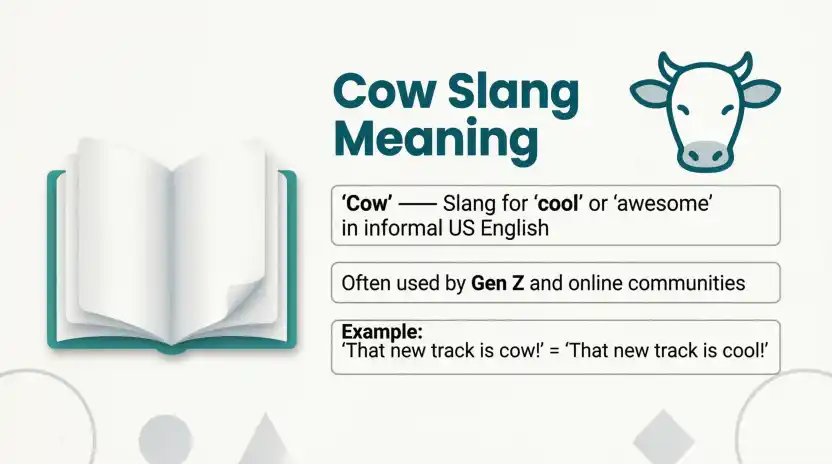
The word cow slang can be confusing because “cow” has a normal meaning as an animal, but it can also have a slang or insulting meaning. In English, the slang use depends strongly on the country and context.
In British English, cow can be an offensive term for a woman who is considered unpleasant or unkind. Oxford and Cambridge both identify this use as offensive.
In Australian and New Zealand English, the word can also describe something unpleasant or difficult. In everyday American English, the insulting slang use is less central, while expressions such as “have a cow” have their own informal meaning.
This guide explains the meaning of cow slang, where it comes from, how British and American usage differ, when the word may sound offensive, and how to understand it in texts, conversations, social media, and writing.
Cow Slang Meaning: Featured Snippet & AI Overview
Cow slang usually refers to an offensive informal term for a woman who is considered unpleasant, unkind, or disagreeable, especially in British English. In Australian and New Zealand English, “cow” can also describe something unpleasant or difficult. The meaning depends on context and region.
Cow Slang – Quick Answer
When someone calls a person a “cow” as slang, they are usually using the word as an insult.
In British English, it can refer to a woman whom the speaker considers unpleasant or unkind. Cambridge labels this use as offensive.
Examples
- “She called her a cow after the argument.”
- “That was a rude thing to say. Calling someone a cow is insulting.”
- “What a cow!” can express strong dislike toward a woman.
The word should not be confused with the ordinary meaning of cow, which refers to a female bovine animal.
What Does Cow Slang Mean?
The meaning of cow slang depends on how the word is being used.
1. Cow as an insult
The most important slang meaning is an insulting term for a woman.
Oxford defines this slang use as an offensive word for a woman the speaker does not like. Collins similarly describes it as an informal and offensive term for a disagreeable woman.
For example:
“He called her a cow.”
Here, the speaker is not talking about an animal. The word is being used as an insult.
2. Cow for an unpleasant person or situation
Australian and New Zealand English have another informal use. Cow can describe something unpleasant, difficult, or objectionable. Cambridge gives this regional meaning as something difficult or unpleasant.
For example:
“It was a cow of a day.”
The meaning is roughly that the day was difficult or unpleasant.
3. Cow in American expressions
American English also has familiar informal expressions involving the word.
For example, “have a cow” means to become very angry or anxious about something. Oxford lists this as an informal North American expression.
Example:
“Mom will have a cow if I lose the keys.”
This does not mean that the person is being called a cow.
Is “cow” always slang?
No.
The standard meaning is the female animal of the cattle family. It can also refer to females of certain other large mammals, such as elephants and whales.
The context tells you which meaning is intended.
The Origin of Cow Slang
The ordinary noun cow is very old. Oxford traces the animal word to Old English cū, with related forms found in other Germanic languages.
Collins also traces the noun through Old English and gives related forms from languages including Old Norse and Germanic languages.
The insulting sense is different from the animal definition. Modern dictionaries record it as an informal and offensive use, particularly in British English. However, the dictionaries consulted here do not give a simple, precise date for when this particular insulting sense first developed. It is therefore better not to claim a specific invention date without stronger historical evidence.
There is also a separate verb to cow, meaning to frighten or intimidate someone. Oxford traces this verb to a different origin, probably from Old Norse kúga, meaning to oppress.
So, although cow and to cow look identical, they have different histories and meanings.
British English vs American English
The slang meaning of cow differs noticeably between British and American English.
| Feature | British English | American English | Example |
| Animal meaning | Common | Common | “The cow is in the field.” |
| Insult for a woman | Offensive informal use | Understood, but less central | “He called her a cow.” |
| Unpleasant thing | Less common | Not the main use | Context dependent |
| “Have a cow” | Understood | Common informal expression | “Don’t have a cow.” |
| Formal writing | Avoid insulting use | Avoid insulting use | Use neutral wording |
Oxford’s British-oriented dictionary specifically identifies cow as an offensive slang word for a woman. Its American dictionary also records the insulting sense, while Collins distinguishes the British offensive sense from its American entries.
Why does the difference matter?
A British speaker may immediately understand “cow” as an insult when it is directed at a woman.
An American reader may understand the meaning from context, but the word may not have exactly the same everyday force or frequency.
That is why regional context matters when reading British films, books, online comments, or conversations.
Which Version Should You Use?
There is no single “correct” regional version because cow is already an established English word. The important issue is choosing the right meaning and tone.
United States
Use cow normally when discussing the animal. Be careful with the insulting sense, especially in formal or respectful communication.
The expression “have a cow” is an informal American expression meaning to become very upset or anxious.
United Kingdom
Be aware that calling a woman a cow can be clearly insulting. Avoid it in professional, academic, or respectful communication.
Canada
Use the standard animal meaning normally. Informal expressions may vary according to the speaker’s exposure to British or American English.
Australia
Pay attention to regional context. Australian English has an additional informal use for something difficult or unpleasant.
International English
If you are writing for a global audience, avoid using cow as an insult unless you are explaining the term or deliberately reproducing dialogue.
Academic writing
Use neutral language such as:
- unpleasant person
- rude person
- unkind person
- offensive term
Business writing
Do not use cow as an insult. Professional writing should describe behavior rather than attack a person.
Common Mistakes
Mistake 1: Assuming every “cow” means the animal
Incorrect interpretation:
“She’s such a cow.”
Better interpretation:
The speaker is probably using cow as an insult.
Explanation:
The surrounding words and context matter.
Memory tip:
If “cow” describes a person rather than an animal, check it is being used informally.
Mistake 2: Treating “cow” as a polite word
Incorrect:
“Cow is a friendly way to describe someone.”
Correct:
“Cow can be an offensive insult when used about a woman.”
Oxford and Cambridge both identify this usage as offensive.
Mistake 3: Confusing “cow” with “cowed”
Cow: can be a noun referring to an animal or an offensive slang term.
Cowed: means frightened or intimidated.
For example:
- “The farmer owns a cow.”
- “She was cowed by the pressure.”
The verb to cow means to frighten someone into obedience or submission.
Mistake 4: Assuming “have a cow” is an insult
“Have a cow” is a separate informal expression. It means becoming very angry or anxious about something.
Everyday Examples
Cow slang in text messages
“She was being such a cow.”
This usually means the speaker thinks the woman was unpleasant or unkind.
In a social media comment
“What a cow!”
This can be a direct insult and may sound harsh.
In a conversation
“Don’t call her a cow.”
Here, the speaker is pointing out that the term is insulting.
In a business email
Avoid:
“The customer was a cow.”
Better:
“The customer was difficult to deal with.”
In academic writing
Avoid the slang term unless you are analyzing language.
Better:
“The word ‘cow’ can function as an offensive insult in British English.”
In a blog
A language article can explain the word directly:
“In British slang, cow can be an offensive term for an unpleasant woman.”
In a news headline
News writing normally avoids the slang insult unless it is relevant to a reported quotation or event.
In daily conversation
“Don’t have a cow.”
This is an informal expression meaning “Don’t become so upset or anxious.”
Google Trends & Modern Usage
People may search for cow slang because they encounter the word in British TV shows, movies, social media posts, text messages, books, or online discussions.
The main confusion comes from the fact that cow has several meanings:
- a female cattle animal
- an offensive term for a woman
- an Australian or New Zealand expression for something unpleasant
- part of informal phrases such as “have a cow”
Modern online readers can also encounter British and American English together. This makes regional context more important than simply looking at the word by itself.
Exact Google Trends popularity figures are not included here because a reliable current trend dataset was not verified. It is safer to describe the search intent without inventing search-volume or popularity statistics.
Quick Comparison Table
| Version | Meaning | Correct? | Region | Example |
| Cow | Female cattle animal | Yes | International | “The cow is grazing.” |
| Cow | Offensive term for a woman | Yes, but offensive | Especially UK | “He called her a cow.” |
| Cow | Unpleasant or difficult thing | Yes, informal | Australia/NZ | “It was a cow of a day.” |
| Have a cow | Become angry or anxious | Yes, informal | North America | “Don’t have a cow.” |
| Cowed | Frightened or intimidated | Yes | International | “He was cowed by the pressure.” |
The regional and usage distinctions above are documented by Oxford, Cambridge, and Collins.
Key Takeaways
- Cow slang can mean an insulting term for a woman.
- This insulting use is especially associated with British English.
- The slang meaning is offensive, so it should be used carefully.
- Cow can also have its normal animal meaning.
- Australian and New Zealand English have an additional informal use for something unpleasant or difficult.
- “Have a cow” is a separate informal expression meaning to become very angry or anxious.
- “Cowed” means frightened or intimidated and has a different word origin.
- Context and region are essential when interpreting cow slang.
FAQs
What does cow mean in slang?
In slang, cow can be an offensive term for a woman whom the speaker considers unpleasant, unkind, or disagreeable. This use is especially associated with British English. It is not a polite description and should generally be avoided when speaking respectfully about someone.
Is calling someone a cow an insult?
Yes. When cow is used about a woman in this slang sense, it is an insult. Cambridge and Oxford both identify this usage as offensive. The exact strength of the insult can depend on the speaker, situation, and region, but it should not normally be treated as a neutral description.
Is “cow” British slang?
Yes, cow has a well-established British informal and offensive use referring to a woman considered unpleasant or disagreeable. The ordinary animal meaning is not specifically British, but the insulting slang meaning is strongly associated with British English.
What does cow mean in American slang?
In American English, cow still has its normal animal meaning, and the insulting sense is also recorded. Another common informal expression is “have a cow,” which means to become very angry or anxious about something.
What does “have a cow” mean?
“Have a cow” is an informal expression meaning to become very angry, upset, or anxious about something. For example, “Dad will have a cow if I miss the bus” means that Dad may become very upset. It is different from using cow as an insult.
Is cow slang offensive?
Yes, when cow is used as an insult toward a woman, it can be offensive. Major dictionaries label this sense as offensive or disapproving. It is best avoided in professional, academic, or respectful communication unless you are discussing the word itself.
What does “cowed” mean?
Cowed means frightened or intimidated, usually so that someone becomes less willing to resist or act freely. It comes from the verb to cow, which means to frighten or intimidate someone. This meaning is separate from the slang noun cow used as an insult.
Can cow mean something difficult?
Yes. In Australian and New Zealand English, cow can be used informally for something difficult, unpleasant, or objectionable. This is a regional meaning and differs from the British insulting use directed at a woman.
Is cow a bad word?
The word itself is not a bad word because it has a completely ordinary meaning as an animal. However, using cow to insult a woman is offensive. The meaning depends on context, so readers should look at the surrounding sentence before deciding what the speaker means.
What is another word for cow slang?
If you mean the insulting sense, more neutral alternatives include unpleasant person, unkind person, or difficult person. The best replacement depends on the exact behavior being described. In professional and academic writing, a neutral description is usually clearer and more appropriate.
Conclusion
The meaning of cow slang depends on context, region, and how the word is used. In British English, calling a woman a cow is an offensive way to describe someone the speaker considers unpleasant or unkind. Major dictionaries including Oxford and Cambridge clearly identify this usage as offensive.
The word has other meanings too. It can refer to the female animal, appear in the North American expression “have a cow,” or describe something unpleasant in Australian and New Zealand English. The related word cowed has a different meaning and history.
For everyday communication, context is the key. If you are writing for school, work, or a broad international audience, choose neutral wording instead of using the insulting slang sense.
Remember: the meaning of “cow” is not just about the word itself. The speaker, region, and context can change what it means.
Read more about!
- SU Meaning in Texting: Slang Definition & Examples
- Biker Slang: Common Motorcycle Terms & Meanings
- Peng Slang Meaning: What Does Peng Mean?

Daniel Brooks is an English vocabulary educator who creates simple, practical guides on slang, word meanings, and everyday English. His goal is to help students, writers, and English learners expand their vocabulary and communicate with confidence.