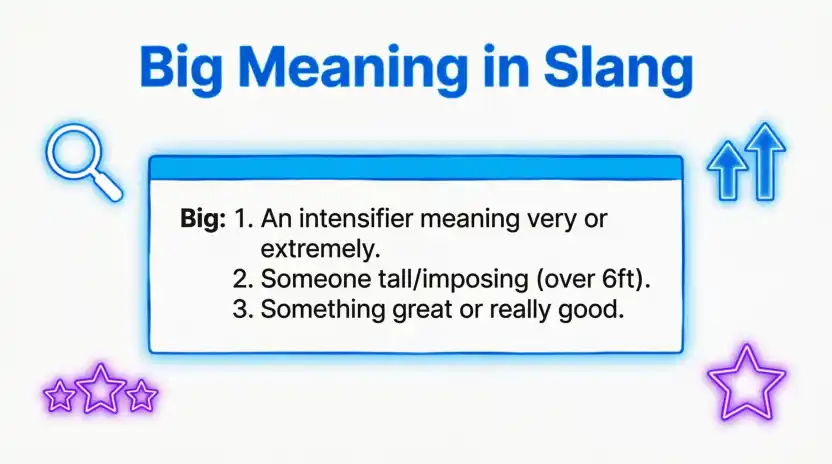
In slang and casual speech, “big” can mean important, impressive, successful, popular, or high in status rather than simply large in size. Its meaning depends on the words around it. For example, “big win” means a major success, while “big name” can mean a famous or influential person.
You may see “big” in a text, comment, caption, or chat and wonder why someone used it when they were not talking about size. The big meaning slang users intend can be closer to “important,” “major,” “impressive,” or “successful.”
The key point is that “big” is not always slang. It is a normal English word with many meanings. In casual online speech, though, people often use it to add extra weight to an idea. Saying “That’s big” can mean that something matters or feels important. “Big win” can mean a major success, while “big name” can describe someone well known or influential.
Understanding the surrounding words is the easiest way to get the right meaning. This guide explains how “big” works in slang, texting, social media, casual speech, and common phrases.
Quick Answer Table
| Question | Answer |
| Meaning | Important, major, impressive, successful, or large, depending on context |
| Tone | Casual and informal when used as slang |
| Used By | General English speakers; meaning varies by context and region |
| Platforms | Texting, social media, chats, comments, and everyday conversation |
| Offensive? | No, “big” itself is not normally offensive |
| Pronunciation | “big” — /bɪɡ/ |
| Common slang phrases | Big win, big deal, big time, big name, big up |
The most important detail is context. “Big” can describe physical size, importance, popularity, influence, or success. It can also appear inside a longer slang expression where the whole phrase has a special meaning.
What Does Big Mean in Slang?
The slang or casual meaning of “big” is often “important,” “major,” “impressive,” or “successful.”
For example:
- “That’s big!” → That is important or impressive.
- “Big win!” → A major success.
- “She’s a big name.” → She is famous or influential.
- “This is a big moment.” → This moment is very important.
- “He went big.” → He chose to do something on a large or ambitious scale.
This use is not completely separate from the normal meaning of “big.” Instead, the idea of physical size is often extended to importance or impact. Dictionaries list meanings of “big” connected with importance, influence, popularity, and success.
Big Can Add Hype
In casual speech, “big” can make something sound more exciting or meaningful.
Compare:
“Nice win.”
“Big win.”
The second phrase gives the win more weight. It suggests that the success was especially important or impressive.
That does not automatically make “big” internet slang. It is often simply informal English used in a more expressive way.
Big Meaning in Text Messages
In texting, “big” usually keeps the meaning given by the surrounding phrase.
Someone might text:
“That’s a big deal.”
Here, “big” means important or significant.
Another person might write:
“Big W!”
Here, “big” strengthens the idea of a win. “W” commonly stands for “win” in informal online language, so “big W” means a major or satisfying success.
You may also see:
“Big news 👀”
This usually means the news is important, exciting, or worth paying attention to.
The same word can therefore carry different shades of meaning without changing its spelling.
Where Big Is Used
“Big” does not have one special meaning on one particular social platform. It is ordinary English that also appears in informal online communication.
| Platform | How “big” may appear | Example |
| TikTok | Comments, captions, reactions | “Big win!” |
| Captions and comments | “Big moment for us.” | |
| Snapchat | Casual messages | “That’s big 😂” |
| Discord | Group chats and gaming talk | “Big W.” |
| Posts and comments | “That was a big move.” | |
| YouTube | Comments and reactions | “Big news!” |
| Personal chats | “That’s a big deal.” | |
| X | Short posts and reactions | “Big day.” |
These examples show why it is better to read the whole sentence instead of treating “big” as a fixed slang code.
Common Slang Phrases With Big
“Big” becomes more slang-like when it appears in established informal expressions.
Big W
Means a major win or success.
Example:
“You got the job? Big W!”
Here, “big” emphasizes how good or important the win feels.
Big L
“Big L” means a major loss, mistake, or failure.
Example:
“Missing the deadline was a big L.”
This is the opposite idea of “big W.”
Big Deal
“Big deal” can mean something important.
But there is an important catch: “big deal” can also be sarcastic.
“You finished five minutes early. Big deal.”
In that sentence, the speaker may actually mean that the achievement is not impressive.
So never interpret “big deal” from the words alone. Tone matters.
Big Time
“Big time” is an informal expression meaning very much, strongly, or at a high level.
Example:
“I messed up big time.”
Here, it means the mistake was serious or substantial.
“Big time” can also describe major success or a high level of activity depending on the sentence.
Big Name
A “big name” is a well-known or influential person, company, or organization.
Example:
“They invited a big name to the event.”
The word “big” refers to status or fame rather than physical size.
Big Move
A “big move” usually means an important, bold, or significant action.
Example:
“Starting her own business was a big move.”
The phrase can be positive, neutral, or even critical depending on context.
Big Up
“Big up” is a separate informal expression, especially associated with British English. It means to praise, support, or give recognition to someone or something. Oxford describes “big up” as an informal phrasal verb meaning to praise or recommend strongly.
Example:
“Big up everyone who helped with the event.”
Do not assume that “big up” simply means “very big.” The full phrase has its own meaning.
Is Big Positive or Negative?
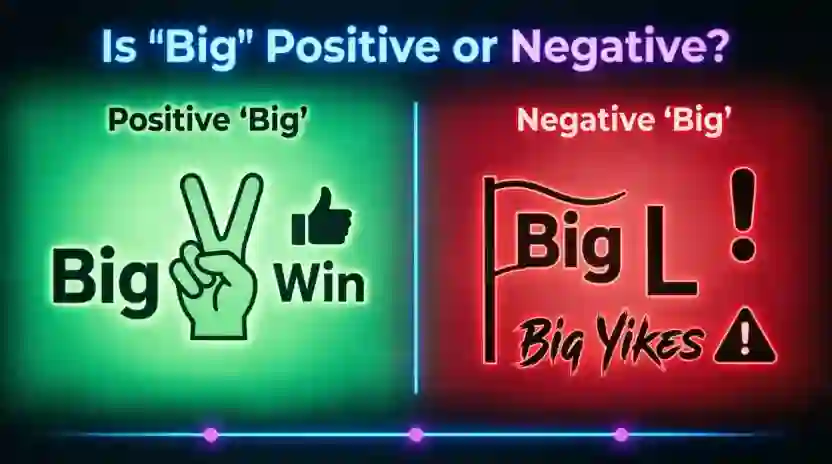
“Big” is neither automatically positive nor negative.
Its tone depends on what it describes.
Positive:
“That was a big win!”
Neutral:
“We have a big meeting tomorrow.”
Negative:
“That’s a big problem.”
Sarcastic:
“Big deal.”
This is why translating “big” into one fixed slang meaning can be misleading.
Look at the noun or phrase that follows it. “Big win” and “big problem” clearly point in different emotional directions.
Is Big Rude or Offensive?
No. The word “big” by itself is not normally rude or offensive.
It is one of the most common English adjectives. The tone can change depending on what someone is describing, though.
For example, calling an event a “big success” is positive. Calling someone “big” when talking about their body can be sensitive because comments about someone’s appearance may feel personal.
Some expressions containing “big” can also be vulgar or insulting. That does not mean the basic word “big” is offensive.
Context matters.
Big as a Word for Importance
One of the most useful slang-like meanings is “important.”
Consider these examples:
- “This is big news.”
- “That’s a big opportunity.”
- “It’s a big moment.”
- “She made a big decision.”
- “That could become a big problem.”
None of these sentences need internet slang to make sense. English has long used “big” to express importance or significance. Dictionary sources also list “big” as meaning important, influential, or popular in informal usage.
That is why an article about “big meaning slang” should not treat every use as a new internet term.
Big vs Huge vs Major
These words can overlap, but they do not always sound the same.
| Word | Main idea | Example |
| Big | Large or important | “That’s a big opportunity.” |
| Huge | Very large or very important | “That was a huge success.” |
| Major | Very important or serious | “It was a major decision.” |
| Massive | Extremely large or substantial | “They had a massive response.” |
| Great | Good, impressive, or large in some contexts | “That was a great achievement.” |
“Big” is usually the most everyday and flexible choice.
Big vs Big W
These should not be confused.
| Expression | Meaning |
| Big | Large, important, impressive, etc. |
| Big W | Major win or success |
| Big L | Major loss or failure |
| Big deal | Important matter, or sarcastic dismissal |
| Big time | To a great degree or at a high level |
| Big up | Praise or give recognition |
The word “big” gets its exact meaning from the expression around it.
Real-Life Examples of Big Meaning Slang
Text Message
Maya: “I got accepted!”
Noah: “That’s big! Congrats!”
Here, “big” means the news is important and exciting. Noah is not talking about physical size.
TikTok Comment
Jordan: “Finally hit 100K followers.”
Comment: “Big milestone 🔥”
The commenter uses “big” to show that the milestone is significant.
Discord Chat
Eli: “We finally beat the final level.”
Sam: “Big W.”
“Big W” means a major win. The phrase is more specific than simply saying “big.”
Instagram Caption
Priya: “Big day for the team.”
This means the day is important or memorable for the group.
School Conversation
Aiden: “The science project is due tomorrow.”
Leo: “Yeah, that’s a big deadline.”
Here, “big” suggests that the deadline is important or serious.
Workplace Conversation
Nora: “The company just signed a new client.”
Daniel: “That’s a big deal.”
In this context, “big deal” means the event is important. Depending on tone, however, “big deal” can also be sarcastic.
Common Mistakes With Big Slang
Mistake 1: Assuming Big Always Means Large
“Big” can mean large, but it can also mean important, famous, successful, or influential.
“Big name” usually refers to fame or influence, not physical size.
Mistake 2: Calling Every Use Slang
Many uses of “big” are simply standard English.
“This is a big house” is not automatically slang.
“This is big news” is also normal English, even though it has a casual tone.
Mistake 3: Ignoring the Full Phrase
“Big,” “big W,” “big deal,” and “big up” should not be treated as identical expressions.
The complete phrase can change the meaning.
Mistake 4: Missing Sarcasm
“Big deal” can sound positive or sarcastic.
If someone says:
“Wow, you got one extra point. Big deal.”
they probably are not praising the achievement.
Mistake 5: Assuming Everyone Uses It the Same Way
Age, region, community, and context can affect slang. A phrase that feels common in one online group may sound unusual or simply informal to someone else.
Is “Big” Still Used in Slang?
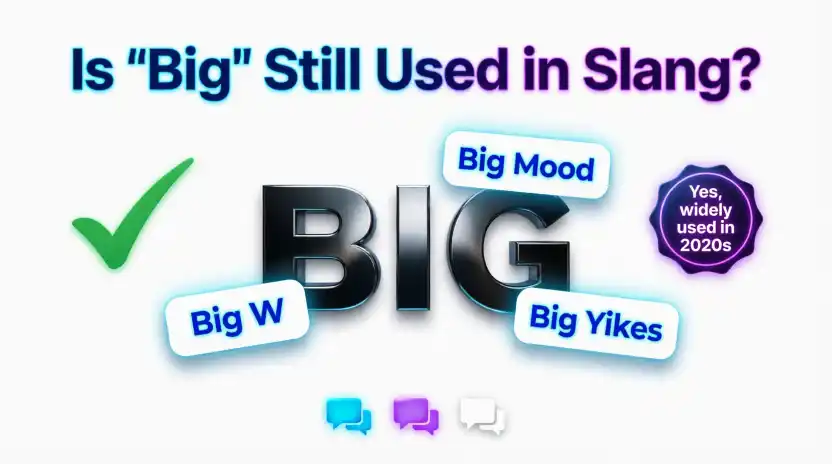
Yes, but it is more accurate to say that “big” remains a common English word with many informal and slang-like uses rather than calling the basic word a new trending slang term.
Expressions such as “big W,” “big deal,” “big time,” and “big up” can have distinct informal meanings. Their popularity can vary by community and region.
There is no need to assume that every use of “big” comes from Gen Z, TikTok, or another specific group.
Key Takeaways
- “Big” can mean important, major, impressive, or successful in casual speech.
- It does not always mean physically large.
- “Big” itself is often ordinary English rather than pure internet slang.
- The full phrase matters: “big W,” “big deal,” and “big up” have different meanings.
- “Big” is not normally offensive, but context and tone can change how a phrase feels.
FAQs About Big Meaning Slang
1. What does “big” mean in slang?
In slang or casual speech, “big” can mean important, major, impressive, successful, popular, or influential. The exact meaning depends on context. For example, “big win” means a major success, while “big name” usually means a famous or influential person. Sometimes “big” is simply being used in its normal English sense of large.
2. What does “big” mean in texting?
In texting, “big” often adds emphasis. Someone might write “big news” for important news or “big win” for a major success. It can also appear in phrases such as “big W” or “big deal.” You need to read the complete message because “big” does not have one fixed texting definition.
3. Does “big” mean important?
Yes. “Big” can mean important or significant. For example, “This is a big decision” means the decision matters a lot. This is not necessarily modern slang; it is an established English use of the word. Dictionary sources list importance and influence among the meanings of “big.”
4. What does “big W” mean?
“Big W” means a major win or success. The “W” stands for “win” in informal online language. Someone might comment “Big W!” after a friend succeeds at something. It is usually positive and celebratory.
5. Is “big deal” positive or negative?
It can be either. “That’s a big deal” normally means something is important. But “big deal” can also be sarcastic and mean that something is not impressive or important. Tone, punctuation, and the situation help show which meaning the speaker intends.
6. What does “big up” mean?
“Big up” is an informal expression meaning to praise, support, recommend, or give recognition to someone or something. Oxford lists it as an informal phrasal verb meaning to praise or recommend strongly. It is different from simply using “big” as an adjectiv.
7. Is “big” a Gen Z slang word?
Not exactly. “Big” is a standard English word that has been used in many ways for a long time. Younger internet users may use it in phrases such as “big W,” but the basic word is not exclusive to Gen Z. Its meaning should be understood from the phrase and context.
8. Is “big” rude?
The word “big” itself is not normally rude. It is a common English word. However, calling attention to someone’s body or appearance can feel uncomfortable, depending on the situation. Other expressions containing “big” may also have rude meanings, so the complete phrase matters.
Conclusion
The big meaning slang readers often look for is usually connected to importance, impact, success, or status rather than physical size. Someone can say “That’s big” to mean “That really matters,” while “big win” can describe a major success.
Still, “big” is not automatically slang whenever it appears online. It is a normal English word with many established meanings. Context tells you if it means large, important, impressive, popular, or something else.
The safest way to understand it is to read the complete phrase. “Big W,” “big L,” “big deal,” “big time,” “big name,” and “big up” each add their own meaning.
If you are building your slang vocabulary, learning these connected phrases can help you understand texts, comments, chats, and casual conversations without guessing from one word alone.
Read more about!
- SU Meaning in Texting: Slang Definition & Examples
- Biker Slang: Common Motorcycle Terms & Meanings
- Peng Slang Meaning: What Does Peng Mean?
Hi, I’m Ryan Mitchell. I write simple guides about slang, internet language, and everyday English to make modern expressions easy to understand. My goal is to help learners use real-life English with confidence.