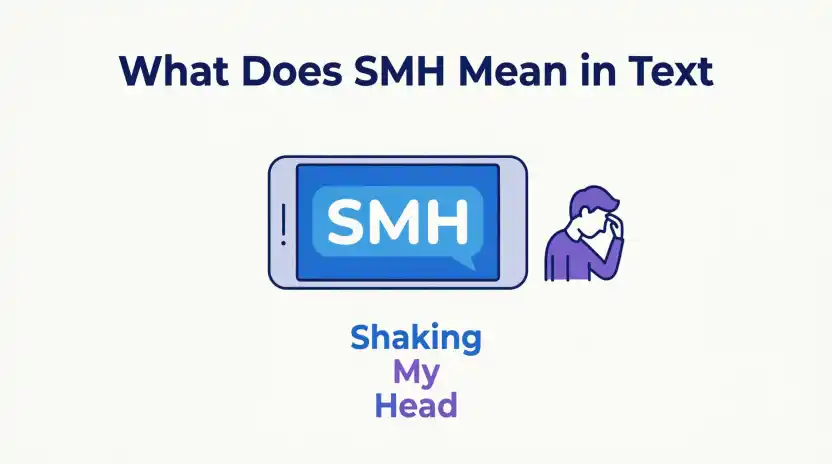
SMH in text means “shaking my head.” People use it to show disappointment, frustration, disbelief, or mild annoyance. You may see SMH in texts, TikTok comments, Snapchat messages, Instagram posts, WhatsApp chats, and other casual online conversations.
If someone writes “You forgot your keys again, smh,” they usually mean something like “I can’t believe you did that” or “That is frustrating.”
SMH is an internet slang initialism. It became common in online communication because it quickly expresses a reaction without needing a long sentence. Dictionary.com notes that its exact origin is unclear, but the abbreviation emerged in online communication by the 2000s.
SMH Meaning in Text
SMH stands for “shaking my head.”
It describes the idea of shaking your head because something is silly, disappointing, frustrating, surprising, or hard to believe.
For example:
“You really forgot your homework again? SMH.”
The person is not usually saying that they are literally shaking their head. They are using SMH to show their reaction.
In everyday texting, SMH can mean:
- “I can’t believe this.”
- “That was a bad move.”
- “Seriously?”
- “That’s frustrating.”
- “Come on.”
- “I’m disappointed.”
- “I don’t know what to say.”
The exact feeling depends on the conversation.
Is SMH an Acronym or Abbreviation?
SMH is usually described as an initialism because each letter represents the first letter of a word:
- S = Shaking
- M = My
- H = Head
People often call it an acronym in everyday conversation, and you may see both terms used. For practical purposes, it is an internet abbreviation used in casual communication.
Unlike a word such as “LOL,” SMH is normally understood by reading the letters individually: “S-M-H.”
What Does SMH Feel Like in a Conversation?
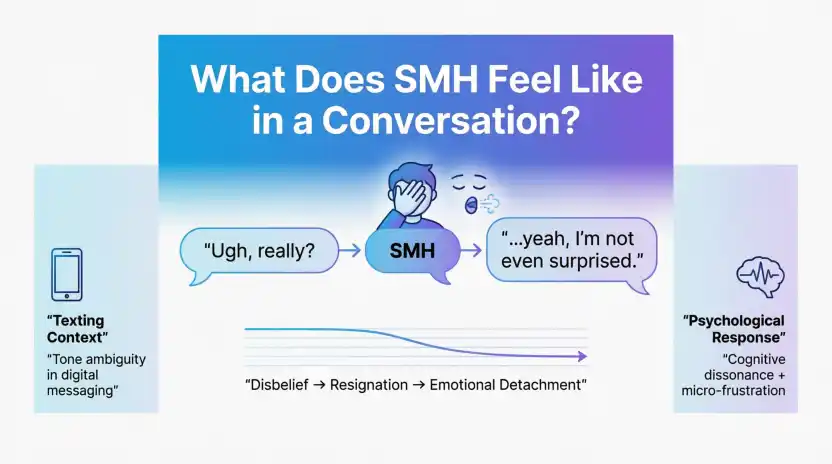
SMH often has a tone of disbelief or frustration.
Compare these messages:
“Okay.”
“Okay, smh.”
The second one carries more emotion. The writer may be annoyed, disappointed, or simply amused by what happened.
It does not always mean serious anger. Friends may use SMH playfully when someone makes a silly mistake.
Where People Use SMH
SMH is not limited to one app. It is common in casual digital communication and can appear in texts, comments, posts, and private messages. Dictionary.com describes it as an abbreviation used across digital communication, while its TikTok slang guide also describes SMH as common in social media and texting.
SMH on TikTok
On TikTok, SMH can appear in comments, captions, replies, and discussions.
Someone might comment:
“He really did that? smh”
Here, the commenter is expressing disbelief or frustration.
TikTok does not give SMH a completely different meaning. It usually keeps the same basic meaning it has in texting: “shaking my head.”
SMH on Snapchat
On Snapchat, people may use SMH in direct messages or replies to Stories.
For example:
“You left without telling me smh 😂”
This could be serious, but the laughing emoji makes it more likely that the person is joking or teasing.
SMH on Instagram
On Instagram, you may see SMH in comments, captions, replies, or DMs.
For example:
“People are still arguing about this? SMH.”
The writer is showing annoyance or disbelief.
SMH on WhatsApp
WhatsApp conversations often use SMH just like ordinary texting.
A friend might write:
“I missed the bus by 10 seconds smh.”
The abbreviation makes the message short while still showing emotion.
SMH in SMS Text Messages
SMH is especially useful in short messages because it communicates a reaction without a full explanation.
For example:
“My phone died right before the call smh.”
The writer means that the situation is frustrating or unfortunate.
What Does SMH Mean From a Friend?
When a friend sends SMH, do not automatically assume they are angry with you.
The meaning depends on what happened.
If you tell your friend:
“I accidentally wore two different shoes today.”
They might reply:
“SMH 😂”
That could be playful teasing.
If you tell someone:
“I ignored your message because I was upset.”
And they reply:
“smh.”
That may carry more disappointment.
The same abbreviation can therefore have a soft or stronger tone depending on the situation.
10 Real Texting Examples of SMH
Here are realistic examples showing how SMH can work in different conversations.
Example 1: Forgetting Something
A: “I left my charger at home again.”
B: “SMH 😭”
A: “I know. I never learn.”
Here, SMH is playful frustration.
Example 2: A Silly Mistake
A: “I searched for my phone for ten minutes.”
B: “Was it in your hand?”
A: “…yes.”
B: “SMH 😂”
The speaker is teasing rather than seriously criticizing the person.
Example 3: Bad Timing
A: “The rain started five minutes before I left.”
B: “SMH, that always happens.”
The abbreviation shows mild frustration about the situation.
Example 4: School
A: “I studied the wrong chapter for the quiz.”
B: “SMH. That hurts.”
Here, the response shows sympathy mixed with disbelief.
Example 5: Plans
A: “They canceled the event after everyone arrived.”
B: “SMH, seriously?”
This use shows disappointment with the situation.
Example 6: Social Media
A: “People are fighting in the comments again.”
B: “SMH. Why does this always happen?”
Here, SMH expresses annoyance.
Example 7: A Friend’s Joke
A: “I just tried to open the door with my car keys.”
B: “SMH 😂”
This is a lighthearted reaction.
Example 8: Missing a Deadline
A: “I thought the assignment was due tomorrow.”
B: “It was due today. SMH.”
The tone is more serious because the mistake has consequences.
Example 9: Unexpected News
A: “He sold his old game collection without checking the value.”
B: “SMH. He could’ve gotten much more.”
The writer is expressing disbelief.
Example 10: Everyday Frustration
A: “My internet stopped working during the last minute of the movie.”
B: “SMH 😭”
Here, the abbreviation shows frustration with bad timing.
How to Reply When Someone Says “SMH”
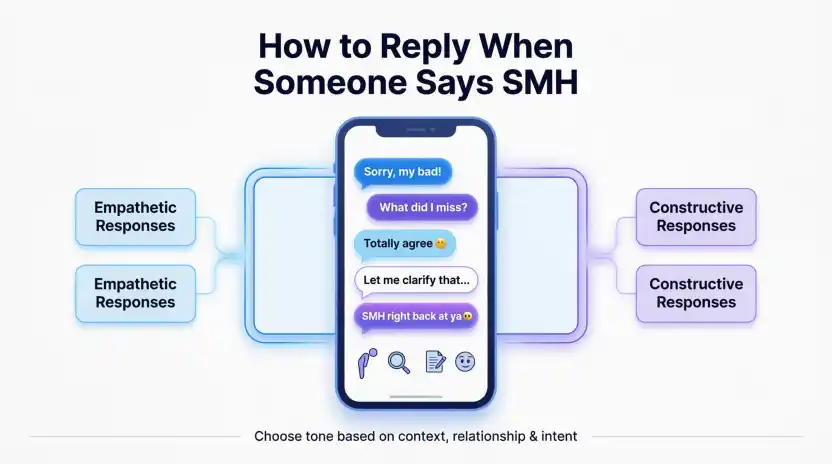
There is no single correct response to SMH.
Your reply should match the tone of the conversation.
Funny Replies
If your friend is clearly joking, you can answer with humor.
- “I know 😭”
- “Don’t judge me 😂”
- “It happens!”
- “I have no excuse.”
- “Okay, okay, I messed up.”
Casual Replies
For a normal conversation, keep it simple.
- “Yeah, my bad.”
- “I know.”
- “Seriously.”
- “Exactly.”
- “Right? 😭”
Friendly Replies
If someone is teasing you but not being harsh, you can respond warmly.
- “You know me too well.”
- “I’ll do better next time.”
- “Haha, fair.”
- “I deserved that one.”
- “Okay, you got me.”
Neutral Replies
If you are unsure about their tone, use a calm answer.
- “What do you mean?”
- “Haha, why?”
- “I know, right?”
- “Was that bad?”
- “I was just trying to help.”
As with most texting slang, context matters more than the three letters themselves.
Is SMH Rude or Offensive?
SMH is generally not a profanity or inherently offensive expression.
It can, however, sound dismissive or critical.
For example:
“SMH, you never listen.”
That message may make the other person feel criticized.
By contrast:
“You forgot your umbrella again? SMH 😂”
Between close friends, the same abbreviation may be harmless teasing.
Is SMH Safe to Use?
SMH is generally fine in casual conversations when the tone is clear.
It is commonly understood as informal internet language. Grammarly lists SMH among examples of internet slang and recommends avoiding slang in formal situations such as professional or legal communication.
Is SMH Appropriate at School?
It can be fine in a casual message to a friend.
For formal school work, essays, assignments, or communication with a teacher, writing the full thought is usually clearer.
Instead of:
“SMH, this rule makes no sense.”
A formal message could say:
“I find this rule confusing and would like some clarification.”
Is SMH Appropriate at Work?
SMH is usually better kept out of formal emails and professional documents.
A coworker may understand it, but the abbreviation can sound too casual or dismissive depending on the situation.
For a professional message, say exactly what you mean.
Who Uses SMH?
SMH is part of internet and texting culture and can be understood by many different age groups.
It is not accurate to treat SMH as a term used only by teenagers or Gen Z. Dictionary.com describes it as widely familiar in internet culture and notes that it has been used across digital communication.
Gen Z and SMH
You may see SMH used by Gen Z in texting and social media, but the abbreviation is not exclusive to that generation.
It appeared in online communication well before TikTok became a major social platform.
Is SMH Still Used?
SMH remains recognizable in online communication and continues to appear in explanations of current texting and social-media slang. Dictionary.com currently describes it as common in social media and texting.
That does not mean every person uses it often.
Some people prefer newer slang, emojis, GIFs, or plain language. Others still use SMH naturally.
Its meaning is stable even when individual usage habits change.
Origin of SMH
The exact origin of SMH is not clearly documented.
Dictionary.com reports that the initialism emerged by the 2000s as a way to communicate tone in text messages and online. It also notes that SMH received an Urban Dictionary entry in 2004 and spread on Twitter by 2007.
The idea behind the expression is older than the abbreviation itself.
People have long shaken their heads to show disagreement, disbelief, frustration, or disapproval. The abbreviation simply turns that familiar gesture into three letters that work well in written conversation.
The term became part of the larger growth of internet slang, where users shortened common phrases to communicate quickly.
Did SMH Start on TikTok?
No.
SMH was already part of internet communication before TikTok became popular.
TikTok helped expose many existing abbreviations to newer audiences, but it did not create SMH. Current TikTok slang references describe SMH as an established abbreviation used across social media and texting.
SMH vs IDK vs IDC vs IMO vs BRB
These abbreviations are easy to see together in text conversations, but they express very different ideas.
| Term | Meaning | Type | Usage | Popularity |
| SMH | Shaking my head | Initialism / internet slang | Disbelief, frustration, disappointment | Widely recognized |
| IDK | I don’t know | Initialism | Uncertainty or lack of knowledge | Widely recognized |
| IDC | I don’t care | Initialism | Indifference or lack of concern | Widely recognized |
| IMO | In my opinion | Initialism | Giving a personal view | Widely recognized |
| BRB | Be right back | Initialism | Temporarily leaving a chat | Widely recognized |
These terms are not interchangeable.
For example:
“SMH, you forgot again.”
means something different from:
“IDK what happened.”
And:
“IMO, the first movie was better.”
does not express frustration at all.
Text abbreviations work because each one gives the reader a quick clue about the speaker’s intention.
SMH vs SMDH
You may also see SMDH.
SMDH commonly means “shaking my damn head.”
It adds stronger emphasis to the original expression.
For example:
“SMDH, they did it again.”
Because it includes “damn,” SMDH can sound stronger than SMH.
Dictionary.com identifies SMDH as an intensified form of SMH.
If you want to keep your message mild, SMH is the simpler option.
SMH vs Facepalm
SMH is built around the idea of shaking your head because something is frustrating, silly, or disappointing.
A facepalm suggests putting your hand over your face because something is embarrassing, foolish, or frustrating.
For example:
“He forgot his own birthday. SMH.”
You could also react with a facepalm emoji:
“He forgot his own birthday. 🤦”
Both communicate a negative reaction, but they use different images.
What Does SMH Mean in a Positive Conversation?
SMH usually carries a negative or frustrated reaction, but the surrounding tone can make it playful.
For example:
“You actually ate the entire pizza by yourself? SMH 😂”
The writer may not be genuinely upset.
The laughing emoji changes the feel of the message.
This is why you should not translate SMH into “I am angry” every time.
Depending on context, it can express:
- Mild frustration
- Disbelief
- Amusement
- Disappointment
- Playful teasing
- Exasperation
Real-World Usage Example
Imagine two classmates are working on a group project.
One student sends a message:
“I just realized I uploaded the old version of our presentation.”
The other replies:
“SMH 😭”
The response probably means:
“I can’t believe that happened.”
It does not necessarily mean the second student is angry.
If the first student quickly fixes the mistake, the exchange may even become a joke between them.
This is a useful way to understand SMH: it often describes the speaker’s reaction to a situation rather than giving a detailed opinion about it.
When Should You Avoid Using SMH?
SMH is easy to understand in casual chat, but there are times when clearer language is better.
Avoid it when:
- Writing a formal school assignment
- Sending a formal email
- Writing a job application
- Communicating with someone who may not know internet slang
- Discussing a serious issue where your tone could be misunderstood
- Giving an official explanation
Instead of writing:
“SMH, this keeps happening.”
You could say:
“I’m frustrated because this keeps happening.”
That version is clearer and more appropriate for formal communication.
Common Mistakes People Make With SMH
Thinking It Always Means Anger
SMH can show frustration, but it does not automatically mean someone is angry.
The tone can be mild, serious, sarcastic, or playful.
Reading It as a Literal Action
Most people are not literally shaking their heads while typing SMH.
It is a written expression of a reaction.
Assuming Only Young People Use It
SMH is associated with internet slang, but it is not limited to teenagers or Gen Z.
It has been used in online communication since at least the 2000s.
Using It in Every Situation
SMH works best in casual communication.
A formal email usually needs clearer language.
Confusing SMH With Similar Abbreviations
SMH means “shaking my head.”
IDK means “I don’t know.”
IDC means “I don’t care.”
IMO means “in my opinion.”
BRB means “be right back.”
Knowing these differences prevents confusion.
Frequently Asked Questions
What does SMH mean in text messages?
SMH means “shaking my head.” People use it in text messages to show frustration, disbelief, disappointment, or mild annoyance. It can also be playful between friends. The exact tone depends on what happened in the conversation and if other words or emojis make the message sound serious or humorous.
What does SMH mean on TikTok?
On TikTok, SMH means “shaking my head.” It is used in comments, captions, replies, and conversations to show disbelief, frustration, or exasperation. TikTok does not give SMH a separate basic definition; it generally carries the same meaning it has in texting and other social media.
Is SMH slang?
Yes. SMH is commonly treated as internet slang or a texting abbreviation. More specifically, it is an initialism made from the first letters of “shaking my head.” It became established in online communication during the 2000s and remains recognizable in digital conversations.
Is SMH rude or offensive?
SMH is not normally considered a swear word or inherently offensive. Still, it can sound dismissive or judgmental depending on the sentence. “SMH 😂” between friends may be playful, while “SMH, you never listen” can sound critical. Context and relationship matter.
How should you reply to SMH?
Reply based on the tone. If someone is joking, you might say “Haha, I know” or “Don’t judge me 😂.” If they seem frustrated, you can acknowledge it with “Yeah, my bad” or explain what happened.
Conclusion
SMH means “shaking my head,” and it is one of the common abbreviations used in casual online communication.
People use it when they feel frustrated, disappointed, surprised, or unable to believe what just happened. It can also be playful when friends use it with laughing emojis or jokes.
You may see SMH in text messages, TikTok comments, Snapchat chats, Instagram posts, WhatsApp conversations, and other online spaces. Its basic meaning stays the same across these platforms.
The abbreviation is usually fine for casual conversations, but it is better to avoid it in formal school or workplace writing when clear language is more appropriate.
Once you know that SMH means “shaking my head,” most uses are easy to understand. Just pay attention to the words around it, because the surrounding conversation tells you if the writer is frustrated, joking, disappointed, or simply reacting to something unexpected.
Read more about!
- Big Meaning Slang: What Does “Big” Mean?
- Cho Meaning Slang: What Does “Cho” Mean?
- Cow Slang Meaning: What Does “Cow” Mean in Slang?
Hi, I’m Ryan Mitchell. I write simple guides about slang, internet language, and everyday English to make modern expressions easy to understand. My goal is to help learners use real-life English with confidence.