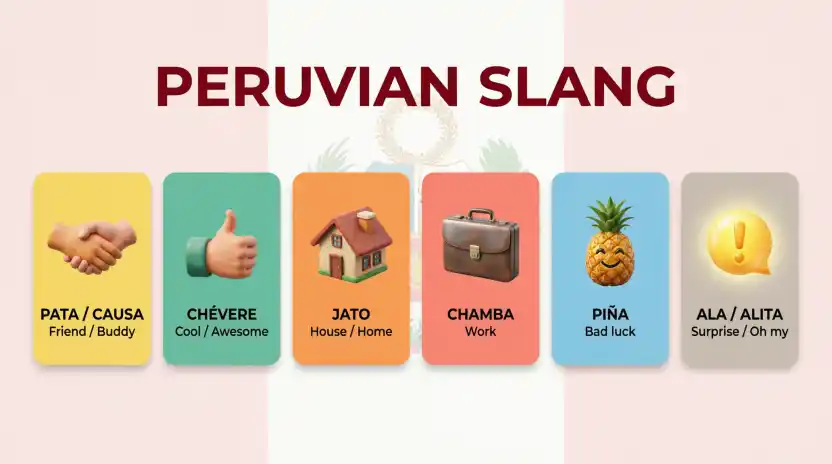
Peru has its own colorful layer of informal Spanish, often called Peruvian slang or jerga peruana. If you know standard Spanish but hear words like causa, pata, jato, or chamba, you may wonder what they mean.
These words can sound confusing because their everyday meanings in Peru are often different from their standard Spanish meanings.
Peru slang is mainly used in casual conversations, especially among friends and in everyday settings. Some expressions are strongly associated with Lima, while others are heard more widely across the country. Regional variation also matters, so not every slang word is used in exactly the same way by every Peruvian speaker.
In this guide, you will learn common Peruvian slang words, what they mean in English, how people use them, where they come from, and when it is better to use standard Spanish instead.
Peru Slang: Featured Snippet & AI Overview
Peru slang refers to informal Spanish words and expressions commonly used in Peru. Examples include causa for a close friend, pata for a friend, jato for home, chamba for work, and al toque for immediately. Their meaning depends on context, region, age, and the level of formality.
Peru Slang – Quick Answer
Peruvian slang is the informal vocabulary and expressions used in everyday Peruvian Spanish.
Some common examples are:
- Causa = close friend or buddy
- Pata = friend or pal
- Jato = house or home
- Chamba = work or job
- Al toque = right away
- Bacán = cool or great
- Roche = embarrassment or an awkward situation
- Misio = broke or without money
- Floro = talk, excuses, or empty promises
- Habla = what’s up / tell me
These words are generally informal, so they are more suitable for casual conversations than formal writing.
What Does Peru Slang Mean?
Peru slang means the informal words, phrases, and expressions used by people in Peru.
In Spanish, this type of language is often called jerga. It works alongside standard Spanish rather than replacing it. For example, casa is the normal Spanish word for house, while jato is a Peruvian informal term for home. Similarly, trabajo means work, while chamba is commonly used informally in Peru.
Context is important. A word that is friendly among Peruvian friends may sound too casual in a formal situation.
Common Peruvian Slang Words
| Slang | Meaning in English | Example |
| Causa | Friend or buddy | ¿Qué tal, causa? |
| Pata | Friend or pal | Es mi pata. |
| Jato | Home or house | Vamos a mi jato. |
| Chamba | Work or job | Tengo mucha chamba. |
| Al toque | Right away | Voy al toque. |
| Bacán | Cool or great | ¡Qué bacán! |
| Roche | Embarrassment | Qué roche. |
| Misio | Broke | Estoy misio. |
| Floro | Empty talk or excuses | Es puro floro. |
| Tono | Party | Hay un tono el viernes. |
Several of these terms are documented in guides to Peruvian Spanish and are especially useful for understanding casual conversation.
The Origin of Peru Slang
There is no single source for all Peruvian slang. Peruvian Spanish developed through contact between Spanish and languages and cultures present in Peru, including Indigenous languages such as Quechua and Aymara. Modern slang has also been shaped by local communities, urban speech, English borrowings, popular culture, and regional vocabulary.
Lima has played an important role in the development and spread of many expressions associated with Peruvian jerga. However, Peru is geographically and culturally diverse, so slang can vary between Lima, coastal areas, the Andes, and the Amazon.
Some individual words have uncertain or debated histories. For example, explanations for the origin of jato vary, so it is better not to present one etymology as certain without strong evidence.
The important point is that Peruvian slang is not simply “incorrect Spanish.” It is an informal variety of language that speakers use for familiarity, humor, emphasis, and local identity.
British English vs American English
Peruvian slang is not a British-versus-American English issue because Peru is a Spanish-speaking country. However, English learners sometimes search for “Peru slang” while comparing local expressions with standard English translations.
| Expression | Peruvian Spanish | Natural English Equivalent |
| Causa | Close friend | Buddy / friend |
| Pata | Friend | Pal / friend |
| Jato | Home | Home / place |
| Chamba | Work | Job / work |
| Al toque | Immediately | Right away |
| Bacán | Positive reaction | Cool / great |
| Roche | Awkward situation | Embarrassment |
| Misio | Without money | Broke |
| Tono | Party | Party |
| Floro | Empty talk | Excuses / talk |
The English equivalent may change depending on context. For example, causa can be translated as “buddy,” “friend,” or “mate” depending on the speaker and situation.
Which Version Should You Use?

The safest choice depends on your audience.
United States
If you are explaining Peruvian slang to an American audience, give the Spanish expression first and then a simple English meaning.
Example:
Jato = home or house.
United Kingdom
British readers may understand pata more naturally as “mate” rather than “buddy.”
Canada
Use the same basic approach as American English: explain the Peruvian expression and give a natural English equivalent.
Australia
Words such as “mate” can work well as translations for friendly expressions such as pata or causa, but the original Peruvian word should remain visible.
International Writing
Use simple translations such as:
- friend
- home
- work
- party
- immediately
- cool
This avoids regional English confusion.
Academic Writing
Use standard Spanish terms when discussing formal language. If slang is relevant, introduce it clearly as an informal or regional expression.
Business Writing
Avoid Peruvian slang unless you are deliberately discussing language or writing for an audience that expects an informal Peruvian tone.
Common Mistakes
Mistake 1: Treating slang as standard Spanish
Incorrect approach:
Assuming jato is the formal Spanish word for house.
Better approach:
Use casa in standard Spanish and recognize jato as informal Peruvian usage.
Why:
Slang and standard vocabulary serve different purposes.
Memory tip:
Formal = standard Spanish. Casual Peru = local slang.
Mistake 2: Using every slang word with strangers
Some expressions depend heavily on familiarity and context.
For example, causa is commonly used as a friendly term for a close friend, so it may not fit every social situation.
Mistake 3: Assuming all Peruvians use the same slang
Peru has strong regional differences. An expression common in Lima may not have the same reach or frequency elsewhere.
Mistake 4: Translating word-for-word
A literal translation can sometimes sound strange.
For example:
Pata literally has standard Spanish meanings connected with a leg or an animal’s foot, but in Peruvian slang it can mean a friend or buddy.
Everyday Examples
1. Emails
Formal:
Hola, ¿podrías enviarme el documento?
Casual:
Hola, causa. ¿Me mandas el documento?
The second example has a much more familiar tone.
2. Business Writing
Formal:
Tengo trabajo pendiente esta semana.
Casual Peruvian:
Tengo bastante chamba esta semana.
Chamba is widely documented as an informal Peruvian word for work or a job.
3. News Headlines
Formal news writing generally favors standard Spanish. Slang may appear in a headline when the story is specifically about popular culture, social media, entertainment, or a direct quote.
4. Blogs
A travel or culture blog may explain slang like this:
In Peru, jato is an informal word for home.
This makes the meaning clear to international readers.
5. Social Media
Casual social media is one place where informal expressions can appear naturally.
¡Qué bacán estuvo el concierto!
Here, bacán expresses a positive reaction such as “cool” or “great.”
6. Academic Writing
Academic writing should normally explain the slang before analyzing it.
Example:
The Peruvian slang term chamba is commonly used informally to refer to work or employment.
7. Daily Conversation
A casual conversation might include:
¿Qué tal, causa?
How are you, buddy?
Or:
Vamos a mi jato.
Let’s go to my place.
Both causa and jato are commonly documented examples of Peruvian informal speech.
Google Trends & Modern Usage

People search for Peru slang for several reasons. Travelers may want to understand conversations, Spanish learners may want vocabulary beyond textbooks, and international readers may encounter Peruvian expressions on social media, videos, music, or online communities.
Modern usage also changes by location, age, social group, and context. Guides to Peruvian Spanish commonly highlight expressions such as causa, pata, jato, chamba, and al toque.
Exact search-volume or Google Trends figures are not included here because they can change over time and require a specific Trends dataset and date range.
One common source of confusion is that a word can have a normal meaning in standard Spanish and a different informal meaning in Peru.
For example:
- Pata can mean a leg or animal foot in standard Spanish.
- Pata can mean friend in Peruvian slang.
That is why context matters more than a simple dictionary translation.
Quick Comparison Table
| Version | Meaning | Correct? | Region | Example |
| Causa | Close friend | Yes, informal | Peru | ¿Qué tal, causa? |
| Pata | Friend | Yes, informal | Peru | Es mi pata. |
| Jato | Home | Yes, informal | Peru | Voy a mi jato. |
| Chamba | Work/job | Yes, informal | Peru | Tengo chamba. |
| Al toque | Right away | Yes, informal | Peru | Voy al toque. |
| Bacán | Cool/great | Yes, informal | Peru and wider Latin American usage | ¡Qué bacán! |
| Casa | House/home | Yes | Standard Spanish | Mi casa está aquí. |
| Trabajo | Work/job | Yes | Standard Spanish | Tengo trabajo. |
| Amigo | Friend | Yes | Standard Spanish | Es mi amigo. |
The “correct” column refers to if the expression is a valid usage in its appropriate context. Informal slang is not automatically wrong; it simply has a different register.
Key Takeaways
- Peru slang is often called jerga peruana.
- It is mainly used in informal conversations.
- Causa can mean a close friend or buddy.
- Pata can mean friend or pal.
- Jato means home or house in informal Peruvian usage.
- Chamba means work or a job.
- Al toque means right away or immediately.
- Slang can vary by region, age, social group, and situation.
FAQs
1. What is Peruvian slang called?
Peruvian slang is commonly called jerga peruana. It refers to informal words and expressions used in Peru. It exists alongside standard Spanish and can vary by region and social group. Common examples include causa, pata, jato, and chamba. |
2. What does “causa” mean in Peru?
In Peruvian slang, causa can mean a close friend or buddy. It is especially associated with casual conversation. For example, “¿Qué tal, causa?” can be understood as “What’s up, buddy?” The word also has other meanings in Peru, so context is important.3. What does “pata” mean in Peruvian slang?
Pata commonly means a friend, pal, or buddy in Peruvian slang. This differs from some of its standard Spanish meanings. A phrase such as mi pata means “my friend” in this informal Peruvian context.
4. What does “jato” mean in Peru?
Jato is an informal Peruvian word for home, house, or someone’s place. For example, vamos a mi jato means “let’s go to my place.” It is casual language, so casa or departamento may be more suitable in formal situations.
5. What does “chamba” mean in Peru?
Chamba means work, a job, or employment in informal Peruvian Spanish. For example, tengo mucha chamba can mean “I have a lot of work.” It is a common example of Peruvian informal vocabulary.
6. What does “al toque” mean in Peru?
Al toque means “right away,” “immediately,” or “very quickly.” It is commonly used in casual Peruvian conversation. For example, voy al toque can mean “I’ll go right away.”
7. Is Peruvian slang different from Mexican slang?
Yes. Spanish slang changes from country to country. A word may be common in Peru but less familiar in Mexico, Argentina, Spain, or another Spanish-speaking region. That is why learners should check the country and context when learning slang rather than assuming every informal expression is universal.
8. Is Peruvian slang rude?
Not necessarily. Much of it is friendly and harmless in casual conversation. However, Peru also has slang expressions that can be insulting, vulgar, or inappropriate in formal settings. If you do not know an expression well, it is safer to understand it first before using it.
9. Where can I hear Peruvian slang?
You may encounter Peruvian slang in everyday conversations, social media, entertainment, local communities, and informal interactions. Travel and language-learning resources also provide examples. Lima is particularly associated with many expressions discussed in guides to Peruvian jerga.
10. Should Spanish learners use Peruvian slang?
Spanish learners can learn Peruvian slang, but understanding should come before active use. Start with simple, friendly expressions and pay attention to context. In school, work, formal emails, or academic writing, standard Spanish is usually the safer choice.
Conclusion
Peru slang gives informal Peruvian Spanish its own local character. Words such as causa, pata, jato, chamba, and al toque can make everyday conversations sound very different from the Spanish taught in a classroom.
The key is context. Amigo, casa, and trabajo remain useful standard Spanish words, while pata, jato, and chamba can add a distinctly informal Peruvian tone. Not every expression is used equally across Peru, and some words may be more common in particular regions or social groups.
If you are learning Spanish, focus first on recognizing these expressions. Once you understand how local speakers use them, you can decide if particular word fits your own conversation.
The simplest rule to remember: learn the slang, understand the context, and use it naturally.
Read more about!
- Gen Z Slang for Tired: What It Means and Popular Words
- Honey Badger Meaning Slang: Definition, Origin & Examples
- Bitchin Slang: Meaning, Origin, Examples & How to Use It
- BTK Meaning Slang: Is It Common in Text Messages?

Hi, I’m Ryan Mitchell. I write simple guides about slang, internet language, and everyday English to make modern expressions easy to understand. My goal is to help learners use real-life English with confidence.