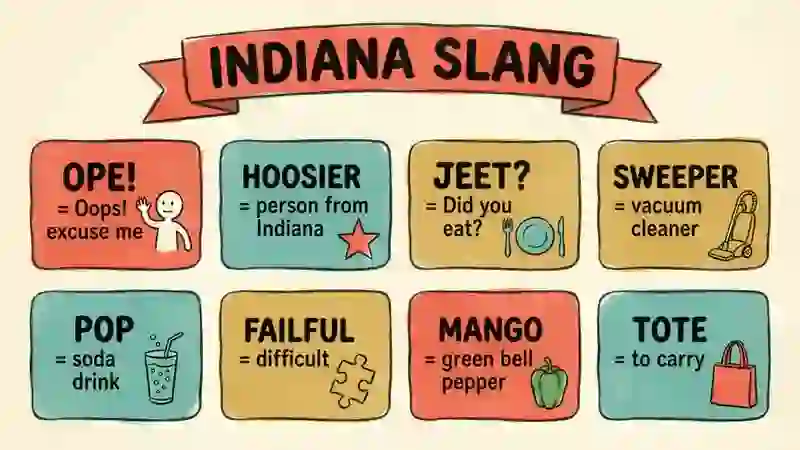
Indiana slang includes the casual words, phrases, and local expressions people may use in everyday conversations across the state.
Some terms are shaped by local culture, while others are common American expressions with a special connection to Indiana life.
You may hear different slang in cities, small towns, schools, sports, and online chats. Understanding these expressions can make local conversations easier to follow and help visitors feel more familiar with the way people communicate.
In this guide, we’ll explore Indiana slang meaning, common words, popular phrases, and local expressions, along with simple examples showing how they are used.
Indiana slang is a collection of local words, phrases, and expressions that people in Indiana may use in everyday conversations, texting, social media, and casual speech.
Some terms are strongly connected with Hoosier culture, while others are informal expressions shared across the Midwest.
What Does Indiana Slang Mean?
Simple Definition
Indiana slang refers to informal words and phrases associated with Indiana and its local culture. Some expressions describe places, people, food, weather, sports, or everyday life.
Why Indiana Slang Can Be Confusing
If you are not from Indiana, a local expression may sound unusual even when the meaning is simple. Words such as Hoosier, pop, and ope can be understood differently depending on the speaker and context.
The important thing is to look at the whole sentence rather than trying to understand one word by itself.
Common Indiana Slang Words and Phrases
1. Hoosier
Meaning: A person from Indiana.
“Hoosier” is one of the best-known terms connected with Indiana. It is commonly used as a name for Indiana residents and is closely tied to the state’s identity.
Example:
“She’s a proud Hoosier.”
2. Ope
Meaning: A casual expression used when someone notices a small mistake, surprise, or unexpected situation.
“Ope” is strongly associated with Midwestern speech. You may hear it when someone moves around another person, drops something, or suddenly realizes something.
Example:
“Ope, I forgot my keys.”
3. Pop
Meaning: A soft drink or soda.
In parts of Indiana and the wider Midwest, people may say pop instead of soda.
Example:
“Do you want a pop with your lunch?”
4. You Guys
Meaning: A casual way to address a group of people.
This phrase is common in many parts of the United States, including the Midwest. It does not necessarily refer only to males.
Example:
“Are you guys coming with us?”
5. Naptown
Meaning: A nickname for Indianapolis.
“Naptown” is an informal nickname associated with Indianapolis. You may see it in casual conversations, music, local culture, and social media.
Example:
“I’m heading back to Naptown this weekend.”
6. Indy
Meaning: A short form of Indianapolis.
“Indy” is much more common in everyday speech than saying the full city name every time.
Example:
“I’m visiting Indy tomorrow.”
7. The Region
Meaning: A common nickname for the Northwest Indiana area near Chicago.
People from Northwest Indiana may use “the Region” to describe their part of the state.
Example:
“My family lives in the Region.”
8. Hoosier Hospitality
Meaning: A friendly and welcoming attitude associated with Indiana culture.
This expression is more cultural than traditional slang, but it can appear in conversations about Indiana identity.
Example:
“You’ll get plenty of Hoosier hospitality here.”
9. Corn Country
Meaning: A casual description of rural areas known for farming.
Indiana has a strong agricultural identity, so expressions connected with farmland and corn may appear in local conversations.
Example:
“He grew up out in corn country.”
10. Y’all
Meaning: An informal way to address multiple people.
Although “y’all” is especially associated with Southern American English, it is also used by some Indiana speakers. Its use can vary from person to person.
Example:
“Are y’all ready to go?”
Indiana Slang Related to Local Identity
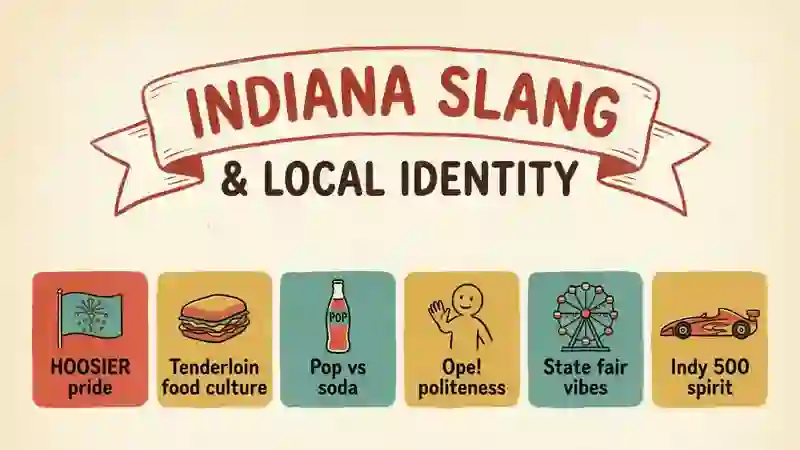
Hoosier Culture
Indiana has a strong local identity, and language is one way people show that connection. The word “Hoosier” is especially important because it is used as the standard term for someone from Indiana.
The exact historical origin of “Hoosier” is uncertain. Several explanations have been suggested over the years, but there is no universally accepted origin story.
Indiana Pride
Local expressions can also show pride in a city, region, sports team, or community. Someone might use “Indy,” “Naptown,” or “Hoosier” simply to show that they are familiar with Indiana culture.
Indiana Slang Used in Everyday Conversation
Casual Conversation
Many Indiana expressions are not difficult slang terms. They are simply informal ways of speaking.
For example:
“Ope, let me move around you.”
The speaker is not trying to use complicated slang. The expression simply adds a casual Midwestern tone.
Texting and Messaging
People may shorten words in texts just as they do elsewhere. Common informal terms such as “Indy” can make messages quicker and more natural.
Example:
“Going to Indy tonight.”
Social Media
Indiana-related slang can also appear in posts, captions, comments, and videos. Local nicknames are especially useful when someone is talking about a city or region.
Example:
“Nothing beats a weekend in Indy.”
Where Is Indiana Slang Commonly Used?
In Indiana
The most natural place to hear Indiana expressions is in everyday conversations among local residents.
On Social Media
Local expressions can appear on platforms such as Instagram, TikTok, Reddit, Facebook, and X when people discuss Indiana communities, sports, food, travel, or local events.
In Text Messages
Friends and family may use informal expressions because texting is usually more relaxed than formal writing.
In Online Communities
Indiana-based Reddit communities, local Facebook groups, and other online communities may contain regional expressions. However, not every expression used online is uniquely from Indiana.
Is Indiana Slang Rude or Offensive?
Usually Neutral
Most Indiana expressions are harmless and informal. Words such as “Indy,” “pop,” and “ope” are generally casual rather than offensive.
Context Still Matters
The same phrase can feel different depending on the speaker’s tone. A nickname may sound friendly in one conversation but dismissive in another.
For that reason, it is useful to understand the situation before using unfamiliar regional slang.
The Word “Hoosier”
“Hoosier” is normally a neutral term for someone from Indiana and is widely used as part of Indiana identity. However, context matters because “hoosier” can also have unrelated meanings in some varieties of American English.
When discussing Indiana, the intended meaning is usually a person from the state.
Real-Life Examples of Indiana Slang
Friendly Examples
Example 1:
“Hey, Hoosier, how have you been?”
Example 2:
“Want to grab a pop before we leave?”
Casual Examples
Example 1:
“Ope, I left my phone in the car.”
Example 2:
“We’re driving through the Region later.”
Social Media Examples
Example 1:
“Indiana sunsets never get old.”
Example 2:
“Back in Indy for the weekend!”
Gaming or Online Community Examples
Indiana slang is not specifically gaming slang, but local expressions can still appear in gaming chats when players are talking about where they live.
Example:
“I’m from Indy too.”
The meaning comes from the local context, not from gaming terminology.
Indiana Slang vs. General Midwest Slang
Similarities
Indiana is part of the Midwest, so some expressions associated with Indiana are also heard in neighboring states.
For example, ope and pop are not exclusive to Indiana. They are part of broader Midwestern speech patterns.
Differences
Some expressions are more closely connected to Indiana places and identity.
| Term | Meaning | Indiana Connection |
| Hoosier | Person from Indiana | Very strong |
| Indy | Indianapolis | Strong |
| Naptown | Indianapolis nickname | Strong |
| The Region | Northwest Indiana | Strong |
| Ope | Casual reaction | Broader Midwest |
| Pop | Soft drink | Broader Midwest |
This distinction is important because calling every Midwestern expression “Indiana slang” can be misleading.
The Origin and Background of Indiana Slang
Regional Language
Indiana slang developed through local communities, migration, farming culture, neighboring states, cities, and broader Midwestern speech patterns.
Indiana sits between several cultural and linguistic regions, so its everyday language is not completely isolated from surrounding areas.
Influence of Nearby States
Indiana borders Illinois, Michigan, Ohio, Kentucky, and other states. People travel, work, study, and communicate across these borders, allowing words and expressions to spread between communities.
Indianapolis Influence
Indianapolis also has a major influence on modern Indiana language. As the state’s largest city, it contributes to local culture, media, sports, entertainment, and online communication.
Why Do People Use Indiana Slang?
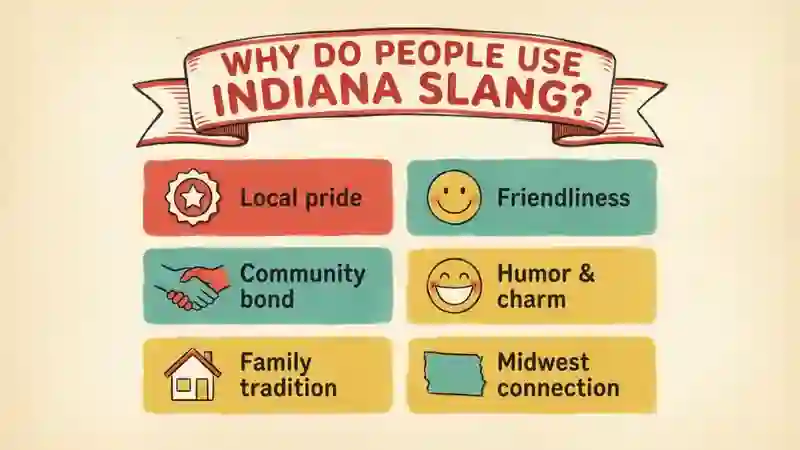
To Show Local Identity
Regional words can make speakers feel connected to their home state or city.
To Sound Natural
People usually use slang because it feels comfortable and familiar, not because they are consciously trying to use “slang.”
To Build Community
Shared expressions can help people recognize that they have something in common.
To Add Personality
Informal language can make conversations feel more relaxed and personal.
When Should You Avoid Indiana Slang?
Formal Writing
Avoid heavy regional slang in academic papers, professional reports, and other formal writing unless the term is directly relevant.
When Speaking to an Unfamiliar Audience
If your audience may not understand a local expression, use a clearer standard term.
When Meaning Is Unclear
Do not assume that every Midwestern expression has exactly the same meaning everywhere.
A word can change meaning across regions, generations, and social groups.
Polite Alternatives to Regional Slang
Instead of “Pop”
Use soda or soft drink if you are speaking to an audience that may not use “pop.”
Instead of “Ope”
You can simply say:
- “Excuse me.”
- “Oh, sorry.”
- “Oops.”
- “Let me move.”
Instead of “Indy”
Use Indianapolis in formal writing when clarity is more important than casual style.
Regional slang is not necessarily bad. The goal is simply to choose language that fits the audience.
The Impact of Indiana Slang on Communication
It Can Create Connection
Using a familiar local phrase can make a conversation feel warmer and more natural.
It Can Show Where Someone Is From
Regional vocabulary sometimes gives listeners clues about a person’s background or community.
It Can Cause Confusion
Someone from another region may not immediately understand a local expression.
That is why context is especially important when regional slang appears in online conversations.
Is Indiana Slang Safe for Social Media?
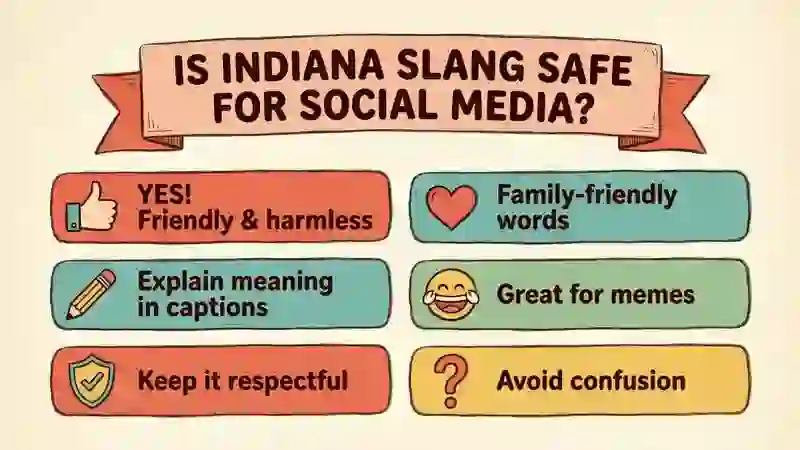
Generally Yes
Most Indiana slang is ordinary regional language and is safe to use on social media.
However, users should still consider the normal rules of respectful online communication.
Think About Your Audience
A phrase that is funny or familiar to Indiana residents may not make sense to someone from another part of the country.
If a local word could be misunderstood, adding a little context can help.
How to Understand Indiana Slang in Text
Look at the Whole Message
Do not judge a slang word alone. Read the sentence around it.
Consider the Location
If the person is talking about Indianapolis, Northwest Indiana, or another local area, a regional meaning may be intended.
Check the Tone
Friendly messages, jokes, arguments, and formal conversations can change how a phrase is understood.
Ask for Clarification
If someone uses an unfamiliar term, asking what they mean is often the easiest solution.
Indiana Slang Examples in Text Messages
Example 1
Message: “Ope, I forgot to send that.”
Meaning: The person is casually acknowledging a small mistake.
Example 2
Message: “I’ll be in Indy Friday.”
Meaning: The person means Indianapolis.
Example 3
Message: “Want a pop?”
Meaning: The person is askingi f you want a soft drink.
Example 4
Message: “He’s a Hoosier through and through.”
Meaning: The person is strongly connected with Indiana.
Example 5
Message: “I grew up in the Region.”
Meaning: The speaker is referring to Northwest Indiana.
Frequently Asked Questions About Indiana Slang
1. What is the most famous Indiana slang word?
Hoosier is probably the best-known term connected with Indiana. It commonly refers to a person from Indiana.
2. What does “Hoosier” mean in Indiana slang?
In an Indiana context, Hoosier means a person from Indiana. It is strongly connected with the state’s identity.
3. Do people in Indiana say “pop” or “soda”?
Many Indiana speakers use pop, although usage varies by person and region. “Soda” is also understood.
4. What does “ope” mean in Indiana?
“Ope” is a casual Midwestern expression used for small surprises, mistakes, or moments when someone needs to move around another person.
5. What does “Indy” mean?
“Indy” is a common short form of Indianapolis, the capital and largest city of Indiana.
6. Is Indiana slang different from Midwest slang?
Yes, but there is overlap. Some expressions associated with Indiana are also common across the Midwest, while others are strongly connected with Indiana cities, regions, or culture.
Conclusion
Indiana slang reflects the state’s local identity, Midwestern speech patterns, and diverse communities. Words such as Hoosier, Indy, Naptown, the Region, pop, and ope can appear in everyday speech, texting, and online conversations.
Not every expression associated with Indiana is unique to the state. Some are shared across the wider Midwest, so context matters when deciding what a word means.
If you come across unfamiliar Indiana slang, look at the surrounding message, consider the location, and pay attention to the speaker’s tone. Understanding these small language clues can make conversations easier and help you appreciate the local character behind the words.
Read more about!
- HP Meaning Slang: What Does HP Mean in Text, Gaming & Online?
- Trenches Slang Meaning in Text: What Does “Trenches” Mean?
- Slaying Meaning Slang: Definition, Origin, Examples
- Grape Slang Meaning: What Does Grape Mean in Slang?
Hi, I’m Ryan Mitchell. I write simple guides about slang, internet language, and everyday English to make modern expressions easy to understand. My goal is to help learners use real-life English with confidence.