Last Updated: August 31, 2026
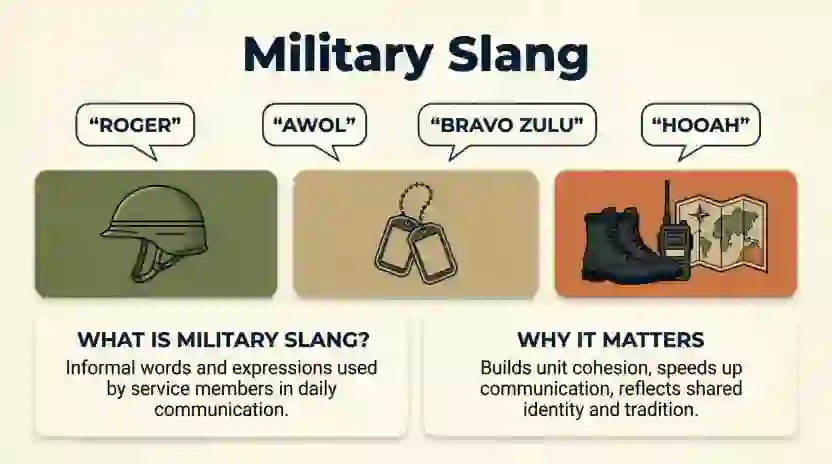
Military slang is informal language used by service members to describe people, situations, daily life, and shared experiences. Unlike official military terminology, slang is usually more casual and can change from one group, branch, or time period to another.
People often search for military slang because they hear a term in a movie, read it in a text, see it online, or come across it in a conversation with a veteran or service member. Some military slang has also moved into everyday English.
This guide explains common military slang words and meanings in simple English. It also explains the difference between military slang, military jargon, acronyms, and official terms, so you can understand what a phrase means without guessing from context.
What Does Military Slang Mean?
Military slang means informal words, phrases, nicknames, or expressions associated with military life and service members. These expressions are often shaped by shared experiences, humor, training, local culture, and the need for quick communication.
Military slang is not one fixed vocabulary. Different branches, units, jobs, countries, and generations can use different expressions. U.S. Army writing guidance specifically notes that slang meanings can vary by location and user.
Simple Definition
Military slang is casual language connected with military culture and service life. It may be used by service members, veterans, military families, or civilians who have picked up the expressions.
Military Slang vs. Military Jargon
These terms are related, but they are not exactly the same.
Military slang is generally informal and can be humorous, personal, or strongly tied to a particular group.
Military jargon is specialized language used within military work. It can include technical terms, professional vocabulary, abbreviations, and standardized expressions.
The U.S. Army explains that military jargon can help professionals communicate complex ideas quickly, while unclear jargon can confuse readers who do not share the same background.
For example:
| Type | Meaning | Typical use |
|---|---|---|
| Military slang | Informal military expression | Casual conversation |
| Military jargon | Specialized military vocabulary | Professional communication |
| Acronym | Short form made from letters | Official or informal communication |
| Nickname | Informal name for a person or group | Social or cultural use |
| Official term | Standardized military language | Training and formal documents |
Common Military Slang Words and Meanings
Military slang includes hundreds of expressions, and the exact vocabulary can change over time. The examples below focus on commonly recognized terms and expressions rather than pretending that every service uses the same language.
Boot
Boot is an informal term for a new or inexperienced service member.
The word can be teasing, depending on who says it and how it is used. It may refer to someone who has recently joined the military and has not yet gained much experience.
Example:
“He’s still a boot, so he’s learning how everything works.”
The tone is usually casual, but it can sound disrespectful if someone uses it to put down another person.
Chow
Chow is an informal military word for food or a meal.
It has been used in military settings for many years and is one of the expressions that people may recognize outside the military as well.
Example:
“Let’s grab some chow before we head back.”
The word is usually casual rather than offensive.
Squared Away
Squared away describes someone or something that is organized, prepared, neat, or in good order.
It can describe a person, a workspace, equipment, or a task.
Example:
“Everything is squared away before the meeting.”
The expression has also entered general American English.
Hooah
Hooah is a well-known U.S. Army expression associated with enthusiasm, agreement, motivation, or acknowledgment.
Its exact feeling depends on context. It can be used as a response, expression of enthusiasm, or informal sign of agreement.
Example:
“Ready for the next task?”
“Hooah.”
It is strongly associated with Army culture, so it may sound unusual in an ordinary civilian conversation.
Brass
Brass can be an informal way to refer to senior military leadership or high-ranking officers.
The expression comes from the traditional association between brass insignia and military rank.
Example:
“The brass will review the plan later.”
The term is informal and depends heavily on context.
Private News Network
Private News Network is a humorous expression used for the rumor mill or informal flow of information among soldiers.
It is a good example of military humor creating a playful alternative to an ordinary phrase.
Example:
“I heard it from the Private News Network.”
The speaker is jokingly saying that the information came through informal gossip.
Military Slang Used in Everyday Conversation
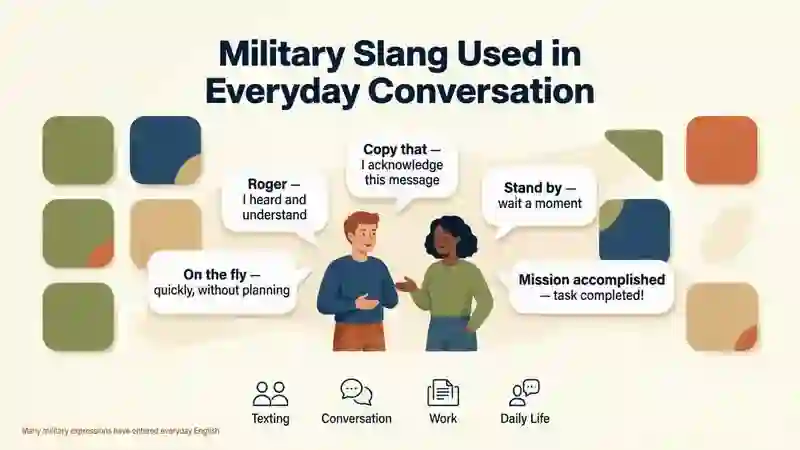
Some military expressions have moved beyond military communities and can appear in ordinary speech.
“Squared Away”
Someone might say:
“Don’t worry. Everything is squared away.”
Here, the phrase simply means everything is organized or taken care of.
“Chow”
A civilian might hear:
“Where should we get some chow?”
The speaker simply means food or a meal.
“Boot”
Outside military settings, boot can have other meanings, so context matters. When discussing military culture, however, it can refer to a new or inexperienced service member.
This is a useful reminder that military slang cannot always be understood by looking at the word alone.
Army Slang and Soldier Slang
Army slang specifically refers to informal expressions associated with the Army.
Soldier slang usually refers to informal expressions used by soldiers. It can overlap heavily with Army slang, especially when discussing U.S. Army culture.
However, military language is not completely uniform. Different branches and specialties can develop their own vocabulary. Research published by Army University Press notes that military jargon is highly fragmented because different branches, specialties, and professional communities develop different language.
This means a phrase commonly heard in one military community may be unfamiliar to someone from another.
Military Slang Abbreviations and Acronyms
These categories overlap, but they are not identical.
An abbreviation shortens a word or phrase.
An acronym is formed from letters or parts of words and is generally pronounced as a word.
An initialism is also formed from letters, but the letters are spoken individually.
The Department of Defense explains these distinctions in its terminology guidance.
Why Military Acronyms Can Be Confusing
Military organizations use many shortened terms because they can save time and space. But someone outside the military may not know what the letters mean.
That is why a term that seems obvious to a service member can be confusing to a civilian.
The Army has also noted that acronyms and military lingo can become so familiar to service members that they may forget that people outside the military do not understand them.
Funny Military Slang Words
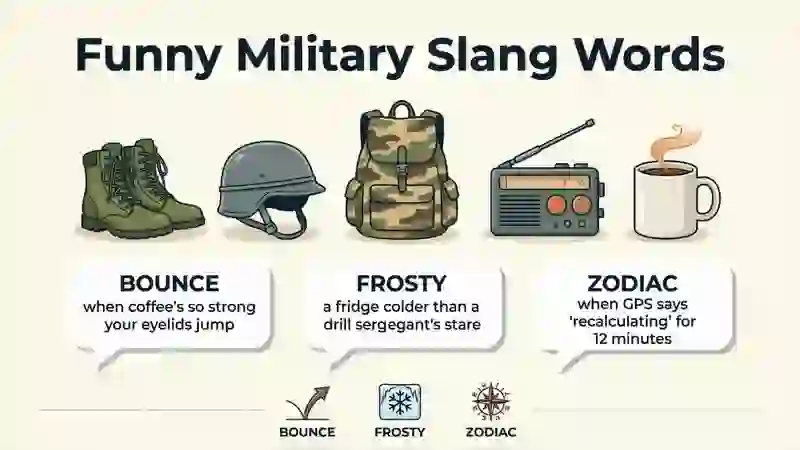
Some expressions are playful descriptions of ordinary military experiences. Others turn formal language into jokes.
Why Military Humor Is Common
Military communities often share:
- Similar routines
- Shared training experiences
- Common frustrations
- Specialized work
- Strong group identity
- Inside jokes
This shared background can create expressions that outsiders may not immediately understand.
For example, Private News Network humorously turns the idea of a rumor mill into something that sounds like an official organization.
The important point is that not every funny military expression is universal. Some are strongly tied to a particular branch, unit, period, or group.
Old Military Slang vs. Modern Military Slang
Historical military sources show that American service members have created informal language for generations. The U.S. Army has documented slang from World War I, including expressions connected with military technology, daily life, and wartime experiences.
Older Military Expressions
Older slang may appear in:
- Historical books
- War documentaries
- Older movies
- Military memoirs
- Historical newspapers
A term that was common decades ago may sound dated today.
Modern Military Slang
Modern expressions can be influenced by:
- New technology
- Social media
- Gaming culture
- Online communities
- New military jobs
- Changes in military organization
Because slang changes, an article should not treat every historical expression as current slang.
Where Is Military Slang Commonly Used?
Military slang is most naturally found in conversations and communities connected with military life.
Texting
Service members and veterans may use informal military expressions when texting friends or colleagues.
However, the meaning of a short phrase may depend heavily on shared knowledge.
Social Media
Military slang can appear in posts, comments, memes, and discussions involving military culture.
A civilian may also use a military expression after hearing it from a friend, family member, veteran, movie, or online community.
Gaming
Some military-related language appears in gaming communities, especially in games that use military themes.
Reddit and Online Communities
Military-related communities can use specialized vocabulary that is familiar to members but confusing to outsiders.
The same expression may also be explained differently depending on the branch or community being discussed.
Workplace Conversations
Military slang can appear when veterans talk with former colleagues or other people who understand military culture.
It is less suitable when the audience does not know the terminology.
Is Military Slang Rude or Offensive?
Military slang is not automatically rude or offensive. Some expressions are neutral, some are humorous, and others can be insulting depending on the term and situation.
Neutral Military Slang
Terms such as chow or squared away are generally informal rather than offensive.
Teasing or Insulting Terms
Some military expressions are used to tease inexperienced people or describe groups in a negative way.
For example, certain informal labels can carry a mocking tone. A term that sounds funny to one person may feel disrespectful to another.
Context Matters
Ask:
- Who is speaking?
- Who is being described?
- Is the speaker joking?
- Is the listener familiar with military culture?
- Could the term sound insulting?
Context can completely change how an expression is received.
Military Slang vs. Everyday Slang
Military slang is a type of group language. Everyday slang is much broader.
| Feature | Military Slang | Everyday Slang |
|---|---|---|
| Main group | Military communities | General public |
| Main purpose | Informal communication and shared culture | Casual communication |
| Vocabulary | Often military-related | Covers many topics |
| Audience | Often people familiar with military life | Usually wider |
| Context | Service, veteran, or military culture | Everyday social life |
| Meaning | Can vary by branch or group | Can vary by region and generation |
Why Do Soldiers Use Military Slang?
It Builds Group Identity
Shared expressions can make people feel part of the same community.
It Saves Time
Short informal expressions can sometimes communicate an idea faster than a longer explanation.
It Creates Humor
Humor can turn ordinary or frustrating experiences into shared jokes.
It Reflects Experience
People who share the same environment often develop words for things that outsiders may never need to describe.
Common Misunderstandings About Military Slang
All Military Branches Use the Same Slang
Not necessarily.
Different branches, specialties, and communities can have different expressions.
Military Slang Is the Same as Military Terminology
No.
Official military terminology can be standardized, while slang is informal and may vary.
Every Military Word Is Slang
No.
Some words are formal technical terms, acronyms, or doctrinal language rather than slang.
Military Slang Is Always Offensive
No.
Many expressions are simply informal or humorous.
Old Military Slang Is Still Popular
Not always.
Some expressions become dated, while others survive for decades and enter general English.
When Should You Avoid Using Military Slang?
This is especially important in:
- Formal emails
- School assignments
- Job interviews
- Professional reports
- Official communication
- Conversations with people unfamiliar with military culture
The U.S. Army’s writing guidance recommends clear language and explains that unexplained slang or jargon can make written communication difficult to understand.
A Better Approach
If you need to use a military term in a formal piece of writing, explain it the first time.
For example:
“The team described the situation as ‘squared away,’ meaning that everything was organized and ready.”
This lets readers understand the expression without needing military experience.
Can Civilians Use Military Slang?
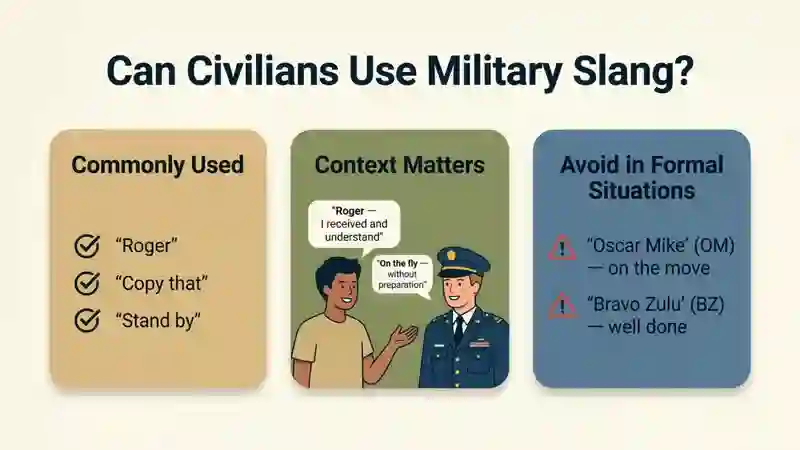
Yes, civilians can use some military expressions, especially when the meaning has become widely understood in everyday English.
However, copying an unfamiliar military expression simply to sound like an insider can sometimes feel unnatural.
If you are not sure about a term, learn its meaning and tone first.
A phrase that is harmless among close friends may sound strange, disrespectful, or confusing in another setting.
Is Military Slang Safe to Use on Social Media?
Generally, harmless military slang can be used on social media, but context still matters.
Before posting an expression, consider:
- Whether the audience understands it
- Whether the phrase has an insulting meaning
- Whether it is outdated
- Whether it belongs to a specific military community
- Whether the post is public or private
It is also worth remembering that online text does not carry facial expressions or tone of voice. A joke that sounds friendly when spoken may look harsh when written.
Real-Life Examples of Military Slang
Friendly Conversation
Person A: “Are you ready for tomorrow?”
Person B: “Yep, everything is squared away.”
Here, squared away means organized and ready.
Casual Conversation
Person A: “Are you hungry?”
Person B: “Definitely. Let’s get some chow.”
Here, chow means food or a meal.
Humorous Conversation
Person A: “How did everyone hear the news so quickly?”
Person B: “The Private News Network.”
The speaker is joking about an informal rumor network.
Social Media Context
Post: “Finally got everything squared away before the weekend.”
The expression is being used casually to say that things are organized or completed.
Workplace Context
A veteran might say:
“Everything is squared away.”
A coworker who does not know military expressions may understand it from context, but a more direct phrase such as “Everything is ready” may be clearer in formal communication.
Military Slang: Quick Comparison
| Expression | Basic meaning | Tone |
|---|---|---|
| Boot | New or inexperienced service member | Casual; can be teasing |
| Chow | Food or meal | Casual |
| Squared away | Organized or ready | Informal, usually neutral |
| Hooah | Agreement, enthusiasm, or acknowledgment | Informal |
| Brass | Senior military leadership | Informal |
| Private News Network | Rumor mill or informal information | Humorous |
Meanings can vary between branches, groups, and periods, so the surrounding conversation should always be considered.
Frequently Asked Questions About Military Slang
1. What is military slang?
Military slang is informal language associated with military culture and service members. It can include casual words, humorous expressions, nicknames, and group-specific phrases.
2. What are some common military slang words?
Examples include boot, chow, squared away, hooah, and brass. Their exact meaning and tone can vary depending on context.
3. What slang do soldiers use?
Soldiers may use slang related to military life, food, training, people, routines, and shared experiences. Vocabulary can differ between units, specialties, branches, and generations.
4. Is military slang the same as military jargon?
No. Military jargon is specialized professional language, while slang is generally more informal and flexible. Some expressions can overlap, but they serve different purposes.
5. Is military slang used in texting?
Yes. Military slang can appear in informal texts between people who understand the expressions. However, unfamiliar slang may confuse people outside the military community.
6. Can civilians use military slang?
Yes, especially when the expression is widely understood. Still, civilians should understand the meaning and tone before using an unfamiliar military expression.
7. Is military slang rude?
Not automatically. Some military slang is neutral or humorous, while other expressions can be teasing or insulting. The specific word and context matter.
8. Why does military slang change over time?
Military slang changes because groups, technology, jobs, social habits, and generations change. Some expressions disappear while others become part of everyday English.
Conclusion
Military slang is the informal language that grows around communities and shared service experiences. It can include casual expressions, humorous phrases, nicknames, and terms that are familiar to service members but less familiar to civilians.
The most important thing to remember is that military slang is not one fixed dictionary. Different branches, specialties, generations, and communities can use different expressions. Army research also shows that military language can become highly specialized within different professional groups.
Terms such as chow, boot, and squared away may be easy to recognize, while other expressions require more context. and some abbreviations are official terms rather than casual expressions.
If you are using military slang in everyday conversation, focus on meaning and tone first. In formal writing, it is usually better to explain unfamiliar terms so every reader can follow the message.
Read more about!
- HP Meaning Slang: What Does HP Mean in Text, Gaming & Online?
- Slaying Meaning Slang: Definition, Origin, Examples
- Grape Slang Meaning: What Does Grape Mean in Slang?
- What Does Baked Mean in Slang? Examples & Usage

Hi, I’m Nathan Collins. I create easy-to-understand English language content focused on internet slang, texting abbreviations, modern expressions, vocabulary, and word meanings. My goal is to help students, writers, professionals, and English learners communicate with confidence through clear explanations, practical examples, and reliable language guides.