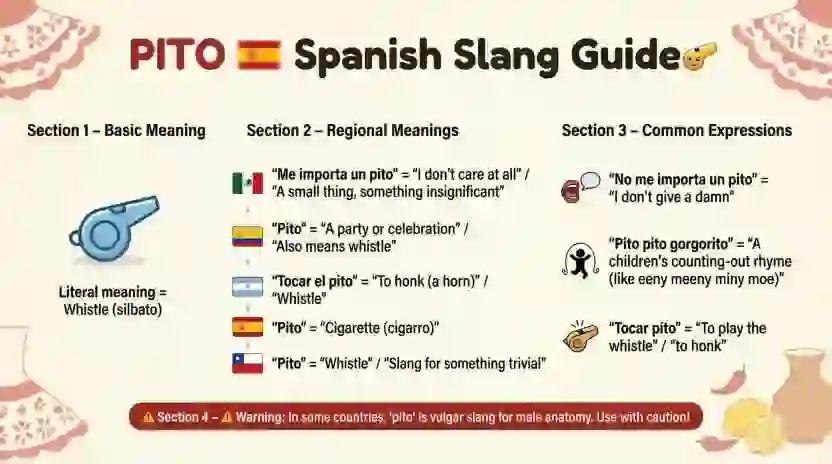
When you see “pito in Spanish slang”, the meaning can be confusing because pito has more than one meaning in Spanish. In informal speech, it can refer to male anatomy, but in ordinary Spanish it can also mean a whistle, horn, or similar sound-making object.
The important point is that pito does not always mean slang. The sentence and situation tell you which meaning is intended. For example, a sports conversation may use pito for a referee’s whistle, while an informal conversation may use it in a vulgar anatomical sense. The Royal Spanish Academy’s historical dictionary also shows that pito has had several meanings over time.
This guide explains pito in Spanish slang, its common meanings, regional variation, origin, tone, common mistakes, and how to understand it when you see it online or in conversation.
Pito in Spanish Slang: Featured Snippet Answer
Pito in Spanish slang is an informal and, in some contexts, vulgar word for the penis. However, pito also commonly means a whistle or horn. The correct meaning depends on context, country, and the sentence where the word appears. In formal Spanish, use a neutral anatomical term instead.
Pito in Spanish Slang – Quick Answer
The simplest answer is:
Pito can be a slang word for the penis in Spanish, but it does not always have a sexual meaning.
It can also refer to:
- A whistle
- A vehicle horn
- A sharp or high-pitched sound
- A cigarette in some regional Spanish usage
- Male anatomy in informal or vulgar speech
For example, in a sports context, el pito can refer to the referee’s whistle. In a discussion about a car, it may refer to the horn.
So, if you see pito in a Spanish text, do not automatically translate it as slang. Read the complete sentence first.
What Does Pito Mean in Spanish Slang?
The word pito is a masculine Spanish noun. Its meaning changes according to context.
The slang meaning that English-speaking learners often want to know is an informal word for the penis. Dictionaries describe this anatomical sense as colloquial or informal, and some sources mark it as vulgar.
That means pito is not the best choice for formal writing when you need to discuss anatomy.
A useful distinction is:
| Spanish word | General meaning | Tone |
| pito | Whistle, horn, or informal anatomical term | Depends on context |
| pene | Penis | Neutral/anatomical |
| silbato | Whistle | Neutral |
| bocina | Horn | Neutral in many contexts |
The same word can therefore sound completely different depending on the situation.
When Pito Is Not Slang
If someone says el árbitro tocó el pito, the subject is a referee and the context is sports. Here, pito refers to a whistle. Cambridge gives this meaning and also lists pito for horns and other sound-making devices.
Similarly, el pito del tren can refer to a train whistle.
This is why context is especially important for Spanish learners.
When Pito Is Slang
When the surrounding conversation clearly concerns male anatomy, pito can have its informal anatomical meaning.
Because this usage can be vulgar, learners should recognize it rather than assume it is suitable for everyday formal conversation.
The Origin of Pito

The history of pito is more interesting than a simple slang translation suggests.
The Royal Spanish Academy’s Diccionario histórico de la lengua española traces pito back to an onomatopoeic origin, meaning that the word is connected with a sound or sound imitation. The historical record shows pito being used for a small instrument that produces a high sound when blown. The Academy records this meaning in medieval sources.
Over time, pito developed several meanings and appears in different expressions and regional uses.
Its long history includes meanings connected with:
- Whistles and small wind instruments
- High-pitched sounds
- Vehicle horns
- Traditional expressions
- Various regional meanings
The anatomical slang meaning is therefore only one part of the word’s history.
It is also important not to claim that the slang meaning has one simple modern origin. Spanish developed across many countries, and regional vocabulary changed in different ways.
British English vs American English
The British English vs American English distinction does not directly apply to pito, because pito is a Spanish word.
However, English translations can vary between British and American English. The important point is that the Spanish word itself does not change simply because an English speaker uses a different variety of English.
| Spanish context | General English meaning | British English tendency | American English tendency |
| pito for a referee | whistle | whistle | whistle |
| pito for a vehicle | horn | horn/hooter | horn |
| pito as informal anatomy | Informal anatomical term | Informal equivalent | Informal equivalent |
| pito in an idiom | Depends on expression | Natural equivalent | Natural equivalent |
For Spanish learners, regional Spanish is more important than British vs American English when interpreting pito.
Different Spanish-speaking countries can use the same word in different ways.
Which Version Should You Use?
There is no British or American “version” of pito. Instead, choose your Spanish wording based on the audience and situation.
United States
For formal or educational writing, use neutral Spanish vocabulary. If you are explaining pito, clearly label its informal meaning.
United Kingdom
The same basic rule applies. English translation choices may differ, but the Spanish context remains the key factor.
Canada
Use neutral Spanish when writing for a broad audience. Avoid assuming that a slang word has exactly the same tone in every Spanish-speaking community.
Australia
For Spanish learners, context and regional Spanish matter more than the English variety used to explain the word.
International Writing
If your readers come from different countries, explain that pito has multiple meanings. Do not present one slang interpretation as universal.
Academic Writing
Avoid using pito as a slang term in formal academic prose unless you are discussing the word itself. Use a neutral anatomical term when the subject requires one.
Business Writing
Avoid slang. If the word appears in a quotation or translation, explain its context rather than using it as your own formal vocabulary.
Common Mistakes
Mistake 1: Assuming Pito Always Means Slang
Incorrect assumption:
“Pito always means penis.”
Better understanding:
Pito has several meanings, including whistle and horn.
Why?
Spanish dictionaries list multiple senses.
Memory tip:
Context first, translation second.
Mistake 2: Treating It as Formal Vocabulary
Incorrect:
Using pito as the preferred anatomical term in formal academic writing.
Better:
Use a neutral anatomical term such as pene when discussing anatomy formally.
Why?
Pito can be informal or vulgar in its anatomical sense.
Mistake 3: Assuming Every Spanish-Speaking Country Uses It the Same Way
Spanish vocabulary can vary by country and region.
Memory tip:
A slang meaning listed in one dictionary or associated with one community should not automatically be treated as universal Spanish.
Everyday Examples
Because pito can have a vulgar anatomical meaning, examples below focus mainly on its non-sexual uses and language-learning context.
In Emails
Formal Spanish emails normally avoid slang.
A sentence about a referee, for example, may use pito when referring to a whistle, but a professional writer should choose wording that makes the meaning clear.
In Business Writing
A business document might discuss a vehicle horn or an audible signal. In that context, pito can appear in regional Spanish, but more neutral terminology may be preferable for an international audience.
In News Headlines
A Spanish-language news report may use pito in an established expression or when reporting a regional usage. The headline’s subject usually makes the intended meaning clear.
In Blogs
A language blog may discuss pito in Spanish slang specifically to explain its informal meaning.
On Social Media
Social media can make context harder to understand because users often post short phrases, jokes, or comments without explanation.
If you see pito online, check the surrounding words before deciding what it means.
In Academic Writing
A Spanish learner researching vocabulary may encounter pito in a dictionary or linguistic discussion.
In formal writing, explain the word rather than using its slang sense casually.
In Daily Conversation
A conversation about sports, traffic, or a vehicle may use pito without any slang meaning at all.
That is one of the most important points for learners.
Google Trends & Modern Usage

People search “pito in Spanish slang” because the word appears in translations, social media, conversations, entertainment, and language-learning materials.
However, exact search-volume or Google Trends statistics should not be invented. Search interest can also change over time and differ between countries.
The strongest general usage point is that pito remains a multi-meaning Spanish word. Modern dictionaries continue to record meanings related to whistles, horns, informal vocabulary, and other regional uses.
The word can be especially confusing online because short posts often remove the context that would normally make the meaning obvious.
For learners, three clues are useful:
- Look at the topic. Is the conversation about sports, traffic, or anatomy?
- Look at nearby words. They often reveal the intended meaning.
- Consider the country. Spanish slang is not identical across all Spanish-speaking regions.
The historical record also shows that pito has had many meanings and expressions over several centuries, so its vocabulary history is much broader than its modern slang use.
Quick Comparison Table
| Version | Meaning | Correct? | Region | Example |
| pito | Whistle | Yes | Spanish-speaking regions | A referee’s whistle |
| pito | Horn | Yes | Regional Spanish | A vehicle horn |
| pito | Informal anatomical term | Yes, in relevant slang contexts | Varies by region | Informal conversation |
| silbato | Whistle | Yes | Broad Spanish use | Sports whistle |
| bocina | Horn | Yes | Common in many regions | Vehicle horn |
| pene | Neutral anatomical term | Yes | Broad Spanish | Formal anatomy |
Dictionary sources confirm that pito can refer to a whistle, horn, and informal anatomical vocabulary.
Key Takeaways
- Pito in Spanish slang can refer informally to the penis.
- Pito does not always have a slang meaning.
- It can also mean a whistle or horn.
- Context is essential when translating the word.
- Its anatomical meaning can be informal or vulgar.
- Pene is a more neutral term for formal anatomical writing.
- Spanish usage can vary across countries and regions.
- The word has a long documented history beyond its slang meaning.
FAQs About Pito in Spanish Slang
What does pito mean in Spanish slang?
In Spanish slang, pito can be an informal word for the penis. However, this is only one meaning. The same word can mean a whistle, horn, or another sound-related object depending on the sentence. Dictionary sources list several meanings, so context is essential when translating pito.
Is pito a bad word in Spanish?
It depends on how it is used. The anatomical meaning can be informal or vulgar, so it may be inappropriate in formal situations. However, pito is not automatically a bad word because it also has ordinary meanings such as whistle and horn. The surrounding sentence determines its meaning and tone.
Does pito mean penis?
Yes, pito can mean penis in informal Spanish. Dictionaries identify this as a colloquial meaning, while some classify it as vulgar. However, the word also has non-sexual meanings, especially whistle and horn. Therefore, translating pito as “penis” without checking context can produce the wrong meaning.
Does pito mean whistle in Spanish?
Yes. Pito can mean a whistle, especially in contexts involving sports or signaling. Cambridge lists whistle as one of its meanings, and silbato is a common synonym. A sentence about a referee, for example, may use pito without any slang meaning.
Is pito formal Spanish?
Not in every sense. The word itself is a legitimate Spanish word, but its anatomical meaning is informal and can be vulgar. Its ordinary meanings, such as whistle or horn, can occur in normal language. For formal anatomy, a neutral anatomical term is more suitable.
How do you pronounce pito?
Pito is pronounced approximately “PEE-toh”, with the stress on the first syllable. Spanish pronunciation is generally consistent, so both vowels are pronounced clearly. The word has two syllables: pi-to.
Is pito the same in every Spanish-speaking country?
No. Spanish vocabulary varies by country and region. Pito has several documented meanings, and the exact meaning or tone can depend on local usage. This is why learners should avoid treating one slang definition as universal Spanish.
What is the neutral word for penis in Spanish?
The neutral anatomical term is pene. It is appropriate when discussing anatomy in educational, medical, or formal contexts. Pito can have an informal or vulgar anatomical meaning, so it is not the best choice when you need precise, neutral terminology.
Why does pito have so many meanings?
Pito has a long history in Spanish. The Royal Spanish Academy’s historical dictionary connects its earliest documented sense with a small instrument that produces a high sound and describes many later meanings and expressions. Over time, regional and figurative uses added to the word’s range.
What should I do if I see pito in a text?
Read the whole sentence before translating it. Check if the conversation is about sports, traffic, sound, or informal vocabulary. If the context is unclear, avoid assuming the slang meaning. This simple habit helps Spanish learners avoid many incorrect translations.
Conclusion
Understanding pito in Spanish slang is mainly about understanding context. The word can have an informal anatomical meaning, but it can also refer to a whistle, horn, or other sound-related object. Spanish dictionaries confirm these multiple meanings, so a single English translation does not work in every sentence.
For formal Spanish, avoid using the slang anatomical sense when a neutral term is needed. If you are reading an informal message, social post, or conversation, look at the surrounding words and consider the speaker’s regional variety of Spanish.
The word also has a long documented history. The RAE’s historical dictionary traces its earliest recorded sense to a small sound-making instrument and records many later meanings and expressions.
The easiest rule to remember is: “Pito” does not have just one meaning, so always check the context before translating it.
If you are learning Spanish slang, understanding context is often more useful than memorizing a single English translation.
Read more about!
- Gen Z Slang for Tired: What It Means and Popular Words
- Honey Badger Meaning Slang: Definition, Origin & Examples
- Bitchin Slang: Meaning, Origin, Examples & How to Use It
- BTK Meaning Slang: Is It Common in Text Messages?

Daniel Brooks is an English vocabulary educator who creates simple, practical guides on slang, word meanings, and everyday English. His goal is to help students, writers, and English learners expand their vocabulary and communicate with confidence.