When you see “OT” in a text, comment, or group chat, its meaning depends on the context. In online conversations, OT slang most commonly means “off topic,” while in work and sports conversations, OT often means “overtime.”
This short abbreviation can be confusing because the same two letters can describe very different ideas. Someone on Reddit or Discord may use “OT” to show that they are moving away from the main discussion. A worker may use it to mean extra working hours, while a sports fan may use it for extra playing time.
Understanding the sentence around “OT” is the easiest way to find the intended meaning. This guide explains what OT slang means, where it came from, how people use it in texting and social media, and how to avoid confusing it with other meanings.
OT Slang: Featured Snippet & AI Overview
OT slang most commonly means “off topic” in online chats, forums, and social media. It tells readers that a comment or question is not directly related to the main discussion. In work and sports, OT commonly means “overtime.” The surrounding conversation usually makes the intended meaning clear.
OT Slang – Quick Answer
OT slang usually means “off topic” when it appears in an online conversation. It can also mean “overtime” when people are talking about work, sports, or extra time.
For example:
- “OT, but did you watch the new movie?” = “Off topic, but…”
- “I have OT tomorrow.” = “I have overtime tomorrow.”
- “The game went into OT.” = “The game went into overtime.”
So, if you see OT in a text, do not assume there is only one meaning. Check the topic first.
What Does OT Slang Mean?
OT is a short form or initialism with several meanings. In internet conversations, “off topic” is one of its most common meanings. It is used when someone wants to make a comment that does not directly relate to the main subject.
For example, imagine people are discussing a school project:
“OT, but has anyone seen the new game?”
Here, OT tells the group that the speaker is changing the subject.
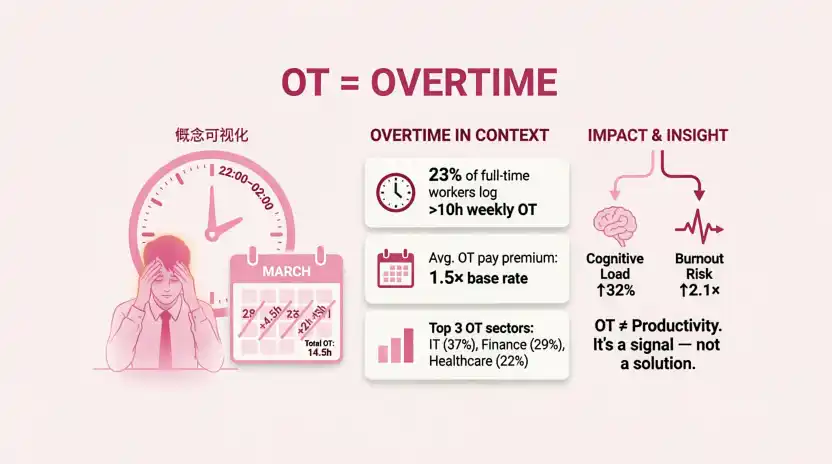
OT can also mean “overtime.” This meaning is common in workplace conversations and sports. At work, it can refer to hours worked beyond a normal schedule. In sports, it can refer to extra playing time after a tied game.
OT Meaning in Texting
In texting, context is especially important.
If a friend says:
“OT, what are you doing this weekend?”
OT probably means “off topic.”
But if someone says:
“I have to work OT tonight.”
It means “overtime.”
OT Meaning on Social Media
On social media, OT may appear before a side comment. This is especially useful in discussions where people want to separate the main subject from an unrelated thought.
For example:
“OT: Does anyone know a good place to eat?”
The writer is signaling that the question is not about the original discussion.
OT Meaning on Forums
The “off topic” meaning has a strong connection with online discussion culture. Forum users have long used OT to mark posts or comments that move away from the main subject.
The Origin of OT Slang
There is no single documented origin for every use of “OT.” The abbreviation developed from phrases that were already common in different settings.
The “off topic” meaning is connected with online forums, mailing lists, message boards, and other discussion spaces. Users needed a quick way to tell readers that a message did not belong to the main subject. “OT” became a simple label for this type of comment.
The “overtime” meaning has a separate history. OT is widely used as an abbreviation for overtime in sports and employment contexts. Major dictionaries also list overtime among the meanings of OT.
Because these meanings developed in different contexts, OT is not a slang word with one clear definition. It is better understood as a flexible abbreviation whose meaning changes with the conversation.
Why Does OT Have So Many Meanings?
Short abbreviations are useful because they save time and space. However, the same letters can be reused for different phrases.
For OT, common meanings include:
- Off topic
- Overtime
- Old Testament
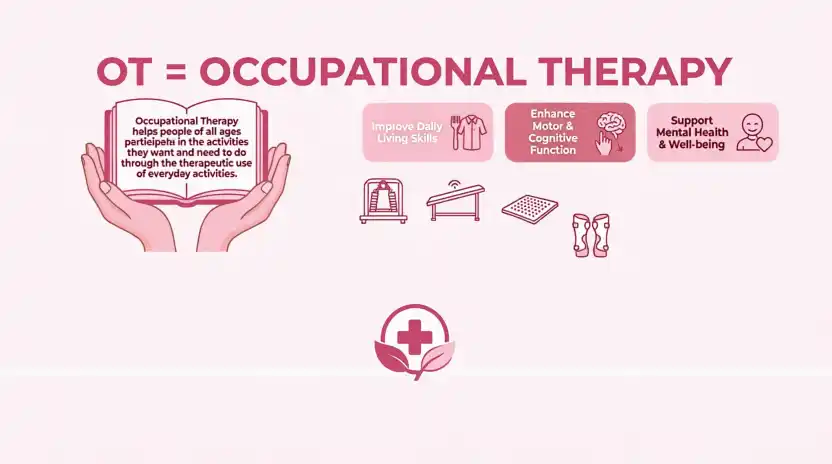
- Occupational therapy
- Occupational therapist
- Offensive tackle in American football
Dictionaries such as Collins and Dictionary.com list several of these meanings. (Collins Dictionary)
That is why context matters more than the abbreviation itself.
British English vs American English
OT does not have one strict British-versus-American slang difference. Some meanings appear in both varieties of English, although dictionaries may list additional regional uses.
| British English | American English | Example |
| OT can mean overtime | OT can mean overtime | “The game went into OT.” |
| OT can mean off-topic online | OT can mean off-topic online | “OT, but I have a question.” |
| OT can mean occupational therapy | OT can mean occupational therapy | “She works in OT.” |
| OT can mean occupational therapist | OT can mean occupational therapist | “Ask the OT about the appointment.” |
| OT can refer to the Old Testament | OT can refer to the Old Testament | “The OT contains many books.” |
Collins lists off-topic, overtime, occupational therapy, occupational therapist, and Old Testament among meanings associated with OT in British English. Its American English entries include occupational therapy, Old Testament, and overtime, with additional uses in specific contexts.
Is OT More Common in American or British English?
There is no simple rule saying that OT belongs to only one variety of English.
The online meaning “off topic” can appear in international internet communities. The meaning “overtime” is also used across English-speaking regions.
The subject of the conversation is usually more useful than the country of the speaker.
Which Version Should You Use?
Your choice depends on the situation.
United States
In casual online discussions, OT can work as shorthand for “off topic.” In workplaces and sports, OT commonly means “overtime.”
United Kingdom
The same basic context rule applies. In formal writing, it is usually clearer to write the complete phrase instead of relying on an abbreviation.
Canada
Canadian readers generally understand common English abbreviations such as OT, but formal communication should still favor clear wording.
Australia
OT may be understood from context, but the full phrase is safer when the audience may not know the abbreviation.
International Writing
If your audience includes English learners, avoid unexplained abbreviations. Write “off topic” or “overtime” the first time, then use OT if needed.
Academic Writing
Avoid unexplained slang and casual abbreviations in academic work. “Off topic” is usually clearer than OT.
Business Writing
Use “overtime” when discussing work hours unless your workplace already uses OT as a standard abbreviation.
Common Mistakes
One common mistake is assuming that OT always means “off topic.”
Incorrect Example
“I worked OT last night, so I am tired.”
If the writer means extra working hours, this sentence is understandable to many readers, but spelling out “overtime” may be clearer for a general audience.
Correct Example
“I worked overtime last night, so I am tired.”
Another Common Mistake
“OT, I have a question about the project.”
This is correct if the writer is signaling that the question is unrelated to the main topic.
Memory Tip
Think:
Online discussion = Off Topic
Work or sports = Overtime
This is not an absolute rule, but it is a useful starting point.
Everyday Examples
OT appears in different types of communication. The meaning changes with the setting.
Emails
“OT: One more question before we finish.”
Here, OT means “off topic.”
In a workplace email:
“The team will receive OT pay for the extra hours.”
Here, OT means “overtime.”
Business Writing
“Employees must receive approval before working OT.”
In this context, OT means overtime.
For formal documents, however, writing “overtime” may be clearer for readers who are unfamiliar with the abbreviation.
News Headlines
Sports headlines may use OT to describe a game that went beyond regulation.
“Team wins in OT.”
The meaning is “overtime.”
Blogs
A blogger may write:
“OT: Before we continue, here is a quick tip.”
The writer is marking a side note that is outside the main subject.
Social Media
“OT, but your new profile picture looks great.”
The person is moving briefly away from the main topic.
Academic Writing
In formal academic writing, “off topic” is usually preferable to OT unless the abbreviation has already been defined or is part of a quoted source.
Daily Conversation
People may use OT when talking about work:
“Are you doing OT this weekend?”
Here, OT means overtime.
OT Slang in Different Online Contexts
The meaning of OT can change depending on where you see it.
| Context | Likely Meaning | Example |
| Group chat | Off topic | “OT, did you finish the movie?” |
| Online forum | Off topic | “That comment is OT.” |
| Reddit-style discussion | Off topic | “OT: Has anyone tried this?” |
| Discord discussion | Off topic | “OT for a second, I have a question.” |
| Workplace chat | Overtime | “I am scheduled for OT.” |
| Sports discussion | Overtime | “The match went into OT.” |
| Religious discussion | Old Testament | “This passage is from the OT.” |
| Healthcare context | Occupational therapy | “She is studying OT.” |
The table shows why reading the entire message is important.
Google Trends & Modern Usage
People search for “OT slang” because the abbreviation appears in many settings and does not have one universal meaning.
Someone searching after seeing “OT” in a Discord conversation may want to know if it means “off topic.” Someone searching after seeing “OT” in a work message may be asking about overtime instead.
Current slang-reference pages commonly identify “off topic” and “overtime” as major meanings of OT. Dictionary sources also document several non-slang meanings.
There is no need to assume a specific search-volume number without reliable trend data. The practical pattern is clear: searches for OT are driven by context confusion.
When you encounter OT online, ask three questions:
- What are people talking about?
- Is the conversation about work, sports, or online discussion?
- Does the sentence make sense with “off topic” or “overtime”?
These clues usually reveal the intended meaning.
Quick Comparison Table
| Version | Meaning | Correct? | Region | Example |
| OT | Off topic | Yes | International online use | “OT, can I ask something?” |
| OT | Overtime | Yes | English-speaking regions | “I am working OT tonight.” |
| OT | Old Testament | Yes | Religious writing | “The OT is part of the Bible.” |
| OT | Occupational therapy | Yes | Professional/medical context | “She works in OT.” |
| OT | Occupational therapist | Yes | Professional/medical context | “Ask the OT for advice.” |
| OT | Offensive tackle | Yes | Mainly US football | “He plays OT.” |
These meanings are documented in dictionary and abbreviation sources, although the exact use depends on context.
Key Takeaways
- OT slang most commonly means “off topic” in online discussions.
- OT can also mean “overtime” in work and sports conversations.
- The same abbreviation can have professional and religious meanings.
- “OT” does not have one universal definition.
- The surrounding words usually reveal the intended meaning.
- “Off topic” is especially common in forums and online discussions.
- In formal writing, spelling out the phrase can make your meaning clearer.
- Do not assume OT means “off topic” when the conversation is about work or sports.
FAQs
1. What does OT slang mean?
OT slang usually means “off topic” in online chats, forums, and social media. People use it to show that a comment or question is not related to the main discussion. In other situations, especially work and sports, OT commonly means “overtime.” Context tells you which meaning is intended.
2. What does OT mean in texting?
In texting, OT often means “off topic.” For example, someone might write, “OT, did you watch the game?” to signal a change in subject. However, if the conversation is about work hours, OT may mean “overtime.” Always read the surrounding message before deciding what the abbreviation means.
3. What does OT mean on social media?
On social media, OT can mean “off topic.” A person may use it before making a side comment that does not directly relate to the original post or discussion. It helps readers understand that the next statement is separate from the main subject.
4. Does OT mean overtime?
Yes. OT commonly means “overtime” in workplace and sports contexts. At work, it can refer to hours beyond a normal schedule. In sports, it can refer to additional playing time after a tied game. Dictionaries such as Collins document overtime as a meaning of OT.
5. What does OT mean on Reddit or forums?
On Reddit and other discussion forums, OT generally means “off topic.” Someone may write “OT:” before asking an unrelated question or adding a side comment. The abbreviation is linked to online discussion practices where users mark content that moves away from the main subject.
6. Is OT slang or an abbreviation?
OT is better described as an abbreviation or initialism than as a single slang word. “Off topic” is an informal online use, while “overtime,” “Old Testament,” and “occupational therapy” are established abbreviations in other contexts.
7. What does OT mean in sports?
In sports, OT usually means “overtime.” It refers to extra playing time used when a game is tied after the normal period of play. For example, “The team won in OT” means the team won during overtime.
8. Is OT appropriate in formal writing?
OT can be appropriate when it is a standard abbreviation for the subject being discussed, but unexplained slang is usually best avoided in formal writing. In academic or professional communication, spelling out “off topic” or “overtime” can make your meaning easier to understand.
9. Can OT mean something besides off topic and overtime?
Yes. OT can also refer to the Old Testament, occupational therapy, an occupational therapist, and other specialized terms. American football can use OT for offensive tackle. The intended meaning depends on the subject and audience.
10. How can I tell which OT meaning someone intends?
Look at the words around OT. A discussion about a forum topic probably points to “off topic.” A message about shifts or pay probably means “overtime.” A sports conversation also points to “overtime.” Professional or religious discussions can point to other meanings.
Conclusion
OT slang is a useful example of how two letters can have several meanings. In online conversations, “OT” commonly means “off topic,” especially when someone is about to make a side comment or move away from the main discussion. In work and sports, however, OT commonly means “overtime.”
The best way to understand OT is to look at the context instead of relying on the abbreviation alone. If someone writes “OT, but I have a question,” they are probably using the online meaning. If someone says “I have OT tonight,” they are likely talking about extra work hours.
Other meanings also exist, including Old Testament and occupational therapy. That is why context is the key to understanding this short expression.
For casual online writing, OT can be a quick and useful shorthand. For school, business, or formal writing, spelling out the meaning is often clearer.
Remember: with OT, the conversation around the abbreviation tells you what it means.
Read more about!
- BTK Meaning Slang: Is It Common in Text Messages?
- Grape Slang Meaning: What Does Grape Mean in Slang?
- Birdie Slang Meaning: Everything You Need to Know

Daniel Brooks is an English vocabulary educator who creates simple, practical guides on slang, word meanings, and everyday English. His goal is to help students, writers, and English learners expand their vocabulary and communicate with confidence.