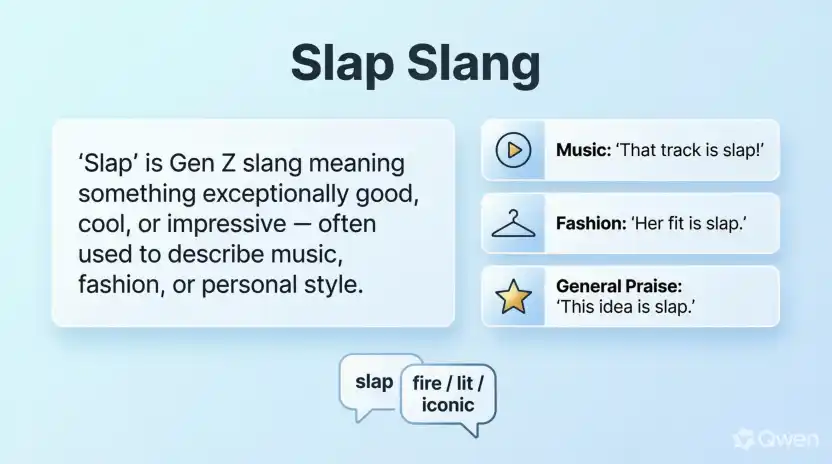
“Slap” in slang usually means something is very good, enjoyable, or impressive, especially music, food, or entertainment.
The word can be confusing because “slap” also has a normal dictionary meaning: to hit someone with an open hand.
Online, in texting, and in casual speech, however, “slap” can have a completely different meaning. Someone might say, “This song slaps,” and they are usually giving the song a strong compliment, not talking about hitting anyone.
People search for “slap slang” to understand this newer casual meaning, especially when they see it in TikTok comments, social media posts, music reviews, gaming chats, or text messages.
The meaning can also change slightly based on context. It may describe a song with a strong beat, great food, an exciting experience, or something that works extremely well.
Understanding the context helps you avoid taking the word too literally. This guide explains the meaning, origin, examples, common mistakes, and the best situations for using “slap” in slang.
Slap Slang – Quick Answer
In slang, “slap” means something is excellent, enjoyable, or highly satisfying. It is often used for music, food, videos, or experiences.
Examples:
- “This song slaps.” = This song is really good.
- “These fries slap.” = These fries taste great.
- “That beat slaps.” = That beat sounds powerful and enjoyable.
“Slaps” is especially common in casual online and spoken English.
Definition and Meaning of Slap Slang
Clear Definition
Slap is an informal slang word used to say that something is very good, enjoyable, exciting, or effective.
It is most strongly linked with music.
When someone says:
“This song slaps.”
They mean the song sounds great, has a strong beat, or gives them an enjoyable feeling.
Simple Meaning
The simplest meaning of “slap” in slang is:
Slap = very good, enjoyable, or impressive.
The exact meaning depends on what is being described.
Context and Usage
You may see “slap” used for:
- Songs
- Beats
- Food
- Videos
- Movies
- Games
- Parties
- Experiences
- Creative work
For example:
“Your playlist slaps.”
This means the speaker really likes the playlist.
Different Meanings of Slap
“Slap” has more than one meaning in English.
| Meaning | Example | Explanation |
| Physical action | “He slapped the table.” | To hit with an open hand |
| Slang compliment | “This song slaps.” | The song is very good |
| Casual praise | “These tacos slap.” | The food is excellent |
| Strong impact | “That bass slaps.” | The sound feels powerful |
Context is important. The slang meaning is usually clear when “slap” describes something enjoyable.
The Origin of Slap Slang
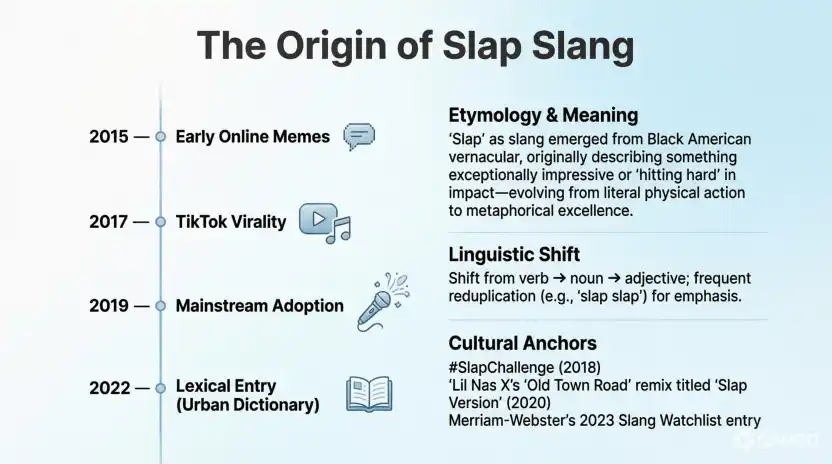
The word “slap” itself is much older than its slang meaning.
The traditional English word refers to hitting something or someone with an open hand. It has been used in English for centuries.
The slang use developed later through informal speech and music culture. It became especially connected with songs and beats that sound powerful, energetic, or enjoyable.
The exact point when “slap” became popular slang is not firmly documented. It is better to describe its rise as a gradual development in informal English rather than give one exact invention date.
Music and youth culture helped spread the expression. As online communication grew, phrases such as “this song slaps” became common in social media posts, comments, forums, and music discussions.
Why Does “Slap” Have This Meaning?
The slang sense can be understood as a figurative extension of the original idea of a strong impact.
A powerful beat can feel like it “hits” hard. Over time, “slap” became a way to praise music with strong energy, rhythm, or impact.
Today, the expression is not limited to music. People also use it more broadly for things they strongly enjoy.
British English vs American English Spelling
“Slap” does not have a major British-versus-American spelling difference.
Both British and American English normally spell the word as:
slap
The main difference is not spelling. It is often the surrounding vocabulary, tone, and frequency of slang use.
| Form | American English | British English | Meaning |
| slap | Yes | Yes | Hit with an open hand |
| slaps | Yes | Yes | Slang: is very good |
| slapped | Yes | Yes | Past form |
| slapping | Yes | Yes | -ing form |
| slap | Yes | Yes | Informal praise in suitable contexts |
For example:
American English:
“This song slaps.”
British English:
“This song slaps.”
The spelling stays the same.
Slap vs Slapped
These forms can have different uses.
“Slap”:
“This beat slaps.”
“Slapped”:
“That song really slapped.”
The second sentence describes something that was very good or enjoyable in the past.
Which Spelling Should You Use?
Use slap regardless of if you write American or British English.
There is no special British spelling such as “slappe” or another standard variation.
For American Readers
“Slap” and “slaps” are natural in casual speech and online communication.
For British and Commonwealth Readers
The word is also understandable, especially in online and music-related contexts. However, slang can vary between communities.
For Global English
Use “slap” when your audience is familiar with internet or youth slang.
For formal writing, it is often better to use clearer words such as:
- excellent
- impressive
- enjoyable
- powerful
- very good
The right choice depends on your audience and the level of formality.
Common Mistakes with Slap Slang
Mistake 1: Taking It Literally
“This song slaps” does not normally mean someone is physically hitting the song.
Correct meaning:
“This song is really good.”
Mistake 2: Using It in Every Situation
“Slap” is informal slang.
It may sound strange in a formal report, business letter, academic paper, or professional email.
Instead of:
“The new company strategy slaps.”
A formal version would be:
“The new company strategy is highly effective.”
Mistake 3: Confusing Slap With Slaps
When talking about one thing in the present:
“This song slaps.”
When giving an instruction or using the base form:
“Let the beat slap.”
Mistake 4: Assuming It Only Means Music
Music is the most common context, but people can use “slap” more broadly.
For example:
“These noodles slap.”
Here, “slap” means the noodles taste very good.
Mistake 5: Using It With the Wrong Audience
Some people may not know the slang meaning. If clarity matters, use a more direct word such as “great” or “excellent.”
Slap Slang in Everyday Examples
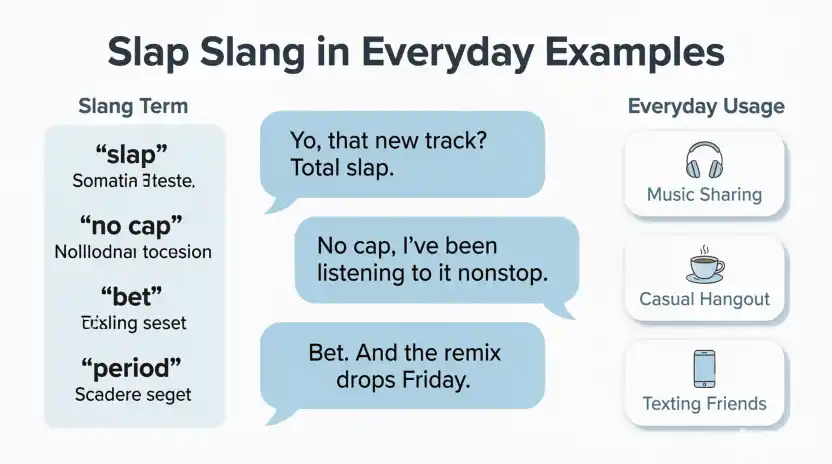
In Text Messages
“Have you heard this song? It slaps.”
Meaning: The speaker really likes the song.
On Social Media
“This new track slaps 🔥”
Meaning: The track is excellent or has a powerful sound.
In Music Discussions
“The bass on this song slaps.”
Meaning: The bass sounds strong and enjoyable.
About Food
“These burgers slap.”
Meaning: The burgers taste very good.
In Gaming
“That soundtrack slaps.”
Meaning: The soundtrack is really enjoyable.
In Emails
“Slap” is usually too informal for a professional email.
Instead of:
“Your presentation slaps.”
Use:
“Your presentation was excellent.”
In News Writing
News articles normally avoid slang unless they are discussing internet culture, music, or quoting someone’s casual language.
For example, a writer might explain that fans described a new song as “slapping.”
In Formal Writing
Avoid slang when writing:
- Academic essays
- Business reports
- Official documents
- School assignments
- Professional proposals
Use precise words instead.
Slap Slang – Google Trends & Usage Data
Search interest for slang words can change over time and by region. “Slap” is also a difficult keyword to measure because people search for the normal dictionary meaning as well as the slang meaning.
This means Google searches for “slap” do not represent slang interest alone.
Where Is Slap Slang Common?
The slang use is especially visible in:
- Online communities
- Social media
- Music discussions
- Text messages
- Youth-oriented conversations
- Video platforms
- Gaming communities
The expression is also understood beyond the United States because internet slang spreads quickly across English-speaking online communities.
Why Search Data Can Be Misleading
A search for “slap” might mean:
- The physical action
- The slang meaning
- A song title
- A brand or product
- A phrase containing “slap”
- A news story
For this reason, “slap slang” is a more specific search than simply “slap.”
Slap Variations Compared
| Variation | Meaning | Common Context |
| slap | Be very good | Music, food, casual talk |
| slaps | Is very good | Music, social media |
| slapped | Was very good | Past experiences |
| slapping | Being very good | Music or casual praise |
| this slaps | This is excellent | Online comments |
| song slaps | Song is great | Music |
| beat slaps | Beat sounds powerful | Music |
FAQs About Slap Slang
1. What does slap mean in slang?
In slang, “slap” usually means something is very good, enjoyable, impressive, or powerful.
2. What does “this song slaps” mean?
“This song slaps” means the speaker thinks the song is very good, often because it has a strong beat or enjoyable sound.
3. Is slap a bad word?
No. “Slap” is not normally a swear word. However, its slang use is informal and may not fit every situation.
4. Can you use slap for food?
Yes. People sometimes say food “slaps” when they think it tastes especially good.
5. Is slap slang only used for music?
No. Music is a major use, but people can also use it for food, videos, games, experiences, and other things they enjoy.
6. Is “slaps” the same as “slap”?
They are related, but grammar changes the form. “This song slaps” means the song is very good. “Slap” can also appear in other sentence structures.
7. Should I use slap in formal writing?
Usually, no. “Slap” is informal slang, so formal writing is usually clearer with words such as “excellent,” “effective,” or “impressive.”
Conclusion
“Slap” in slang usually means that something is very good, enjoyable, exciting, or impressive. The expression is especially common when people talk about music, beats, and songs, but it can also describe food, videos, games, and other enjoyable things.
The key point is context. “Slap” can have its normal meaning of hitting something with an open hand, but “this song slaps” is a casual compliment. The spelling is the same in British and American English, so there is no major spelling difference to remember.
For casual texts, social media, music conversations, and friendly chats, “slap” can sound natural. For schoolwork, business writing, professional emails, and formal documents, clearer words such as “excellent” or “impressive” are usually better.
Understanding this difference makes it easier to read modern online English without confusing slang with the traditional meaning of the word.
Read more about!
- Bitchin Slang: Meaning, Origin, Examples & How to Use It
- Honey Badger Meaning Slang: Definition, Origin & Examples
- Pittsburgh Slang Meaning : 30+ Pittsburgh Words & Expressions
Daniel Brooks is an English vocabulary educator who creates simple, practical guides on slang, word meanings, and everyday English. His goal is to help students, writers, and English learners expand their vocabulary and communicate with confidence.