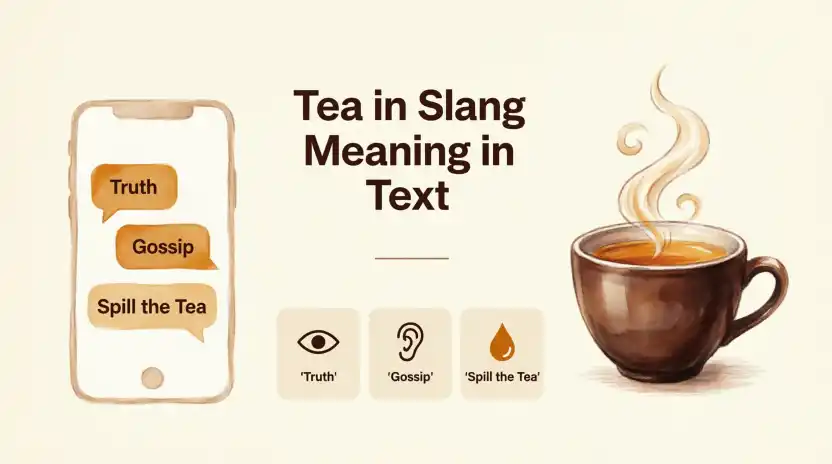
Tea in slang usually means gossip, inside information, or interesting details about a person or situation. If someone asks, “What’s the tea?” they are usually asking what happened or what the latest gossip is. The term is especially common in casual online communication and social media.
You may also see phrases such as “spill the tea,” “the tea is,” or “I have some tea.” These expressions can be playful, but they often involve information about other people, so context matters.
The slang meaning has a documented history connected to Black gay and drag culture, rather than simply being a modern TikTok invention. Early written evidence appears decades before today’s social-media use.
This guide explains the meaning of tea in slang, common phrases, examples, pronunciation, origin, tone, and when to use or avoid it.
Quick Answer: In slang, tea means gossip, private information, or the interesting truth about a situation. “Spill the tea” means to share the details, while “What’s the tea?” means “What happened?” or “What’s the latest information?”
What Does Tea Mean in Slang?
In slang, tea means gossip, inside information, or personal details that people are interested in hearing.
The word does not usually refer to the drink when it appears in expressions such as:
“What’s the tea?”
Here, the speaker is asking for the story or details behind a situation.
For example:
“You look like you know something. What’s the tea?”
This means:
“You seem to know what happened. Tell me the details.”
Tea Meaning in Text
In texting, tea can be used as a short way to talk about gossip or interesting information.
For example:
“I have some tea for you.”
This means:
“I have some interesting information to tell you.”
The word is informal, so it usually belongs in casual conversations rather than formal writing.
Tea Slang Full Meaning and Definition
The slang meaning of tea is generally gossip, private information, or interesting inside details.
Cambridge defines “spill the tea” as sharing gossip or information about something secret or private. It also notes that “T” can represent “truth.”
| Expression | Meaning |
| Tea | Gossip or inside information |
| The tea | The interesting details |
| What’s the tea? | What happened? |
| Spill the tea | Tell the gossip or details |
| I have tea | I have interesting information |
| No tea | No gossip or information to share |
The exact meaning can shift slightly with the conversation, but the basic idea is information that someone wants to hear.
Does Tea Stand for Something?
Tea is sometimes connected with the letter T, which can mean “truth.” Historical sources connect this usage with Black gay and drag communities.
It is therefore better not to treat “tea” as simply an abbreviation. Its modern slang use developed through cultural and linguistic usage.
How Do You Pronounce Tea in Slang?
Tea is pronounced exactly like the ordinary English word “tea.”
Pronunciation: /tiː/
The slang meaning does not change the pronunciation.
For example:
“What’s the tea?”
and
“I want a cup of tea.”
use the same pronunciation, but the meaning comes from context.
Tea vs. T
You may sometimes see T instead of tea.
For example:
“What’s the T?”
This can mean:
“What’s the truth?” or “What’s the gossip?”
The connection between T and tea is part of the history of the slang expression.
Common Phrases Using Tea
Tea appears in several popular expressions.
“What’s the Tea?”
“What’s the tea?” means “What happened?”, especially when the speaker wants gossip or interesting details.
Example:
“You two were talking earlier. What’s the tea?”
The speaker wants to know what was discussed.
“Spill the Tea”
“Spill the tea” means share the gossip, secret, or interesting information. Cambridge lists this as an informal expression for telling gossip or private information.
Example:
“Okay, spill the tea. What happened?”
“I Have Some Tea”
This means the speaker has some interesting information to share.
Example:
“I have some tea about yesterday’s meeting.”
The phrase does not necessarily mean the information is true. As with any gossip, the details may need to be checked.
“That’s the Tea”
“That’s the tea” can be used to signal that someone has stated the important truth or final version of a situation.
Example:
“She decided to leave because she wanted a new opportunity.”
“Yep, that’s the tea.”
Where Is Tea Used as Slang?
Tea is mainly used in informal conversations and online communication.
You may encounter it in:
- Text messages
- Social media posts
- Comments
- Group chats
- Memes
- Casual conversations
- Entertainment discussions
Its use is not limited to one website or app. The expression has moved from specific cultural communities into broader internet and popular culture.
Tea on TikTok
On TikTok, tea can appear when people discuss drama, celebrity news, friendships, or an unexpected situation.
Example:
“Wait, what’s the tea here?”
This asks someone to explain the situation.
Tea on Instagram
On Instagram, users may use tea in comments, captions, Stories, or DMs when talking about interesting personal or entertainment news.
Tea in Texting
In texting, “tea” is often very short and casual:
“Girl, I have tea.”
The recipient understands that the sender has something interesting to share.
Tea on Reddit and Other Communities
The word can also appear when people discuss controversies, stories, rumors, or personal situations online. However, the meaning remains context-dependent.
Is Tea Slang Rude or Offensive?
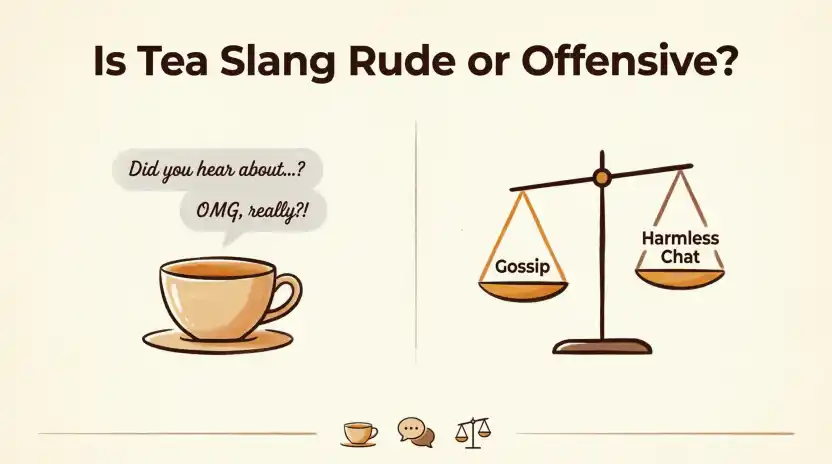
Tea is generally informal rather than offensive.
However, the subject of the gossip can make a conversation uncomfortable or harmful. Saying “spill the tea” about a harmless TV show is different from encouraging someone to spread someone’s private information.
When Tea Is Harmless
It can be playful when discussing:
- A TV show
- A celebrity interview
- A fictional character
- A funny social situation
Example:
“What’s the tea about the new episode?”
When Tea Can Cause Problems
Be more careful when the information concerns someone’s:
- Private life
- Personal problems
- Family
- School situation
- Workplace issues
The word itself is not usually the problem. What people share as “tea” is what matters.
Real Examples of Tea in Slang
Here are natural examples showing different contexts.
Friendly Example
“I have some tea for you!”
Meaning: “I have some interesting news to tell you.”
Casual Texting Example
“What’s the tea? 👀”
Meaning: “What happened? Tell me the interesting details.”
Social Media Example
“Okay, spill the tea!”
Meaning: “Tell us what happened.”
Entertainment Example
“The tea about that show is everywhere.”
Meaning: “There is a lot of gossip or discussion about that show.”
Playful Example
“I’m just here for the tea.”
Meaning: “I’m interested in hearing the interesting details, but I may not want to get involved.”
Cautious Example
“That’s interesting, but we should check if the tea is actually true.”
This highlights an important point: tea can be gossip, and gossip is not automatically factual.
Tea vs. Gossip vs. Rumor
These words are related, but they are not exactly the same.
| Term | Meaning |
| Tea | Interesting or private information, often gossip |
| Gossip | Talk about other people’s private lives |
| Rumor | Information that may be untrue or unconfirmed |
| News | Information about something that happened |
| Scoop | Interesting information discovered or revealed before others |
“Tea” often sounds more playful and conversational than “gossip.”
Why Context Matters
If someone says:
“I have tea about the movie.”
They could mean interesting behind-the-scenes information.
If someone says:
“I have tea about my classmate.”
They may mean personal gossip.
So the topic around the word helps determine its tone.
Where Did Tea Slang Come From?
The slang meaning of tea has a documented connection to Black gay culture and drag communities, with evidence reaching back at least to the late 20th century. A 1991 ethnographic work about gay Black men in Harlem recorded “tea” meaning gossip, while other historical evidence traces related usage to earlier decades.
One important historical idea is the use of T to mean truth. The term could refer to someone’s personal truth or information about another person.
The exact path from T to the spelling tea is not completely settled. Some explanations connect the word with social gatherings where people shared information over tea, but the historical record is more complicated than a single origin story.
How Tea Became Mainstream
The expression later became much more visible outside its original communities through drag culture, television, memes, and internet culture. Sources point to shows such as RuPaul’s Drag Race as part of the wider spread of drag vocabulary into mainstream audiences.
The popular Kermit “sipping tea” meme also helped connect the idea of casually watching drama with the word tea online.
So, tea slang did not originate with TikTok, even though social media has helped keep the expression widely visible.
Similar Slang to Tea
Several expressions have a similar meaning.
Spill the Tea
This is the most direct related phrase. It means to reveal gossip or interesting details.
Spill the T
This older form connects more directly with T = truth and has historical ties to the same slang tradition.
The Scoop
“The scoop” means interesting or newly discovered information.
The Dirt
“The dirt” can mean embarrassing or secret information about someone.
Drama
“Drama” usually refers to conflict, tension, or a complicated social situation. Tea can be information about that drama.
Opposite Expressions to Tea
There is no exact opposite of tea, but several expressions communicate the idea of not sharing or not wanting gossip.
Examples include:
- “I don’t know anything.”
- “Keep it private.”
- “It’s none of my business.”
- “Let’s not get involved.”
- “I don’t want to spread rumors.”
A person can also say:
“No comment.”
That usually means they do not want to provide information.
When Should You Avoid Using Tea?
Tea is casual slang, so it is not suitable for every situation.
At School
Using “tea” with friends may be fine, but formal school assignments should use standard language.
Instead of:
“The tea is that the event was canceled.”
write:
“The information is that the event was canceled.”
At Work
Avoid slang when writing formal emails, reports, or professional documents unless you know the setting is very informal.
When Discussing Private Information
Think before sharing someone’s personal information just because someone asks for “the tea.”
A funny phrase does not make private information public or harmless.
When You Are Not Sure the Information Is True
Use words such as “rumor” or “unconfirmed information” when appropriate. Do not present gossip as fact.
Why Do People Say “Tea”?
People use tea because it makes a conversation about information sound casual, playful, and socially engaging.
Instead of saying:
“Please tell me the details of this situation.”
someone might simply say:
“What’s the tea?”
The shorter expression fits naturally into online conversations and can add humor to a message.
Tea and Social Connection
Sharing stories can help people connect. But the same behavior can also create problems if private or unverified information is spread without care.
That is why understanding the tone and context of tea is more useful than memorizing a single definition.
Is Tea Still Popular?
Popularity Status: As of 2026
Tea remains recognizable as informal slang for gossip or interesting information, especially in online and casual communication. Current usage varies by community, age group, and platform. Recent language coverage continues to describe the term as part of modern internet vocabulary.
It is also important to remember that slang changes over time. Not every person uses tea in the same way, and some people may use it more often than others.
Common Misunderstandings About Tea
Tea Does Not Always Mean Gossip
The ordinary word “tea” still means the drink. The slang meaning only applies when the surrounding context indicates it.
“Spill the Tea” Does Not Mean Literally Spilling a Drink
In slang, it means revealing information or gossip.
Tea Is Not the Same as a Verified Fact
Someone can call information “tea” even when it has not been confirmed. It is wise to separate gossip from reliable information.
Tea Did Not Start on TikTok
The slang has a much older documented history connected with Black gay and drag culture. Social media later helped spread it to wider audiences.
Frequently Asked Questions About Tea in Slang
1. What does tea mean in slang?
Tea usually means gossip, private information, or interesting details about a situation. For example, “What’s the tea?” means “What happened?” or “What are the details?” It is informal and is commonly used in casual conversations and online communication.
2. What does “spill the tea” mean?
“Spill the tea” means to share gossip, secrets, or interesting information. It is an informal expression. Someone might say “Spill the tea!” when they want another person to explain what happened in a situation.
3. What does “what’s the tea?” mean in text?
“What’s the tea?” means “What happened?” or “What is the interesting information?” in a casual text conversation. It often shows that the sender wants to hear the details of a situation.
4. Is tea slang offensive?
The word tea itself is generally not offensive when used as slang for gossip. However, the information being shared can be sensitive or private. It is better to avoid spreading unverified or personal information about other people.
5. Where did tea slang come from?
The slang meaning has documented roots in Black gay culture, with connections to drag and queer communities. Written evidence from the late 20th century records tea as gossip, while T was also used in connection with truth. The exact development of the spelling “tea” is not completely certain.
6. Does tea mean truth?
Sometimes the slang is connected with T meaning “truth.” In modern usage, however, tea usually refers more broadly to gossip, inside information, or interesting details rather than only literal truth.
7. Can I use tea in formal writing?
It is better to avoid tea as slang in formal writing unless you are intentionally discussing slang or quoting casual language. In professional or academic writing, words such as “information,” “gossip,” or “details” are clearer.
8. Does tea mean gossip on social media?
Yes, tea is commonly used online to refer to gossip or interesting information. The exact frequency varies by community and platform. Expressions such as “spill the tea” and “what’s the tea?” are widely recognizable forms.
Conclusion
Tea in slang means gossip, inside information, or interesting details about a person or situation. Common expressions include “What’s the tea?” for asking what happened and “spill the tea” for asking someone to share the details.
Although the word is now common in online conversations, its slang history is older than today’s social-media culture. Historical sources connect the term with Black gay and drag communities, including documented uses of “tea” and “T” for gossip or truth.
Tea is usually casual and playful, but context matters. Gossip can involve real people’s private lives, and not every piece of “tea” is verified. Use the expression freely in appropriate informal conversations, but choose clearer, more formal language for school, work, and professional communication.
Read more about!
- SU Meaning in Texting: Slang Definition & Examples
- Biker Slang: Common Motorcycle Terms & Meanings
- Peng Slang Meaning: What Does Peng Mean?

Daniel Brooks is an English vocabulary educator who creates simple, practical guides on slang, word meanings, and everyday English. His goal is to help students, writers, and English learners expand their vocabulary and communicate with confidence.