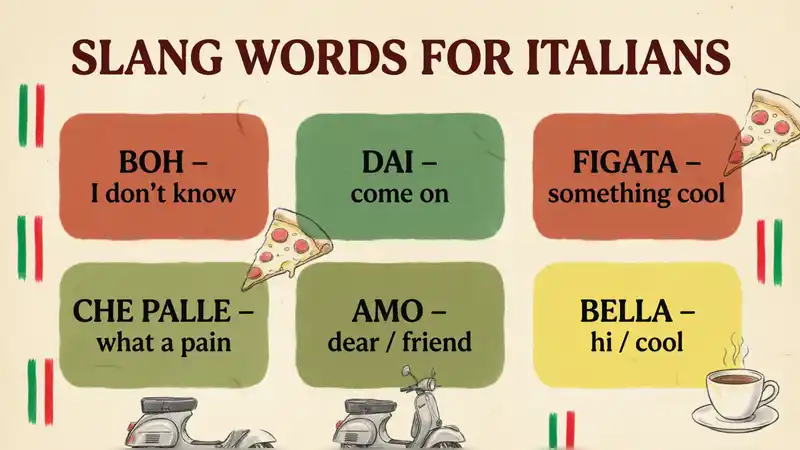
Slang words for Italians can be confusing because the phrase may refer to friendly Italian-American expressions, regional nicknames, cultural terms, or words that have become stereotypes or ethnic insults. The meaning often depends on who is speaking, where they are from, and how the word is used.
If you have seen an Italian-related word in a movie, TikTok comment, Reddit post, text message, or conversation, it may not have the same meaning in Italy as it does in the United States or Canada.
Italian-American communities, especially those influenced by Southern Italian dialects, have developed many informal expressions over generations. Some are affectionate, while others can be offensive.
This guide explains common slang words for Italians, their meanings, regional background, tone, and when they are appropriate.
Quick Answer
Slang words for Italians can include friendly or informal expressions such as paesano/paisan in Italian-American contexts, while terms such as Guido can carry a stereotypical or derogatory meaning depending on context. Historical ethnic slurs also exist, but they should not be used as casual nicknames.
What Do Slang Words for Italians Mean?
There is no single slang word that applies to every Italian person.
The expression may describe:
- An Italian person
- An Italian-American
- Someone from a particular Italian region
- A friend within an Italian-American community
- A stereotype associated with Italian-American culture
- A historical ethnic insult
This distinction matters because Italian and Italian-American are not always interchangeable. A word that developed in North American Italian-American communities may not be common or meaningful in Italy.
For example, paesano comes from Italian paesano, meaning someone from the same town or local area. In Italian-American speech, it can be used more broadly for someone who shares an Italian background or community connection.
By contrast, Guido has a very different history in North American slang. It has been used as a stereotype for a working-class urban Italian-American man and is often considered derogatory or an ethnic slur.
So, when someone searches for slang words for Italians, it is important to understand the difference between cultural slang, nicknames, and insults.
Common Slang and Informal Terms for Italians
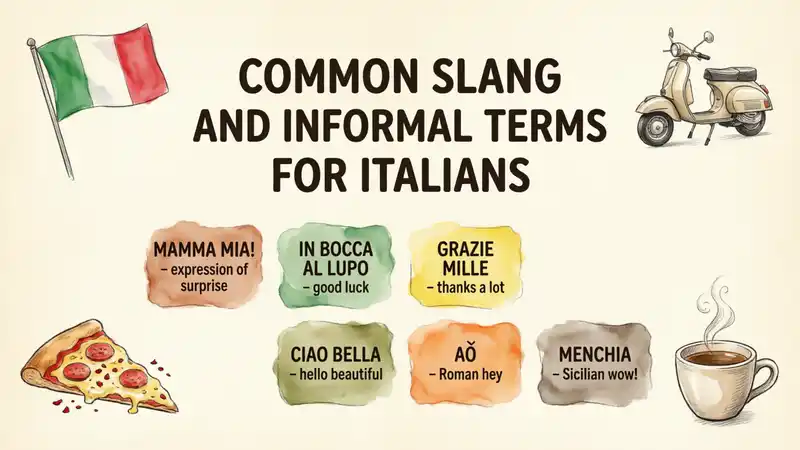
1. Paesano or Paisan
Paesano literally relates to someone from the same town or country area. In Italian-American communities, paisan became a familiar informal form and can refer to a fellow Italian or someone from the same community.
It can sound friendly when used between people who share the cultural background.
Example:
“Hey, paisan, how have you been?”
Here, the word can have a warm, familiar tone.
The spelling paisan is especially associated with English-language Italian-American usage, while paesano is the standard Italian form.
2. Guido
Guido is one of the most recognizable Italian-American slang terms, but it needs a warning.
It is not simply a casual word for “Italian.” In North American usage, it has been associated with a particular stereotype of a working-class urban Italian-American man, often involving exaggerated ideas about appearance, behavior, or masculinity. Because of this history, it is widely considered derogatory in many contexts.
Some people have used or reclaimed the term for themselves, but that does not make it universally acceptable.
Best advice: Avoid calling another person a “Guido” unless you know the person and context well.
3. Cugino
Cugino means “cousin” in Italian.
In some Italian-American communities, an English-style pronunciation of the word has also been used informally as a familiar way to refer to another Italian-American person. The exact use varies between families and communities.
Because the standard Italian meaning is simply “cousin,” context is essential.
4. Gino
Gino is an Italian male given name, but it has also appeared in some North American slang and stereotype-based usage.
In certain regions, especially places with large Italian-Canadian or Italian-American populations, it has sometimes been used as a stereotypical label for an Italian or Italian-Canadian man.
That does not mean every person named Gino is being described by the slang sense.
A person’s name and a slang stereotype are two completely different things.
5. Italian-American Dialect Terms
Some expressions that people call “Italian slang” are actually words inherited from Neapolitan, Sicilian, Calabrian, or other Southern Italian dialects.
Examples include terms such as:
- Gabagool an Italian-American pronunciation of capocollo
- Agita a word associated with heartburn, stomach discomfort, or anxiety in Italian-American speech
- Stunad an informal term associated with someone foolish or dazed
- Mannaggia an exclamation used to express annoyance or frustration
These are better understood as examples of Italian-American dialect and cultural speech rather than universal slang words for Italian people. Italian-American communities preserved many Southern Italian dialect features through immigration and family traditions.
Are Slang Words for Italians Rude or Offensive?
Not all of them are.
The tone can range from affectionate to neutral, stereotypical, or offensive.
Friendly or Familiar
Words such as paisan can sound friendly when used between people who share a cultural connection.
Neutral
The simplest and safest terms are:
- Italian
- Italian person
- Italian-American
- Italian-Canadian
These do not rely on stereotypes.
Stereotypical
Some terms are connected to exaggerated ideas about Italian-American appearance, behavior, or lifestyle. Even if someone uses them jokingly, another person may find them disrespectful.
Offensive
Historical ethnic slurs targeting Italians exist in English. Some have a long history of discrimination against Italian immigrants and Italian Americans. Linguistic research specifically identifies several such expressions as derogatory ethnic slurs.
Because these terms can function as insults rather than useful slang, they are best discussed in historical or educational contexts rather than used to label people.
Italian vs. Italian-American Slang
One of the most important things to understand is that Italian slang and Italian-American slang are not the same thing.
| Term or Category | Where It May Appear | General Meaning |
| Italian | Worldwide | Person from Italy |
| Paesano | Italian / Italian-American contexts | Person from the same area or community |
| Paisan | Italian-American English | Familiar term for a fellow Italian or community member |
| Guido | North American slang | Stereotypical Italian-American male; often derogatory |
| Gino | Regional North American usage | Stereotypical label in some communities |
| Italian-American dialect | Mainly North American communities | Words influenced by Southern Italian dialects |
This difference is especially useful if you are learning Italian.
A word heard in an American movie may not be something an Italian person in Rome would normally say.
Where Are These Terms Commonly Used?
The answer depends on the particular expression.
Italian-American Communities
Many informal terms developed within Italian-American communities in the United States and Canada.
Italian immigration brought many Southern Italian dialects into North American neighborhoods, particularly during the late 19th and early 20th centuries. These dialects influenced the vocabulary spoken in families and communities.
Movies and Television
Italian-American slang has appeared frequently in American entertainment.
This can make certain words seem more common than they actually are in everyday life. A television character may deliberately use a stereotype or exaggerated expression for characterization.
Social Media
On TikTok, Instagram, Reddit, and other platforms, users may discuss Italian-American culture, food, accents, family life, or stereotypes.
However, social media also removes words from their original context. A term used affectionately within one community can look insulting when repeated by someone outside that community.
Texting and Online Chats
People may shorten words, spell them phonetically, or use English versions of Italian expressions.
The intended meaning often becomes clear from the rest of the message.
Real-Life Examples of Italian Slang
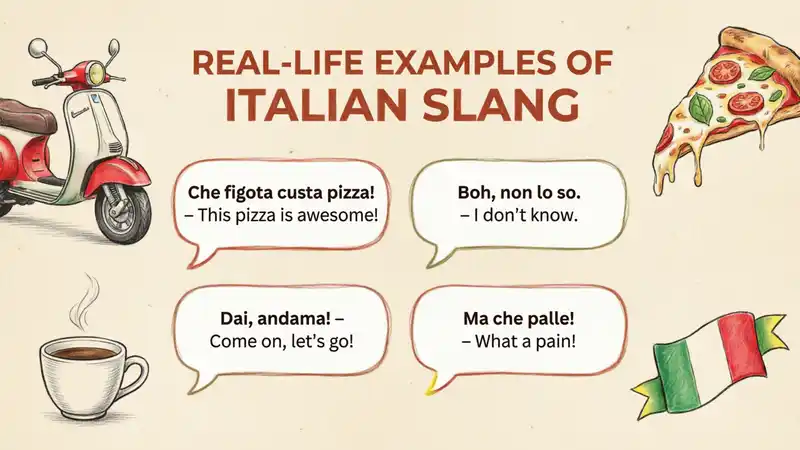
Friendly Example
“Hey, paisan! Long time no see.”
Here, paisan is being used as a familiar term between people with a shared cultural connection.
Family Example
“My grandmother still uses a lot of Italian-American expressions.”
This refers to family language influenced by Italian dialects.
Cultural Example
“I grew up hearing gabagool and agita at home.”
Here, the speaker is describing Italian-American vocabulary rather than calling someone an Italian slang name.
Social Media Example
“This video explains where Italian-American slang comes from.”
This is a neutral use of the phrase.
Stereotype Example
“The character is written as a stereotypical Italian-American guy.”
This is a description of a fictional stereotype, not a recommendation to label real people that way.
Why Do People Use Slang Words for Italians?
There are several reasons these expressions appear.
Cultural Identity
Some Italian-American expressions help people maintain a connection with their family history.
Words passed down through grandparents and parents can become part of family identity even when the family no longer speaks Italian fluently.
Community Connection
An informal term can create a sense of familiarity between people who share the same background.
Humor
Italian-American expressions are often used humorously in families, movies, television, and online content.
However, humor does not automatically make a term harmless. The relationship between the speakers still matters.
Stereotypes
Some slang developed around stereotypes of Italian-American communities. These expressions can become problematic when they reduce a diverse group of people to one exaggerated image.
Origin and Background of Italian-American Slang
A large part of Italian-American slang comes from the history of immigration.
Many Italian immigrants who arrived in North America between the late 19th and early 20th centuries came from Southern Italy. They brought regional speech varieties rather than only standardized Italian.
Over time, these dialects mixed with English.
That created distinctive Italian-American vocabulary and pronunciation. Words used at home, especially around food, family, emotions, and everyday life, were passed between generations.
This is why words such as gabagool are not simply random “bad Italian.” They can reflect historical pronunciation patterns from Southern Italian dialects.
Modern media later spread some of these expressions to audiences who had no Italian family background.
What Is the Difference Between Slang and an Ethnic Slur?
This distinction is important.
Slang is informal language used by a particular group or community.
An ethnic slur is a derogatory expression used to insult or demean people because of their ethnic background.
A term can also have different meanings depending on who uses it and why.
For example, Guido has sometimes been used as a self-description by people within Italian-American culture, but it is also widely documented as a derogatory stereotype and ethnic slur.
So, simply calling something “slang” does not automatically make it harmless.
How to Use Italian-Related Slang Respectfully
If you are learning about Italian slang, focus on context rather than memorizing a list of labels.
Before using an informal term, consider:
- Who are you speaking to?
- Is the person Italian or Italian-American?
- Is the term actually used in that region?
- Is it friendly, neutral, or derogatory?
- Are you using it to describe yourself or another person?
- Could it reinforce a stereotype?
If you do not know the answer, use Italian or Italian-American instead.
Clear language is usually better than risking an unintended insult.
When Should You Avoid These Terms?
Avoid slang labels for Italians in situations where respectful and precise language is expected.
Professional Communication
Use Italian, Italian-American, or another accurate description rather than a slang label.
Academic Writing
Formal writing should identify people accurately and avoid stereotype-based terminology unless you are specifically discussing the term as part of your research.
Talking to Strangers
You cannot know how someone feels about a particular cultural nickname.
Cross-Cultural Conversations
A word that sounds playful in one community may sound offensive somewhere else.
When You Are Unsure
If you are uncertain about a word, do not guess. Use a neutral term instead.
Polite Alternatives to Slang
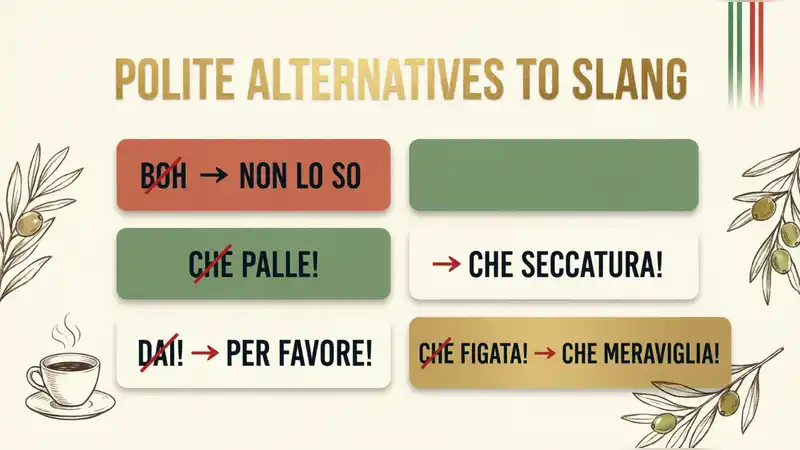
The safest alternatives are straightforward:
- Italian
- Italian person
- Italian-American
- Italian-Canadian
- Person of Italian heritage
- Italian immigrant, when historically accurate
- Italian community member, when appropriate
These descriptions are much clearer than using a stereotype or informal label.
Slang Words for Italians in Modern Internet Culture
Internet culture has changed how people encounter ethnic slang.
A term can spread through a meme or television clip and suddenly be recognized by millions of people who have never heard it in real life.
This creates an important problem: recognition does not equal acceptance.
A person might recognize a word from a popular show but still consider it offensive when someone uses it toward them.
Online comments also remove important clues such as facial expression, relationship, tone of voice, and local culture.
That is why ethnic slang can be especially easy to misunderstand online.
Comparison: Friendly Terms vs. Stereotypical Labels
| Type | Example | Tone | Best Use |
| Standard identity | Italian | Neutral | General communication |
| Cultural identity | Italian-American | Neutral | North American context |
| Familiar expression | Paisan | Friendly in some contexts | Community/familiar use |
| Dialect term | Gabagool | Cultural/informal | Discussing Italian-American speech |
| Stereotypical label | Guido | Often derogatory | Avoid labeling others |
| Historical slur | Certain older ethnic insults | Offensive | Historical discussion only |
The important lesson is that not every informal Italian-related word is interchangeable.
Is It Safe to Use These Terms on Social Media?
Using neutral terms such as Italian and Italian-American is generally the safest choice.
Cultural expressions may also be fine when they are used appropriately and accurately.
However, ethnic stereotypes and slurs can cause harm, start arguments, or violate community rules. Even when a word appears frequently online, that does not mean it is respectful.
If you are writing educational content, explain the historical or cultural meaning instead of using an offensive term as a casual label.
Common Misunderstandings About Italian Slang
Thinking All Italian Slang Comes From Italy
Some expressions commonly called “Italian slang” actually come from Italian-American communities and Southern Italian dialects.
Assuming Every Italian Person Uses the Same Words
Italy has many regional speech varieties. Vocabulary can differ significantly between regions.
Thinking a TV Expression Is Universal
Movies and television often exaggerate language for entertainment.
Assuming a Joke Is Always Harmless
A word can be used jokingly and still carry a history of stereotyping.
Treating Italian and Italian-American as the Same
The two identities overlap for some people, but they are not identical.
Frequently Asked Questions
1. What are slang words for Italians?
The phrase can refer to informal Italian-American expressions, cultural nicknames, or stereotypes. Paisan is one example of a familiar Italian-American term, while some other labels have derogatory meanings.
2. What is a friendly slang word for an Italian?
Paisan can be friendly in some Italian-American contexts, especially when used between people who share a cultural connection. However, regional and personal preferences matter.
3. Is Guido a slang word for Italian?
Guido is a North American slang term associated with a stereotypical Italian-American man. It can be self-used in some contexts, but it is also widely considered derogatory, so it should not be casually used for another person.
4. Are Italian slang words used in Italy?
Some are, but many expressions described as “Italian-American slang” developed in North America and are not standard expressions in Italy.
5. Is Italian-American slang the same as Italian slang?
No. Italian-American slang includes vocabulary influenced by Southern Italian dialects and English. It developed in a different cultural environment from modern slang used in Italy.
6. Should I use slang words for Italians?
Use caution. Friendly cultural expressions can be appropriate in the right setting, but stereotype-based labels and ethnic slurs should not be used to describe other people.
Key Takeaways
- Slang words for Italians do not have one universal meaning.
- Some expressions are friendly cultural terms.
- Paisan can be a familiar Italian-American expression.
- Guido has a controversial and often derogatory meaning in North American usage.
- Italian-American slang is strongly influenced by Southern Italian dialects and immigration history.
- Not every Italian-American expression is used in Italy.
- Context, region, relationship, and tone all matter.
- When in doubt, Italian or Italian-American is the safest wording.
Conclusion
Slang words for Italians can describe a wide range of language, from friendly Italian-American expressions to stereotype-based labels and historical ethnic insults. Understanding the difference is more important than simply memorizing a list of words.
Expressions such as paisan may carry a sense of community and familiarity, while terms such as Guido can have a much more complicated history and may be offensive depending on how they are used.
Italian-American slang also reflects immigration history. Many expressions came from Southern Italian dialects and changed as families and communities adapted to life in North America.
If you are using these expressions online, in conversation, or while learning about Italian culture, always consider the speaker, audience, region, and context. When there is any doubt, a clear term such as Italian or Italian-American is the most respectful choice.
Read more about!
- UK Slang Words Roadman: Meaning, Popular Terms & Examples
- Bitchin Slang: Meaning, Origin, Examples & How to Use It
- BTK Meaning Slang: Is It Common in Text Messages?
- Grape Slang Meaning: What Does Grape Mean in Slang?

Hi, I’m Ryan Mitchell. I write simple guides about slang, internet language, and everyday English to make modern expressions easy to understand. My goal is to help learners use real-life English with confidence.