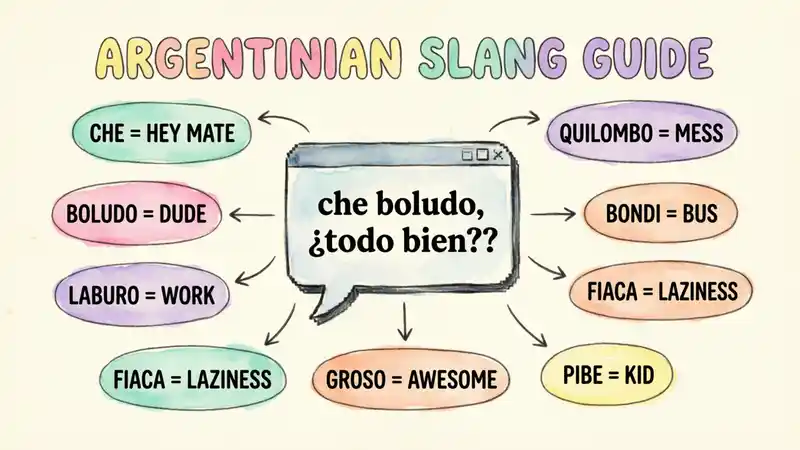
Argentinian slang refers to the informal words and expressions commonly used in Argentina, especially in everyday conversations. Some of these words are also recognized across other Spanish-speaking countries, while others are strongly connected to Argentine Spanish and local culture.
If you are learning Spanish or watching Argentine videos, movies, football content, or social media posts, you may notice words that do not sound like standard Spanish. Terms such as “che,” “boludo,” “laburo,” and “pibe” can have meanings that change depending on the situation and the speaker’s tone.
This guide explains Argentinian slang in simple English, including common meanings, examples, tone, regional use, and situations where certain expressions should be avoided.
Quick Answer: Argentinian slang is the informal vocabulary and expressions used in everyday Argentine Spanish. Many terms are friendly and casual, but some can be rude depending on context and tone.
What Does Argentinian Slang Mean?
Argentinian slang is a collection of informal words, phrases, and expressions used by people in Argentina. It is often heard in casual conversations between friends, family members, classmates, coworkers, and online communities.
Why Is Argentinian Slang Different?
Argentine Spanish has developed its own vocabulary and speaking style over time. Italian immigration, local culture, regional Spanish, and other influences have all helped shape the way many Argentinians speak.
The result is a form of Spanish that can sound quite different to someone who learned Spanish from a textbook.
Is Argentinian Slang the Same Everywhere?
No. Argentina is a large country, so slang can vary by region, age group, and social setting.
A word that is common in Buenos Aires may be less common elsewhere. Younger speakers may also use internet expressions that older speakers rarely use.
Common Argentinian Slang Words
The following words are among the expressions learners may encounter when hearing Argentine Spanish.
Che
“Che” is a very common informal expression used to get someone’s attention or address someone casually.
It can be similar to “hey” or “mate,” depending on the context.
Example:
“Che, ¿vamos?”
Meaning: “Hey, shall we go?”
Boludo
“Boludo” is one of the best-known Argentine slang words. Its meaning depends heavily on tone and relationship.
Among close friends, it can be used casually, almost like “dude” or “bro.” In an angry conversation, however, it can become insulting.
Example:
“Boludo, mirá esto.”
Meaning: “Dude, look at this.”
Because the word can also be offensive, learners should pay attention to how native speakers use it before using it themselves.
Pibe
“Pibe” usually means “boy,” “kid,” “young guy,” or “young person.”
The feminine form “piba” is also commonly used.
Example:
“Ese pibe juega muy bien.”
Meaning: “That guy plays very well.”
Laburo
“Laburo” means “work” or “job.”
It is a very common informal term in Argentina.
Example:
“Estoy en el laburo.”
Meaning: “I’m at work.”
Laburar
“Laburar” means “to work.”
It is the informal verb related to “laburo.”
Example:
“Mañana tengo que laburar.”
Meaning: “I have to work tomorrow.”
Plata
“Plata” literally means “silver,” but in everyday Spanish it can mean “money.” This usage is not exclusive to Argentina, although it is very common in Argentine speech.
Example:
“No tengo plata.”
Meaning: “I don’t have any money.”
Quilombo
“Quilombo” is a strong informal word that can mean a mess, complicated situation, chaos, or trouble.
Its meaning depends on context.
Example:
“Hay un quilombo en la oficina.”
Meaning: “There is a huge mess at the office.”
It is casual and may not be suitable for formal situations.
Copado
“Copado” can mean cool, great, nice, or enjoyable.
It is generally positive and informal.
Example:
“Tu idea está copada.”
Meaning: “Your idea is cool.”
Re
“Re” is often placed before an adjective or expression to add emphasis.
It can work somewhat like “really” or “very.”
Example:
“Está re bueno.”
Meaning: “It’s really good.”
Buena onda
“Buena onda” describes someone or something as friendly, pleasant, or positive.
Example:
“Ella es re buena onda.”
Meaning: “She’s really friendly.”
How Argentinian Slang Is Used in Conversation
Argentinian slang is mostly used in informal communication. You may hear it in conversations between friends or see it in online posts and messages.
In Everyday Conversation
Friends may use several slang expressions in the same conversation. This can make Argentine Spanish sound fast and expressive to learners.
For example:
“Che, pibe, ¿qué hacés?”
A natural English meaning could be: “Hey, dude, what are you doing?”
The exact translation changes depending on the relationship and tone.
In Text Messages
Argentine speakers may use slang in WhatsApp messages, social media comments, and other casual chats.
Short expressions are especially common because they make messages feel relaxed and personal.
In Social Media
Argentinian slang can appear on platforms such as TikTok, Instagram, Reddit, and other online communities where Argentine users communicate.
However, not every slang word seen online is uniquely Argentine. Some expressions spread across Spanish-speaking countries through social media.
Argentinian Slang and Tone
Tone is extremely important when understanding Argentine slang.
Friendly Tone
A word that looks rude in a dictionary may sound friendly between close friends.
For example, “boludo” can sometimes function like “dude” when used between people who know each other well.
Serious or Angry Tone
The same word can sound insulting when said during an argument.
This is why translating slang word-for-word can lead to mistakes. The relationship between speakers and the tone of the conversation matter.
Humorous Tone
Argentinians may also use slang jokingly. Facial expressions, voice, and the surrounding conversation can help show if an expression is serious or playful.
Is Argentinian Slang Rude or Offensive?
Some Argentinian slang is harmless, while other expressions can be vulgar or insulting.
There is no single rule that applies to every slang word.
Generally Friendly Expressions
Words such as “che,” “copado,” and “buena onda” are generally informal rather than offensive.
Context-Dependent Expressions
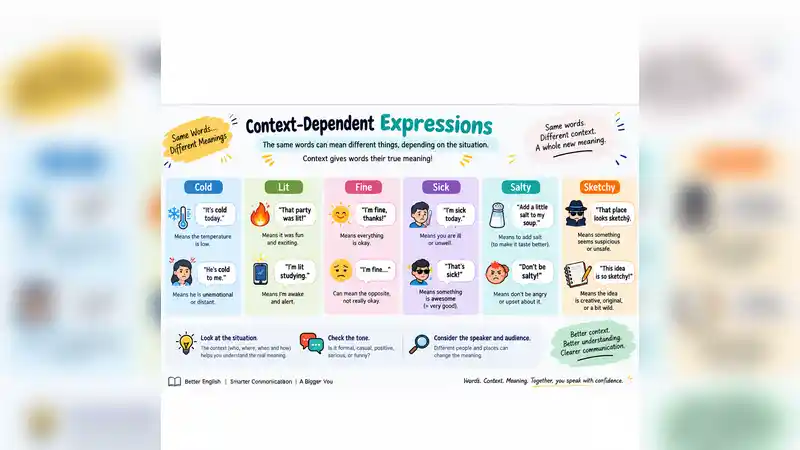
Words such as “boludo” can change meaning based on tone, relationship, and situation.
A learner should not assume that every use has the same meaning.
Strong or Vulgar Expressions
Some Argentine slang can be considered vulgar. These expressions are better understood before being repeated, especially around teachers, employers, strangers, or in formal settings.
Argentinian Slang Examples
Here are a few simple examples showing how slang can appear naturally.
Friendly Example
“Che, ¿querés venir con nosotros?”
Meaning: “Hey, do you want to come with us?”
Casual Example
“Estoy en el laburo ahora.”
Meaning: “I’m at work right now.”
Positive Example
“Tu casa está re copada.”
Meaning: “Your house is really cool.”
Informal Question
“¿Qué hacés, pibe?”
Meaning: “What are you doing, dude?”
Situation Example
“Hay un quilombo acá.”
Meaning: “There’s a big mess here.”
The best English translation depends on the situation rather than the individual word alone.
Why Do Argentinians Use Slang?
Slang makes informal communication feel natural and personal.
To Sound Casual
Slang helps speakers avoid sounding overly formal when talking with friends.
To Show Familiarity
Some expressions signal that two people are comfortable with each other.
To Express Emotion
Argentine slang can make speech sound more expressive, humorous, excited, or frustrated.
To Show Local Identity
Regional vocabulary can also connect speakers to Argentine culture and everyday life.
When Should You Avoid Argentinian Slang?
If you are still learning Argentine Spanish, it is usually better to understand a slang word before using it.
Avoid unfamiliar slang when speaking with:
- Teachers
- Employers
- Interviewers
- Officials
- New professional contacts
- People you do not know well
Formal Spanish is usually safer in professional and academic situations.
Argentinian Slang vs Standard Spanish
| Argentinian Informal Term | General Meaning | More Neutral Idea |
| Che | Hey / informal address | Excuse me / hey |
| Pibe | Boy / young guy | Chico |
| Laburo | Work / job | Trabajo |
| Laburar | To work | Trabajar |
| Copado | Cool / nice | Bueno / agradable |
| Quilombo | Mess / chaos | Problema / desorden |
| Re | Really / very | Muy / realmente |
These comparisons are approximate because slang does not always have a perfect one-word replacement.
Origin and History
Argentinian slang has a long history shaped by local Spanish and contact with other languages and communities. Buenos Aires, in particular, developed a distinctive urban vocabulary that became part of everyday Argentine speech.
Lunfardo and Argentine Spanish
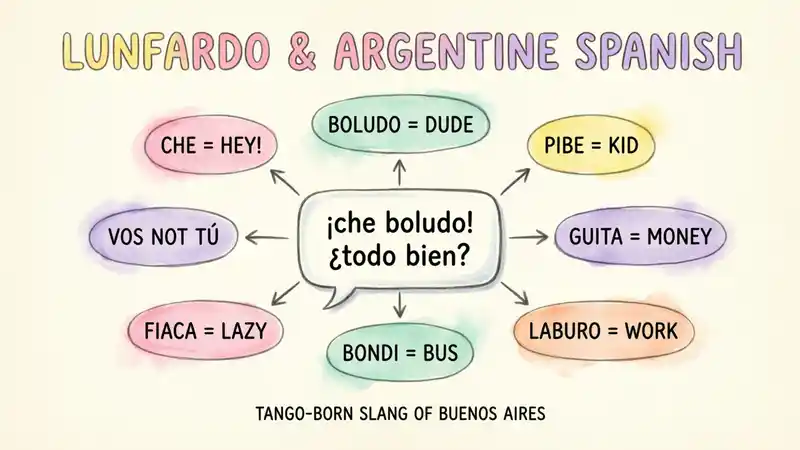
One important influence is Lunfardo, a vocabulary that developed in Buenos Aires and the surrounding Río de la Plata region. It grew in urban settings and was influenced by the many immigrant communities living in the area, especially during the late 19th and early 20th centuries.
Lunfardo is often linked with tango and popular culture, which helped spread many expressions beyond their original social settings.
Italian Influence
Italian immigration had a strong influence on the vocabulary and sound of Argentine Spanish. This is one reason some Argentine expressions may sound unusual to Spanish learners from other countries.
However, it would be inaccurate to say that all Argentinian slang comes from Italian. Argentine slang has several sources and has continued changing over time.
Modern Internet Influence
Today, Argentine slang also changes through social media, streaming, gaming, music, and online communities. Younger speakers may mix traditional Argentine expressions with newer internet slang.
Because of this, a slang word can sometimes feel more common among younger users than older generations.
Argentinian Slang on Social Media
Argentinian slang is widely visible online, but the exact vocabulary depends on the platform and community.
TikTok and Instagram
Short videos and comments often use casual expressions such as “re,” “che,” “pibe,” and other informal vocabulary.
Social media can also help Argentine expressions reach Spanish speakers in other countries.
Reddit and Online Forums
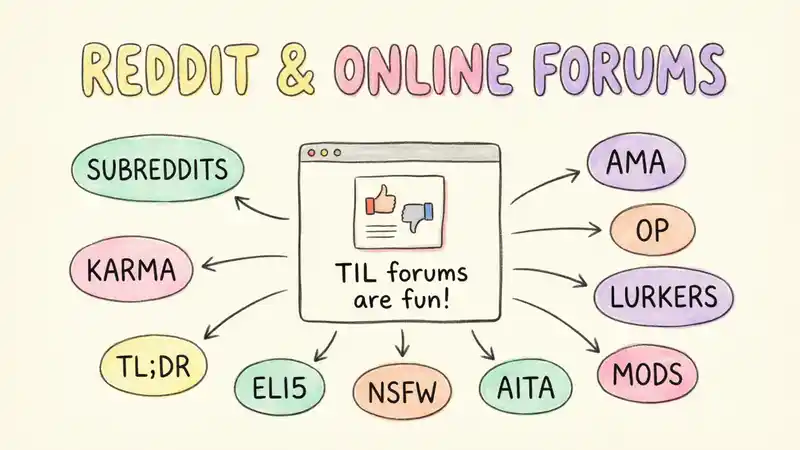
Argentine users may use local expressions when discussing football, entertainment, politics, games, or everyday life.
A reader from another Spanish-speaking country may need the surrounding context to understand the intended meaning.
Discord and Gaming
Gaming communities often combine Argentine slang with international gaming terms.
For example, an Argentine player might use local expressions while also using common gaming words such as “rank,” “team,” or “GG.”
Texting
In private messages, slang can make communication shorter and more relaxed. Friends may use words that would sound too informal in a school or professional message.
Common Misunderstandings About Argentinian Slang
Argentinian slang can be confusing because direct translation does not always explain the real meaning.
A Slang Word Is Not Always an Insult
Some words may look offensive when translated literally but can be friendly in the right context.
The word “boludo” is a good example. Its meaning can range from a friendly “dude” to an insult, depending on how it is used.
Not Every Argentine Expression Is Unique to Argentina
Some words commonly heard in Argentina are also used elsewhere in Latin America.
Therefore, calling every informal Spanish word “Argentinian slang” would be misleading.
Context Changes Meaning
The same expression can sound friendly, funny, annoyed, or insulting.
When learning slang, look at the entire sentence rather than translating one word by itself.
Argentinian Slang Compared With Other Spanish
Argentine Spanish has several features that make it easy to recognize.
Vocabulary Differences
Some everyday words differ from the Spanish commonly taught in textbooks.
For example, “laburo” is a familiar Argentine term for work, while “trabajo” is the more general word.
Pronunciation Differences
Argentine Spanish, especially in the Río de la Plata region, is also known for distinctive pronunciation patterns. The way certain letters and sounds are pronounced can make Argentine speech sound different from Spanish spoken in Mexico, Spain, or other Latin American countries.
Vos Instead of Tú
One major feature is voseo, where “vos” is commonly used instead of “tú” in informal speech.
For example:
“¿Vos querés venir?”
This means:
“Do you want to come?”
This is not simply slang. It is a recognized feature of Argentine Spanish and other varieties of Spanish.
When Should You Avoid Argentinian Slang?
The safest approach is to avoid slang when you do not understand its tone or social meaning.
At School
When speaking with teachers or writing academic work, standard and polite Spanish is usually a better choice.
At Work
Professional emails, interviews, and formal conversations generally call for neutral language.
With Strangers
Some expressions that are friendly among close friends may sound too familiar with someone you have just met.
In Formal Writing
Avoid casual slang in applications, official documents, business writing, and formal reports unless the context specifically calls for it.
Polite Alternatives to Informal Slang
You do not always need slang to communicate naturally.
| Informal Expression | Safer Alternative | Meaning |
| Che | Hola / disculpá | Hey / excuse me |
| Pibe | Chico / joven | Boy / young person |
| Laburo | Trabajo | Work |
| Laburar | Trabajar | To work |
| Copado | Bueno / agradable | Cool / nice |
| Quilombo | Problema / desorden | Problem / mess |
These alternatives are easier to use with people you do not know well.
Why Do People Use Argentinian Slang?
People use slang for several practical and social reasons.
It Makes Conversation Feel Natural
Informal vocabulary can make a conversation sound more relaxed.
It Shows Local Identity
Argentine expressions can reflect where a speaker comes from and connect people through shared culture.
It Builds Familiarity
Friends often use casual language to show that they are comfortable with each other.
It Adds Emotion
Slang can make a sentence sound more excited, humorous, annoyed, or friendly than neutral vocabulary would.
Is Argentinian Slang Safe to Use Online?
Most everyday Argentinian slang is not inherently unsafe. The main concern is social context rather than physical safety.
Some words are vulgar or insulting, so users should understand their meaning before posting them publicly.
Before Posting Slang Online
Consider:
- Who will read the message?
- Is the word friendly or insulting?
- Could the word have another meaning?
- Is the conversation formal?
- Could someone misunderstand your intention?
A word that works perfectly in a private joke between friends may not work well in a public comment.
Frequently Asked Questions
1. What is Argentinian slang?
Argentinian slang is informal vocabulary and expressions commonly used in Argentina. Some terms are local, while others are also used in other Spanish-speaking regions.
2. What is the most famous Argentinian slang word?
“Che” is one of the most recognizable Argentine expressions. It is commonly used to address someone or get their attention, similar to “hey.”
3. Is Argentinian slang the same as Spanish slang?
No. Spanish slang varies by country and region. Argentina has its own vocabulary, expressions, pronunciation patterns, and cultural influences.
4. Is “boludo” a bad word?
It can be. Among close friends, “boludo” may be used casually like “dude,” but it can also be insulting. Tone and context are very important.
5. What does “pibe” mean in Argentina?
“Pibe” is an informal word meaning a boy, kid, or young guy. “Piba” is commonly used for a girl or young woman.
6. Can I use Argentinian slang at work?
It is better to use neutral Spanish in formal workplace situations, especially with new colleagues, managers, customers, or professional contacts.
Conclusion
Argentinian slang gives Argentine Spanish much of its informal and expressive character. Words such as “che,” “pibe,” “laburo,” “copado,” and “re” can appear naturally in everyday conversations, messages, and online communities.
The most important lesson is that slang should always be understood through context. Some expressions are friendly and harmless, while others can become rude depending on the speaker, relationship, and tone.
If you are learning Argentine Spanish, start by recognizing common expressions before trying to use them. When you are unsure, choose neutral Spanish instead.
:::
Read more about!
- Bitchin Slang: Meaning, Origin, Examples & How to Use It
- BTK Meaning Slang: Is It Common in Text Messages?
- Grape Slang Meaning: What Does Grape Mean in Slang?
- Birdie Slang Meaning: Everything You Need to Know

Daniel Brooks is an English vocabulary educator and content editor with experience creating educational resources about English words, idioms, and everyday communication. He reviews language content for clarity, accuracy, and readability to ensure readers receive reliable and easy-to-understand information.