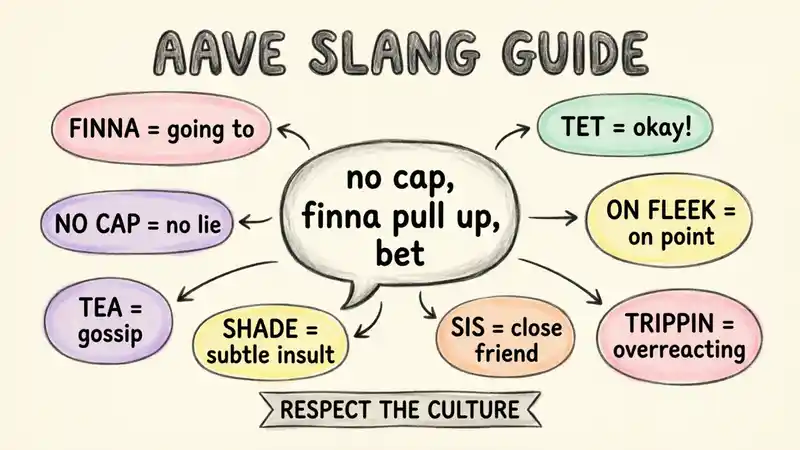
“Black people slang” usually refers to informal words, phrases, and expressions associated with Black communities, especially African American English , also called African American Vernacular English .
However, there is no single list of words that all Black people use. Language differs by region, age, family, community, and personal style.
People often search for black people slang because they hear an expression online, in music, in a conversation, or on social media and want to understand what it means. Some expressions have roots in African American communities and later become popular more widely.
This guide explains what the term means, how African American English differs from random “slang,” why context matters, and how to understand common expressions respectfully. A key point is that AAE is a genuine linguistic variety with its own patterns, not simply incorrect or broken English.
Quick Answer: What Does “Black People Slang” Mean?
“Black people slang” is an informal search term for slang and expressions associated with Black communities. In the United States, many such expressions are connected to African American English, but usage varies widely and not every Black person uses the same words.
What Does Black People Slang Mean?
The phrase “black people slang” is broad. It does not describe one language or one fixed vocabulary.
In the United States, people may use the phrase when talking about expressions associated with African American English. Linguists study AAE as a systematic variety of English with recognizable patterns in grammar, pronunciation, word formation, and vocabulary.
That distinction matters.
Calling every expression used by a Black person “Black slang” can create a misleading picture. A word may be popular among young people generally, may come from a particular city, or may have entered mainstream speech through music and online culture.
Slang Is Not the Same as African American English
Slang is informal vocabulary. A language variety is much broader.
African American English includes patterns of speech and grammar as well as vocabulary. Researchers have studied its structure, history, and use for decades.
So, if someone searches for “black people slang,” they may actually be looking for one of several things:
- African American English expressions
- Informal Black American vocabulary
- Expressions popularized through hip-hop
- Social-media language associated with Black creators
- Regional expressions
- Words that later became mainstream
These categories can overlap, but they are not identical.
Is There One “Black Slang” Dictionary?
No. There is no single vocabulary used by all Black people.
Black communities are diverse. Someone from Atlanta may use different expressions from someone in New York, Chicago, Los Angeles, or another part of the United States. Age and social setting can also change vocabulary.
An expression that is common among one group may sound unfamiliar to another.
This is why a good slang guide should explain the specific word or phrase rather than claiming that every Black person uses it.
African American English and Its History
English has a long and complex history in the United States.
African Americans came from many different African linguistic and cultural backgrounds. Over generations, English interacted with African languages, regional American English, and other language varieties. Scholars have studied these historical influences as part of the development of African American language.
African American speech traditions also developed through storytelling, music, religious traditions, poetry, political speech, and everyday conversation.
The Smithsonian notes the importance of African American oral traditions in preserving history, identity, community, and cultural expression.
This history is important because modern expressions did not simply appear on the internet. Many forms of African American language have much deeper cultural histories.
Why Does Black Slang Become Popular Online?
Some expressions associated with African American communities become widely recognized through music, entertainment, sports, television, and social media.
African American music has had a major influence on American culture, including blues, jazz, soul, funk, rap, and hip-hop.
The internet has increased this spread.
A phrase may begin in a particular community, appear in music or entertainment, and eventually become familiar to people who have never lived in that community.
However, widespread popularity does not erase the expression’s cultural background.
Examples of Expressions Associated With African American English
The following examples are included to explain language and context. They should not be treated as a universal list of “Black words.”
1. “Bet”
“Bet” can mean “okay,” “sure,” or “I agree.”
Example:
“Meet me at six.”
“Bet.”
The response is short and casual. It can be used by people from many backgrounds today, so it should not automatically be labeled exclusively Black slang.
2. “Ain’t”
“Ain’t” is an informal English form found in several varieties of English, including African American English.
Its use is not unique to Black speakers.
Example:
“I ain’t going there today.”
In formal writing, a different construction may be preferred, but informal speech follows different rules.
3. “Finna”
“Finna” is associated with African American English and is used to express an intention or something that is about to happen.
Example:
“I’m finna head home.”
The expression has a specific grammatical role in varieties of English where it is used. It should not simply be treated as a random misspelling of “going to.”
4. “Salty”
“Salty” can describe someone who is annoyed, upset, or unhappy about something.
Example:
“He’s still salty about losing the game.”
The word has spread well beyond African American communities and is now widely recognized in informal English.
5. “Woke”
“Woke” developed from African American usage referring to awareness, especially awareness of social and racial injustice. It later became much more widely used and developed additional political meanings.
Because its meaning has changed across contexts, the surrounding sentence matters.
Why Context Matters
A major mistake in slang discussions is assuming that one word always has one fixed meaning.
The same expression can have different meanings depending on:
- The speaker
- The audience
- Region
- Age group
- Conversation topic
- Tone
- Online community
- Historical period
For example, a word that sounds playful between close friends may sound disrespectful when copied by someone outside that community.
Meaning is not only about vocabulary. Social context matters too.
Is Black Slang Offensive?
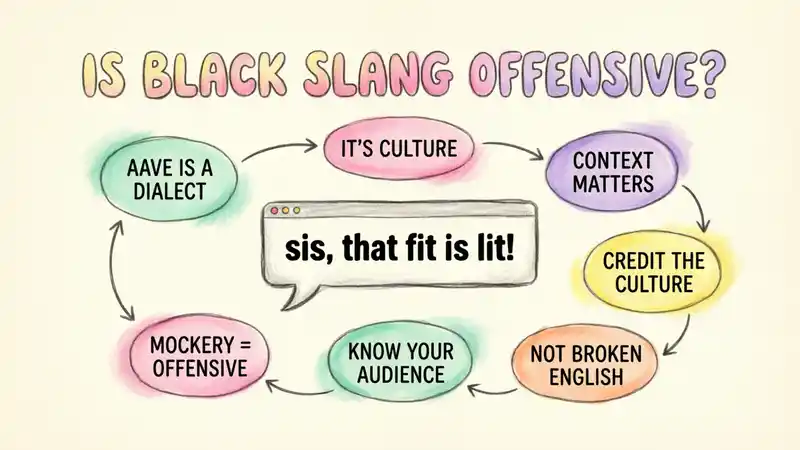
Black slang itself is not automatically offensive.
The important issue is how a particular word is used.
Many expressions associated with African American English are ordinary informal language. Others may be sensitive, culturally specific, or inappropriate in certain settings.
A separate concern is mocking someone’s speech.
Using an expression to communicate naturally is different from exaggerating pronunciation or copying a stereotyped version of Black speech for entertainment.
Historically, Black language and culture have also been mocked and stereotyped in American popular culture. The Smithsonian’s discussion of blackface explains how language, movement, appearance, and behavior were turned into racial caricatures.
That history helps explain why imitation can sometimes feel very different from genuine language use.
Who Uses African American English?
African American English is used by many Black Americans, but not everyone uses it in the same way.
Some speakers use AAE frequently in everyday conversation. Others use a mixture of AAE and other varieties of American English.
Speakers may also change their language depending on the setting.
For example, someone may speak differently with close friends than they do during a formal presentation.
This process is commonly called code-switching. Smithsonian educational material describes how speakers may adjust their language depending on the social situation.
Black Slang on Social Media
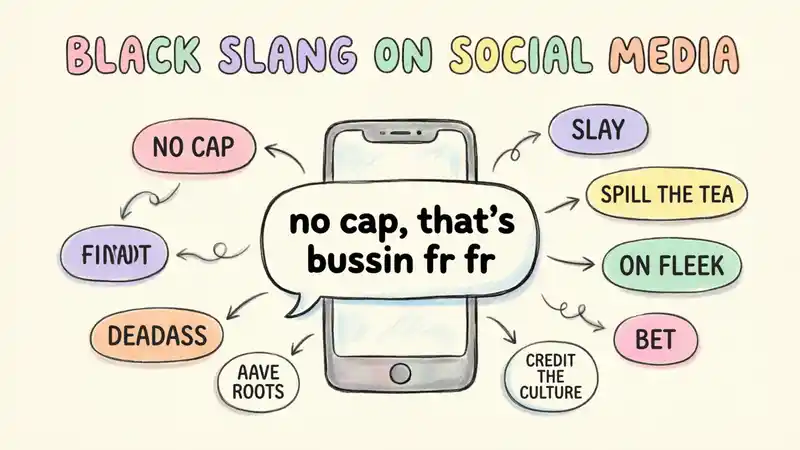
Social media has made expressions from many communities easier to encounter.
You may see African American English expressions in:
- Short-form videos
- Online conversations
- Music discussions
- Memes
- Comments
- Text messages
- Gaming communities
- Entertainment content
But seeing a word online does not tell you its full cultural history.
A phrase may have been used in Black communities for years before becoming popular online. Another expression may have developed recently and spread across many groups.
That is why it is better to research the individual expression rather than assume that every popular internet phrase is “Black slang.”
Real-Life Context Examples
Friendly Conversation
“Bet, I’ll see you later.”
Here, “bet” communicates agreement in a relaxed way.
Casual Texting
“I’m finna grab something to eat.”
The speaker is informally expressing an intention.
Social Media
“He’s still salty about that loss.”
Here, “salty” means annoyed or upset.
Formal Setting
In a school assignment or professional report, standard formal wording may be more suitable than informal slang.
This does not make informal language “bad.” It simply means different settings have different expectations.
Can Non-Black People Use Black Slang?
There is no single rule covering every expression.
Some expressions associated with African American English have become common parts of wider American English. Others remain strongly connected to particular communities or cultural contexts.
The safest approach is to understand the expression first.
Ask:
- What does the word actually mean?
- Where did it come from?
- Is it widely used today?
- Is it connected to a particular community?
- Could my use sound like imitation or mockery?
- Is there a more natural word I already use?
Learning about another variety of English is not the same as copying someone else’s identity or speech style.
Workplace and School Appropriateness
Informal slang is usually less suitable for formal writing and professional communication.
This applies to slang from any community.
For schoolwork, business emails, formal reports, and professional presentations, choose language that fits the situation.
That does not mean African American English is inferior to formal English. Linguists describe as a rule-governed language variety. The issue is simply choosing the appropriate variety for the audience and purpose.
Common Misunderstandings
“All Black people use the same slang.”
False.
Black communities are diverse, and language varies by location, age, background, and personal experience.
“Black slang is just incorrect English.”
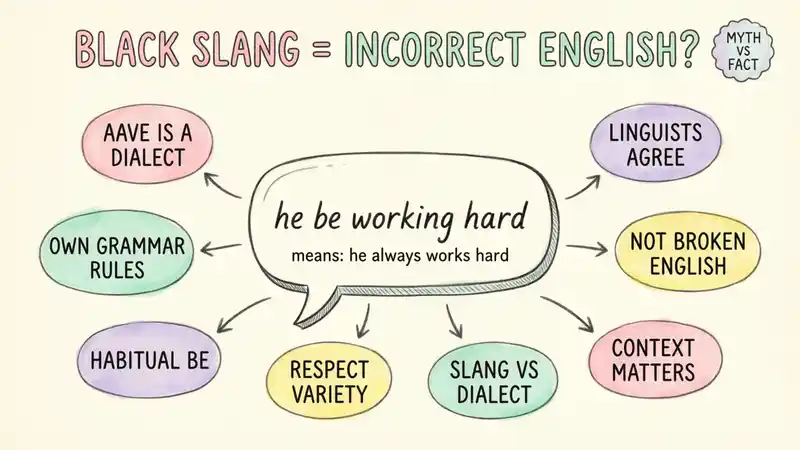
This is inaccurate.
African American English has systematic patterns in grammar, pronunciation, and vocabulary. Linguistic research treats it as a legitimate variety of English.
“Every slang word used online comes from AAE.”
No.
Internet language comes from many communities, regions, languages, and subcultures.
“If a word becomes mainstream, its history no longer matters.”
Not necessarily.
A word can become widely used while still having a cultural history worth understanding.
When Should You Avoid Using Black Slang?
Avoid using an expression when:
- You do not know what it means.
- You are copying it only because it sounds funny.
- You are exaggerating a racial stereotype.
- You are using it to imitate someone’s accent.
- You are unsure if the expression is offensive.
- You are writing something formal.
- You are using a culturally specific term without understanding its context.
Learning is encouraged. Mockery is different from learning.
Why Do People Use Slang?
People use slang for many reasons.
It can help speakers:
- Show personality
- Build connection
- Express emotion
- Sound relaxed
- Show belonging to a group
- Create humor
- Communicate quickly
- Reflect cultural identity
African American language traditions have also played an important role in storytelling, music, poetry, and cultural expression.
Frequently Asked Questions
1. What is black people slang?
It is a broad informal phrase for slang or expressions associated with Black communities. In the United States, the term often refers to expressions connected with African American English.
2. Is Black slang the same as AAVE?
No. AAE or AAVE is a broader language variety. Slang is only one part of vocabulary and does not describe the entire language system.
3. Do all Black people use the same slang?
No. Usage varies by region, age, community, background, and individual preference.
4. Is African American English real English?
Yes. Linguists study African American English as a systematic, rule-governed variety of English with its own grammatical, phonological, and lexical patterns.
5. Can slang associated with Black communities become mainstream?
Yes. Expressions can spread through music, entertainment, sports, and social media and become familiar to speakers from many backgrounds.
6. Is it okay to use Black slang?
It depends on the individual expression and context. Understanding its meaning and cultural background is important, and using language to mock or stereotype a group should be avoided.
Conclusion
“Black people slang” is a broad search term, not the name of one fixed language. In the United States, many people use it when searching for expressions connected with African American English, but Black communities do not all speak or use slang in the same way.
African American English has a rich history and is recognized by linguistic research as a systematic variety of English. Its vocabulary and expressions have influenced American music, entertainment, and everyday speech.
The best way to understand an expression is to look at its meaning, history, community, and context. Avoid turning a diverse language tradition into a stereotype.
Read more about!
- Bitchin Slang: Meaning, Origin, Examples & How to Use It
- BTK Meaning Slang: Is It Common in Text Messages?
- Grape Slang Meaning: What Does Grape Mean in Slang?
- Birdie Slang Meaning: Everything You Need to Know
Hi, I’m Olivia Harper. I create clear and easy-to-understand English language content, including word meanings, slang explanations, idioms, synonyms, and everyday vocabulary. My goal is to help students, writers, professionals, and English learners improve their communication skills with simple explanations, practical examples, and reliable language guides.