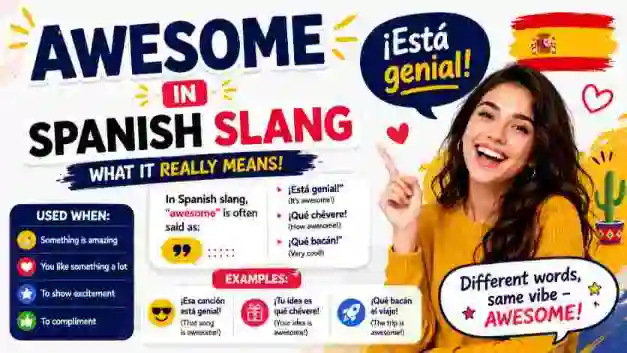
Awesome in Spanish slang does not have one single translation. Different Spanish-speaking countries use different slang words to say “awesome,” “cool,” or “amazing
.” For example, people in Mexico often say chido, while people in Colombia may say chévere, and in Chile or Peru, bacán is very common.
If you’re learning Spanish or chatting with native speakers online, knowing these slang words can help you sound more natural. In this guide,
you’ll learn the meaning of the most popular Spanish slang words for “awesome,” where they’re used, when to avoid them, and real-life examples.
1. Quick Answer
What does awesome in Spanish slang mean?
There isn’t one universal Spanish slang word for “awesome.” Instead, each country has its own favorite expression. Words like chido, chévere, bacán, padre, genial, and brutal all can mean “awesome,” depending on the country and the situation.
Quick Comparison Table
| Spanish Slang | English Meaning | Common Country | Tone |
| Chido | Awesome, Cool | Mexico | Casual |
| Chévere | Awesome, Great | Colombia, Venezuela | Friendly |
| Bacán | Awesome, Excellent | Chile, Peru | Casual |
| Padre | Really Cool | Mexico | Informal |
| Genial | Great, Awesome | Spain | Neutral |
| Brutal | Amazing | Spain | Very Informal |
2. What Does Awesome in Spanish Slang Mean?
Basic Meaning
In Spanish slang, “awesome” describes something exciting, impressive, fun, or very good. The exact word changes depending on where the speaker is from.
For example:
- “That movie was awesome.”
- “Your new shoes look awesome.”
- “The concert was awesome.”
Each country may use a different slang word to express the same feeling.
Why Are There So Many Different Words?
Spanish is spoken in more than 20 countries. Because of this, every region has developed its own everyday slang over many years.
Someone from Mexico may never say bacán, while someone from Chile might rarely use chido.
Is There One Word Everyone Understands?
Words like genial and increíble are understood almost everywhere because they are closer to standard Spanish.
However, regional slang often sounds more natural when talking with local people.
3. Most Popular Spanish Slang Words for Awesome
Chido (Mexico)
“Chido” is one of Mexico’s most popular slang words for “awesome.”
Examples:
- “¡Qué chido!”
- “Tu carro está bien chido.”
- “Ese restaurante está chido.”
Meaning:
- Awesome
- Cool
- Really nice
Chévere (Colombia, Venezuela, Caribbean)
“Chévere” is a friendly way to say something is excellent or cool.
Examples:
- “La fiesta estuvo chévere.”
- “Qué idea tan chévere.”
- “Tu video quedó chévere.”
Meaning:
- Great
- Awesome
- Nice
Bacán (Chile and Peru)
“Bacán” is used when something is impressive or enjoyable.
Examples:
- “Tu computadora está bacán.”
- “La película estuvo bacán.”
- “Fue un viaje bacán.”
Meaning:
- Awesome
- Excellent
- Fantastic
Padre (Mexico)
Although padre normally means “father,” Mexican slang also uses it to mean “really cool.”
Examples:
- “Está padre.”
- “Qué padre estuvo el concierto.”
- “La comida estuvo padre.”
Meaning:
- Awesome
- Cool
- Great
Genial (Spain and Many Countries)
“Genial” is one of the safest words to use because nearly every Spanish speaker understands it.
Examples:
- “¡Genial!”
- “Tu idea es genial.”
- “El partido estuvo genial.”
Meaning:
- Great
- Awesome
- Wonderful
Brutal (Spain)
In Spain, “brutal” often means something is unbelievably good.
Examples:
- “Ese gol fue brutal.”
- “La canción está brutal.”
- “Tu dibujo quedó brutal.”
Meaning:
- Incredible
- Awesome
- Amazing
Buenísimo
“Buenísimo” literally means “very good,” but many speakers use it the same way English speakers say “awesome.”
Examples:
- “Está buenísimo.”
- “El pastel está buenísimo.”
- “Ese videojuego está buenísimo.”
Meaning:
- Really good
- Awesome
- Excellent
4. Where Is It Commonly Used?
Mexico
The most common slang words include:
- Chido
- Padre
These words appear in everyday conversations, memes, YouTube videos, and casual texting.
Colombia

People commonly use:
- Chévere
- Bacano (a variation of bacán)
They are common among friends, classmates, and families.
Chile
Many Chileans say:
- Bacán
It is one of the country’s best-known slang expressions.
Spain
People often use:
- Genial
- Brutal
Both are common in daily conversations and social media.
On Social Media
You’ll frequently see these words on:
- TikTok comments
- Instagram captions
- YouTube videos
- Facebook posts
- WhatsApp chats
- X (formerly Twitter)
They help users express excitement in a short, natural way.
5. Is Awesome in Spanish Slang Rude or Harmless?
Is it offensive?
No. Most Spanish slang words for “awesome” are friendly compliments. They are used to show excitement, admiration, or approval.
Examples:
- “¡Qué chido!”
- “Está bacán.”
- “La comida está buenísima.”
These are positive expressions.
Is it safe to use?
Yes, in most casual conversations.
However, remember that regional slang changes from country to country. A word that sounds natural in Mexico may sound unusual in Spain.
Can you use it at work?
It depends on the word.
| Situation | Recommended? | Better Choice |
| Talking with friends | ✅ Yes | Chido, Chévere, Bacán |
| Social media | ✅ Yes | Any regional slang |
| School friends | ✅ Yes | Chido, Genial |
| Workplace meeting | ⚠️ Sometimes | Genial, Excelente |
| Business email | ❌ No | Excelente, Muy bueno |
6. Real-Life Examples
Friends
Carlos: “¿Viste la película?”
Luis: “Sí. Estuvo chida.”
Family
“Tu pastel quedó buenísimo.”
(Your cake turned out awesome.)
School
“Esa presentación estuvo genial.”
(That presentation was awesome.)
“¡Qué fotos tan chéveres!”
(Those photos are awesome!)
TikTok
“Ese baile está brutal.”
(That dance is awesome.)

A: “Ya terminé el proyecto.”
B: “¡Qué bacán!”
Gaming
“Tu jugada estuvo brutal.”
(That play was awesome.)
7. Origin and History
Why are there so many words?
Spanish developed differently across Latin America and Spain. Each region created its own local expressions over time.
Because of this, there is no single slang word for “awesome.”
Regional development
- Chido became popular in Mexico.
- Chévere spread across Venezuela and Colombia.
- Bacán became common in Chile and Peru.
- Brutal gained popularity in Spain with younger speakers.
Are these words still popular?
Yes.
Most remain common today, especially on:
- TikTok
- YouTube
- Everyday conversations
Some words like padre are more associated with Mexican Spanish and may sound less common outside Mexico.
8. Similar Spanish Slang Words
Other words that mean awesome
| Word | Meaning | Country |
| Chido | Awesome | Mexico |
| Chévere | Great | Colombia, Venezuela |
| Bacán | Excellent | Chile, Peru |
| Padre | Cool | Mexico |
| Genial | Great | Spain & International |
| Brutal | Incredible | Spain |
| Buenísimo | Very Good | Many Countries |
| Increíble | Amazing | Everywhere |
| Excelente | Excellent | Everywhere |
| Fenomenal | Fantastic | Everywhere |
Which word should beginners learn first?
If you’re just starting Spanish, these are the easiest:
- Genial
- Excelente
- Increíble
If you’re visiting specific countries:
- Mexico Chido
- Colombia Chévere
- Chile Bacán
- Spain Brutal
9. When Should You Avoid Using These Words?
Formal business meetings
Avoid regional slang during professional presentations.
Instead, use:
- Excelente
- Muy bien
- Impresionante
Academic writing
Don’t use slang in essays or official reports.
Choose formal vocabulary instead.
Speaking with people from another country
Some regional slang may confuse listeners.
If you’re unsure, use genial because almost everyone understands it.
Why Do People Use Spanish Slang for Awesome?
To sound natural
Native speakers often prefer slang in casual conversations.
To express excitement
These words quickly show happiness or admiration.
To fit local culture
Using local slang can make conversations feel warmer and more natural.
To react quickly online
Short words like chido or chévere work well in comments and text messages.
Common Mistakes
Using every slang word everywhere
Not every Spanish-speaking country uses the same expressions.
Assuming slang is formal
Words like chido and bacán are informal.
Use formal words in professional situations.
Translating directly
English “awesome” doesn’t always translate into the same Spanish slang word.
Choose the word that fits the country and situation.
Forgetting regional differences
Learning where each slang word is used helps you avoid misunderstandings.
Frequently Asked Questions
1. What is the most common way to say awesome in Spanish slang?
There is no single answer because Spanish slang changes by country. Chido is common in Mexico, chévere in Colombia and Venezuela, bacán in Chile and Peru, and genial is understood almost everywhere.
2. What does “chido” mean?
Chido is Mexican slang that means awesome, cool, or really good.
Example:
- “¡Qué chido está tu carro!”
- (Your car is awesome!)
3. What does “chévere” mean?
Chévere means great, awesome, or cool. It is widely used in Colombia, Venezuela, and several Caribbean countries.
4. Is “bacán” a compliment?
Yes. Calling something bacán means you think it is excellent, impressive, or awesome.
5. Which Spanish slang word is understood in most countries?
Genial is one of the safest choices because it is understood across most Spanish-speaking countries.
6. Is “awesome” translated the same way in every Spanish-speaking country?
No. Different countries have their own slang words. That’s why it’s helpful to learn the local expression before traveling or chatting with native speakers.
7. Can I use these slang words at work?
Some words, such as genial, are acceptable in casual workplaces. However, in formal business settings, words like excelente or muy bueno are usually better.
8. Are these words popular on social media?
Yes. You’ll often see chido, chévere, bacán, genial, and brutal in comments on TikTok, Instagram, YouTube, WhatsApp, and X.
9. Which word should beginners learn first?
If you’re new to Spanish, start with:
- Genial
- Excelente
- Increíble
These are widely understood and easy to use.
10. Is “brutal” always negative?
No. In Spain, brutal often means amazing or incredibly good, even though the literal English translation sounds negative.
13. Conclusion
Spanish has many slang words that mean awesome, but the best choice depends on the country and the situation. Chido, chévere, bacán, padre, genial, and brutal all express excitement and admiration, but each belongs to different regional varieties of Spanish.
If you’re speaking with friends, watching Spanish-language videos, or traveling, using the local slang can make your conversations sound more natural. If you’re unsure which word to use, genial is the safest option because it is understood almost everywhere.
Learning these expressions will help you understand native speakers better and make your Spanish sound more authentic.
Find out more!

Hi, I’m Nathan Collins. I create easy-to-understand English language content focused on internet slang, texting abbreviations, modern expressions, vocabulary, and word meanings. My goal is to help students, writers, professionals, and English learners communicate with confidence through clear explanations, practical examples, and reliable language guides.