You may see “HY” in a text, Snapchat message, TikTok comment, or group chat and wonder what those two letters mean. In slang text, “HY” most commonly means “hell yeah.” It is a short, informal way to say yes with extra excitement or strong agreement.
For example, if someone texts, “Are you coming with us?” and the reply is “HY,” the person is saying something like “Absolutely!” or “Yes, definitely!”
The abbreviation is mainly used in casual online conversations. It can sound excited, confident, or playful. Since “hell” is part of the full phrase, HY is not usually the best choice for formal school or workplace writing.
This guide explains what HY means, how it is used, where you may see it, what tone it gives, and how it differs from similar text abbreviations.
Quick Answer
| Question | Answer |
| Meaning | Usually “Hell yeah” |
| Tone | Excited, casual, strongly positive |
| Used by | People in informal texting and online chats |
| Common platforms | Text messages, Snapchat, TikTok, Discord, social media |
| Offensive? | Mildly vulgar in its full form, but usually not meant offensively |
| Formal? | No; avoid it in formal writing |
The important part is the strength of the response. “HY” is usually stronger than a simple “yes.” It can show that someone is very interested, excited, or fully agrees with what was said.
What Does HY Mean in Slang Text?
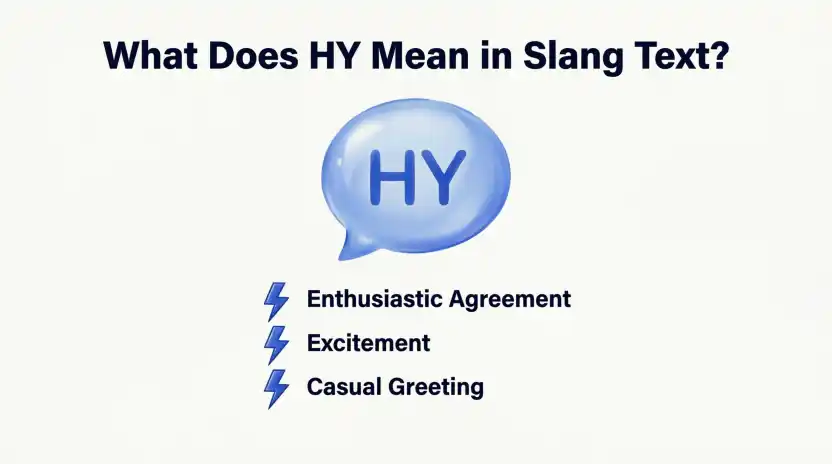
The most common meaning of HY in slang text is “hell yeah.”
People use it to express:
- Strong agreement
- Excitement
- Approval
- Enthusiasm
- A confident “yes”
Simple example
“Do you want pizza tonight?”
“HY!”
Here, “HY” means “Hell yeah!” The person is not simply saying yes. They are showing enthusiasm about the idea.
Another example:
“You coming to the game?”
“HY, I’ll be there.”
In this case, HY gives the message an upbeat and confident tone.
What Does HY Stand For?
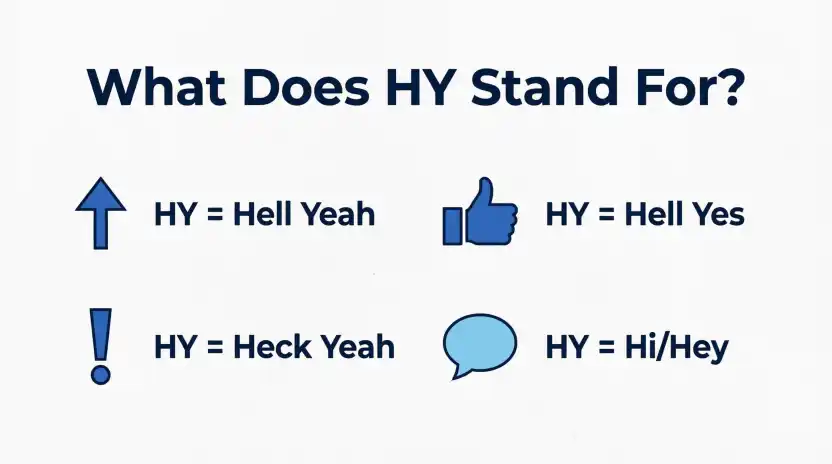
In casual slang, HY stands for “hell yeah.”
“Yeah” is an informal form of “yes,” while “hell” adds emphasis. Together, “hell yeah” is a strong way to agree.
The abbreviation removes the words and keeps only the first letters:
H = Hell
Y = Yeah
So:
HY → Hell Yeah
This is why the abbreviation usually appears in short, casual messages rather than formal communication.
HY Tone and Meaning by Context
The meaning of HY is fairly simple, but the tone can change slightly depending on the conversation.
| Context | Likely meaning | Tone |
| “Want to come?” — “HY!” | Definitely yes | Excited |
| “That was a great movie.” — “HY!” | Strong agreement | Positive |
| “You ready?” — “HY” | Yes, definitely | Confident |
| “Should we order food?” — “HY 😂” | Definitely | Playful |
| “You agree with me?” — “HY” | Strong agreement | Supportive |
Punctuation and emojis can make the tone even clearer. “HY!!!” looks more excited than “HY.” Likewise, “HY 😂” may sound playful or joking.
Is HY Positive or Negative?
HY is usually positive.
It normally communicates agreement, approval, or excitement. It is not commonly used as an insult or negative reaction.
For example:
“We got tickets!”
“HY!!!”
The response shows excitement about getting the tickets.
Still, context matters. Someone could use almost any short phrase sarcastically. If the surrounding conversation is clearly mocking or joking, HY may not be completely literal.
Is HY Rude or Offensive?
HY is not normally intended to be offensive, but its full form, “hell yeah,” contains mild profanity.
That makes HY more suitable for casual conversations than formal settings.
Usually okay
- Texting friends
- Casual group chats
- Gaming chats
- Social media comments
- Informal conversations
Better to avoid
- Formal school assignments
- Professional emails
- Job applications
- Formal reports
- Messages to someone who expects very polite language
If you want a cleaner alternative, use “Absolutely,” “Definitely,” “Yes!” or “For sure.”
Where Is HY Used?
HY can appear in several forms of casual online communication. Its basic meaning generally stays the same.
| Platform | How HY may be used | Example |
| Text messages | Quick agreement | “Movie tonight?” — “HY!” |
| Snapchat | Short reaction | “That photo is funny.” — “HY 😂” |
| TikTok | Comment agreement | “This is the best trend.” — “HY!” |
| Discord | Fast group-chat response | “Anyone playing?” — “HY” |
| Casual comment or DM | “You should post this.” — “HY” | |
| Gaming chat | Strong agreement | “Ready for another round?” — “HY” |
The abbreviation is especially useful when a person wants to give a fast, energetic response without typing the full phrase.
HY in Text Messages
In ordinary texting, HY often works as a quick yes with emphasis.
For example:
“Are you free after school?”
“HY, what’s up?”
The person is saying they are definitely free.
Another example:
“Want to grab some food?”
“HY 😭”
The emoji can add a joking or exaggerated feeling.
HY on Social Media
On social media, HY can appear as a reaction to a post or comment that someone strongly agrees with.
For example:
“We need more songs like this.”
“HY.”
Here, the commenter is strongly agreeing with the statement.
You may also see variations such as:
- HY!
- HY!!!
- HY 😂
- HY fr
- Hell yeah
These versions are not separate slang terms. They mainly change the tone or add emphasis.
HY vs Similar Text Abbreviations
People sometimes confuse HY with other short ways to agree.
| Slang | Meaning | Main difference |
| HY | Hell yeah | Strong, excited agreement |
| YEAH | Yes | Casual agreement |
| YEP | Yes | Simple and relaxed |
| YUP | Yes | Casual confirmation |
| FR | For real | Agreement or emphasis |
| BET | Okay / definitely | Agreement or acceptance |
| ABS | Absolutely | Strong agreement, less slangy |
| OFC | Of course | Strong or expected agreement |
HY vs YUP
“Yup” usually means a simple yes.
“HY” is more energetic and emphatic.
Yup: “Yes.”
HY: “Absolutely! Yes!”
HY vs FR
“FR” means “for real.” It can show agreement, but it is not exactly the same as HY.
“That game was amazing.”
“FR.”
This means “For real” or “I agree.”
“Want to play again?”
“HY!”
This means “Hell yeah!” or “Definitely!”
Real-Life Examples of HY
Here are some natural ways HY can appear in casual conversations.
Text Message
Mason: “Want to get ice cream later?”
Noah: “HY 😂”
Meaning: Noah is saying, “Hell yeah!” and showing enthusiasm.
Discord Chat
Priya: “Anyone want to join the game?”
Jordan: “HY, give me a minute.”
Meaning: Jordan definitely wants to join.
TikTok Comment
Comment: “This song never gets old.”
Reply: “HY!”
Meaning: The person strongly agrees.
Snapchat
Ava: “That was the funniest thing ever.”
Leah: “HY 😭”
Meaning: Leah strongly agrees and uses the emoji to make the reaction more playful.
Casual School Conversation
Ethan: “Are you going to the game Friday?”
Lucas: “HY.”
Meaning: Lucas is saying yes in a very casual way.
Common Mistakes When Using HY
Mistake 1: Assuming HY Always Means One Thing
“Hell yeah” is the common slang meaning, but abbreviations can have different meanings in other contexts.
Look at the surrounding message before deciding what HY means.
Mistake 2: Using HY in Formal Writing
HY is casual slang. It does not belong in most formal essays, reports, applications, or professional emails.
Use “yes,” “certainly,” “absolutely,” or “definitely” instead.
Mistake 3: Thinking HY Means “How Are You?”
Some people may guess that HY means “how are you?” because of the letters.
That is not the usual slang-text meaning of HY. In casual slang, “hell yeah” is the common interpretation when HY is being used as an enthusiastic reply.
Mistake 4: Missing the Tone
HY is usually stronger than a plain “yes.”
If someone replies “HY!!!,” they are likely showing excitement rather than simply confirming something.
Is HY Still Used?
HY can still be understood as casual internet and texting slang, but it is not necessarily used by everyone.
Usage can vary by:
- Age
- Friend group
- Online community
- Region
- Personal texting style
Some people prefer writing “hell yeah,” “yeah,” “absolutely,” or “for sure.” Others use short abbreviations because they make conversations faster.
So, seeing HY does not automatically mean the person belongs to a particular age group or online community.
What Emoji Goes With HY?
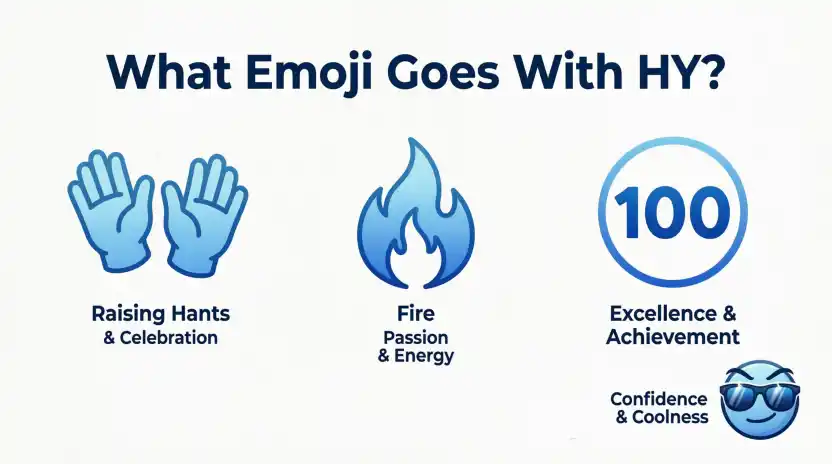
There is no official emoji for HY, but people may pair it with emojis that show excitement or strong agreement.
Common choices include:
- 🔥 — excitement
- 😂 — joking or playful reaction
- 😭 — exaggerated excitement
- 🙌 — celebration or agreement
- 💯 — strong agreement
For example:
“HY 🔥”
This can make the response feel more energetic.
The emoji does not change the basic meaning of HY. It mainly adds emotion.
When Should You Use HY?
HY works best when the conversation is relaxed and informal.
Use it when:
- You strongly agree with a friend.
- You want to say yes with excitement.
- You are replying quickly in a group chat.
- You are reacting casually to a social media post.
- The people involved are comfortable with slang.
For a cleaner tone, use “Absolutely,” “Definitely,” “For sure,” or “Yes!”
When Should You Avoid HY?
Avoid HY when the situation calls for professional or formal language.
For example, instead of:
“HY, I can attend the meeting.”
A professional message would be:
“Yes, I can attend the meeting.”
The issue is not that HY is automatically offensive. It is simply too casual for many formal situations.
Key Takeaways
- HY usually means “hell yeah” in slang text.
- It expresses strong agreement, approval, or excitement.
- It is mainly used in casual texts, chats, and social media.
- HY is usually positive, but the full phrase contains mild profanity.
- Use “yes,” “definitely,” or “absolutely” when you need a more formal tone.
FAQs About HY in Slang Text
1. What does HY mean in texting?
HY most commonly means “hell yeah” in casual texting. It is a short way to show strong agreement, excitement, or approval. For example, if someone asks, “Want to go?” and the reply is “HY!”, the person is saying “Hell yeah!” or “Definitely!”
2. Is HY a bad word?
HY itself is an abbreviation, but its common full form, “hell yeah,” contains the word “hell.” It is generally considered casual rather than seriously offensive. Still, it may not be suitable for formal school, workplace, or professional communication.
3. Does HY mean “how are you”?
Usually, no. In slang texting, HY is commonly understood as “hell yeah” when it is used as a response. “How are you?” is normally written as “HAY,” “HRU,” or simply “How are you?” depending on the person and context.
4. What does HY mean from a girl or guy?
HY does not have a special meaning based on if the sender is a girl or a guy. If someone replies with HY, it generally means they strongly agree, approve, or are excited. The relationship and surrounding conversation can help explain the exact tone.
5. What does HY mean on Snapchat?
On Snapchat, HY can mean “hell yeah.” Someone might use it as a quick response to a friend, such as “Want to hang out?” — “HY!” The platform does not automatically give HY a different meaning.
6. Is HY positive or negative?
HY is normally positive. It shows agreement, approval, or enthusiasm. For example, “HY!” can mean “Absolutely!” or “Definitely!” Context can affect the tone, especially if someone is clearly being sarcastic or joking.
7. What is the difference between HY and FR?
HY usually means “hell yeah,” while FR means “for real.” HY is often a strong yes or enthusiastic agreement. FR is more often used to agree with or emphasize a statement, such as “That movie was great.” — “FR.”
8. Can I use HY in a formal message?
It is better to avoid HY in formal messages. Although most people will understand it in casual settings, it can sound too informal. In a professional or school message, use words such as “yes,” “certainly,” “absolutely,” or “definitely.”
Conclusion
If you see HY in slang text, the most common meaning is “hell yeah.” It is a short, casual way to express strong agreement, excitement, or approval.
The best way to understand it is to look at the message around it. “HY!” after an invitation usually means “Absolutely!” while “HY 😂” may add a playful tone. The abbreviation is common in informal conversations, including texts, group chats, gaming chats, and social media.
HY is generally positive, but it is not formal because its full form contains mild profanity. If you are writing to a teacher, employer, customer, or another person in a formal setting, choose “definitely,” “absolutely,” or “yes” instead.
Read more about!
- 19th Century Slang: Popular Words & Phrases From the 1800s
- What Does IONK Mean in Text? Meaning, Uses & Examples
- What Does Ion Mean in Text? Slang Meaning, Examples & Usage

Hi, I’m Ryan Mitchell. I write simple guides about slang, internet language, and everyday English to make modern expressions easy to understand. My goal is to help learners use real-life English with confidence.