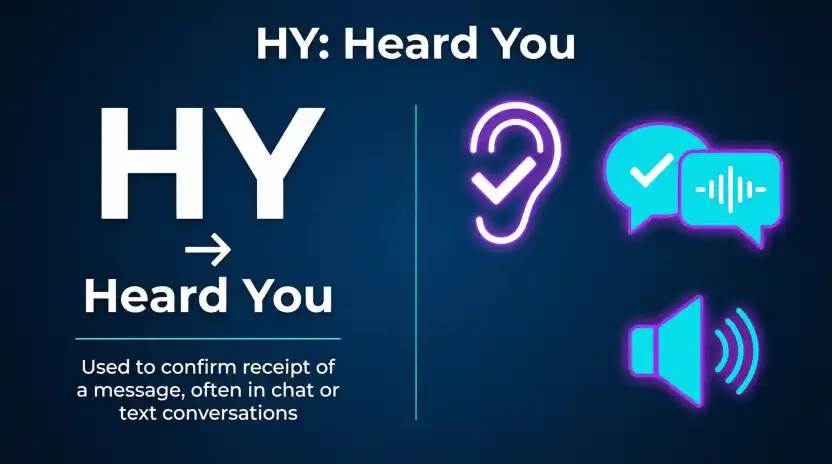
You may receive a message that simply says “HY” and wonder what the two letters mean. In casual texting, HY has more than one possible meaning, so the message around it matters.
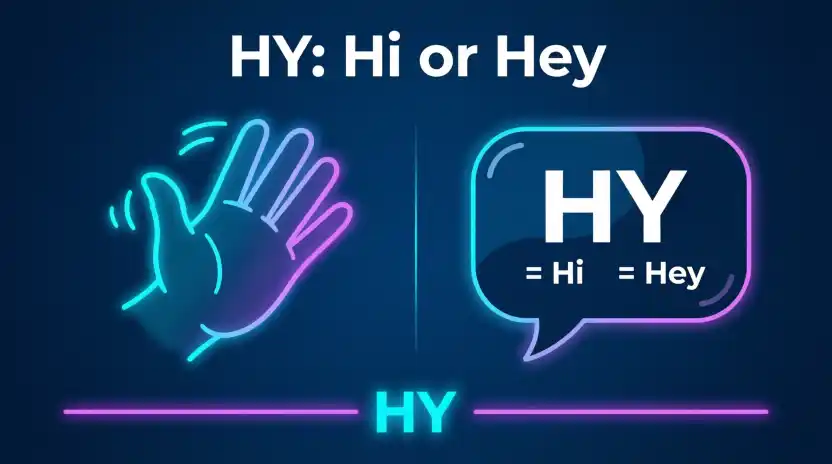
When HY starts a conversation, it can work as a short form of “Hey” or “Hi.” For example, “HY, what are you doing?” is simply a quick greeting. When HY appears as a response to a question or exciting news, it can mean “Hell Yes” or “Hell Yeah,” showing strong agreement or excitement.
That difference is important because the same two letters can have very different tones. A message opener may be friendly and casual, while a reply such as “HY!” can sound enthusiastic.
This guide explains what HY means in text messages, how to tell the meanings apart, where you may see it, how to reply, and when it is better to use clearer words.
Quick Answer Table
| Question | Answer |
| Meaning | “Hey/Hi” or “Hell Yes/Hell Yeah” |
| Tone | Casual; enthusiastic when used as “Hell Yeah” |
| Used By | People using informal texting and online chats |
| Platforms | Text messages, DMs, group chats, social media |
| Offensive? | Usually no, but “hell” makes the enthusiastic meaning mildly informal |
| Formal? | No; avoid it in formal writing |
The easiest clue is where HY appears in the conversation. At the beginning, it is more likely to be a greeting. As an answer to a question such as “Are you coming?” it is more likely to express an enthusiastic yes.
What Does HY Mean in a Text Message?
HY has two useful meanings in everyday texting:
- Hey / Hi — a short, casual greeting.
- Hell Yes / Hell Yeah — a strong and excited way to say yes.
There is no single meaning that fits every message. Current slang references give both interpretations, and some sources disagree about which one should be treated as the primary meaning. That makes context especially important.
HY = “Hey” or “Hi”
When someone begins a message with “HY,” they may simply be saying hello.
For example:
“HY, what’s up?”
This means:
“Hey, what’s up?”
It is short and informal. You may see this style in quick chats, DMs, or messages between people who already know each other.
HY = “Hell Yes” or “Hell Yeah”
When HY appears as a reply, it can show strong agreement or excitement.
For example:
“Want to go to the game?”
“HY!”
Here, HY means something like “Hell yeah!” or “Absolutely!”
This interpretation is also documented by Cyber Definitions, which lists “Hell Yes” as a texting meaning for HY.
How to Tell Which HY Meaning Someone Intended
Context is your best clue.
| Where HY appears | Likely meaning | Example |
| Beginning of a chat | Hey / Hi | “HY, how are you?” |
| Before a question | Hey / Hi | “HY, are you free?” |
| Reply to an invitation | Hell Yes / Hell Yeah | “Movie tonight?” → “HY!” |
| Reply to good news | Hell Yes / Hell Yeah | “I got tickets!” → “HY!” |
| Standing alone | Unclear | “HY” |
A standalone “HY” can be ambiguous. If you are unsure, look at the message immediately before it.
For example:
“HY, are you awake?”
→ Probably “Hey.”
“You want pizza?”
“HY!”
→ Probably “Hell yeah.”
This context-first approach is more reliable than assuming every HY has one fixed definition.
Is HY a Slang Word or an Abbreviation?
HY is better described as informal texting shorthand or an initialism, depending on the meaning.
When it means “Hell Yeah,” the letters come from the beginning of the two words. Some slang references classify this use as an initialism.
When people use lowercase “hy” as “hey” or “hi,” it can function more like a shortened texting form than a strict acronym.
So you do not need to treat HY like a formal English abbreviation. Its meaning comes from casual digital communication.
What Tone Does HY Have?
The tone depends on which meaning is intended.
When HY means “Hey”
The tone is usually:
- Casual
- Friendly
- Brief
- Relaxed
Example:
“HY, you still coming?”
It feels like a quick greeting before the main question.
When HY means “Hell Yeah”
The tone is usually:
- Excited
- Positive
- Strong
- Informal
- Supportive
Example:
“We finally finished the project!”
“HY! 🎉”
The second use has much more energy than a simple “yes.”
Is HY Rude or Offensive?
HY is usually not rude or offensive. The greeting meaning is simply a casual way to say “Hey” or “Hi.”
The “Hell Yes/Hell Yeah” meaning is more informal because it contains the word “hell.” That does not automatically make it offensive, but it may not be suitable for every setting.
For a formal message, safer choices include:
- Yes
- Absolutely
- Definitely
- Sounds good
- I agree
The meaning and tone should also be judged by the people involved and the setting, rather than by the abbreviation alone.
Where Is HY Used?
HY can appear in different types of casual online communication. The meaning generally depends more on context than on the platform.
| Platform or setting | How HY may appear | Example |
| Text messages | Greeting or excited reply | “HY, what’s up?” |
| Instagram DMs | Short greeting or reaction | “HY! You coming?” |
| Snapchat | Quick casual message | “HY 👋” |
| TikTok comments | Short reaction | “HY!” |
| Discord | Casual chat or enthusiastic response | “HY, let’s do it!” |
| Informal greeting or agreement | “HY, are you free?” | |
| Group chats | Greeting or strong agreement | “HY! I’m in.” |
These uses should not be treated as separate platform-specific definitions. The same two meanings can appear across casual messaging spaces. Current explanations of HY consistently point to context as the main way to distinguish them.
How to Pronounce HY
The pronunciation depends on how the sender intends it.
If HY means “Hell Yeah” or “Hell Yes,” people normally read the full phrase rather than saying the letters aloud.
If someone is using HY as “Hey” or “Hi,” it is usually understood as the greeting itself.
In normal texting, though, people usually understand the intended phrase from context.
Does HY Mean “How Are You?”
You may sometimes see people online claim that HY means “How You” or is a shortened way of asking “How are you?”
This is not the safest default interpretation for ordinary texting. Some online pages give this expansion, but other current slang references identify “Hey/Hi” and “Hell Yes/Hell Yeah” as the main casual meanings.
If someone sends:
“HY?”
you should not automatically assume it means “How are you?”
The best approach is to check the surrounding conversation or ask what they meant if the message is unclear.
How to Reply to HY
Your reply should match the meaning.
If HY means “Hey” or “Hi”
You can answer naturally with:
- “Hey!”
- “Hi! What’s up?”
- “Hey, how are you?”
- “Hi! What are you doing?”
If HY means “Hell Yeah”

You can respond with:
- “Haha, I knew you’d say yes!”
- “Awesome!”
- “Let’s go!”
- “Perfect!”
- “Same!”
You do not need to copy the abbreviation. A normal reply works perfectly well.
Real-Life Examples of HY in Texting
Example 1: Simple Greeting
Maya: “HY, are you free?”
Nora: “Hey! Yeah, what’s up?”
Here, HY means “Hey.” It starts the conversation.
Example 2: Excited Agreement
Caleb: “Want to get pizza after school?”
Jordan: “HY! I’m starving.”
Here, HY means “Hell Yeah” or “Hell Yes.” The exclamation mark and the invitation make the meaning clear.
Example 3: Friendly DM
Sofia: “HY 😊 How have you been?”
Avery: “Hey! I’m doing good.”
In this case, HY works as a casual greeting. The emoji also supports a friendly tone.
Example 4: Group Chat
Ethan: “We’re playing tonight. Anyone joining?”
Marcus: “HY!”
Here, HY is an enthusiastic yes. It is not a greeting because it directly answers the question.
Example 5: Reaction to Good News
Leah: “I finally got the concert tickets!”
Riley: “HY! That’s awesome.”
The sender is using HY as an excited reaction to positive news.
HY vs. Similar Texting Terms
| Term | Meaning | Tone |
| HY | Hey/Hi or Hell Yeah/Hell Yes | Casual |
| Hi | Hello | Casual to neutral |
| Hey | Hello / attention-getter | Casual |
| Yeah | Yes | Casual |
| Yup | Yes | Casual |
| Absolutely | Strong yes | Casual to neutral |
| HBU | How about you? | Casual |
| WYD | What are you doing? | Casual |
The important difference is that HY is context-dependent, while terms such as “HBU” and “WYD” have more stable meanings in ordinary texting.
Common Mistakes When Reading HY
Mistake 1: Assuming HY Always Means “Hey”
This can lead to confusion.
If someone asks:
“Are you coming with us?”
and the answer is:
“HY!”
the person probably is not greeting you. They are expressing strong agreement.
Mistake 2: Assuming HY Always Means “Hell Yeah”
The opposite mistake is just as easy.
If someone writes:
“HY, what are you doing?”
the message is probably starting with a casual “Hey.”
Mistake 3: Treating It as Formal English
HY belongs in informal communication. It is not a good choice for formal letters, school assignments, professional applications, or other situations where clear standard language is expected.
Mistake 4: Overthinking a Possible Typo
Sometimes “hy” may simply be a typo for “hi.” You cannot always know the sender’s intention from two letters alone.
If the meaning affects the conversation, a simple question such as “Did you mean hey?” can clear things up.
When Should You Avoid HY?
Avoid HY when clarity and formality matter.
For example, instead of:
“HY, I wanted to ask about my appointment.”
a formal message would be clearer as:
“Hello, I wanted to ask about my appointment.”
Likewise, instead of using “HY” as an enthusiastic response in a formal setting, use:
- “Absolutely.”
- “Yes, I agree.”
- “That sounds good.”
- “Definitely.”
HY works best when the people involved are already comfortable with casual texting.
Is HY Still Used?
HY is still seen in current online slang and texting references, but it should not be treated as a universal or highly standardized abbreviation. Current sources disagree about which meaning is most common: some list “Hell Yes” first, while others list “Hey” first
That disagreement is useful information. It means you should not assume that every person uses HY in exactly the same way.
The sender’s writing style, the position of HY, punctuation, emojis, and the previous message can all help you understand it.
Key Takeaways
- HY can mean “Hey” or “Hi” when used as a casual greeting.
- It can also mean “Hell Yes” or “Hell Yeah” when showing strong agreement.
- The conversation context is the best way to tell the difference.
- HY is informal and works best in casual chats.
- If the meaning is unclear, use the surrounding message rather than guessing.
FAQs About What Does HY Mean in a Text Message?
1. What is the most common meaning of HY in text?
HY commonly means “Hell Yes” or “Hell Yeah” in some texting references, while other sources list “Hey” or “Hi” as the main meaning. Because usage varies, there is no reliable single answer for every conversation. If HY starts a message, read it as a greeting; if it answers a question, an enthusiastic yes is more likely.
2. Does HY mean “Hey” in texting?
Yes. HY can be used as a short, informal version of “Hey” or “Hi.” This is especially likely when it appears at the beginning of a message, such as “HY, what are you doing?” The exact usage varies between people, so context still matters.
3. Does HY mean “Hell Yeah”?
Yes. HY can mean “Hell Yeah” or “Hell Yes,” especially when it appears as an enthusiastic response. For example, if someone asks, “Want to come with us?” and the reply is “HY!”, the sender is expressing a strong yes. Cyber Definitions lists “Hell Yes” as a texting meaning.
4. Is HY a rude word?
Usually, no. HY itself is not normally used as an insult. However, when it means “Hell Yeah” or “Hell Yes,” it contains mildly informal language. That makes it better for casual conversations than formal messages. If you need a neutral answer, use “Absolutely,” “Definitely,” or simply “Yes.”
5. How do I know if HY means Hey or Hell Yeah?
Look at its position in the conversation. “HY, how are you?” is probably “Hey.” But “Want to go?” → “HY!” is probably “Hell Yeah.” The words before and after HY provide a much stronger clue than capitalization alone.
6. Can HY mean “Hi”?
Yes. Some people use lowercase “hy” as a quick greeting similar to “hi.” This use is informal and may also be a simple typo. If someone writes “hy, how are you?” the intended meaning is likely a greeting rather than an acronym.
7. Is HY appropriate for school or work messages?
It depends on the situation, but standard words are usually clearer. In a casual message to a friend or classmate, HY may be fine. In an email to a teacher, employer, client, or other formal contact, use “Hello,” “Hi,” “Yes,” or “Absolutely” instead.
8. What should I reply when someone texts HY?
First decide what the sender likely means. If HY means “Hey,” reply with “Hey!” or “Hi!” If it means “Hell Yeah,” you can answer with something like “Awesome!” or “Let’s go!” If the message is too unclear to interpret, simply ask what they meant.
Conclusion
So, what does HY mean in a text message? The answer depends on context. HY can be a short greeting meaning “Hey” or “Hi,” or it can be an enthusiastic “Hell Yes” or “Hell Yeah.”
A simple rule can help: when HY opens a conversation, think “Hey” or “Hi.” When HY answers a question or reacts to good news, an enthusiastic “Hell Yeah” or “Hell Yes” is more likely.
HY is informal, so it fits casual texts, DMs, group chats, and online conversations better than formal writing. There is also some disagreement among current slang references about which meaning is most common, so it is better to read HY in context than to memorize one fixed definition.
If you are building a slang dictionary, this is also a good example of why short internet abbreviations often need context to be understood correctly.
Read more about!
- 19th Century Slang: Popular Words & Phrases From the 1800s
- What Does IONK Mean in Text? Meaning, Uses & Examples
- What Does Ion Mean in Text? Slang Meaning, Examples & Usage

Hi, I’m Olivia Harper. I create clear and easy-to-understand English language content, including word meanings, slang explanations, idioms, synonyms, and everyday vocabulary. My goal is to help students, writers, professionals, and English learners improve their communication skills with simple explanations, practical examples, and reliable language guides.